Mahle (Germany)
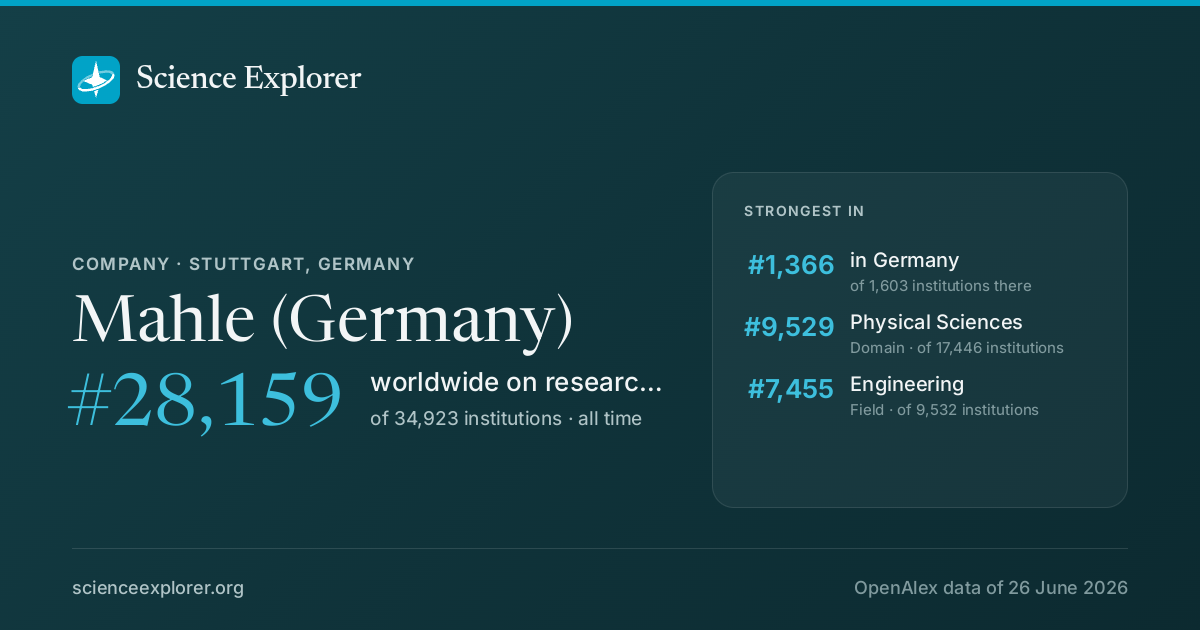
In research, Mahle (Germany) stands highest in Physical Sciences (#9,529 of 17,446 worldwide) and Engineering (#7,455 of 9,532 worldwide), over all time.
- World rank, all time
- #28,159 of 34,923
- Rank in Germany
- #1,366 of 1,603
- Research works
- 288 ▼ 66% vs 2018-21
- Citations
- 1.5k 5.1 per fractional work
- Top-10% rate
- 4.8% all institutions 10.0%
- vs its own fields
- 0.92× 1.00× is exactly expected
- Open access
- 6% world 40%
- International
- 16% world 18%
What is Mahle (Germany) known for in research?
The fields where it stands highest, over all time, ranked among every institution above the floor in each field.
| Field | World rank | Where that sits | Top-10% rate | Works |
|---|---|---|---|---|
| Physical SciencesDomain | #9,529 of 17,446 | 3.4% | 273 | |
| EngineeringField | #7,455 of 9,532 | 4.0% | 215 |
Each strip is that field's whole ranked pool, with the notch where Mahle (Germany) sits in it, in the colour of the band that rank falls in. The track under the rate is the rate itself: it carries no average mark, because the average differs by field (from about 6% in Dentistry to 21% in Economics).
Which fields of science does Mahle (Germany) work in?
In 2022-now, 92% of research at Mahle (Germany) is in Physical Sciences, 7% in Social Sciences. Its largest fields are Engineering (74%), Chemical Engineering (9%), Materials Science (8%). It does 2.1× the world's share of Physical Sciences.
Each ring splits the one inside it: the four domains of science, their fields, their subfields. Size is fractional works in 2022-now. Every slice is a page; the interactive view zooms down to single topics and colours each by how much more of it this institution does than the world.
Its 3 domains and 8 fields, with their numbers
- Physical Sciences2991.8%
- Engineering2374.3%
- Chemical Engineering39.3%
- Materials Science27.6%
- Energy00.5%
- Social Sciences27.4%
- Health Sciences00.8%
- Medicine00.8%
Field profile
Location quotient across every field it publishes in: outside the ring is more than an institution of this size would be expected to publish, inside it is less.
Rings at 0.5×, 1× and 2×. Widest outward: Chemical Engineering, 26.7×. Every wedge is a field page.
All 8 fields, with their numbers
- Chemical Engineering26.73×3 works
- Engineering4.96×23 works
- Materials Science2.17×2 works
- Decision Sciences1.64×0 works
- Business, Management and Accounting1.48×2 works
- Energy0.58×0 works
- Social Sciences0.08×0 works
- Medicine0.04×0 works
Who are the top researchers at Mahle (Germany)?
Ranked on the quality score, Peter Geskes, Jürgen Stehlig and Alfred Elsäßer lead among researchers whose main affiliation is Mahle (Germany).
- 1
Peter Geskes
 Germany · #4,193,922 worldwide
68 citations · 14 works
- 2
Jürgen Stehlig
Germany · #4,201,343 worldwide
51 citations · 15 works
- 3
Alfred Elsäßer
Germany · #4,223,374 worldwide
130 citations · 28 works
- 4
René Dingelstadt
Germany · #4,473,513 worldwide
114 citations · 19 works
- 5
Simon Schneider
Germany · #4,485,945 worldwide
97 citations · 25 works
- 6
Andreas Eilemann
Germany · #4,534,179 worldwide
37 citations · 22 works
- 7
Hannes Marlok
Germany · #4,535,993 worldwide
29 citations · 16 works
- 8
Eberhard Pantow
Germany · #4,698,636 worldwide
177 citations · 40 works
- 9
Thomas Deuß
Germany · #4,763,631 worldwide
112 citations · 23 works
- 10
Otmar Scharrer
Germany · #4,973,705 worldwide
30 citations · 26 works
Which keywords describe research at Mahle (Germany)?
By fractional works in 2022-now, weighted toward what it does more of than the world: Electric Vehicles, Emissions, Chemical Kinetics, Combustion, Soot Formation, Renewable Energy Integration, Energy Storage Systems and Hybrid Vehicles.
- Wireless Energy Harvesting
- Information Transfer
- Numerical Simulation
- Heat Transfer
- Permanent Magnet Machines
- Inductive Power Transfer
- Electric Motor Drives
- Mechanical Properties
- Efficiency Optimization
- Wireless Power Transfer
- Charging Infrastructure
- Energy Storage Systems
- Renewable Energy Integration
- Combustion
- Emissions
- Electric Vehicles
- Chemical Kinetics
- Soot Formation
- Sustainability
- Hybrid Vehicles
- Vehicle-to-Grid
- Energy Efficiency
- Thermal Analysis
- Eco-Driving
- Fuel Consumption
- Magnetic Resonant Coupling
- Thermal Management
- Laser Surface Texturing
- Tribological Performance
- Process Optimization
Size is fractional works in 2022-now in the topics tagged with each word; colour is the word's share of this institution's work against its share of the world's. The 30 words are chosen for being large and distinctive. Each links to the topic it comes from most.
All 30 words, with their numbers
- Electric Vehicles6▲ 61×3 topics
- Emissions3▲ 53×2 topics
- Chemical Kinetics3▲ 106×2 topics
- Combustion3▲ 151×1 topic
- Soot Formation3▲ 208×1 topic
- Renewable Energy Integration3▲ 27×2 topics
- Sustainability3▲ 3.6×2 topics
- Energy Storage Systems2▲ 57×1 topic
- Hybrid Vehicles2▲ 214×1 topic
- Charging Infrastructure2▲ 106×1 topic
- Vehicle-to-Grid2▲ 106×1 topic
- Wireless Power Transfer2▲ 81×2 topics
- Energy Efficiency2▲ 6.9×5 topics
- Efficiency Optimization2▲ 131×2 topics
- Thermal Analysis2▲ 47×2 topics
- Mechanical Properties2▲ 4.9×4 topics
- Eco-Driving1▲ 88×1 topic
- Electric Motor Drives1▲ 106×1 topic
- Fuel Consumption1▲ 59×1 topic
- Inductive Power Transfer1▲ 144×1 topic
- Magnetic Resonant Coupling1▲ 144×1 topic
- Permanent Magnet Machines1▲ 106×1 topic
- Thermal Management1▲ 12×5 topics
- Heat Transfer1▲ 7.2×5 topics
- Laser Surface Texturing1▲ 124×1 topic
- Numerical Simulation1▲ 12×3 topics
- Tribological Performance1▲ 62×1 topic
- Information Transfer1▲ 52×1 topic
- Process Optimization1▲ 49×2 topics
- Wireless Energy Harvesting1▲ 52×1 topic
Which research topics does Mahle (Germany) publish most on?
By volume in 2022-now: Advanced Combustion Engine Technologies, Electric and Hybrid Vehicle Technologies, Electric Vehicles and Infrastructure and Vehicle emissions and performance.
Area is fractional works; colour is the subfield each topic belongs to.
- 1 Advanced Combustion Engine Technologies Fluid Flow and Transfer Processes 3 works
- 2 Electric and Hybrid Vehicle Technologies Automotive Engineering 2 works
- 3 Electric Vehicles and Infrastructure Electrical and Electronic Engineering 2 works
- 4 Vehicle emissions and performance Automotive Engineering 1 works
- 5 Wireless Power Transfer Systems Electrical and Electronic Engineering 1 works
- 6 Electric Motor Design and Analysis Electrical and Electronic Engineering 1 works
- 7 Tribology and Lubrication Engineering Mechanical Engineering 1 works
- 8 Energy Harvesting in Wireless Networks Electrical and Electronic Engineering 1 works
- 9 Fuel Cells and Related Materials Electrical and Electronic Engineering 1 works
- 10 RFID technology advancements Media Technology 1 works
How open and international is its research?
Against the world's own shares: the tick on each track. Both are shares of its output, so they sit on one scale and can be read against each other as well as against the world.
World: 40% of research is openly available.
World: 18% is written across borders.
How has Mahle (Germany)'s research output changed?
Output in 2022-2025 was 66% lower than in 2018-2021.
The same series as a ribbon: one cell per year, darker for more. The line above answers how much; this answers when.
Its share of all research
Growing output can still be a shrinking share: all of science grows. This is Mahle (Germany) as a percentage of every work published that year, 0.000086% in 2024.
Fractional works of Mahle (Germany) over all fractional works that year. How the balance of science has shifted.
Other research institutions in Stuttgart
- University of Stuttgart
- University of Hohenheim
- Stuttgart Observatory
- Alcatel Lucent (Germany)
- Daimler (Germany)
- Robert Bosch (Germany)
- Stuttgart Technical University of Applied Sciences
- Olgahospital


Share Mahle (Germany)'s ranking
Badges for a website1Each links back here and updates with every snapshot

Research measures only: rankings here say nothing about teaching, admissions or student experience. Comparable institutions and collaboration partners have tabs of their own, above.
Discussion
Ask a question or share a note about Mahle (Germany). Posts are plain text and can be reported.