Science Explorer Back to mapMap
Discussion
Hospital / health system · Nordhausen · Germany

Südharz Klinikum

In research, Südharz Klinikum stands highest in Health Sciences (#6,785 of 16,688 worldwide) and Medicine (#6,309 of 14,558 worldwide), over all time.

World rank, all time
#24,260
of 34,923
Rank in Germany
#1,178
of 1,603
Research works
223
▼ 10% vs 2018-21
Citations
1.5k
6.8 per fractional work
Top-10% rate
9.6%
all institutions 10.0%
vs its own fields
1.01×
1.00× is exactly expected
Open access
25%
world 40%
International
7%
world 18%

What is Südharz Klinikum known for in research?

The fields where it stands highest, over all time, ranked among every institution above the floor in each field.

FieldWorld rankWhere that sitsTop-10% rateWorks
Health SciencesDomain #6,785 of 16,688 5.5%165
MedicineField #6,309 of 14,558 5.0%143

Each strip is that field's whole ranked pool, with the notch where Südharz Klinikum sits in it, in the colour of the band that rank falls in. The track under the rate is the rate itself: it carries no average mark, because the average differs by field (from about 6% in Dentistry to 21% in Economics).

Which fields of science does Südharz Klinikum work in?

In 2022-now, 75% of research at Südharz Klinikum is in Health Sciences, 12% in Social Sciences. Its largest fields are Medicine (56%), Health Professions (18%), Social Sciences (6%). It does 2.7× the world's share of Health Sciences.

Health Sciences: 30 fractional works · 75.1% of its workMedicine: 22 fractional works · 55.7% of its workOncology: 3 fractional works · 8.5% of its workSurgery: 3 fractional works · 6.7% of its workPublic Health, Environmental and Occupational Health: 2 fractional works · 5.5% of its workComplementary and alternative medicine: 2 fractional works · 5.5% of its workPulmonary and Respiratory Medicine: 2 fractional works · 5.5% of its workPhysiology: 2 fractional works · 5.1% of its workCardiology and Cardiovascular Medicine: 2 fractional works · 4.5% of its workRadiology, Nuclear Medicine and Imaging: 2 fractional works · 4.2% of its workOtorhinolaryngology: 1 fractional works · 2.7% of its workRheumatology: 1 fractional works · 1.3% of its workOrthopedics and Sports Medicine: 0 fractional works · 1.1% of its workRehabilitation: 0 fractional works · 0.8% of its workPharmacology: 0 fractional works · 0.6% of its workPathology and Forensic Medicine: 0 fractional works · 0.5% of its workEpidemiology: 0 fractional works · 0.4% of its workGenetics: 0 fractional works · 0.4% of its workCritical Care and Intensive Care Medicine: 0 fractional works · 0.4% of its workNeurology: 0 fractional works · 0.4% of its workEndocrinology, Diabetes and Metabolism: 0 fractional works · 0.3% of its workReproductive Medicine: 0 fractional works · 0.3% of its workPediatrics, Perinatology and Child Health: 0 fractional works · 0.2% of its workSmaller subfields together: 0 fractional works · 0.5% of its workHealth Professions: 7 fractional works · 18.4% of its workGeneral Health Professions: 5 fractional works · 12.4% of its workPhysical Therapy, Sports Therapy and Rehabilitation: 2 fractional works · 4.3% of its workSpeech and Hearing: 0 fractional works · 1.2% of its workComplementary and Manual Therapy: 0 fractional works · 0.3% of its workSmaller subfields together: 0 fractional works · 0.2% of its workNursing: 0 fractional works · 0.7% of its workNutrition and Dietetics: 0 fractional works · 0.7% of its workDentistry: 0 fractional works · 0.4% of its workPeriodontics: 0 fractional works · 0.2% of its workSmaller subfields together: 0 fractional works · 0.2% of its workSocial Sciences: 5 fractional works · 12.5% of its workSocial Sciences: 2 fractional works · 5.5% of its workSociology and Political Science: 1 fractional works · 2.7% of its workHealth: 0 fractional works · 1.2% of its workEducation: 0 fractional works · 0.8% of its workLaw: 0 fractional works · 0.8% of its workPsychology: 2 fractional works · 4.7% of its workClinical Psychology: 1 fractional works · 1.3% of its workSocial Psychology: 0 fractional works · 1.2% of its workDevelopmental and Educational Psychology: 0 fractional works · 1.1% of its workApplied Psychology: 0 fractional works · 0.8% of its workSmaller subfields together: 0 fractional works · 0.2% of its workArts and Humanities: 1 fractional works · 2.1% of its workHistory and Philosophy of Science: 0 fractional works · 1.3% of its workArcheology: 0 fractional works · 0.5% of its workSmaller subfields together: 0 fractional works · 0.3% of its workEconomics, Econometrics and Finance: 0 fractional works · 0.2% of its workLife Sciences: 3 fractional works · 6.5% of its workBiochemistry, Genetics and Molecular Biology: 1 fractional works · 3.5% of its workCancer Research: 0 fractional works · 0.9% of its workCell Biology: 0 fractional works · 0.8% of its workGenetics: 0 fractional works · 0.8% of its workMolecular Biology: 0 fractional works · 0.7% of its workMolecular Medicine: 0 fractional works · 0.2% of its workSmaller subfields together: 0 fractional works · 0.1% of its workNeuroscience: 1 fractional works · 1.8% of its workCognitive Neuroscience: 0 fractional works · 0.7% of its workDevelopmental Neuroscience: 0 fractional works · 0.4% of its workSensory Systems: 0 fractional works · 0.4% of its workSmaller subfields together: 0 fractional works · 0.2% of its workAgricultural and Biological Sciences: 0 fractional works · 0.8% of its workPlant Science: 0 fractional works · 0.3% of its workAnimal Science and Zoology: 0 fractional works · 0.3% of its workSmaller subfields together: 0 fractional works · 0.2% of its workImmunology and Microbiology: 0 fractional works · 0.5% of its workImmunology: 0 fractional works · 0.5% of its workPhysical Sciences: 2 fractional works · 5.9% of its workEngineering: 2 fractional works · 4.8% of its workCivil and Structural Engineering: 1 fractional works · 1.7% of its workBiomedical Engineering: 0 fractional works · 1.1% of its workControl and Systems Engineering: 0 fractional works · 0.8% of its workComputational Mechanics: 0 fractional works · 0.4% of its workMechanical Engineering: 0 fractional works · 0.4% of its workSmaller subfields together: 0 fractional works · 0.3% of its workComputer Science: 0 fractional works · 0.5% of its workComputer Vision and Pattern Recognition: 0 fractional works · 0.4% of its workSmaller subfields together: 0 fractional works · 0.1% of its workPhysics and Astronomy: 0 fractional works · 0.4% of its workRadiation: 0 fractional works · 0.2% of its workSmaller subfields together: 0 fractional works · 0.2% of its workEnvironmental Science: 0 fractional works · 0.1% of its workEarth and Planetary Sciences: 0 fractional works · 0.1% of its workALL ITS WORKSüdharz Klinikum39fractional works, 2022-now
Life Sciences7%Physical Sciences6%Health Sciences75%Social Sciences12%

Each ring splits the one inside it: the four domains of science, their fields, their subfields. Size is fractional works in 2022-now. Every slice is a page; the interactive view zooms down to single topics and colours each by how much more of it this institution does than the world.

Its 4 domains and 17 fields, with their numbers
    1. Medicine2255.7%
    2. Health Professions718.4%
    3. Nursing00.7%
    4. Dentistry00.4%
    1. Social Sciences25.5%
    2. Psychology24.7%
    3. Arts and Humanities12.1%
    4. Economics, Econometrics and Finance00.2%
    1. Biochemistry, Genetics and Molecular Biology13.5%
    2. Neuroscience11.8%
    3. Agricultural and Biological Sciences00.8%
    4. Immunology and Microbiology00.5%
    1. Engineering24.8%
    2. Computer Science00.5%
    3. Physics and Astronomy00.4%
    4. Environmental Science00.1%
    5. Earth and Planetary Sciences00.1%
All of science, and how each field's share has moved since 1950: the Science domain explorer

Field profile

Location quotient across every field it publishes in: outside the ring is more than an institution of this size would be expected to publish, inside it is less.

Agricultural and Biological Sciences: 0.17× its world share, 0 worksAgricultural and Bio…Biochemistry, Genetics and Molecular Biology: 0.65× its world share, 1 worksBiochemistry, Geneti…Immunology and Microbiology: 0.53× its world share, 0 worksImmunology and Micro…Neuroscience: 1.09× its world share, 1 worksNeuroscienceComputer Science: 0.06× its world share, 0 worksComputer ScienceEarth and Planetary Sciences: 0.06× its world share, 0 worksEarth and Planetary …Engineering: 0.32× its world share, 2 worksEngineeringEnvironmental Science: 0.02× its world share, 0 worksEnvironmental SciencePhysics and Astronomy: 0.17× its world share, 0 worksPhysics and AstronomyDentistry: 0.79× its world share, 0 worksDentistryHealth Professions: 6.98× its world share, 7 worksHealth ProfessionsMedicine: 2.89× its world share, 22 worksMedicineNursing: 1.33× its world share, 0 worksNursingArts and Humanities: 0.72× its world share, 1 worksArts and HumanitiesEconomics, Econometrics and Finance: 0.09× its world share, 0 worksEconomics, Econometr…Psychology: 1.53× its world share, 2 worksPsychologySocial Sciences: 0.44× its world share, 2 worksSocial Sciences1×world share
more than its size predictsabout as predictedless

Rings at 0.5×, 1× and 2×. Widest outward: Health Professions, 7.0×. Every wedge is a field page.

All 17 fields, with their numbers
  1. Health Professions6.98×7 works
  2. Medicine2.89×22 works
  3. Psychology1.53×2 works
  4. Nursing1.33×0 works
  5. Neuroscience1.09×1 works
  6. Dentistry0.79×0 works
  7. Arts and Humanities0.72×1 works
  8. Biochemistry, Genetics and Molecular Biology0.65×1 works
  9. Immunology and Microbiology0.53×0 works
  10. Social Sciences0.44×2 works
  11. Engineering0.32×2 works
  12. Agricultural and Biological Sciences0.17×0 works
  13. Physics and Astronomy0.17×0 works
  14. Economics, Econometrics and Finance0.09×0 works
  15. Computer Science0.06×0 works
  16. Earth and Planetary Sciences0.06×0 works
  17. Environmental Science0.02×0 works

Who are the top researchers at Südharz Klinikum?

Ranked on the quality score, Ismini E. Papageorgiou, Michael Glatzel and Jens Buentzel lead among researchers whose main affiliation is Südharz Klinikum.

  1. 1 Ismini E. Papageorgiou Germany · #1,834,516 worldwide 1.6k citations · 66 works
  2. 2 Michael Glatzel Germany · #1,866,008 worldwide 1.2k citations · 37 works
  3. 3 Jens Buentzel Germany · #1,876,593 worldwide 2.3k citations · 105 works
  4. 4 Wolfgang Oehler Germany · #2,062,487 worldwide 364 citations · 41 works
  5. 5 Dietmar Fröhlich Germany · #3,624,556 worldwide 419 citations · 38 works
  6. 6 Klaus Schönekaes Germany · #4,335,211 worldwide 644 citations · 38 works
  7. 7 Jens Büntzel Germany · #6,983,768 worldwide 2k citations · 245 works
All ranked researchers at Südharz Klinikum

What are the most cited papers from Südharz Klinikum?

The most cited paper from Südharz Klinikum is "Thermal ablation of colorectal liver metastases: a position paper by an international panel of ablation experts, the interventional oncology sans frontières meeting 2013" (Alice R. Gillams et al., 2015), with 328 citations. Next come "Treatment of Bendamustine and Prednisone in patients with newly diagnosed multiple myeloma results in superior complete response rate, prolonged time to treatment failure and improved quality of life compared to treatment with Melphalan and Prednisone—a randomized phase III study of the East German Study Group of Hematology and Oncology (OSHO)" (192) and "Central venous catheter–related infections in hematology and oncology: 2020 updated guidelines on diagnosis, management, and prevention by the Infectious Diseases Working Party (AGIHO) of the German Society of Hematology and Medical Oncology (DGHO)" (166).

Most cited papers
#PaperReleasedCitations
1 Thermal ablation of colorectal liver metastases: a position paper by an international panel of ablation experts, the interventional oncology sans frontières meeting 2013 Alice R. Gillams et al. · European Radiology Open access 20 May 2015 328
2 Treatment of Bendamustine and Prednisone in patients with newly diagnosed multiple myeloma results in superior complete response rate, prolonged time to treatment failure and improved quality of life compared to treatment with Melphalan and Prednisone—a randomized phase III study of the East German Study Group of Hematology and Oncology (OSHO) Wolfram Pönisch et al. · Journal of Cancer Research and Clinical Oncology Open access 9 Jan 2006 192
3 Central venous catheter–related infections in hematology and oncology: 2020 updated guidelines on diagnosis, management, and prevention by the Infectious Diseases Working Party (AGIHO) of the German Society of Hematology and Medical Oncology (DGHO) Boris Böll, Enrico Schalk, Dieter Buchheidt et al. · Annals of Hematology Open access 30 Sep 2020 166
4 Intravenous amifostine during chemoradiotherapy for head-and-neck cancer: A randomized placebo-controlled phase III study Jens Buentzel, Oliver Micke, Irenäus A. Adamietz et al. · International Journal of Radiation Oncology*Biology*Physics 24 Oct 2005 148
5 Potential MRI Interpretation Model: Differentiation of Benign from Malignant Breast Masses Ansgar Malich, Dorothee Rita Fischer, Susanne Wurdinger et al. · American Journal of Roentgenology Oct 2005 120
All 60 most cited papers, with filters and sorting

Which keywords describe research at Südharz Klinikum?

By fractional works in 2022-now, weighted toward what it does more of than the world: Quality of Life, Chronic Diseases, Radiotherapy, Chemotherapy, Public Health, Germany, Health Surveys and Prognosis.

▲ more of its work than of the world's◆ about the world's share▼ less than the world's

Size is fractional works in 2022-now in the topics tagged with each word; colour is the word's share of this institution's work against its share of the world's. The 40 words are chosen for being large and distinctive. Each links to the topic it comes from most.

All 40 words, with their numbers
  1. Quality of Life4▲ 6.6×12 topics
  2. Public Health3▲ 5.5×6 topics
  3. Chronic Diseases3▲ 29×2 topics
  4. Chemotherapy3▲ 10×8 topics
  5. Radiotherapy3▲ 18×6 topics
  6. Germany3▲ 351×1 topic
  7. Health Surveys3▲ 351×1 topic
  8. Healthcare2▲ 5.4×3 topics
  9. Prognosis2▲ 19×3 topics
  10. Rehabilitation2▲ 14×3 topics
  11. Inflammation2▲ 2.5×10 topics
  12. Depression2▲ 5.9×6 topics
  13. Management2▲ 5.9×5 topics
  14. Cancer2▲ 3.4×9 topics
  15. Patient Care2▲ 36×1 topic
  16. Quality2▲ 100×1 topic
  17. Survival2▲ 31×2 topics
  18. Anxiety2▲ 8.7×5 topics
  19. Herbal Medicine2▲ 14×3 topics
  20. Physical Activity2▲ 8.5×2 topics
  21. Aging2▲ 7.0×3 topics
  22. Clinical Practice Guidelines2▲ 6.9×5 topics
  23. End-of-Life Care2▲ 33×2 topics
  24. Genetic Testing2▲ 33×3 topics
  25. Health-related Quality of Life2▲ 16×3 topics
  26. Body Composition1▲ 35×2 topics
  27. Cancer Cachexia1▲ 39×1 topic
  28. Elderly Care1▲ 23×2 topics
  29. Muscle Mass1▲ 32×2 topics
  30. Sarcopenia1▲ 39×1 topic
  31. Cancer Survivorship1▲ 44×1 topic
  32. Demographic Transition1▲ 55×1 topic
  33. Migrant Health1▲ 459×1 topic
  34. Patient-Reported Outcomes1▲ 60×1 topic
  35. Qualitative Inhaltsanalyse1▲ 87×2 topics
  36. Alternative Medicine1▲ 101×1 topic
  37. Breast Cancer1▲ 11×5 topics
  38. Cancer Patients1▲ 69×2 topics
  39. Informed Consent1▲ 37×3 topics
  40. Squamous Cell Carcinoma1▲ 31×2 topics

Which research topics does Südharz Klinikum publish most on?

By volume in 2022-now: Health and Medical Studies, Medical Practices and Rehabilitation, Nutrition and Health in Aging and Social and Demographic Issues in Germany.

  1. 1 Health and Medical Studies General Health Professions 3 works
  2. 2 Medical Practices and Rehabilitation Physical Therapy, Sports Therapy and Rehabilitation 2 works
  3. 3 Nutrition and Health in Aging Physiology 1 works
  4. 4 Social and Demographic Issues in Germany General Health Professions 1 works
  5. 5 Cancer survivorship and care Oncology 1 works
  6. 6 Complementary and Alternative Medicine Studies Complementary and alternative medicine 1 works
  7. 7 Head and Neck Cancer Studies Otorhinolaryngology 1 works
  8. 8 Medical and Health Sciences Research Public Health, Environmental and Occupational Health 1 works
  9. 9 Sociology and Education Studies Sociology and Political Science 1 works
  10. 10 Eosinophilic Esophagitis Surgery 1 works

How open and international is its research?

Against the world's own shares: the tick on each track. Both are shares of its output, so they sit on one scale and can be read against each other as well as against the world.

openly available24.6%not open75.4%

World: 40% of research is openly available.

with international co-authors7.0%domestic only93.0%

World: 18% is written across borders.

How has Südharz Klinikum's research output changed?

Output in 2022-2025 was 10% lower than in 2018-2021.

still counting1990200020102020
grewheldshrank

The same series as a ribbon: one cell per year, darker for more. The line above answers how much; this answers when.

Its share of all research

Growing output can still be a shrinking share: all of science grows. This is Südharz Klinikum as a percentage of every work published that year, 0.00019% in 2024.

still counting0.00050%0.0010%Südharz Klinikum0.000096% in 20251990200020102020

Fractional works of Südharz Klinikum over all fractional works that year. How the balance of science has shifted.

Other research institutions in Nordhausen

All research institutions in Nordhausen

Share Südharz Klinikum's ranking
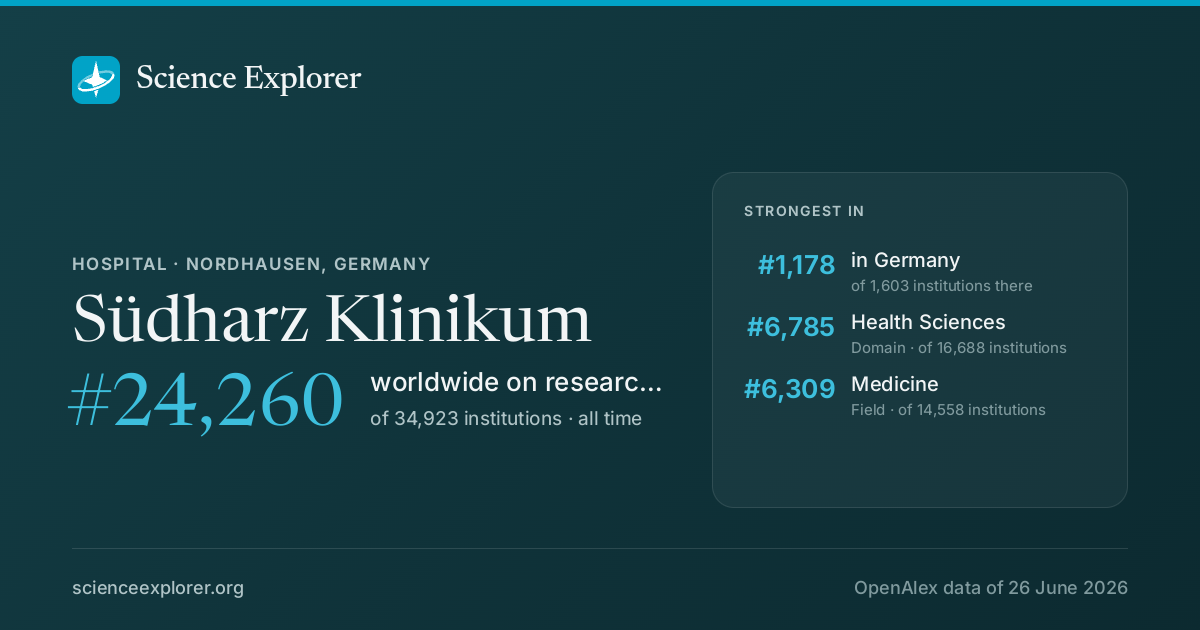
Südharz Klinikum on Science Explorer

A card with Südharz Klinikum's standing and the fields it leads in, for a post or a slide. A link to this page previews as the same card.

Download the card

1200 × 630 PNG, sized for social posts, drawn from the latest snapshot.

Badges for a website1Each links back here and updates with every snapshot

Research measures only: rankings here say nothing about teaching, admissions or student experience. Comparable institutions and collaboration partners have tabs of their own, above.

Discussion

Ask a question or share a note about Südharz Klinikum. Posts are plain text and can be reported.
