Cancer Research research
Cancer Research is a subfield of Biochemistry, Genetics and Molecular Biology. Science Explorer counts 511k research works in it since 1950. 10.1% of them reached the world's top 10% most cited for their field and year.
In short: research into cancer to identify causes and develop strategies for prevention, diagnosis, treatment, and cure.
- Research works
- 511k fractional, since 1950
- In the world top 10%
- 51k per year above
- Top-10% rate
- 10.1% share of its works in the world top 10%
- Topics
- 13
- Growth, 2018-21 → 2022-25
- -1% the tick is no change
- Largest producer
 China
46% of the 10 largest, 2022-now
What is Cancer Research research about, and what is growing?
By the world's output in 2021-25, its most used keywords are Cancer, Gene Expression, Metastasis, Long Noncoding RNAs, RNA Regulation, Regulation. Gaining share since 2011-15: Cancer Genomics, Mutational Signatures, Long Noncoding RNAs, RNA Regulation, Biomarkers. Losing share: Ecteinascidin, Tetrahydroisoquinoline, Inflammation, Signaling.
- Ecteinascidin
- Myxozoan
- Cantharidin
- Anti-inflammatory
- Apoptosis
- Inflammation
- Matrix Metalloproteinases
- Comet Assay
- Lipid Metabolism
- Treatment Response
- Warburg Effect
- Mutational Signatures
- MicroRNA
- Regulation
- Long Noncoding RNAs
- Gene Expression
- Cancer
- Metastasis
- RNA Regulation
- Biomarkers
- Cancer Genomics
- HIF-1
- Breast Tumours
- Fatty Acid Synthase
- NF-?B
- Genotoxicity Testing
- Tissue Inhibitors of Metalloproteinases
- Signaling
- Pharmacology
- Sesquiterpene Lactones
- Protein Phosphatase Inhibitors
- Parasite
- Tetrahydroisoquinoline
Size is the world's fractional works in 2021-25 in the topics tagged with each word; colour compares the word's share of this field with 2011-15. Each links to the topic it comes from most.
All 33 words, with their numbers
- Cancer62k◆ 1.11×5 topics
- Gene Expression35k◆ 1.07×2 topics
- Metastasis26k◆ 0.97×2 topics
- Long Noncoding RNAs25k▲ 1.41×1 topic
- RNA Regulation25k▲ 1.41×1 topic
- Regulation25k◆ 1.00×2 topics
- Biomarkers22k◆ 1.15×1 topic
- MicroRNA22k◆ 1.15×1 topic
- Cancer Genomics20k▲ 1.53×1 topic
- Mutational Signatures20k▲ 1.53×1 topic
- HIF-116k▼ 0.80×1 topic
- Warburg Effect16k▼ 0.80×1 topic
- Breast Tumours13k◆ 0.94×1 topic
- Treatment Response13k◆ 0.94×1 topic
- Fatty Acid Synthase11k◆ 0.99×1 topic
- Lipid Metabolism11k◆ 0.99×1 topic
- NF-?B4,562▼ 0.55×2 topics
- Comet Assay4,377▼ 0.55×1 topic
- Genotoxicity Testing4,377▼ 0.55×1 topic
- Matrix Metalloproteinases4,155▼ 0.53×1 topic
- Tissue Inhibitors of Metalloproteinases4,155▼ 0.53×1 topic
- Inflammation2,748▼ 0.49×1 topic
- Signaling2,748▼ 0.49×1 topic
- Apoptosis2,599▼ 0.74×2 topics
- Pharmacology2,548▼ 0.58×2 topics
- Anti-inflammatory1,814▼ 0.69×1 topic
- Sesquiterpene Lactones1,814▼ 0.69×1 topic
- Cantharidin785◆ 0.91×1 topic
- Protein Phosphatase Inhibitors785◆ 0.91×1 topic
- Myxozoan769◆ 1.03×1 topic
- Parasite769◆ 1.03×1 topic
- Ecteinascidin734▼ 0.42×1 topic
- Tetrahydroisoquinoline734▼ 0.42×1 topic
Which countries lead Cancer Research research?
On research quality in 2022-now, the United States, China and Germany rank highest in Cancer Research. By volume, China and the United States publish the most (37k and 20k works in 2022-now).
By research quality, 2022-now
- 1
 United States #1 all time
0.91× citation excellence · 1.66× journals · 100% breadth
11.4% top 10% · 18k works
- 2
China #2 all time
1.15× citation excellence · 0.86× journals · 100% breadth
11.2% top 10% · 34k works
- 3
 Germany #4 all time
1.21× citation excellence · 1.50× journals · 100% breadth
10.8% top 10% · 2.6k works
- 4
 United Kingdom #3 all time
1.09× citation excellence · 1.70× journals · 100% breadth
11.7% top 10% · 2.5k works
- 5
 France #5 all time
1.10× citation excellence · 1.37× journals · 100% breadth
9.8% top 10% · 1.6k works
- 6
 Canada #6 all time
1.02× citation excellence · 1.35× journals · 100% breadth
10.7% top 10% · 1.5k works
- 7
 Netherlands #7 all time
1.23× citation excellence · 1.47× journals · 100% breadth
11.3% top 10% · 855 works
- 8
 Switzerland #8 all time
1.25× citation excellence · 1.97× journals · 100% breadth
12.9% top 10% · 510 works
- 9
 Australia #9 all time
1.26× citation excellence · 1.25× journals · 100% breadth
12.9% top 10% · 995 works
- 10
 Spain #10 all time
1.07× citation excellence · 1.02× journals · 100% breadth
9.8% top 10% · 1.6k works
The track on each row is that row's top-10% rate. The ranking itself is the quality score, which compares the rate with what each place's own topics predict, adds its share of papers in the Nature Index journals, and counts output and breadth too.
Of 42 countries ranked in Cancer Research. Ranked on the quality score for 2022-now; the bracket is the all-time rank.
All countries ranked in Cancer ResearchBy volume, 2022-now
- 1
China
37k works
- 2
United States
20k works
- 3
 India
4.5k works
- 4
 Japan
3.2k works
- 5
 Italy
3k works
- 6
Germany
3k works
- 7
United Kingdom
2.8k works
- 8
 South Korea
2.4k works
- 9
 Iran
2.1k works
- 10
Spain
1.9k works
How concentrated that is
The same countries as shares of everything the list above accounts for. A node where two countries do two thirds of the work and one spread evenly across twelve read alike as a ranking and not at all alike here.
Shares of the rows listed above, not of the whole node.
Which institutions lead Cancer Research research?
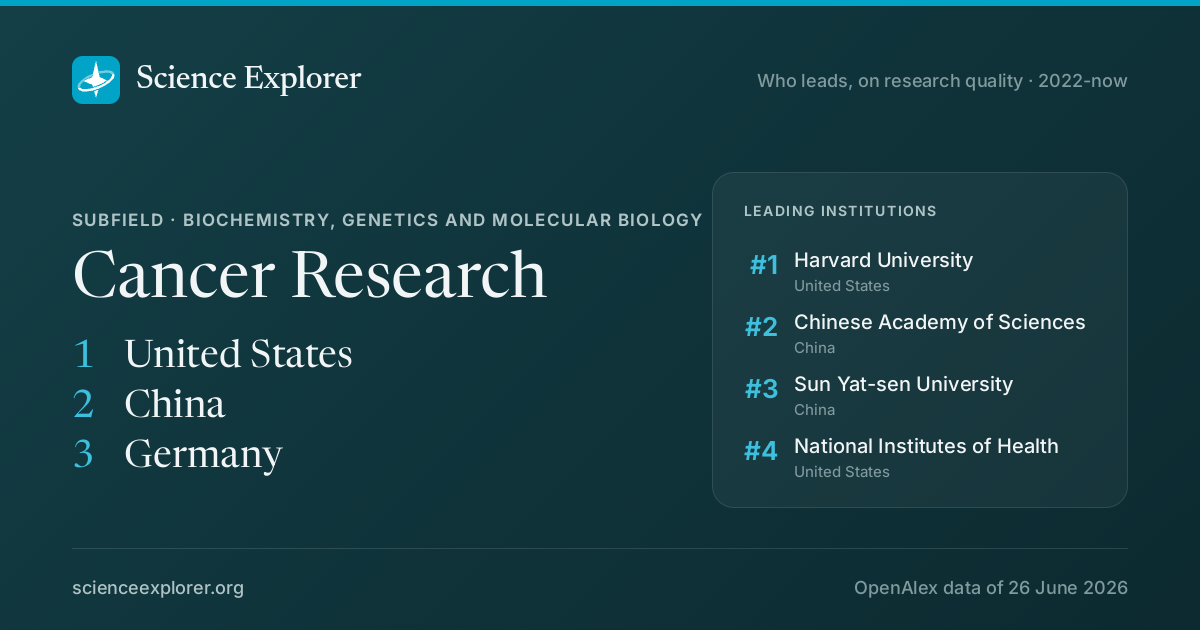
Harvard University (United States) ranks first in Cancer Research on research quality in 2022-now, followed by Chinese Academy of Sciences and Sun Yat-sen University.
By research quality, 2022-now
- 1
Harvard University United States · Cambridge · #1 all time
17.1% top 10% · 842 works
- 2
Chinese Academy of Sciences China · Beijing · #4 all time
17.2% top 10% · 510 works
- 3
Sun Yat-sen University China · Guangzhou · #9 all time
15.9% top 10% · 889 works
- 4
National Institutes of Health United States · Bethesda · #2 all time
13.8% top 10% · 403 works
- 5
Shanghai Jiao Tong University China · Shanghai · #12 all time
14.4% top 10% · 781 works
- 6
Fudan University China · Shanghai · #23 all time
15.0% top 10% · 542 works
- 7
Sichuan University China · Chengdu · #33 all time
16.3% top 10% · 568 works
- 8
Stanford University United States · Stanford · #5 all time
16.5% top 10% · 213 works
- 9
Zhejiang University China · Hangzhou · #31 all time
13.8% top 10% · 581 works
- 10
Wuhan University China · Wuhan · #32 all time
14.9% top 10% · 422 works



The track on each row is that row's top-10% rate. The ranking itself is the quality score, which compares the rate with what each place's own topics predict, adds its share of papers in the Nature Index journals, and counts output and breadth too.
Of 262 institutions above the floor of 40 fractional works in Cancer Research.
Top 100 Cancer Research institutionsBy volume, 2022-now
- 1
Sun Yat-sen UniversityChina
967 works
- 2
Harvard UniversityUnited States
945 works
- 3
Shanghai Jiao Tong UniversityChina
853 works
- 4
Nanjing Medical UniversityChina
798 works
- 5
Zhejiang UniversityChina
635 works
- 6
Central South UniversityChina
635 works
- 7
Sichuan UniversityChina
622 works
- 8
Fudan UniversityChina
585 works
- 9
Chinese Academy of Medical Sciences & Peking Union Medical CollegeChina
579 works
- 10
Chinese Academy of SciencesChina
570 works
Who are the leading researchers in Cancer Research?
Counting only their work in Cancer Research, Carlo Maria Croce, Gregg L. Semenza and Gad A. Getz have the most papers in the world top 10% for their subfield and year beyond the 10% expected.
- 1
Carlo Maria Croce
United States · #8,514 worldwide overall
103.2 of 214 papers here in the top 10%
- 2
Gregg L. Semenza
United States · #322 worldwide overall
83.2 of 140 papers here in the top 10%
- 3
Gad A. Getz
United States · #1 worldwide overall
72.3 of 101 papers here in the top 10%
- 4
Charles M. Perou
United States · #4,748 worldwide overall
78.7 of 187 papers here in the top 10%
- 5
Michael Karin
United States · #27 worldwide overall
62.5 of 98 papers here in the top 10%
- 6
Adrian L. Harris
United Kingdom · #40,788 worldwide overall
78.9 of 266 papers here in the top 10%
- 7
Jorge Sergio Reis-Filho
United States · #1,691 worldwide overall
60.5 of 132 papers here in the top 10%
- 8
Eric P. Winer
United States · #2,116 worldwide overall
59.8 of 149 papers here in the top 10%
- 9
Gabriel N. Hortobágyi
United States · #9,527 worldwide overall
65.3 of 219 papers here in the top 10%
- 10
Nikolaus D. Schultz
United States · #26 worldwide overall
51.0 of 79 papers here in the top 10%
Ranked on their work in Cancer Research alone: how many more of their papers here reached the world top 10% for their subfield and year than the 10% expected, among 1,554,695 ranked researchers with a paper here. Each paper counts once, so many strong papers outrank one famous one, and a long record of ordinary papers does not climb. Identities come from OpenAlex author disambiguation, which occasionally merges or splits people.
Top 100 Cancer Research researchersWhere is Cancer Research research done?
The largest centres of Cancer Research research in 2022-now are Beijing (China), Shanghai (China), Guangzhou (China) and Nanjing (China). Among places with at least 20 works in it, it is an unusually large share of all research in Cambridge, San Carlos and Duarte.
Largest cities, 2022-now
Where it is the local speciality
- Cambridge30.7 works24×
- San CarlosUS · 35.3 works21×
- Duarte22.1 works16×
- RutherfordUS · 22.3 works15×
Location quotient: how much more of its research is in Cancer Research than the world average.
Cancer Research research by country
The best places for Cancer Research research inside each country, with that country's researchers and world standing.
 Israel
 Austria
 Norway
 Taiwan
 Finland
 Poland
 Czechia
 Portugal
 Greece
 Brazil
 Russia
 Egypt
 Türkiye
Where is the best place to study Cancer Research?
Among universities, judged by research, Harvard University, Sun Yat-sen University and Stanford University score highest, combining standing in the field's ranking, citation excellence, specialisation, size, growth and international reach. Research strength is one signal when choosing where to study; it does not measure teaching.
One dot per university in the first ten of the table below, at the default weights. The upper left is the interesting corner: small places doing unusually strong work.
| # | University | Score | Rank in field (all time) | Top 10% | Specialisation | Works | Growth |
|---|---|---|---|---|---|---|---|
| 1 | Harvard UniversityUnited States |
86.1 | #1 (#1) | 16.9% | 3.3× | 945 | -12.6% |
| 2 | Sun Yat-sen UniversityChina |
66.1 | #3 (#9) | 15.5% | 5.2× | 967 | -13.3% |
| 3 | Stanford UniversityUnited States |
63.4 | #8 (#5) | 15.9% | 1.8× | 240 | -10.2% |
| 4 | Shanghai Jiao Tong UniversityChina |
61.1 | #5 (#12) | 14.1% | 3.3× | 852 | -13.5% |
| 5 | Johns Hopkins UniversityUnited States |
59.2 | #14 (#8) | 12.8% | 2.1× | 292 | -14.5% |
| 6 | Sichuan UniversityChina |
57.7 | #7 (#33) | 16.0% | 3.1× | 622 | +21.6% |
| 7 | University of California, San FranciscoUnited States |
57.0 | #16 (#7) | 11.5% | 3.1× | 198 | -22.3% |
| 8 | Fudan UniversityChina |
56.8 | #6 (#23) | 14.5% | 4.1× | 585 | -4.8% |
| 9 | Cornell UniversityUnited States |
56.5 | #12 (#13) | 13.5% | 2.2× | 265 | -6.9% |
| 10 | University of California San DiegoUnited States |
53.9 | #25 (#11) | 13.0% | 1.9× | 168 | -12.4% |
| 11 | Zhejiang UniversityChina |
53.2 | #9 (#31) | 13.7% | 2.6× | 635 | -10.3% |
| 12 | University of OxfordUnited Kingdom |
52.8 | #29 (#10) | 13.4% | 1.0× | 130 | -19.8% |
| 13 | University of CambridgeUnited Kingdom |
52.8 | #15 (#14) | 18.4% | 1.1× | 120 | -21.1% |
| 14 | University of PennsylvaniaUnited States |
52.0 | #20 (#15) | 13.6% | 2.1× | 203 | -10.1% |
| 15 | Peking UniversityChina |
51.9 | #11 (#30) | 13.1% | 2.6× | 473 | -5.7% |
| 16 | University of TorontoCanada |
51.5 | #31 (#18) | 11.1% | 1.7× | 303 | -11.1% |
| 17 | Wuhan UniversityChina |
51.2 | #10 (#32) | 14.7% | 3.6× | 453 | -11.3% |
| 18 | Yale UniversityUnited States |
50.9 | #22 (#21) | 13.6% | 2.1× | 203 | -4.6% |
| 19 | Karolinska Institutet Sweden |
49.5 | #26 (#38) | 12.7% | 3.6× | 180 | -2.6% |
| 20 | Columbia UniversityUnited States |
49.4 | #24 (#22) | 15.7% | 1.6× | 152 | -11.6% |
| 21 | Chinese Academy of Medical Sciences & Peking Union Medical CollegeChina |
48.4 | #30 (#68) | 13.3% | 6.1× | 579 | +9.4% |
| 22 | Huazhong University of Science and TechnologyChina |
48.3 | #18 (#51) | 14.7% | 3.0× | 492 | -1.9% |
| 23 | University of MichiganUnited States |
48.0 | #33 (#19) | 12.0% | 1.7× | 232 | -14.1% |
| 24 | Heidelberg UniversityGermany |
47.8 | #19 (#29) | 12.6% | 3.2× | 222 | -22.8% |
| 25 | University of Hong KongChina |
47.3 | #36 (#63) | 13.3% | 1.9× | 162 | +17.6% |
| 26 | University of WashingtonUnited States |
46.4 | #46 (#25) | 13.0% | 1.3× | 132 | -4.7% |
| 27 | University of Chinese Academy of SciencesChina |
46.1 | #28 (#28) | 17.3% | 0.9× | 135 | -9.6% |
| 28 | University of Copenhagen Denmark |
45.0 | #51 (#47) | 12.2% | 1.7× | 146 | +11.8% |
| 29 | Nanjing UniversityChina |
44.8 | #17 (#44) | 15.0% | 2.2× | 184 | -10.4% |
| 30 | Washington University in St. LouisUnited States |
44.8 | #54 (#35) | 11.1% | 2.8× | 178 | -0.7% |
| 31 | University of ChicagoUnited States |
44.4 | #41 (#41) | 14.0% | 1.9× | 146 | +3.1% |
| 32 | Chinese University of Hong KongChina |
44.3 | #49 (#69) | 16.5% | 1.9× | 123 | -4.0% |
| 33 | Northwestern UniversityUnited States |
44.2 | #38 (#37) | 13.5% | 2.2× | 165 | -12.4% |
| 34 | Nanjing Medical UniversityChina |
44.0 | #40 (#83) | 11.4% | 10.0× | 798 | -24.5% |
| 35 | Tongji UniversityChina |
44.0 | #23 (#50) | 13.7% | 1.9× | 265 | -8.3% |
| 36 | Central South UniversityChina |
43.9 | #32 (#81) | 14.0% | 3.7× | 635 | -19.2% |
| 37 | University College LondonUnited Kingdom |
43.8 | #50 (#45) | 13.2% | 0.9× | 134 | +6.7% |
| 38 | Massachusetts Institute of TechnologyUnited States |
43.3 | - (#26) | 23.2% | 0.7× | 41 | -31.4% |
| 39 | Vanderbilt UniversityUnited States |
43.0 | #60 (#39) | 13.4% | 2.2× | 144 | -7.3% |
| 40 | Baylor College of MedicineUnited States |
42.9 | #55 (#42) | 12.4% | 3.3× | 151 | -10.0% |
| 41 | KU Leuven Belgium |
41.0 | #90 (#57) | 17.6% | 1.2× | 103 | -15.2% |
| 42 | National University of Singapore Singapore |
40.6 | #61 (#62) | 15.2% | 1.0× | 107 | -9.1% |
| 43 | Imperial College LondonUnited Kingdom |
37.8 | #70 (#55) | 10.7% | 1.3× | 119 | -19.1% |
| 44 | Lanzhou UniversityChina |
36.6 | #57 (#146) | 9.7% | 4.0× | 246 | +38.0% |
| 45 | Anhui Medical UniversityChina |
35.7 | #86 (#233) | 10.3% | 8.1× | 333 | +20.1% |
| 46 | Chengdu University of Traditional Chinese MedicineChina |
34.8 | #154 (#311) | 19.1% | 5.8× | 131 | +86.6% |
| 47 | Kettering UniversityUnited States |
34.7 | - (#391) | 22.3% | 15.9× | 51 | +83.6% |
| 48 | Chongqing UniversityChina |
33.2 | #88 (#160) | 15.7% | 0.8× | 82 | +82.2% |
| 49 | Radboud University NijmegenNetherlands |
33.2 | - (#58) | 14.0% | 1.3× | 68 | -19.5% |
| 50 | Shanghai University of Traditional Chinese MedicineChina |
33.0 | #145 (#256) | 12.6% | 7.7× | 187 | +34.2% |
| 51 | Nanjing University of Chinese MedicineChina |
33.0 | #135 (#247) | 13.3% | 7.2× | 161 | +31.1% |
| 52 | Queen Mary University of LondonUnited Kingdom |
32.7 | - (#131) | 17.1% | 1.5× | 58 | -2.0% |
| 53 | Shandong First Medical UniversityChina |
31.9 | #163 (#325) | 10.8% | 9.4× | 241 | +32.7% |
| 54 | Harbin Medical UniversityChina |
31.7 | #99 (#267) | 9.3% | 16.3× | 500 | -19.1% |
| 55 | China Medical UniversityChina |
31.1 | #108 (#369) | 14.6% | 11.7× | 443 | -38.3% |
| 56 | Université Paris-SaclayFrance |
31.0 | - (#124) | 12.0% | 0.9× | 53 | +26.5% |
| 57 | University of California, BerkeleyUnited States |
30.5 | - (#49) | 14.3% | 0.4× | 32 | -20.2% |
| 58 | University of BernSwitzerland |
25.2 | - (#175) | 11.9% | 1.1× | 52 | -10.6% |
| 59 | Guangdong Medical CollegeChina |
25.0 | #204 (#535) | 9.8% | 11.9× | 118 | +40.8% |
| 60 | Hebei Medical UniversityChina |
24.5 | #224 (#589) | 5.8% | 11.4× | 346 | +12.0% |
| 61 | Maastricht UniversityNetherlands |
24.3 | - (#185) | 8.0% | 1.7× | 59 | -29.6% |
| 62 | Kunming Medical UniversityChina |
24.1 | #220 (#551) | 6.4% | 10.8× | 236 | +13.2% |
| 63 | King Abdulaziz University Saudi Arabia |
22.8 | - (#418) | 12.0% | 1.1× | 54 | +10.9% |
| 64 | Guangxi Medical UniversityChina |
21.0 | #222 (#543) | 5.9% | 11.1× | 252 | -10.2% |
| 65 | Hubei University of MedicineChina |
20.4 | #218 (#555) | 9.2% | 10.3× | 108 | +1.8% |
| 66 | King Saud UniversitySaudi Arabia |
20.1 | #245 (#649) | 7.6% | 0.8× | 70 | +35.3% |
| 67 | Guilin Medical UniversityChina |
16.5 | - (#601) | 8.7% | 11.0× | 61 | -1.5% |










Universities only. The score blends standing (50%), citation excellence (20%), size (15%), specialisation (5%), growth (5%), international reach (5%), 2022-now; growth compares 2018-21 with 2022-25 and counts up to +20%, since a jump from a small base is mostly noise. Standing is the score in this field's institution ranking, three quarters over all time and a quarter 2022-now; excellence averages the two windows too. Four years alone undercount fields such as AI, where many conference and arXiv papers from 2022 on carry no affiliation in the data.
Every institution in Cancer Research, country by countryIs Cancer Research research growing?
Output in 2022-2025 was 1% lower than in 2018-2021, peaking in 2022. The fastest-growing topics are Beetle Biology and Toxicology Studies, Cancer, Lipids, and Metabolism and Myxozoan Parasites in Aquatic Species.
The same series as a ribbon: one cell per year, darker for more. The line above answers how much; this answers when.
Its share of all research
Growing output can still be a shrinking share: all of science grows. This is Cancer Research as a percentage of every work published that year, 0.42% in 2024.
Fractional works of Cancer Research over all fractional works that year. How the balance of science has shifted.
How much of it reaches the world top 10%
Year by year.
Of each year's works in it, the share that reached the world's 10% most cited for their field and year. A field is the world for its own topics, so there is no other line to hold it against.
Which topics inside it are moving
Growth and decline on one axis around a shared zero. Two lists side by side hide the thing that matters: whether the growth dwarfs the decline, or the other way round.
- Beetle Biology and Toxicology Studies+32%
- Cancer, Lipids, and Metabolism+18%
- Myxozoan Parasites in Aquatic Species+15%
- Sesquiterpenes and Asteraceae Studies+12%
- Cancer, Hypoxia, and Metabolism+9%
- Cancer Genomics and Diagnostics+9%
- Cancer-related molecular mechanisms research-10%
- Synthesis and Biological Activity-11%
- MicroRNA in disease regulation-16%
- NF-κB Signaling Pathways-21%
Growth in output from 2018-21 to 2022-25. Every topic is a page of its own.
What does Cancer Research include?
Area is fractional works in that topic. Every name below is a page of its own.
- MicroRNA in disease regulation
- Cancer, Hypoxia, and Metabolism
- Cancer-related molecular mechanisms research
- Breast Cancer Treatment Studies
- Cancer Genomics and Diagnostics
- Carcinogens and Genotoxicity Assessment
- Sesquiterpenes and Asteraceae Studies
- Protease and Inhibitor Mechanisms
- Cancer, Lipids, and Metabolism
- NF-κB Signaling Pathways
- Synthesis and Biological Activity
- Beetle Biology and Toxicology Studies
- Myxozoan Parasites in Aquatic Species
Share who leads Cancer Research
The leading institutions' badges6Each links to that institution's page and updates with every snapshot


Discussion
Ask a question or share a note about Cancer Research. Keep it to the research: no personal attacks, advertising or links. Any reader can report a post, which collapses it for everyone until it is opened.