Northwestern University

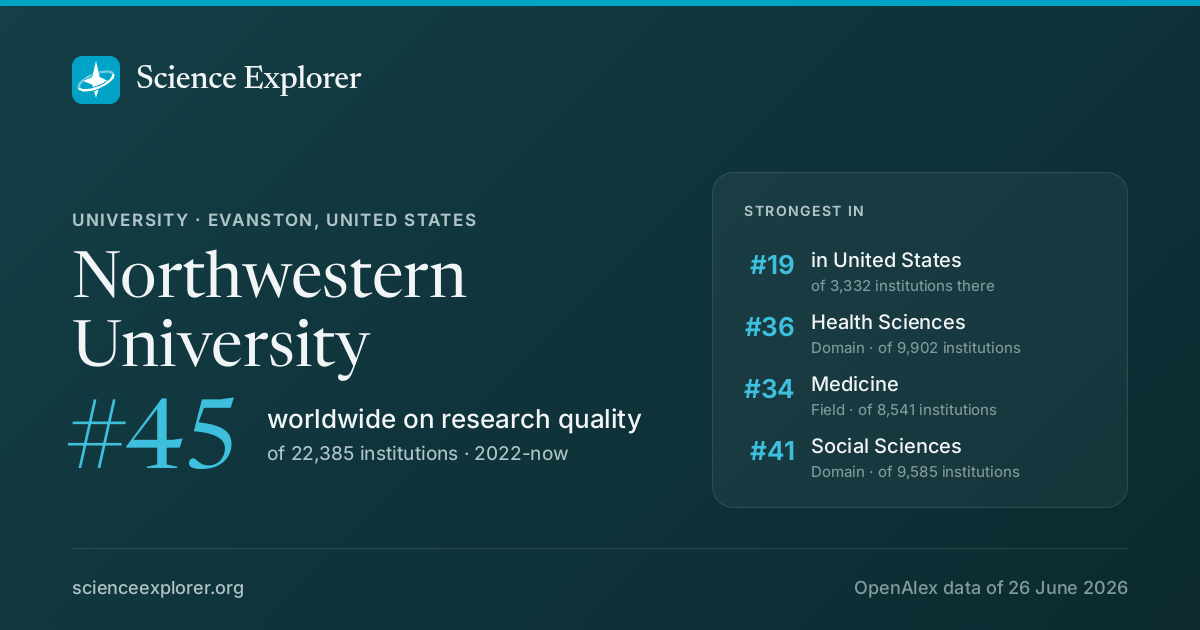
In research, Northwestern University stands highest in Health Sciences (#36 of 9,902 worldwide), Medicine (#34 of 8,541 worldwide) and Social Sciences (#41 of 9,585 worldwide), 2022-now. Relative to its size it is most specialised in Transplantation, Immunology and Allergy and Genetics (Transplantation is 8.6× its share of world research).
- World rank, 2022-now
- #45 of 22,385 · #28 all time
- Rank in United States
- #19 of 3,332
- Research works
- 143k ▼ 7% vs 2018-21
- Citations
- 6.4M 44.8 per fractional work
- Top-10% rate
- 13.8% all institutions 10.0%
- vs its own fields
- 1.17× 1.00× is exactly expected
- Open access
- 31% world 40%
- International
- 13% world 18%
What is Northwestern University known for in research?
The fields where it stands highest, 2022-now, ranked among every institution above the floor in each field.
| Field | World rank | Where that sits | Top-10% rate | Works | All time |
|---|---|---|---|---|---|
| Health SciencesDomain | #36 of 9,902 | 12.9% | 8,412 | #33 | |
| MedicineField | #34 of 8,541 | 12.8% | 7,657 | #26 | |
| Social SciencesDomain | #41 of 9,585 | 15.4% | 2,773 | #22 | |
| Business, Management and AccountingField | #15 of 2,581 | 13.0% | 181 | #21 | |
| Life SciencesDomain | #38 of 6,403 | 13.1% | 2,552 | #29 | |
| Physical SciencesDomain | #81 of 10,670 | 15.9% | 3,646 | #46 | |
| Social SciencesField | #52 of 5,988 | 16.9% | 1,184 | #28 | |
| PsychologyField | #23 of 2,121 | 14.7% | 766 | #15 | |
| Health ProfessionsField | #21 of 1,895 | 13.5% | 657 | #22 | |
| Biochemistry, Genetics and Molecular BiologyField | #34 of 2,964 | 13.3% | 1,524 | #25 |
Each strip is that field's whole ranked pool, with the notch where Northwestern University sits in it, in the colour of the band that rank falls in. The track under the rate is the rate itself: it carries no average mark, because the average differs by field (from about 6% in Dentistry to 21% in Economics).
Which of those standings moved
The same fields on both windows: where it stood over the whole record, and where it stands in 2022-now. The distance is the story, and it is the one thing the two rank columns above cannot show.
- Health Sciences#33 #36
- Medicine#26 #34
- Social Sciences#22 #41
- Business, Management and Accounting#21 #15
- Life Sciences#29 #38
- Physical Sciences#46 #81
- Social Sciences#28 #52
- Psychology#15 #23
- Health Professions#22 #21
- Biochemistry, Genetics and Molecular Biology#25 #34
A dot further right is a better standing. Fields it was not ranked in over the whole record are left out.
Which fields of science does Northwestern University work in?
In 2022-now, 49% of research at Northwestern University is in Health Sciences, 21% in Physical Sciences. Its largest fields are Medicine (45%), Biochemistry, Genetics and Molecular Biology (9%), Social Sciences (7%). It does 2.1× the world's share of Health Sciences.
Each ring splits the one inside it: the four domains of science, their fields, their subfields. Size is fractional works in 2022-now. Every slice is a page; the interactive view zooms down to single topics and colours each by how much more of it this institution does than the world.
Its 4 domains and 26 fields, with their numbers
- Health Sciences9,53348.8%
- Medicine8,69344.5%
- Health Professions7263.7%
- Nursing850.4%
- Dentistry210.1%
- Veterinary90.0%
- Physical Sciences4,03120.7%
- Engineering1,2936.6%
- Computer Science7433.8%
- Materials Science6313.2%
- Physics and Astronomy4892.5%
- Chemistry2521.3%
- Environmental Science2381.2%
- Mathematics1810.9%
- Energy740.4%
- Earth and Planetary Sciences730.4%
- Chemical Engineering570.3%
- Social Sciences3,04115.6%
- Social Sciences1,2996.7%
- Psychology8444.3%
- Economics, Econometrics and Finance2931.5%
- Arts and Humanities2451.3%
- Business, Management and Accounting1981.0%
- Decision Sciences1630.8%
- Life Sciences2,91314.9%
What does Northwestern University specialise in?
Where its research is concentrated relative to its size: Transplantation takes 8.6× the share of its output that it takes of world research.
- TransplantationSubfield · 75.2 works8.6×
- Immunology and AllergySubfield · 82.6 works5.3×
- GeneticsSubfield · 196.7 works3.7×
- Internal MedicineSubfield · 43.2 works3.6×
- Cardiology and Cardiovascular MedicineSubfield · 737.3 works3.6×
- Family PracticeSubfield · 33.5 works3.6×
Location quotient, a volume reading rather than an impact one. It surfaces small, lopsided specialities.
Field profile
Location quotient across every field it publishes in: outside the ring is more than an institution of this size would be expected to publish, inside it is less.
Rings at 0.5×, 1× and 2×. Widest outward: Medicine, 2.3×. Every wedge is a field page.
All 26 fields, with their numbers
- Medicine2.32×8,693 works
- Neuroscience2.12×671 works
- Immunology and Microbiology1.83×359 works
- Biochemistry, Genetics and Molecular Biology1.67×1,742 works
- Psychology1.42×844 works
- Health Professions1.41×726 works
- Physics and Astronomy1.13×489 works
- Materials Science0.93×631 works
- Nursing0.88×85 works
- Decision Sciences0.86×163 works
- Chemical Engineering0.84×57 works
- Chemistry0.82×252 works
- Mathematics0.79×181 works
- Economics, Econometrics and Finance0.70×292 works
- Pharmacology, Toxicology and Pharmaceutics0.56×38 works
- Social Sciences0.53×1,299 works
- Computer Science0.49×743 works
- Engineering0.44×1,293 works
- Arts and Humanities0.43×245 works
- Energy0.41×74 works
- Veterinary0.35×9 works
- Business, Management and Accounting0.31×198 works
- Environmental Science0.25×238 works
- Earth and Planetary Sciences0.24×73 works
- Dentistry0.22×21 works
- Agricultural and Biological Sciences0.11×104 works
- Medicine 2.3×
- Neuroscience 2.1×
- Immunology and Microbiology 1.8×
- Biochemistry, Genetics and Molecular Biology 1.7×
- Psychology 1.4×
- Health Professions 1.4×
- Physics and Astronomy 1.1×
- Materials Science 0.9×
- Nursing 0.9×
- Decision Sciences 0.9×
- Chemical Engineering 0.8×
- Chemistry 0.8×
- Mathematics 0.8×
- Economics, Econometrics and Finance 0.7×
- Pharmacology, Toxicology and Pharmaceutics 0.6×
- Social Sciences 0.5×
- Computer Science 0.5×
- Engineering 0.4×
- Arts and Humanities 0.4×
- Energy 0.4×
- Veterinary 0.3×
- Business, Management and Accounting 0.3×
- Environmental Science 0.2×
- Earth and Planetary Sciences 0.2×
- Dentistry 0.2×
- Agricultural and Biological Sciences 0.1×
Who are the top researchers at Northwestern University?
Ranked on the quality score, Omar K. Farha, M. Zevin and B. Farr lead among researchers whose main affiliation is Northwestern University.
- 1
Omar K. Farha
 United States · #308 worldwide
121k citations · 1,244 works
- 2
M. Zevin
United States · #358 worldwide
64k citations · 261 works
- 3
B. Farr
United States · #377 worldwide
96k citations · 368 works
- 4
Navdeep S. Chandel
United States · #685 worldwide
91k citations · 533 works
- 5
Claude‐André Faucher‐Giguère
United States · #960 worldwide
25k citations · 405 works
- 6
Yonggang Y. Huang
United States · #1,162 worldwide
96k citations · 696 works
- 7
Z. Doctor
United States · #1,902 worldwide
34k citations · 193 works
- 8
Timur İslamoğlu
United States · #2,491 worldwide
19k citations · 270 works
- 9
S. B. Coughlin
United States · #2,665 worldwide
33k citations · 94 works
- 10
William R. Dichtel
United States · #2,863 worldwide
33k citations · 393 works
Which keywords describe research at Northwestern University?
By fractional works in 2022-now, weighted toward what it does more of than the world: Epidemiology, Inflammation, Quality of Life, Treatment, Risk Factors, Immunotherapy, Diagnosis and Management.
- Graft Survival
- Children
- Immunosuppressive Therapy
- Myocardial Infarction
- Primary Care
- Echocardiography
- Genetic Mutations
- Radiotherapy
- Complications
- Obesity
- Clinical Trials
- Heart Failure
- Guidelines
- Depression
- Cancer
- Cardiovascular Disease
- Public Health
- Oxidative Stress
- Treatment
- Inflammation
- Epidemiology
- Quality of Life
- Risk Factors
- Diagnosis
- Immunotherapy
- Mental Health
- Management
- Chemotherapy
- Metabolic Syndrome
- Biomarkers
- Genetics
- Prognostic Factors
- Neurological Disorders
- Clinical Practice Guidelines
- Mortality
- Aging
- Health Disparities
- Clinical Guidelines
- Mortality Risk
- Transplantation
Size is fractional works in 2022-now in the topics tagged with each word; colour is the word's share of this institution's work against its share of the world's. The 40 words are chosen for being large and distinctive. Each links to the topic it comes from most.
All 40 words, with their numbers
- Epidemiology1,597▲ 2.0×129 topics
- Inflammation733▲ 1.77×82 topics
- Quality of Life552▲ 1.96×56 topics
- Treatment514▲ 2.2×50 topics
- Risk Factors482▲ 2.2×36 topics
- Oxidative Stress462▲ 1.44×61 topics
- Diagnosis445▲ 2.4×41 topics
- Public Health417▲ 1.47×57 topics
- Immunotherapy412▲ 2.9×19 topics
- Cardiovascular Disease411▲ 1.85×39 topics
- Mental Health396▲ 1.42×39 topics
- Cancer389▲ 1.48×56 topics
- Management362▲ 2.3×35 topics
- Depression304▲ 1.77×23 topics
- Chemotherapy297▲ 2.1×25 topics
- Guidelines292▲ 3.2×13 topics
- Metabolic Syndrome286▲ 1.81×23 topics
- Heart Failure286▲ 3.3×14 topics
- Biomarkers282▲ 2.1×18 topics
- Clinical Trials280▲ 2.1×19 topics
- Genetics275▲ 2.0×26 topics
- Obesity267▲ 1.78×24 topics
- Prognostic Factors262▲ 3.1×14 topics
- Complications260▲ 2.7×17 topics
- Neurological Disorders250▲ 2.2×20 topics
- Radiotherapy240▲ 3.1×13 topics
- Clinical Practice Guidelines236▲ 2.2×14 topics
- Genetic Mutations234▲ 2.7×23 topics
- Mortality233▲ 2.1×13 topics
- Echocardiography227▲ 4.2×8 topics
- Aging223▲ 2.1×18 topics
- Primary Care182▲ 2.5×14 topics
- Health Disparities166▲ 3.3×9 topics
- Myocardial Infarction165▲ 3.6×7 topics
- Clinical Guidelines165▲ 2.9×9 topics
- Immunosuppressive Therapy164▲ 4.4×8 topics
- Mortality Risk163▲ 3.5×6 topics
- Children159▲ 3.6×7 topics
- Transplantation129▲ 6.3×4 topics
- Graft Survival115▲ 6.9×3 topics
Which research topics does Northwestern University publish most on?
By volume in 2022-now: Glioma Diagnosis and Treatment, Transplantation: Methods and Outcomes, Cardiovascular Health and Risk Factors and Cardiovascular Function and Risk Factors.
Area is fractional works; colour is the subfield each topic belongs to.
- 1 Glioma Diagnosis and Treatment Genetics 87 works
- 2 Transplantation: Methods and Outcomes Surgery 86 works
- 3 Cardiovascular Health and Risk Factors Cardiology and Cardiovascular Medicine 75 works
- 4 Cardiovascular Function and Risk Factors Cardiology and Cardiovascular Medicine 72 works
- 5 Cardiac Valve Diseases and Treatments Cardiology and Cardiovascular Medicine 68 works
- 6 Diversity and Career in Medicine Gender Studies 64 works
- 7 Renal Transplantation Outcomes and Treatments Transplantation 62 works
- 8 Congenital Heart Disease Studies Epidemiology 61 works
- 9 Cardiac Imaging and Diagnostics Radiology, Nuclear Medicine and Imaging 60 works
- 10 Dementia and Cognitive Impairment Research Psychiatry and Mental health 59 works
How open and international is its research?
Against the world's own shares: the tick on each track. Both are shares of its output, so they sit on one scale and can be read against each other as well as against the world.
World: 40% of research is openly available.
World: 18% is written across borders.
How has Northwestern University's research output changed?
Output in 2022-2025 was 7% lower than in 2018-2021.
The same series as a ribbon: one cell per year, darker for more. The line above answers how much; this answers when.
Its share of all research
Growing output can still be a shrinking share: all of science grows. This is Northwestern University as a percentage of every work published that year, 0.080% in 2024.
Fractional works of Northwestern University over all fractional works that year. How the balance of science has shifted.
How much of it reaches the world top 10%
Year by year, against all institutions in the same year.
Of each year's output, the share that reached the world's 10% most cited for its field and year. Peak 20.1% in 2013.
Other research institutions in Evanston
- Endeavor Health
- Garrett–Evangelical Theological Seminary
- St. Francis Hospital
- UL Research Institutes
- Rotary International
- Erie Family Health Center
- Rayonix (United States)
- QuesTek (United States)

Which institutions have research most like Northwestern University's?
Among the world's leading institutions, McMaster University has the research profile closest to Northwestern University's, with both strong in Medicine.
- 1
McMaster University
 Canada · Both strong in Medicine, Psychology, Health Professions
0.87 Compare
- 2
University of PittsburghUnited States · Both strong in Neuroscience, Medicine, Immunology and Microbiology
0.85 Compare
- 3
Washington University in St. LouisUnited States · Both strong in Medicine, Neuroscience, Immunology and Microbiology
0.84 Compare
- 4
University of UtahUnited States · Both strong in Medicine, Biochemistry, Genetics and Molecular Biology, Neuroscience
0.84 Compare
- 5
University of California, IrvineUnited States · Both strong in Neuroscience, Medicine, Biochemistry, Genetics and Molecular Biology
0.84 Compare

Similarity is the correlation of each side's location quotients across every field it publishes in, on a log scale: 1 is the same shape of research, 0 is unrelated. It ignores size. How it is measured.
Compare Northwestern University with
- vs University of Chicago
- vs
 University of Copenhagen
- vs
 University of Edinburgh
- vs
 Helmholtz Association of German Research Centres
- vs University of California, San Francisco
- vs Ludwig-Maximilians-Universität München
Share Northwestern University's ranking



Research measures only: rankings here say nothing about teaching, admissions or student experience. Comparable institutions and collaboration partners have tabs of their own, above.
Discussion
Ask a question or share a note about Northwestern University. Posts are plain text and can be reported.