Condensed Matter Physics research
Condensed Matter Physics is a subfield of Physics and Astronomy. Science Explorer counts 364k research works in it since 1950. 9.9% of them reached the world's top 10% most cited for their field and year.
In short: branch of physics dealing with a property of matter.
- Research works
- 364k fractional, since 1950
- In the world top 10%
- 36k per year above
- Top-10% rate
- 9.9% share of its works in the world top 10%
- Topics
- 8
- Growth, 2018-21 → 2022-25
- +1% the tick is no change
- Largest producer
 China
34% of the 10 largest, 2022-now
What is Condensed Matter Physics research about, and what is growing?
By the world's output in 2021-25, its most used keywords are Superconductivity, Cuprate Superconductors, High-Temperature Superconductivity, III-Nitrides, Semiconductors, Frustrated Magnets. Gaining share since 2011-15: Hydrodynamics, Micro/Nanomotors. Losing share: Heavy Fermion, Quantum Criticality, Critical Phenomena, Phase Transitions.
- Channeling
- Magnesium Diboride
- Heavy Fermion
- Critical Phenomena
- Hydrodynamics
- Frustrated Magnets
- III-Nitrides
- Cuprate Superconductors
- Superconductivity
- High-Temperature Superconductivity
- Semiconductors
- Quantum Spin Liquids
- Micro/Nanomotors
- Phase Transitions
- Quantum Criticality
- Multiple Gaps
- Nuclear Resonant Spectroscopy
Size is the world's fractional works in 2021-25 in the topics tagged with each word; colour compares the word's share of this field with 2011-15. Each links to the topic it comes from most.
All 17 words, with their numbers
- Superconductivity13k◆ 0.95×3 topics
- Cuprate Superconductors9,587◆ 0.91×1 topic
- High-Temperature Superconductivity9,587◆ 0.91×1 topic
- III-Nitrides8,376◆ 0.95×1 topic
- Semiconductors8,376◆ 0.95×1 topic
- Frustrated Magnets7,565◆ 1.12×1 topic
- Quantum Spin Liquids7,565◆ 1.12×1 topic
- Hydrodynamics6,431▲ 2.2×1 topic
- Micro/Nanomotors6,431▲ 2.2×1 topic
- Critical Phenomena5,496▼ 0.80×1 topic
- Phase Transitions5,496▼ 0.80×1 topic
- Heavy Fermion3,428▼ 0.72×1 topic
- Quantum Criticality3,428▼ 0.72×1 topic
- Magnesium Diboride1,793◆ 0.90×1 topic
- Multiple Gaps1,793◆ 0.90×1 topic
- Channeling1,079◆ 0.99×1 topic
- Nuclear Resonant Spectroscopy1,079◆ 0.99×1 topic
Which countries lead Condensed Matter Physics research?
On research quality in 2022-now, the United States, China and Germany rank highest in Condensed Matter Physics. By volume, China and the United States publish the most (10k and 5.9k works in 2022-now).
By research quality, 2022-now
- 1
 United States #1 all time
1.31× citation excellence · 1.48× journals · 100% breadth
12.4% top 10% · 5.2k works
- 2
China #3 all time
1.12× citation excellence · 1.04× journals · 100% breadth
12.1% top 10% · 8.9k works
- 3
 Germany #2 all time
1.20× citation excellence · 1.37× journals · 100% breadth
11.1% top 10% · 2k works
- 4
 France #4 all time
1.00× citation excellence · 1.28× journals · 100% breadth
8.0% top 10% · 1.5k works
- 5
 Switzerland #5 all time
1.51× citation excellence · 1.58× journals · 100% breadth
14.1% top 10% · 437 works
- 6
 Japan #7 all time
0.76× citation excellence · 0.95× journals · 100% breadth
7.0% top 10% · 2.8k works
- 7
 United Kingdom #6 all time
1.09× citation excellence · 1.19× journals · 100% breadth
10.3% top 10% · 1k works
- 8
 Italy #11 all time
1.12× citation excellence · 0.97× journals · 100% breadth
9.5% top 10% · 791 works
- 9
 Canada #8 all time
1.14× citation excellence · 1.32× journals · 100% breadth
10.0% top 10% · 444 works
- 10
 Spain #10 all time
1.13× citation excellence · 1.18× journals · 100% breadth
10.8% top 10% · 486 works
The track on each row is that row's top-10% rate. The ranking itself is the quality score, which compares the rate with what each place's own topics predict, adds its share of papers in the Nature Index journals, and counts output and breadth too.
Of 22 countries ranked in Condensed Matter Physics. Ranked on the quality score for 2022-now; the bracket is the all-time rank.
All countries ranked in Condensed Matter PhysicsBy volume, 2022-now
- 1
China
10k works
- 2
United States
5.9k works
- 3
Japan
3.1k works
- 4
 India
2.4k works
- 5
Germany
2.3k works
- 6
 Russia
1.7k works
- 7
France
1.6k works
- 8
United Kingdom
1.2k works
- 9
Italy
912 works
- 10
 South Korea
893 works
How concentrated that is
The same countries as shares of everything the list above accounts for. A node where two countries do two thirds of the work and one spread evenly across twelve read alike as a ranking and not at all alike here.
Shares of the rows listed above, not of the whole node.
Which institutions lead Condensed Matter Physics research?
Chinese Academy of Sciences (China) ranks first in Condensed Matter Physics on research quality in 2022-now, followed by Max Planck Society and Peking University.
By research quality, 2022-now
- 1
Chinese Academy of Sciences China · Beijing · #4 all time
13.8% top 10% · 1.2k works
- 2
Max Planck Society Germany · Munich · #2 all time
15.6% top 10% · 290 works
- 3
Peking University China · Beijing · #24 all time
16.9% top 10% · 181 works
- 4
Stanford University United States · Stanford · #1 all time
16.9% top 10% · 141 works
- 5
University of California, Santa Barbara United States · Santa Barbara · #3 all time
19.8% top 10% · 99 works
- 6
Massachusetts Institute of Technology United States · Cambridge · #9 all time
21.4% top 10% · 125 works
- 7
ETH Zurich Switzerland · Zurich · #12 all time
20.0% top 10% · 102 works
- 8
Cornell University United States · Ithaca · #14 all time
20.5% top 10% · 85 works
- 9
Princeton University United States · Princeton · #6 all time
21.6% top 10% · 87 works
- 10
Centre National de la Recherche Scientifique France · Paris · #5 all time
7.2% top 10% · 680 works


The track on each row is that row's top-10% rate. The ranking itself is the quality score, which compares the rate with what each place's own topics predict, adds its share of papers in the Nature Index journals, and counts output and breadth too.
Of 88 institutions above the floor of 40 fractional works in Condensed Matter Physics.
Top 100 Condensed Matter Physics institutionsBy volume, 2022-now
- 1
Chinese Academy of SciencesChina
1.4k works
- 2
Russian Academy of SciencesRussia
764 works
- 3
Centre National de la Recherche ScientifiqueFrance
746 works
- 4
Max Planck SocietyGermany
317 works
- 5
Helmholtz Association of German Research CentresGermany
309 works
- 6
The University of TokyoJapan
283 works
- 7
University of Chinese Academy of SciencesChina
257 works
- 8
University of Science and Technology of ChinaChina
236 works
- 9
Tohoku UniversityJapan
226 works
- 10
Peking UniversityChina
205 works
Who are the leading researchers in Condensed Matter Physics?
Counting only their work in Condensed Matter Physics, R. J. Cava, Y. Tokura and Metin Sitti have the most papers in the world top 10% for their subfield and year beyond the 10% expected.
- 1
R. J. Cava
United States · #65,368 worldwide overall
100.9 of 405 papers here in the top 10%
- 2
Y. Tokura
Japan · #49,861 worldwide overall
80.8 of 230 papers here in the top 10%
- 3
Metin Sitti
Germany · #3,891 worldwide overall
69.7 of 121 papers here in the top 10%
- 4
Yoshinori Tokura
Japan · #72,757 worldwide overall
85.4 of 291 papers here in the top 10%
- 5
Subir Sachdev
United States · #19,992 worldwide overall
78.1 of 226 papers here in the top 10%
- 6
Joseph Wang
United States · #2,364 worldwide overall
62.2 of 86 papers here in the top 10%
- 7
Steven P. DenBaars
United States · #128,493 worldwide overall
95.4 of 425 papers here in the top 10%
- 8
Gabriel Kotliar
United States · #44,739 worldwide overall
71.1 of 194 papers here in the top 10%
- 9
Gen Shirane
United States · #13,080 worldwide overall
73.8 of 233 papers here in the top 10%
- 10
Li Zhang
China · #76,340 worldwide overall
60.8 of 103 papers here in the top 10%
Ranked on their work in Condensed Matter Physics alone: how many more of their papers here reached the world top 10% for their subfield and year than the 10% expected, among 558,386 ranked researchers with a paper here. Each paper counts once, so many strong papers outrank one famous one, and a long record of ordinary papers does not climb. Identities come from OpenAlex author disambiguation, which occasionally merges or splits people.
Top 100 Condensed Matter Physics researchersWhere is Condensed Matter Physics research done?
The largest centres of Condensed Matter Physics research in 2022-now are Beijing (China), Tokyo (Japan), Shanghai (China) and Moscow (Russia). Among places with at least 20 works in it, it is an unusually large share of all research in Sayō, Villigen and Bariloche.
Largest cities, 2022-now
Where it is the local speciality
- SayōJP · 46.7 works32×
- VilligenCH · 84.1 works27×
- BarilocheAR · 22.5 works26×
- WakoJP · 92.3 works23×
- DidcotGB · 68.3 works22×
Location quotient: how much more of its research is in Condensed Matter Physics than the world average.
Condensed Matter Physics research by country
The best places for Condensed Matter Physics research inside each country, with that country's researchers and world standing.
 Taiwan
 Poland
 Ukraine
Where is the best place to study Condensed Matter Physics?
Among universities, judged by research, Stanford University, University of California, Santa Barbara and Princeton University score highest, combining standing in the field's ranking, citation excellence, specialisation, size, growth and international reach. Research strength is one signal when choosing where to study; it does not measure teaching.
One dot per university in the first ten of the table below, at the default weights. The upper left is the interesting corner: small places doing unusually strong work.










Universities only. The score blends standing (50%), citation excellence (20%), size (15%), specialisation (5%), growth (5%), international reach (5%), 2022-now; growth compares 2018-21 with 2022-25 and counts up to +20%, since a jump from a small base is mostly noise. Standing is the score in this field's institution ranking, three quarters over all time and a quarter 2022-now; excellence averages the two windows too. Four years alone undercount fields such as AI, where many conference and arXiv papers from 2022 on carry no affiliation in the data.
Every institution in Condensed Matter Physics, country by countryIs Condensed Matter Physics research growing?
Output in 2022-2025 was 1% higher than in 2018-2021, peaking in 2006. The fastest-growing topics are Micro and Nano Robotics, Crystallography and Radiation Phenomena and GaN-based semiconductor devices and materials.
The same series as a ribbon: one cell per year, darker for more. The line above answers how much; this answers when.
Its share of all research
Growing output can still be a shrinking share: all of science grows. This is Condensed Matter Physics as a percentage of every work published that year, 0.16% in 2024.
Fractional works of Condensed Matter Physics over all fractional works that year. How the balance of science has shifted.
How much of it reaches the world top 10%
Year by year.
Of each year's works in it, the share that reached the world's 10% most cited for their field and year. A field is the world for its own topics, so there is no other line to hold it against.
Which topics inside it are moving
Growth and decline on one axis around a shared zero. Two lists side by side hide the thing that matters: whether the growth dwarfs the decline, or the other way round.
- Micro and Nano Robotics+29%
- Crystallography and Radiation Phenomena+9%
- GaN-based semiconductor devices and materials+5%
- Rare-earth and actinide compounds-2%
- Superconductivity in MgB2 and Alloys-4%
- Theoretical and Computational Physics-8%
- Physics of Superconductivity and Magnetism-8%
Growth in output from 2018-21 to 2022-25. Every topic is a page of its own.
What does Condensed Matter Physics include?
Area is fractional works in that topic. Every name below is a page of its own.
Share who leads Condensed Matter Physics
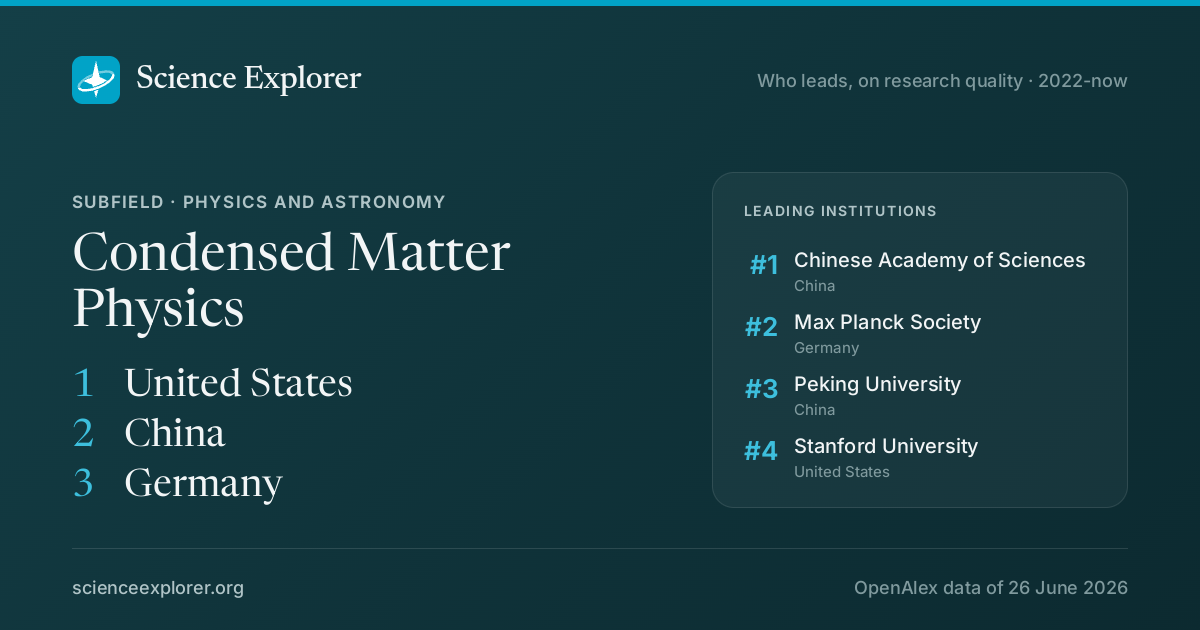
The leading institutions' badges6Each links to that institution's page and updates with every snapshot


Discussion
Ask a question or share a note about Condensed Matter Physics. Keep it to the research: no personal attacks, advertising or links. Any reader can report a post, which collapses it for everyone until it is opened.