 Science in Russia
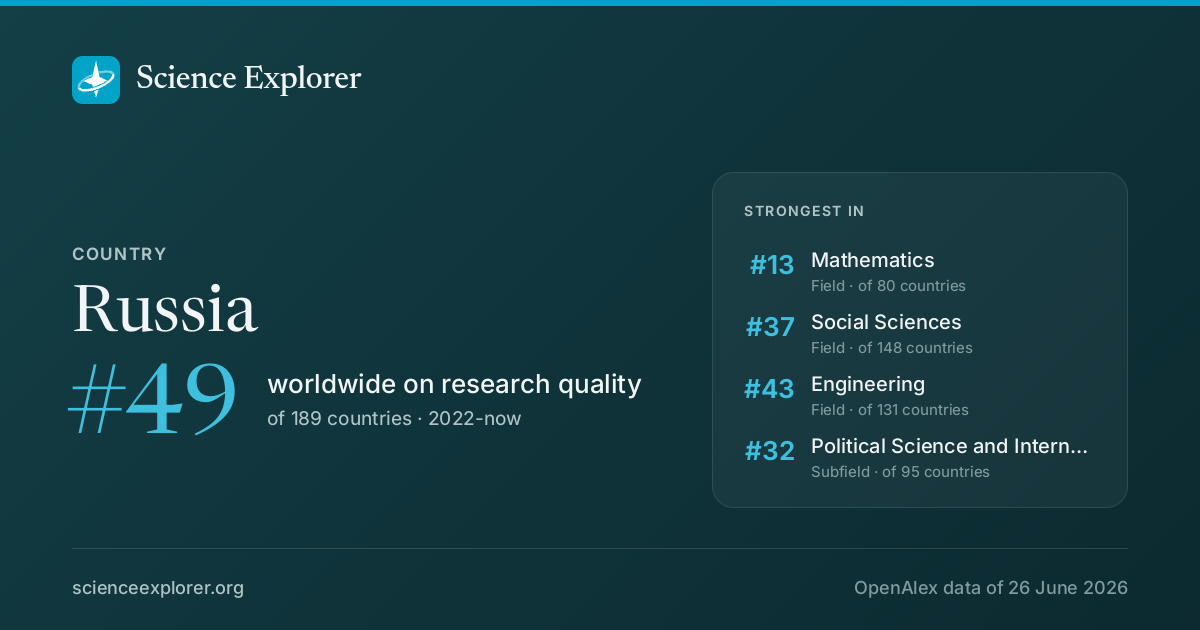
Russia ranks #49 of 189 countries on research quality in 2022-now (#38 all time), with 544k research works and 4.4% of them in the world's top 10%.
- World rank, 2022-now
- #49 of 189 · #38 all time
- Works, 2022-now
- 544k ▼ 10% vs 2018-21
- Citations
- 16.3M 7.0 per fractional work, all time
- Top-10% rate
- 4.4% all institutions 10.0%
- vs its own fields
- 0.34× 1.00× is exactly expected
- In the world top 100
- 0 0 in the top 1,000
- Open access
- 41% world 40%
- International
- 14% world 18%
RussiaWhat is Russia strongest at in science?
On research quality in 2022-now, Russia ranks highest in Mathematics (#13 of 80), Social Sciences (#37 of 148) and Engineering (#43 of 131). Relative to its size it is most specialised in Nuclear Energy and Engineering, Fuel Technology and General Materials Science.
| Field | World rank | Where that sits | Top-10% rate | Works | All time | Institutions |
|---|---|---|---|---|---|---|
| MathematicsField | #13 of 80 | 5.7% | 10,118 | #11 | Institutions | |
| Social SciencesField | #37 of 148 | 7.8% | 79,955 | #34 | Institutions | |
| EngineeringField | #43 of 131 | 3.5% | 97,074 | #34 | Institutions | |
| Political Science and International RelationsSubfield | #32 of 95 | 7.3% | 16,499 | #28 | Institutions | |
| Materials ScienceField | #30 of 87 | 2.9% | 28,230 | #25 | Institutions | |
| Sociology and Political ScienceSubfield | #42 of 119 | 6.8% | 17,591 | #34 | Institutions | |
| Arts and HumanitiesField | #37 of 103 | 7.1% | 14,110 | #34 | Institutions | |
| Computer ScienceField | #46 of 128 | 5.3% | 32,919 | #40 | Institutions | |
| DevelopmentSubfield | #8 of 22 | 8.3% | 5,762 | #6 | Institutions | |
| Economics, Econometrics and FinanceField | #42 of 107 | 5.9% | 15,699 | #37 | Institutions | |
| Physics and AstronomyField | #30 of 76 | 3.0% | 23,518 | #24 | Institutions | |
| Information SystemsSubfield | #36 of 90 | 7.3% | 14,379 | #30 | Institutions |
Where its research is concentrated
Location quotient: how much more (or less) of each node it does than its size predicts. Drawn around 1×, where "twice the world share" and "half of it" are the same distance apart in opposite directions. A volume reading, which on a country axis is largely population and industrial structure.
- Nuclear Energy and EngineeringSubfield · 654.0 works · #1 of 121 active here16×
- Fuel TechnologySubfield · 751.1 works · #1 of 113 active here15×
- General Materials ScienceSubfield · 2,807.4 works · #1 of 155 active here11×
- DevelopmentSubfield · 6,028.1 works · #1 of 190 active here10.0×
- AnatomySubfield · 1,107.7 works · #2 of 159 active here7.7×
- General Economics, Econometrics and FinanceSubfield · 7,182.9 works · #1 of 211 active here4.8×
- General EnergySubfield · 644.6 works · #2 of 167 active here4.0×
- GeologySubfield · 3,127.2 works · #3 of 199 active here3.9×
The whole field profile
All 26 fields at once. A specialist and a generalist produce the same ranked list and a completely different shape.
Rings at 0.5×, 1× and 2×. Widest outward: Earth and Planetary Sciences, 2.2×. Every wedge is a field page.
All 26 fields, with their numbers
- Earth and Planetary Sciences2.18×20k works
- Physics and Astronomy1.91×25k works
- Chemistry1.64×15k works
- Mathematics1.57×11k works
- Materials Science1.46×31k works
- Economics, Econometrics and Finance1.37×18k works
- Chemical Engineering1.31×2,751 works
- Agricultural and Biological Sciences1.20×34k works
- Engineering1.16×105k works
- Social Sciences1.16×88k works
- Energy1.04×5,746 works
- Business, Management and Accounting0.95×18k works
- Environmental Science0.93×28k works
- Arts and Humanities0.90×16k works
- Pharmacology, Toxicology and Pharmaceutics0.84×1,776 works
- Neuroscience0.80×7,797 works
- Biochemistry, Genetics and Molecular Biology0.79×25k works
- Computer Science0.78×37k works
- Immunology and Microbiology0.74×4,440 works
- Decision Sciences0.74×4,282 works
- Medicine0.70×80k works
- Dentistry0.69×2,008 works
- Veterinary0.62×508 works
- Psychology0.61×11k works
- Nursing0.54×1,584 works
- Health Professions0.40×6,352 works
Which fields of science does Russia work in?
In 2022-now, 47% of research in Russia is in Physical Sciences, 26% in Social Sciences. Its largest fields are Engineering (17%), Social Sciences (15%), Medicine (13%).
Each ring splits the one inside it: the four domains of science, their fields, their subfields. Size is fractional works in 2022-now. Every slice is a page; the interactive view zooms down to single topics and colours each by how much more of it this country does than the world.
Its 4 domains and 26 fields, with their numbers
- Physical Sciences280k46.7%
- Engineering105k17.4%
- Computer Science37k6.1%
- Materials Science31k5.1%
- Environmental Science28k4.6%
- Physics and Astronomy25k4.2%
- Earth and Planetary Sciences20k3.4%
- Chemistry15k2.6%
- Mathematics11k1.9%
- Energy5,7461.0%
- Chemical Engineering2,7510.5%
- Social Sciences155k25.9%
- Social Sciences88k14.7%
- Business, Management and Accounting18k3.1%
- Economics, Econometrics and Finance18k2.9%
- Arts and Humanities16k2.6%
- Psychology11k1.9%
- Decision Sciences4,2820.7%
- Health Sciences91k15.1%
- Medicine80k13.4%
- Health Professions6,3521.1%
- Dentistry2,0080.3%
- Nursing1,5840.3%
- Veterinary5080.1%
- Life Sciences73k12.2%
- Agricultural and Biological Sciences34k5.7%
- Biochemistry, Genetics and Molecular Biology25k4.2%
- Neuroscience7,7971.3%
- Immunology and Microbiology4,4400.7%
- Pharmacology, Toxicology and Pharmaceutics1,7760.3%
Which keywords describe research in Russia?
By fractional works in 2022-now, weighted toward what it does more of than the world: Sustainable Development, Digital Transformation, Climate Change, Innovation, Regional Development, Digital Economy, Artificial Intelligence and Globalization.
- Cultural Communication
- Phraseology
- Macroeconomic Assessment
- Knowledge Clusters
- Information Security
- Youth
- Blockchain Technology
- Cyber-Physical Systems
- Geopolitics
- International Relations
- Migration
- Pedagogy
- Digitalization
- E-Learning
- Food Security
- Digital Economy
- Energy Efficiency
- Globalization
- Innovation
- Climate Change
- Sustainable Development
- Digital Transformation
- Artificial Intelligence
- Sustainability
- Regional Development
- Economic Development
- Educational Technology
- Legal Regulation
- Language
- Economic Security
- Ethnicity
- Global Economy
- Media
- Arctic
- Linguistics
- Geographical Analysis
- Digital Technologies
- Agricultural Development
- Russian Economy
- Spatial Patterns
Size is fractional works in 2022-now in the topics tagged with each word; colour is the word's share of this country's work against its share of the world's. The 40 words are chosen for being large and distinctive. Each links to the topic it comes from most.
All 40 words, with their numbers
- Sustainable Development37k▲ 3.9×113 topics
- Climate Change33k▲ 2.0×132 topics
- Digital Transformation24k▲ 7.3×32 topics
- Innovation24k▲ 3.8×91 topics
- Artificial Intelligence23k▲ 2.7×67 topics
- Globalization23k▲ 1.94×186 topics
- Sustainability18k▲ 1.20×140 topics
- Energy Efficiency16k▲ 3.0×45 topics
- Regional Development16k▲ 8.0×21 topics
- Digital Economy15k▲ 12×20 topics
- Economic Development15k▲ 3.1×57 topics
- Food Security13k▲ 4.0×25 topics
- Educational Technology13k▲ 1.80×48 topics
- E-Learning11k▲ 1.97×27 topics
- Legal Regulation11k▲ 8.3×8 topics
- Digitalization11k▲ 9.0×16 topics
- Language11k▲ 7.1×15 topics
- Pedagogy9,445▲ 3.1×30 topics
- Economic Security8,448▲ 6.6×7 topics
- Migration8,418▲ 4.1×35 topics
- Ethnicity8,272▲ 3.7×25 topics
- International Relations7,912▲ 5.4×31 topics
- Global Economy7,846▲ 10×7 topics
- Geopolitics7,489▲ 8.2×12 topics
- Media7,153▲ 7.9×19 topics
- Cyber-Physical Systems6,922▲ 4.4×9 topics
- Arctic6,854▲ 10×4 topics
- Blockchain Technology6,746▲ 20×4 topics
- Linguistics6,575▲ 6.9×9 topics
- Youth6,520▲ 7.8×10 topics
- Geographical Analysis6,050▲ 24×2 topics
- Information Security6,016▲ 10×4 topics
- Digital Technologies5,999▲ 7.4×6 topics
- Knowledge Clusters5,806▲ 25×2 topics
- Agricultural Development5,664▲ 6.2×7 topics
- Macroeconomic Assessment5,469▲ 25×1 topic
- Russian Economy5,469▲ 25×1 topic
- Phraseology5,279▲ 12×3 topics
- Spatial Patterns5,109▲ 9.1×4 topics
- Cultural Communication4,923▲ 24×1 topic
Which research topics does Russia publish the most in?
Its largest topics in 2022-now are Economic and Technological Developments in Russia, Discourse Analysis and Cultural Communication, Regional Socio-Economic Development Trends.
Area is fractional works in 2022-now; colour is the subfield each topic belongs to. Every tile is a topic page.
- 1 Economic and Technological Developments in Russia Development 5.5k works
- 2 Discourse Analysis and Cultural Communication Cultural Studies 4.9k works
- 3 Regional Socio-Economic Development Trends Demography 4.8k works
- 4 Educational Innovations and Challenges Information Systems 4.5k works
- 5 Sociopolitical Dynamics in Russia Sociology and Political Science 4.5k works
- 6 Legal and Policy Issues Law 4.3k works
- 7 Food Industry and Aquatic Biology Food Science 3.7k works
- 8 Healthcare Systems and Public Health Epidemiology 3.6k works
- 9 Security, Politics, and Digital Transformation Political Science and International Relations 3.3k works
- 10 Economic and Technological Systems Analysis Management of Technology and Innovation 3.3k works
- 11 Language, Communication, and Linguistic Studies Communication 3.1k works
- 12 Psychology of Development and Education Developmental and Educational Psychology 3k works
Which universities in Russia lead research?
Russian Academy of Sciences, National Research University Higher School of Economics and Financial University rank highest in Russia on research quality in 2022-now.
One dot per institution in the list below. The upper left is the interesting corner.
- 1Russian Academy of SciencesGovernment institution · Moscow · #1,186 worldwide4.1% top 10% · 132k works
- 2National Research University Higher School of EconomicsUniversity · Moscow · #1,581 worldwide8.0% top 10% · 8.5k works
- 3Financial UniversityUniversity · Moscow · #1,744 worldwide9.5% top 10% · 4.6k works
- 4ITMO UniversityUniversity · St Petersburg · #1,749 worldwide4.7% top 10% · 3.5k works
- 5Ural State University of EconomicsUniversity · Yekaterinburg · #1,995 worldwide4.1% top 10% · 951 works
- 6Skolkovo Institute of Science and TechnologyUniversity · Skolkovo · #2,182 worldwide8.6% top 10% · 1.6k works
- 7Moscow State Institute of International RelationsUniversity · Moscow · #2,352 worldwide6.6% top 10% · 3.6k works
- 8State University of ManagementUniversity · Moscow · #2,677 worldwide7.8% top 10% · 1.5k works
- 9The Russian Presidential Academy of National Economy and Public AdministrationGovernment institution · Moscow · #2,946 worldwide5.5% top 10% · 3k works
- 10Altai State UniversityUniversity · Barnaul · #2,949 worldwide4.9% top 10% · 1.3k works
- 11Kostroma State University named after N A NekrasovUniversity · Kostroma · #3,002 worldwide7.4% top 10% · 462 works
- 12Institute of Electronic Measurements KVARZ (Russia)Company · Nizhny Novgorod · #3,077 worldwide7.0% top 10% · 1.3k works
- 13The Institute of Legislation and Comparative Law under the Government of the Russian FederationNonprofit · Moscow · #3,120 worldwide8.3% top 10% · 605 works
- 14Peoples' Friendship University of RussiaUniversity · Moscow · #3,304 worldwide7.1% top 10% · 6.6k works
- 15Voronezh State Pedagogical UniversityUniversity · Voronezh · #3,405 worldwide3.2% top 10% · 317 works
The track on each row is its top-10% rate; the tick is the average of all institutions, 10.0% (how it is set): teal above it, red below.
All ranked institutions in RussiaWho are the top researchers in Russia?
S. L. Danilishin, A. Khanzadeev and V. Barret rank highest among researchers based in Russia.
- 1 S. L. Danilishin #1,207 worldwide 94k citations · 319 works
- 2 A. Khanzadeev #1,297 worldwide 45k citations · 397 works
- 3 V. Barret #2,233 worldwide 23k citations · 184 works
- 4 I. Novikov #4,043 worldwide 38k citations · 135 works
- 5 V. Punin #4,147 worldwide 27k citations · 248 works
- 6 A. S. Markosyan #4,194 worldwide 68k citations · 204 works
- 7 X. Lopez #5,056 worldwide 17k citations · 130 works
- 8 I. Lokhtin #5,570 worldwide 105k citations · 1,472 works
- 9 D. Alexandre #6,446 worldwide 13k citations · 137 works
- 10 V. D. Peshekhonov #8,140 worldwide 55k citations · 752 works
Which cities in Russia are research hubs?
- 1
MoscowRussia
977k works
- 2
Saint PetersburgRussia
229k works
- 3
NovosibirskRussia
122k works
- 4
YekaterinburgRussia
85k works
- 5
TomskRussia
57k works
- 6
Kazan’Russia
56k works
- 7
Rostov-on-DonRussia
37k works
- 8
Nizhny NovgorodRussia
36k works
- 9
IrkutskRussia
33k works
- 10
UfaRussia
32k works
- 11
SamaraRussia
30k works
- 12
KrasnoyarskRussia
27k works
How much of it is in the largest
The same cities as shares of everything these twelve account for.
Shares of the rows listed above, not of the whole node.
How open and international is Russia's research?
41% of its research is openly available (world: 40%), and 14% is written with international co-authors (world: 18%).
World: 40% of research is openly available.
World: 18% is written across borders.
In 2022-now, 58% of its research is openly available (world 63%) and 13% is written with co-authors abroad (world 22%). Against what its own mix of topics predicts, that is 0.92× the expected open access and 0.62× the expected international share, which puts it #170 of 173 countries on openness.
How has Russia's research grown?
Output in 2022-2025 was 10% lower than in 2018-2021.
The same series as a ribbon: one cell per year, darker for more. The line above answers how much; this answers when.
Its share of all research
Growing output can still be a shrinking share: all of science grows. This is Russia as a percentage of every work published that year, 2.3% in 2024.
Fractional works of Russia over all fractional works that year. How the balance of science has shifted.
How much of it reaches the world top 10%
Over the whole record, 4.6% of its 2.3M works since 1950 reached the world top 10% for their field and year.
Of each year's output, the share that reached the world's 10% most cited for its field and year. Peak 5.1% in 1995.
Which countries have research most like Russia's?
Tajikistan is Russia's closest research twin: of all countries, its research is spread across the fields most like Russia's, with both strong in Earth and Planetary Sciences.
- 1
 TajikistanBoth strong in Earth and Planetary Sciences, Physics and Astronomy, Mathematics
0.79 Compare
- 2
 BelarusBoth strong in Mathematics, Physics and Astronomy, Materials Science
0.72 Compare
- 3
 CzechiaBoth strong in Physics and Astronomy, Earth and Planetary Sciences, Chemistry
0.70 Compare
- 4
 AzerbaijanBoth strong in Mathematics, Earth and Planetary Sciences, Chemistry
0.65 Compare
- 5
 North KoreaBoth strong in Earth and Planetary Sciences, Physics and Astronomy, Chemistry
0.64 Compare
Similarity is the correlation of each side's location quotients across every field it publishes in, on a log scale: 1 is the same shape of research, 0 is unrelated. It ignores size. How it is measured.
Compare Russia with
 Cyprus
 Iceland
 Uganda
 Ethiopia
 Qatar
 Croatia
Share Russia's ranking



Research fields in Russia
- Mathematics
- Social Sciences
- Social Sciences
- Physical Sciences
- Engineering
- Political Science and International Relations
- Materials Science
- Sociology and Political Science
- Arts and Humanities
- Computer Science
- Development
- Economics, Econometrics and Finance
- Physics and Astronomy
- Information Systems
- General Economics, Econometrics and Finance
- Cultural Studies
- Communication
- Medicine
- Life Sciences
- Education
- Atomic and Molecular Physics, and Optics
- Agricultural and Biological Sciences
- Strategy and Management
- Health Sciences
- Economics and Econometrics
- Geometry and Topology
- Transportation
- Language and Linguistics
- Biochemistry, Genetics and Molecular Biology
- Electrical and Electronic Engineering
- Materials Chemistry
- Business, Management and Accounting
- Mechanical Engineering
- Management, Monitoring, Policy and Law
- Chemistry
- Aerospace Engineering
- Demography
- Biomedical Engineering
- Applied Mathematics
- Ocean Engineering
- Artificial Intelligence
- Decision Sciences
- Organic Chemistry
- Ecology, Evolution, Behavior and Systematics
- Law
- Management Science and Operations Research
- Control and Systems Engineering
- Developmental and Educational Psychology
- Molecular Biology
- Computational Theory and Mathematics
- Mechanics of Materials
- Numerical Analysis
- Psychology
- Civil and Structural Engineering
- Industrial and Manufacturing Engineering
- Building and Construction
- Literature and Literary Theory
- Agronomy and Crop Science
- Genetics
- Surgery
Questions people ask
What is Russia strongest at in science?
On research quality in 2022-now, Russia ranks highest in Mathematics (#13 of 80), Social Sciences (#37 of 148) and Engineering (#43 of 131). Relative to its size it is most specialised in Nuclear Energy and Engineering, Fuel Technology and General Materials Science.
See the full answerHow fast is research in Russia growing?
Output in 2022-2025 was 10% lower than in 2018-2021.
How has Russia's research grown?Discussion
Ask a question or share a note about Russia. Keep it to the research: no personal attacks, advertising or links. Any reader can report a post, which collapses it for everyone until it is opened.