Experimental and Cognitive Psychology research
Experimental and Cognitive Psychology is a subfield of Psychology. Science Explorer counts 482k research works in it since 1950. 10.1% of them reached the world's top 10% most cited for their field and year.
In short: subdiscipline of psychology.
- Research works
- 482k fractional, since 1950
- In the world top 10%
- 49k per year above
- Top-10% rate
- 10.1% share of its works in the world top 10%
- Topics
- 24
- Growth, 2018-21 → 2022-25
- +23% the tick is no change
- Largest producer
 United States
32% of the 10 largest, 2022-now
What is Experimental and Cognitive Psychology research about, and what is growing?
By the world's output in 2021-25, its most used keywords are Meta-Analysis, Insomnia, Sleep Duration, Neuroscience, Cognitive Science, Cognition. Gaining share since 2011-15: Emotion Recognition, Multimodal Data, Network Analysis, Psychopathology, Insomnia. Losing share: Crossmodal Processing, Multisensory Integration, Phonetics, Speech Perception.
- Time Perspective
- Phenomenal Experience
- Injury Patterns
- Working Memory
- Self-Efficacy
- Motivation
- Crossmodal Processing
- Evolutionary Psychology
- Phonetics
- Sleep Deprivation
- Cognitive-Behavioral Therapy
- Innovation
- Multimodal Data
- Education
- Time
- Personality Traits
- Network Analysis
- Cognition
- Neuroscience
- Insomnia
- Meta-Analysis
- Sleep Duration
- Cognitive Science
- Language
- Psychopathology
- Metaphor
- Psychology
- Emotion Recognition
- Creativity
- Anxiety Disorders
- Fatigue
- Neural Correlates
- Speech Perception
- Human Behavior
- Multisensory Integration
- Achievement Motivation
- Intelligence
- Dance Movement Therapy
- Consciousness
- Future Orientation
Size is the world's fractional works in 2021-25 in the topics tagged with each word; colour compares the word's share of this field with 2011-15. Each links to the topic it comes from most.
All 40 words, with their numbers
- Meta-Analysis21k▲ 1.26×2 topics
- Insomnia17k▲ 1.50×1 topic
- Sleep Duration17k▲ 1.50×1 topic
- Neuroscience17k◆ 0.90×3 topics
- Cognitive Science16k▼ 0.73×3 topics
- Cognition14k▼ 0.75×2 topics
- Language14k▼ 0.75×2 topics
- Network Analysis14k▲ 1.55×1 topic
- Psychopathology14k▲ 1.55×1 topic
- Personality Traits12k◆ 1.11×2 topics
- Metaphor12k▼ 0.74×1 topic
- Time12k▼ 0.74×1 topic
- Psychology11k◆ 0.99×2 topics
- Education11k◆ 1.05×3 topics
- Emotion Recognition9,649▲ 3.0×1 topic
- Multimodal Data9,649▲ 3.0×1 topic
- Creativity8,987◆ 1.03×1 topic
- Innovation8,987◆ 1.03×1 topic
- Anxiety Disorders8,345▼ 0.86×1 topic
- Cognitive-Behavioral Therapy8,345▼ 0.86×1 topic
- Fatigue8,036▲ 1.35×1 topic
- Sleep Deprivation8,036▲ 1.35×1 topic
- Neural Correlates7,020▼ 0.67×2 topics
- Phonetics6,742▼ 0.63×1 topic
- Speech Perception6,742▼ 0.63×1 topic
- Evolutionary Psychology5,290▼ 0.72×1 topic
- Human Behavior5,290▼ 0.72×1 topic
- Crossmodal Processing4,920▼ 0.62×1 topic
- Multisensory Integration4,920▼ 0.62×1 topic
- Motivation4,777▲ 1.41×2 topics
- Achievement Motivation4,077◆ 1.15×1 topic
- Self-Efficacy4,077◆ 1.15×1 topic
- Intelligence3,858▼ 0.74×1 topic
- Working Memory3,858▼ 0.74×1 topic
- Dance Movement Therapy3,794◆ 0.98×1 topic
- Injury Patterns3,794◆ 0.98×1 topic
- Consciousness3,779▼ 0.64×1 topic
- Phenomenal Experience3,779▼ 0.64×1 topic
- Future Orientation3,368▲ 1.42×1 topic
- Time Perspective3,368▲ 1.42×1 topic
Which countries lead Experimental and Cognitive Psychology research?
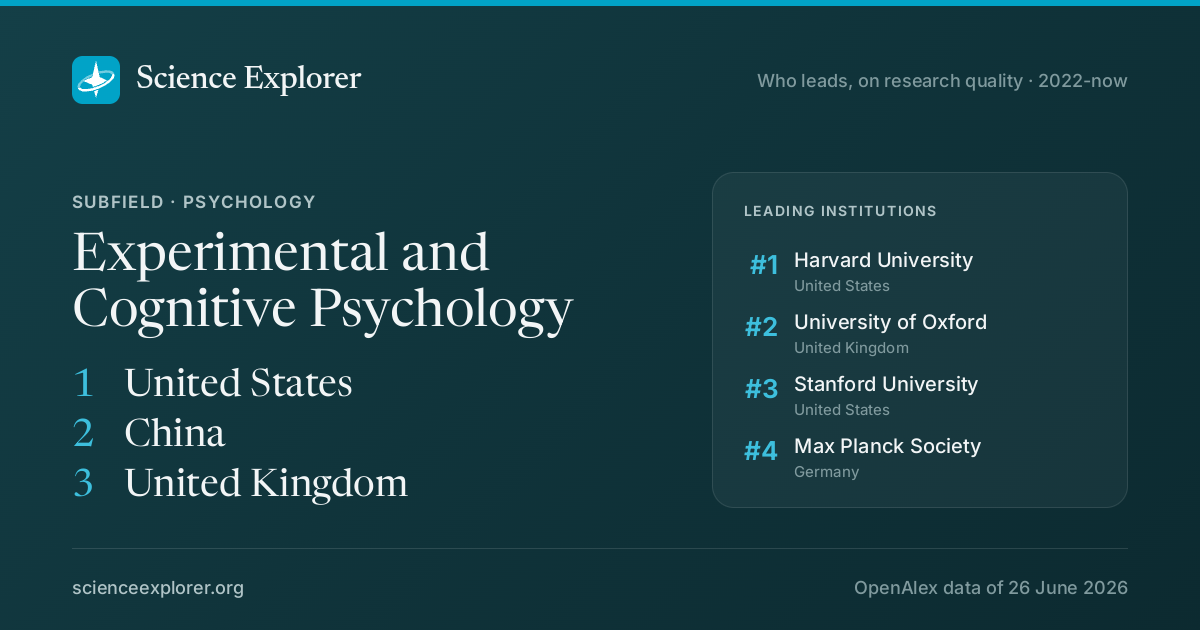
On research quality in 2022-now, the United States, China and the United Kingdom rank highest in Experimental and Cognitive Psychology. By volume, the United States and China publish the most (25k and 17k works in 2022-now).
By research quality, 2022-now
- 1
United States #1 all time
0.95× citation excellence · 1.52× journals · 100% breadth
10.4% top 10% · 21k works
- 2
 China #5 all time
1.27× citation excellence · 0.90× journals · 100% breadth
14.1% top 10% · 14k works
- 3
 United Kingdom #2 all time
1.25× citation excellence · 1.49× journals · 100% breadth
13.4% top 10% · 5.3k works
- 4
 Germany #3 all time
1.29× citation excellence · 1.43× journals · 100% breadth
11.9% top 10% · 4.7k works
- 5
 Netherlands #4 all time
1.41× citation excellence · 1.47× journals · 100% breadth
14.7% top 10% · 1.9k works
- 6
 Australia #7 all time
1.33× citation excellence · 1.16× journals · 100% breadth
14.9% top 10% · 2.7k works
- 7
 Switzerland #8 all time
1.32× citation excellence · 1.87× journals · 100% breadth
13.7% top 10% · 974 works
- 8
 France #6 all time
0.98× citation excellence · 1.33× journals · 100% breadth
8.6% top 10% · 2.7k works
- 9
 Canada #9 all time
1.00× citation excellence · 1.11× journals · 100% breadth
11.0% top 10% · 3k works
- 10
 Spain #10 all time
1.10× citation excellence · 0.93× journals · 100% breadth
10.1% top 10% · 2.5k works
The track on each row is that row's top-10% rate. The ranking itself is the quality score, which compares the rate with what each place's own topics predict, adds its share of papers in the Nature Index journals, and counts output and breadth too.
Of 55 countries ranked in Experimental and Cognitive Psychology. Ranked on the quality score for 2022-now; the bracket is the all-time rank.
All countries ranked in Experimental and Cognitive PsychologyBy volume, 2022-now
- 1
United States
25k works
- 2
China
17k works
- 3
United Kingdom
6.2k works
- 4
 India
6.1k works
- 5
Germany
5.5k works
- 6
 Brazil
3.7k works
- 7
 Japan
3.6k works
- 8
Canada
3.5k works
- 9
Australia
3.2k works
- 10
France
3.2k works
How concentrated that is
The same countries as shares of everything the list above accounts for. A node where two countries do two thirds of the work and one spread evenly across twelve read alike as a ranking and not at all alike here.
Shares of the rows listed above, not of the whole node.
Which institutions lead Experimental and Cognitive Psychology research?
Harvard University (United States) ranks first in Experimental and Cognitive Psychology on research quality in 2022-now, followed by University of Oxford and Stanford University.
By research quality, 2022-now
- 1
Harvard University United States · Cambridge · #1 all time
15.0% top 10% · 562 works
- 2
University of Oxford United Kingdom · Oxford · #3 all time
15.7% top 10% · 301 works
- 3
Stanford University United States · Stanford · #2 all time
14.8% top 10% · 267 works
- 4
Max Planck Society Germany · Munich · #8 all time
21.3% top 10% · 170 works
- 5
University College London United Kingdom · London · #4 all time
16.5% top 10% · 329 works
- 6
University of Cambridge United Kingdom · Cambridge · #9 all time
13.2% top 10% · 217 works
- 7
Peking University China · Beijing · #64 all time
15.6% top 10% · 264 works
- 8
Yale University United States · New Haven · #5 all time
11.4% top 10% · 248 works
- 9
Radboud University Nijmegen Netherlands · Nijmegen · #19 all time
17.0% top 10% · 195 works
- 10
University of Amsterdam Netherlands · Amsterdam · #32 all time
16.9% top 10% · 194 works








The track on each row is that row's top-10% rate. The ranking itself is the quality score, which compares the rate with what each place's own topics predict, adds its share of papers in the Nature Index journals, and counts output and breadth too.
Of 321 institutions above the floor of 40 fractional works in Experimental and Cognitive Psychology.
Top 100 Experimental and Cognitive Psychology institutionsBy volume, 2022-now
- 1
Centre National de la Recherche ScientifiqueFrance
876 works
- 2
Harvard UniversityUnited States
649 works
- 3
University of TorontoCanada
445 works
- 4
University College LondonUnited Kingdom
374 works
- 5
University of OxfordUnited Kingdom
360 works
- 6
Stanford UniversityUnited States
316 works
- 7
Pennsylvania State UniversityUnited States
314 works
- 8
Russian Academy of Sciences
 Russia
314 works
- 9
University of North Carolina at Chapel HillUnited States
313 works
- 10
Beijing Normal UniversityChina
312 works

Who are the leading researchers in Experimental and Cognitive Psychology?
Counting only their work in Experimental and Cognitive Psychology, Susan S Redline, James Jonathan Gross and Pim Cuijpers have the most papers in the world top 10% for their subfield and year beyond the 10% expected.
- 1
Susan S Redline
United States · #6,716 worldwide overall
91.1 of 239 papers here in the top 10%
- 2
James Jonathan Gross
United States · #337 worldwide overall
74.5 of 144 papers here in the top 10%
- 3
Pim Cuijpers
Netherlands · #1,053 worldwide overall
62.4 of 127 papers here in the top 10%
- 4
Charles M. Morin
Canada · #24,201 worldwide overall
58.1 of 167 papers here in the top 10%
- 5
Daniel J. Buysse
United States · #38,596 worldwide overall
62.1 of 219 papers here in the top 10%
- 6
Herbert W. Marsh
Australia · #23,107 worldwide overall
61.8 of 134 papers here in the top 10%
- 7
Richard E. Mayer
United States · #5,248 worldwide overall
47.8 of 106 papers here in the top 10%
- 8
Richard J. Davidson
United States · #9,333 worldwide overall
43.8 of 84 papers here in the top 10%
- 9
Brenda W.J.H. Penninx
Netherlands · #2,624 worldwide overall
49.5 of 144 papers here in the top 10%
- 10
Charles J. Spence
United Kingdom · #146,262 worldwide overall
78.3 of 305 papers here in the top 10%
Ranked on their work in Experimental and Cognitive Psychology alone: how many more of their papers here reached the world top 10% for their subfield and year than the 10% expected, among 913,890 ranked researchers with a paper here. Each paper counts once, so many strong papers outrank one famous one, and a long record of ordinary papers does not climb. Identities come from OpenAlex author disambiguation, which occasionally merges or splits people.
Top 100 Experimental and Cognitive Psychology researchersWhere is Experimental and Cognitive Psychology research done?
The largest centres of Experimental and Cognitive Psychology research in 2022-now are Beijing (China), London (United Kingdom), Shanghai (China) and Tokyo (Japan). Among places with at least 20 works in it, it is an unusually large share of all research in Stoneham.
Largest cities, 2022-now

Where it is the local speciality
- StonehamUS · 26.3 works39×
Location quotient: how much more of its research is in Experimental and Cognitive Psychology than the world average.
Experimental and Cognitive Psychology research by country
The best places for Experimental and Cognitive Psychology research inside each country, with that country's researchers and world standing.
 Sweden
 Italy
 Israel
 Singapore
 Austria
 Norway
 Finland
 Belgium
 Denmark
 Taiwan
 New Zealand
 Ireland
 Poland
 Portugal
 Czechia
 Hungary
 Saudi Arabia
 Greece
 Argentina
 Mexico
 Türkiye
 Iran
 Malaysia
 Croatia
Where is the best place to study Experimental and Cognitive Psychology?
Among universities, judged by research, Harvard University, Stanford University and University of Oxford score highest, combining standing in the field's ranking, citation excellence, specialisation, size, growth and international reach. Research strength is one signal when choosing where to study; it does not measure teaching.
One dot per university in the first ten of the table below, at the default weights. The upper left is the interesting corner: small places doing unusually strong work.
























Universities only. The score blends standing (50%), citation excellence (20%), size (15%), specialisation (5%), growth (5%), international reach (5%), 2022-now; growth compares 2018-21 with 2022-25 and counts up to +20%, since a jump from a small base is mostly noise. Standing is the score in this field's institution ranking, three quarters over all time and a quarter 2022-now; excellence averages the two windows too. Four years alone undercount fields such as AI, where many conference and arXiv papers from 2022 on carry no affiliation in the data.
Every institution in Experimental and Cognitive Psychology, country by countryIs Experimental and Cognitive Psychology research growing?
Output in 2022-2025 was 23% higher than in 2018-2021, peaking in 2025. The fastest-growing topics are Emotion and Mood Recognition, Sound Studies and Aurality and Psychological and Educational Research Studies.
The same series as a ribbon: one cell per year, darker for more. The line above answers how much; this answers when.
Its share of all research
Growing output can still be a shrinking share: all of science grows. This is Experimental and Cognitive Psychology as a percentage of every work published that year, 0.46% in 2024.
Fractional works of Experimental and Cognitive Psychology over all fractional works that year. How the balance of science has shifted.
How much of it reaches the world top 10%
Year by year.
Of each year's works in it, the share that reached the world's 10% most cited for their field and year. A field is the world for its own topics, so there is no other line to hold it against.
Which topics inside it are moving
Growth and decline on one axis around a shared zero. Two lists side by side hide the thing that matters: whether the growth dwarfs the decline, or the other way round.
- Emotion and Mood Recognition+132%
- Sound Studies and Aurality+114%
- Psychological and Educational Research Studies+49%
- Sleep and Work-Related Fatigue+40%
- Sleep and related disorders+39%
- Education, Achievement, and Giftedness+35%
- Multisensory perception and integration-2%
- Philosophy and Theoretical Science-3%
- Evolutionary Psychology and Human Behavior-6%
- Psychology Research and Bibliometrics-18%
Growth in output from 2018-21 to 2022-25. Every topic is a page of its own.
What does Experimental and Cognitive Psychology include?
Area is fractional works in that topic. Every name below is a page of its own.
- Phonetics and Phonology Research
- Language, Metaphor, and Cognition
- Diversity and Impact of Dance
- Sleep and related disorders
- Philosophy and Theoretical Science
- Creativity in Education and Neuroscience
- Mental Health Research Topics
- Evolutionary Psychology and Human Behavior
- Phenomenology and Existential Philosophy
- Cognitive Abilities and Testing
- Anxiety, Depression, Psychometrics, Treatment, Cognitive Processes
- Emotion and Mood Recognition
- Sleep and Work-Related Fatigue
- Education, Achievement, and Giftedness
- Psychology Research and Bibliometrics
- Multisensory perception and integration
- Categorization, perception, and language
- Visual and Cognitive Learning Processes
- Sound Studies and Aurality
- Psychological and Temporal Perspectives Research
- Psychological and Educational Research Studies
- Cognitive Functions and Memory
- Memory, Trauma, and Testimony
- Diverse Academia and Research Topics
Share who leads Experimental and Cognitive Psychology
The leading institutions' badges6Each links to that institution's page and updates with every snapshot


Discussion
Ask a question or share a note about Experimental and Cognitive Psychology. Keep it to the research: no personal attacks, advertising or links. Any reader can report a post, which collapses it for everyone until it is opened.