Lancaster University

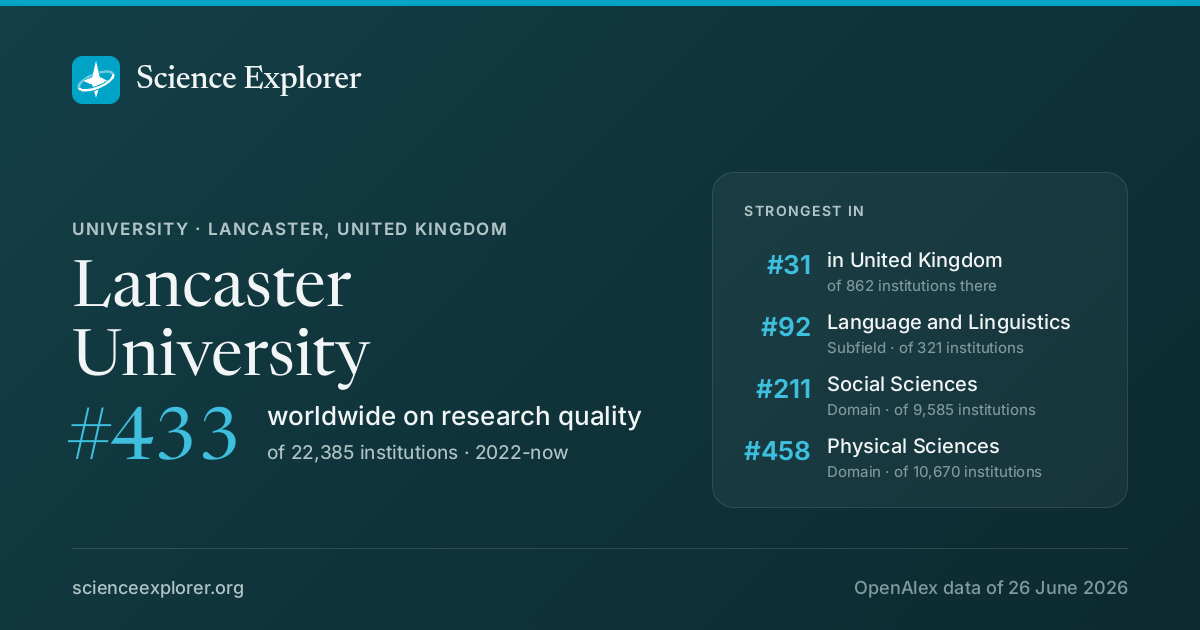
In research, Lancaster University stands highest in Social Sciences (#211 of 9,585 worldwide), Social Sciences (#234 of 5,988 worldwide) and Physical Sciences (#458 of 10,670 worldwide), 2022-now. Relative to its size it is most specialised in Human-Computer Interaction, History and Philosophy of Science and Finance (Human-Computer Interaction is 6.0× its share of world research).
- World rank, 2022-now
- #433 of 22,385 · #372 all time
- Rank in United Kingdom
- #31 of 862
- Research works
- 38k ▼ 4% vs 2018-21
- Citations
- 1.2M 30.7 per fractional work
- Top-10% rate
- 13.8% all institutions 10.0%
- vs its own fields
- 1.17× 1.00× is exactly expected
- Open access
- 40% world 40%
- International
- 25% world 18%
What is Lancaster University known for in research?
The fields where it stands highest, 2022-now, ranked among every institution above the floor in each field.
| Field | World rank | Where that sits | Top-10% rate | Works | All time |
|---|---|---|---|---|---|
| Social SciencesDomain | #211 of 9,585 | 14.9% | 2,475 | #138 | |
| Social SciencesField | #234 of 5,988 | 15.6% | 1,141 | #117 | |
| Physical SciencesDomain | #458 of 10,670 | 12.8% | 2,020 | #402 | |
| Computer ScienceField | #309 of 4,417 | 13.7% | 532 | #219 | |
| Health SciencesDomain | #719 of 9,902 | 16.1% | 592 | #697 | |
| EngineeringField | #534 of 5,901 | 13.4% | 566 | #455 | |
| PsychologyField | #194 of 2,121 | 14.4% | 338 | #202 | |
| MedicineField | #816 of 8,541 | 15.7% | 404 | #783 | |
| Sociology and Political ScienceSubfield | #244 of 2,526 | 15.6% | 392 | #116 | |
| Business, Management and AccountingField | #293 of 2,581 | 18.6% | 251 | #89 |
Each strip is that field's whole ranked pool, with the notch where Lancaster University sits in it, in the colour of the band that rank falls in. The track under the rate is the rate itself: it carries no average mark, because the average differs by field (from about 6% in Dentistry to 21% in Economics).
Which of those standings moved
The same fields on both windows: where it stood over the whole record, and where it stands in 2022-now. The distance is the story, and it is the one thing the two rank columns above cannot show.
- Social Sciences#138 #211
- Social Sciences#117 #234
- Physical Sciences#402 #458
- Computer Science#219 #309
- Health Sciences#697 #719
- Engineering#455 #534
- Psychology#202 #194
- Medicine#783 #816
- Sociology and Political Science#116 #244
- Business, Management and Accounting#89 #293
A dot further right is a better standing. Fields it was not ranked in over the whole record are left out.
Which fields of science does Lancaster University work in?
In 2022-now, 45% of research at Lancaster University is in Social Sciences, 37% in Physical Sciences. Its largest fields are Social Sciences (21%), Engineering (10%), Computer Science (10%). It does 1.8× the world's share of Social Sciences.
Each ring splits the one inside it: the four domains of science, their fields, their subfields. Size is fractional works in 2022-now. Every slice is a page; the interactive view zooms down to single topics and colours each by how much more of it this institution does than the world.
Its 4 domains and 26 fields, with their numbers
- Social Sciences2,78645.1%
- Social Sciences1,29721.0%
- Arts and Humanities4467.2%
- Psychology3836.2%
- Business, Management and Accounting2724.4%
- Economics, Econometrics and Finance2554.1%
- Decision Sciences1332.1%
- Physical Sciences2,28937.0%
- Engineering62910.2%
- Computer Science6049.8%
- Environmental Science3846.2%
- Physics and Astronomy2113.4%
- Mathematics1382.2%
- Materials Science1091.8%
- Earth and Planetary Sciences891.4%
- Chemistry651.0%
- Energy470.8%
- Chemical Engineering130.2%
- Health Sciences70511.4%
- Medicine4827.8%
- Health Professions2043.3%
- Nursing90.1%
- Dentistry60.1%
- Veterinary40.1%
- Life Sciences4036.5%
What does Lancaster University specialise in?
Where its research is concentrated relative to its size: Human-Computer Interaction takes 6.0× the share of its output that it takes of world research.
- Human-Computer InteractionSubfield · 76.1 works6.0×
- History and Philosophy of ScienceSubfield · 37.1 works3.9×
- FinanceSubfield · 67.7 works3.6×
Location quotient, a volume reading rather than an impact one. It surfaces small, lopsided specialities.
Field profile
Location quotient across every field it publishes in: outside the ring is more than an institution of this size would be expected to publish, inside it is less.
Rings at 0.5×, 1× and 2×. Widest outward: Arts and Humanities, 2.5×. Every wedge is a field page.
All 26 fields, with their numbers
- Arts and Humanities2.50×446 works
- Decision Sciences2.22×133 works
- Psychology2.03×383 works
- Economics, Econometrics and Finance1.92×255 works
- Mathematics1.89×138 works
- Social Sciences1.66×1,297 works
- Physics and Astronomy1.53×211 works
- Business, Management and Accounting1.37×272 works
- Computer Science1.26×604 works
- Environmental Science1.25×384 works
- Health Professions1.25×204 works
- Neuroscience1.11×111 works
- Earth and Planetary Sciences0.92×89 works
- Energy0.84×48 works
- Engineering0.68×629 works
- Chemistry0.67×65 works
- Chemical Engineering0.60×13 works
- Agricultural and Biological Sciences0.53×156 works
- Veterinary0.51×4 works
- Materials Science0.50×109 works
- Medicine0.41×482 works
- Biochemistry, Genetics and Molecular Biology0.34×111 works
- Immunology and Microbiology0.33×21 works
- Nursing0.30×9 works
- Pharmacology, Toxicology and Pharmaceutics0.20×4 works
- Dentistry0.19×6 works
- Arts and Humanities 2.5×
- Decision Sciences 2.2×
- Psychology 2.0×
- Economics, Econometrics and Finance 1.9×
- Mathematics 1.9×
- Social Sciences 1.7×
- Physics and Astronomy 1.5×
- Business, Management and Accounting 1.4×
- Computer Science 1.3×
- Environmental Science 1.2×
- Health Professions 1.2×
- Neuroscience 1.1×
- Earth and Planetary Sciences 0.9×
- Energy 0.8×
- Engineering 0.7×
- Chemistry 0.7×
- Chemical Engineering 0.6×
- Agricultural and Biological Sciences 0.5×
- Veterinary 0.5×
- Materials Science 0.5×
- Medicine 0.4×
- Biochemistry, Genetics and Molecular Biology 0.3×
- Immunology and Microbiology 0.3×
- Nursing 0.3×
- Pharmacology, Toxicology and Pharmaceutics 0.2×
- Dentistry 0.2×
Who are the top researchers at Lancaster University?
Ranked on the quality score, Richard D. Bardgett, Nicholas A. J. Graham and Jos Barlow lead among researchers whose main affiliation is Lancaster University.
- 1
Richard D. Bardgett
 United Kingdom · #1,921 worldwide
88k citations · 621 works
- 2
Nicholas A. J. Graham
United Kingdom · #3,034 worldwide
35k citations · 359 works
- 3
Jos Barlow
United Kingdom · #4,661 worldwide
34k citations · 468 works
- 4
Christina Chemtai Hicks
United Kingdom · #5,774 worldwide
13k citations · 156 works
- 5
Érika Berenguer
United Kingdom · #6,493 worldwide
12k citations · 202 works
- 6
Alfredo De Massis
United Kingdom · #12,761 worldwide
21k citations · 487 works
- 7
Carly J. Stevens
United Kingdom · #20,052 worldwide
20k citations · 351 works
- 8
Andrew Sayer
United Kingdom · #35,528 worldwide
18k citations · 373 works
- 9
Sarah L Jack
United Kingdom · #36,504 worldwide
9.9k citations · 193 works
- 10
John Easton Law
United Kingdom · #38,924 worldwide
36k citations · 231 works
Which keywords describe research at Lancaster University?
By fractional works in 2022-now, weighted toward what it does more of than the world: Globalization, Climate Change, Gender, Social Interaction, Neoliberalism, Machine Learning, Sustainability and Identity.
- Academic Writing
- Design Research
- Health Behavior Change
- Aesthetics
- Participatory Design
- Politics
- Corpus Linguistics
- Feminism
- Higher Education
- Corporate Governance
- Colonialism
- Big Data
- History
- Human Rights
- Social Interaction
- Identity
- Gender
- Mental Health
- Deep Learning
- Climate Change
- Globalization
- Machine Learning
- Sustainability
- Public Health
- Social Media
- Neural Networks
- Neoliberalism
- Ethics
- Literature
- Economic Growth
- Nationalism
- Social Capital
- Ethical Considerations
- Embodiment
- Emotion
- Monetary Policy
- User Experience
- Language Development
- Neural Basis
- Interaction Design
Size is fractional works in 2022-now in the topics tagged with each word; colour is the word's share of this institution's work against its share of the world's. The 40 words are chosen for being large and distinctive. Each links to the topic it comes from most.
All 40 words, with their numbers
- Globalization271▲ 2.2×114 topics
- Climate Change257▲ 1.53×10⁴ topics
- Machine Learning215◆ 1.05×81 topics
- Deep Learning194◆ 0.91×75 topics
- Sustainability186▲ 1.23×95 topics
- Mental Health138▲ 1.56×40 topics
- Public Health135▲ 1.49×61 topics
- Gender120▲ 3.6×51 topics
- Social Media118▲ 1.38×33 topics
- Identity110▲ 2.5×57 topics
- Neural Networks105◆ 1.10×37 topics
- Social Interaction104▲ 4.3×11 topics
- Neoliberalism100▲ 4.5×26 topics
- Human Rights96▲ 1.52×58 topics
- Ethics92▲ 2.9×40 topics
- History90▲ 2.1×45 topics
- Literature88▲ 2.6×42 topics
- Big Data84▲ 1.42×26 topics
- Economic Growth83▲ 1.64×28 topics
- Colonialism82▲ 2.8×44 topics
- Nationalism79▲ 2.9×29 topics
- Corporate Governance75▲ 1.65×21 topics
- Social Capital74▲ 2.3×18 topics
- Higher Education73▲ 2.2×23 topics
- Ethical Considerations71▲ 3.3×19 topics
- Feminism66▲ 3.6×22 topics
- Embodiment64▲ 5.5×7 topics
- Corpus Linguistics59▲ 4.5×5 topics
- Emotion55▲ 4.3×12 topics
- Politics54▲ 3.4×18 topics
- Monetary Policy54▲ 3.7×9 topics
- Participatory Design48▲ 15×2 topics
- User Experience47▲ 9.1×3 topics
- Aesthetics43▲ 8.9×8 topics
- Language Development42▲ 5.5×6 topics
- Health Behavior Change42▲ 13×2 topics
- Neural Basis40▲ 7.2×4 topics
- Design Research35▲ 20×1 topic
- Interaction Design35▲ 20×1 topic
- Academic Writing35▲ 15×2 topics
Which research topics does Lancaster University publish most on?
By volume in 2022-now: Innovative Human-Technology Interaction, Language, Metaphor, and Cognition, Discourse Analysis in Language Studies and Language, Discourse, Communication Strategies.
Area is fractional works; colour is the subfield each topic belongs to.
- 1 Innovative Human-Technology Interaction Human-Computer Interaction 35 works
- 2 Language, Metaphor, and Cognition Experimental and Cognitive Psychology 31 works
- 3 Discourse Analysis in Language Studies Literature and Literary Theory 24 works
- 4 Language, Discourse, Communication Strategies Language and Linguistics 23 works
- 5 Palliative Care and End-of-Life Issues Public Health, Environmental and Occupational Health 21 works
- 6 Gender, Feminism, and Media Gender Studies 19 works
- 7 Ethics and Social Impacts of AI Safety Research 18 works
- 8 EFL/ESL Teaching and Learning Language and Linguistics 18 works
- 9 Employment and Welfare Studies General Health Professions 17 works
- 10 Entrepreneurship Studies and Influences Management of Technology and Innovation 16 works
How open and international is its research?
Against the world's own shares: the tick on each track. Both are shares of its output, so they sit on one scale and can be read against each other as well as against the world.
World: 40% of research is openly available.
World: 18% is written across borders.
How has Lancaster University's research output changed?
Output in 2022-2025 was 4% lower than in 2018-2021.
The same series as a ribbon: one cell per year, darker for more. The line above answers how much; this answers when.
Its share of all research
Growing output can still be a shrinking share: all of science grows. This is Lancaster University as a percentage of every work published that year, 0.026% in 2024.
Fractional works of Lancaster University over all fractional works that year. How the balance of science has shifted.
How much of it reaches the world top 10%
Year by year, against all institutions in the same year.
Of each year's output, the share that reached the world's 10% most cited for its field and year. Peak 20.6% in 2005.
Other research institutions in Lancaster
- Royal Lancaster Infirmary
- Lancaster City Council
- Myerscough College
- Ridge Lea Hospital
- Lancaster Royal Grammar School
- Hybrid Instruments (United Kingdom)
- HW Communications (United Kingdom)
- Lancaster and Morecambe College

Compare Lancaster University with
- vs
 Griffith University
- vs
 University of Turku
- vs University of Leicester
- vs
 Brandeis University
- vs
 China University of Mining and Technology
- vs
 Universitat Rovira i Virgili
Share Lancaster University's ranking



Research measures only: rankings here say nothing about teaching, admissions or student experience. Comparable institutions and collaboration partners have tabs of their own, above.
Discussion
Ask a question or share a note about Lancaster University. Posts are plain text and can be reported.