Soil Science research
Soil Science is a subfield of Agricultural and Biological Sciences. Science Explorer counts 266k research works in it since 1950. 10.1% of them reached the world's top 10% most cited for their field and year.
In short: study of soil as a natural resource on the surface of the earth.
- Research works
- 266k fractional, since 1950
- In the world top 10%
- 27k per year above
- Top-10% rate
- 10.1% share of its works in the world top 10%
- Topics
- 12
- Growth, 2018-21 → 2022-25
- +17% the tick is no change
- Largest producer
 China
27% of the 10 largest, 2022-now
What is Soil Science research about, and what is growing?
By the world's output in 2021-25, its most used keywords are Soil Fertility, Microbial Communities, Sustainable Agriculture, Composting, Nitrogen Cycle, Soil Carbon Sequestration. Gaining share since 2011-15: Organic Farming, Plant Nutrition, Composting, Paleosols, Soil Evolution. Losing share: No-till Crop Production, Soil Compaction, Soil Quality, Land Tenure.
- Water Productivity
- Shilajit
- Property Rights
- Organic Waste
- Soil Evolution
- Soil Compaction
- Desertification
- Organic Manure
- Water Use Efficiency
- Vulnerability
- Soil Erosion
- Crop Productivity
- Organic Farming
- Soil Carbon Sequestration
- Composting
- Microbial Communities
- Soil Fertility
- Sustainable Agriculture
- Nitrogen Cycle
- Soil Degradation
- Plant Nutrition
- Agricultural Sustainability
- Risk Management
- Deficit Irrigation
- Integrated Nutrient Management
- Soil Quality
- No-till Crop Production
- Paleosols
- Maturity Assessment
- Land Tenure
- Humic Substances
- Conservation Agriculture
Size is the world's fractional works in 2021-25 in the topics tagged with each word; colour compares the word's share of this field with 2011-15. Each links to the topic it comes from most.
All 32 words, with their numbers
- Soil Fertility37k▲ 1.25×3 topics
- Microbial Communities22k◆ 1.03×2 topics
- Sustainable Agriculture20k▲ 1.82×2 topics
- Composting19k▲ 1.90×2 topics
- Nitrogen Cycle17k◆ 0.91×1 topic
- Soil Carbon Sequestration17k◆ 0.91×1 topic
- Soil Degradation15k▼ 0.66×2 topics
- Organic Farming14k▲ 2.3×1 topic
- Plant Nutrition14k▲ 2.3×1 topic
- Crop Productivity12k◆ 1.00×2 topics
- Agricultural Sustainability11k▼ 0.77×1 topic
- Soil Erosion11k▼ 0.77×1 topic
- Risk Management7,802◆ 1.12×1 topic
- Vulnerability7,802◆ 1.12×1 topic
- Deficit Irrigation6,648◆ 0.88×1 topic
- Water Use Efficiency6,648◆ 0.88×1 topic
- Integrated Nutrient Management5,827▲ 1.19×1 topic
- Organic Manure5,827▲ 1.19×1 topic
- Soil Quality5,579▼ 0.52×2 topics
- Desertification5,538▲ 1.48×2 topics
- No-till Crop Production4,713▼ 0.50×1 topic
- Soil Compaction4,713▼ 0.50×1 topic
- Paleosols4,672▲ 1.90×1 topic
- Soil Evolution4,672▲ 1.90×1 topic
- Maturity Assessment4,347▲ 1.19×1 topic
- Organic Waste4,347▲ 1.19×1 topic
- Land Tenure3,486▼ 0.58×1 topic
- Property Rights3,486▼ 0.58×1 topic
- Humic Substances1,347▲ 1.64×1 topic
- Shilajit1,347▲ 1.64×1 topic
- Conservation Agriculture866▼ 0.68×1 topic
- Water Productivity866▼ 0.68×1 topic
Which countries lead Soil Science research?
On research quality in 2022-now, China, the United States and Germany rank highest in Soil Science. By volume, China and Indonesia publish the most (14k and 12k works in 2022-now).
By research quality, 2022-now
- 1
China #1 all time
1.43× citation excellence · 1.12× journals · 100% breadth
17.2% top 10% · 12k works
- 2
 United States #2 all time
0.96× citation excellence · 1.58× journals · 100% breadth
10.8% top 10% · 4.4k works
- 3
 Germany #3 all time
1.30× citation excellence · 1.39× journals · 100% breadth
14.7% top 10% · 975 works
- 4
 United Kingdom #4 all time
1.16× citation excellence · 1.45× journals · 100% breadth
12.8% top 10% · 851 works
- 5
 Australia #5 all time
1.29× citation excellence · 1.20× journals · 100% breadth
14.4% top 10% · 785 works
- 6
 France #7 all time
1.03× citation excellence · 1.26× journals · 100% breadth
9.2% top 10% · 850 works
- 7
 Netherlands #8 all time
1.52× citation excellence · 1.45× journals · 100% breadth
17.1% top 10% · 309 works
- 8
 Switzerland #9 all time
1.43× citation excellence · 1.87× journals · 100% breadth
16.7% top 10% · 213 works
- 9
 Spain #6 all time
1.19× citation excellence · 1.00× journals · 100% breadth
10.9% top 10% · 764 works
- 10
 India #11 all time
0.60× citation excellence · 0.43× journals · 100% breadth
6.3% top 10% · 7.7k works
The track on each row is that row's top-10% rate. The ranking itself is the quality score, which compares the rate with what each place's own topics predict, adds its share of papers in the Nature Index journals, and counts output and breadth too.
Of 42 countries ranked in Soil Science. Ranked on the quality score for 2022-now; the bracket is the all-time rank.
All countries ranked in Soil ScienceBy volume, 2022-now
- 1
China
14k works
- 2
 Indonesia
12k works
- 3
India
8.9k works
- 4
United States
5.1k works
- 5
 Brazil
3.9k works
- 6
 Russia
2.6k works
- 7
Germany
1.2k works
- 8
 Nigeria
1.2k works
- 9
 Ethiopia
1k works
- 10
United Kingdom
996 works
How concentrated that is
The same countries as shares of everything the list above accounts for. A node where two countries do two thirds of the work and one spread evenly across twelve read alike as a ranking and not at all alike here.
Shares of the rows listed above, not of the whole node.
Which institutions lead Soil Science research?
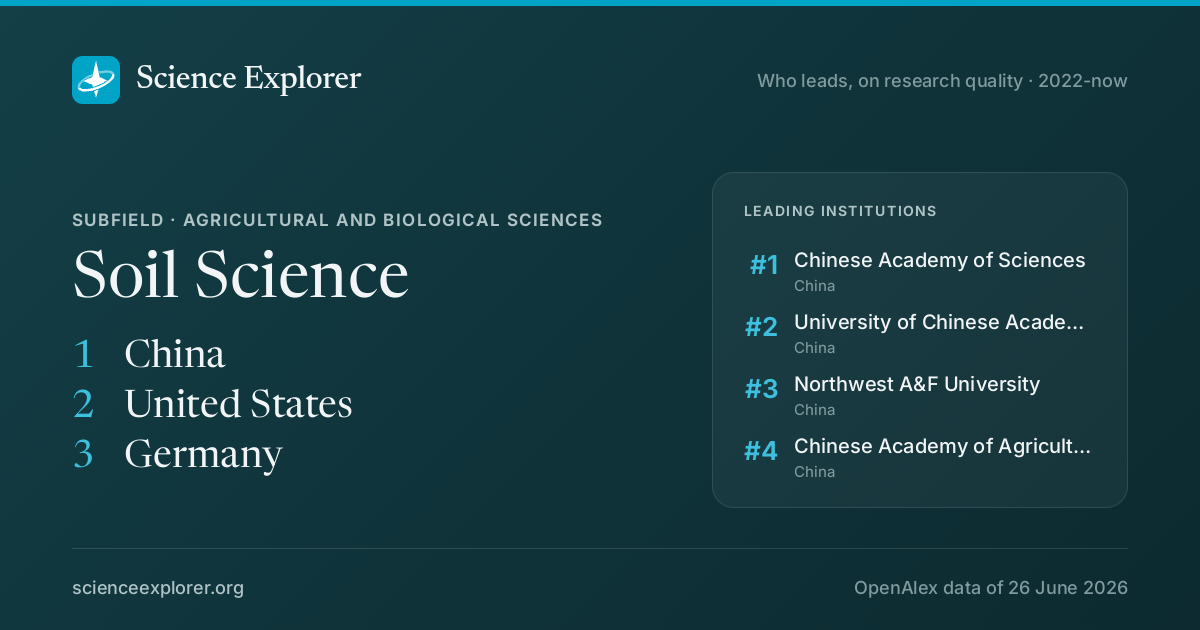
Chinese Academy of Sciences (China) ranks first in Soil Science on research quality in 2022-now, followed by University of Chinese Academy of Sciences and Northwest A&F University.
By research quality, 2022-now
- 1
Chinese Academy of Sciences China · Beijing · #1 all time
18.6% top 10% · 1.5k works
- 2
University of Chinese Academy of Sciences China · Beijing · #2 all time
20.8% top 10% · 272 works
- 3
Northwest A&F University China · Yangling · #3 all time
25.9% top 10% · 356 works
- 4
Chinese Academy of Agricultural Sciences China · Beijing · #7 all time
19.1% top 10% · 767 works
- 5
China Agricultural University China · Beijing · #4 all time
23.1% top 10% · 290 works
- 6
Beijing Normal University China · Beijing · #11 all time
22.9% top 10% · 137 works
- 7
Zhejiang University China · Hangzhou · #16 all time
26.9% top 10% · 108 works
- 8
Cornell University United States · Ithaca · #8 all time
16.1% top 10% · 62 works
- 9
Lanzhou University China · Lanzhou · #30 all time
16.3% top 10% · 126 works
- 10
Wageningen University & Research Netherlands · Wageningen · #6 all time
17.9% top 10% · 107 works
The track on each row is that row's top-10% rate. The ranking itself is the quality score, which compares the rate with what each place's own topics predict, adds its share of papers in the Nature Index journals, and counts output and breadth too.
Of 144 institutions above the floor of 40 fractional works in Soil Science.
Top 100 Soil Science institutionsBy volume, 2022-now
- 1
Chinese Academy of SciencesChina
1.7k works
- 2
Indian Council of Agricultural ResearchIndia
1k works
- 3
Chinese Academy of Agricultural SciencesChina
920 works
- 4
Russian Academy of SciencesRussia
879 works
- 5
Northwest A&F UniversityChina
394 works
- 6
University of MataramIndonesia
352 works
- 7
China Agricultural UniversityChina
344 works
- 8
IPB UniversityIndonesia
327 works
- 9
Ministry of Agriculture and Rural AffairsChina
323 works
- 10
University of Chinese Academy of SciencesChina
319 works

Who are the leading researchers in Soil Science?
Counting only their work in Soil Science, Yakov V. Kuzyakov, Rattan Lal and Johan Six have the most papers in the world top 10% for their subfield and year beyond the 10% expected.
- 1
Yakov V. Kuzyakov
Germany · #1,822 worldwide overall
158.2 of 342 papers here in the top 10%
- 2
Rattan Lal
United States · #7,095 worldwide overall
117.1 of 319 papers here in the top 10%
- 3
Johan Six
Switzerland · #6,905 worldwide overall
71.4 of 160 papers here in the top 10%
- 4
Josep Peñuelas
Spain · #1,488 worldwide overall
64.0 of 141 papers here in the top 10%
- 5
Yiqi Luo
United States · #2,208 worldwide overall
58.9 of 107 papers here in the top 10%
- 6
Pete Smith
United Kingdom · #10,189 worldwide overall
59.9 of 149 papers here in the top 10%
- 7
Fusuo S. Zhang
China · #2,111 worldwide overall
53.3 of 112 papers here in the top 10%
- 8
Zimin Wei
China · #22,147 worldwide overall
50.1 of 86 papers here in the top 10%
- 9
Manuel Delgado‐Baquerizo
Spain · #190 worldwide overall
49.6 of 83 papers here in the top 10%
- 10
Davey L. Jones
United Kingdom · #21,896 worldwide overall
55.9 of 147 papers here in the top 10%
Ranked on their work in Soil Science alone: how many more of their papers here reached the world top 10% for their subfield and year than the 10% expected, among 569,027 ranked researchers with a paper here. Each paper counts once, so many strong papers outrank one famous one, and a long record of ordinary papers does not climb. Identities come from OpenAlex author disambiguation, which occasionally merges or splits people.
Top 100 Soil Science researchersWhere is Soil Science research done?
The largest centres of Soil Science research in 2022-now are Beijing (China), Nanjing (China), Moscow (Russia) and Jakarta (Indonesia). Among places with at least 20 works in it, it is an unusually large share of all research in Yangling, Jobner and Rāhuri.
Largest cities, 2022-now
Where it is the local speciality
- YanglingCN · 190.2 works61×
- JobnerIN · 37.9 works38×
- RāhuriIN · 68.4 works31×
- PālanpurIN · 36.5 works29×
- HarpendenGB · 38.7 works26×
- SabaurIN · 49.7 works25×
- KrishnanagarIN · 75.9 works24×
Location quotient: how much more of its research is in Soil Science than the world average.
Soil Science research by country
The best places for Soil Science research inside each country, with that country's researchers and world standing.
 Canada
 Italy
 Bangladesh
 Argentina
 Iran
 Egypt
 Nepal
 Iraq
Where is the best place to study Soil Science?
Among universities, judged by research, Northwest A&F University, University of Chinese Academy of Sciences and China Agricultural University score highest, combining standing in the field's ranking, citation excellence, specialisation, size, growth and international reach. Research strength is one signal when choosing where to study; it does not measure teaching.
One dot per university in the first ten of the table below, at the default weights. The upper left is the interesting corner: small places doing unusually strong work.
| # | University | Score | Rank in field (all time) | Top 10% | Specialisation | Works | Growth |
|---|---|---|---|---|---|---|---|
| 1 | Northwest A&F UniversityChina |
89.9 | #3 (#3) | 25.1% | 16.4× | 394 | +23.1% |
| 2 | University of Chinese Academy of SciencesChina |
86.3 | #2 (#2) | 19.5% | 3.1× | 318 | +19.5% |
| 3 | China Agricultural UniversityChina |
83.1 | #5 (#4) | 22.1% | 10.0× | 344 | +34.1% |
| 4 | Beijing Normal UniversityChina |
69.5 | #6 (#11) | 21.9% | 3.2× | 158 | +16.9% |
| 5 | Wageningen University & ResearchNetherlands |
68.2 | #10 (#6) | 17.4% | 5.6× | 126 | -13.2% |
| 6 | Zhejiang UniversityChina |
64.8 | #7 (#16) | 25.1% | 0.7× | 124 | +30.3% |
| 7 | Nanjing Agricultural UniversityChina |
59.8 | #16 (#29) | 21.2% | 7.2× | 171 | +31.6% |
| 8 | Cornell UniversityUnited States |
58.3 | #8 (#8) | 15.1% | 0.9× | 72 | -22.8% |
| 9 | Peking UniversityChina |
57.5 | #13 (#24) | 19.9% | 0.6× | 80 | +21.8% |
| 10 | Huazhong Agricultural UniversityChina |
56.3 | #21 (#38) | 20.5% | 6.1× | 127 | +19.9% |
| 11 | Lanzhou UniversityChina |
56.2 | #9 (#30) | 15.4% | 3.3× | 141 | +112.2% |
| 12 | ETH ZurichSwitzerland |
56.0 | - (#5) | 19.8% | 1.1× | 48 | -28.0% |
| 13 | Swedish University of Agricultural Sciences Sweden |
54.8 | #24 (#25) | 16.0% | 8.4× | 81 | +0.9% |
| 14 | The University of Western AustraliaAustralia |
50.1 | #28 (#61) | 19.7% | 3.0× | 79 | +14.6% |
| 15 | Aarhus University Denmark |
50.0 | #22 (#48) | 17.3% | 1.7× | 90 | +19.6% |
| 16 | Hohai UniversityChina |
48.9 | #19 (#57) | 16.5% | 3.2× | 116 | +36.5% |
| 17 | Southwest UniversityChina |
48.2 | #20 (#54) | 18.6% | 2.8× | 94 | +27.7% |
| 18 | University of CopenhagenDenmark |
48.1 | - (#21) | 18.6% | 0.9× | 55 | +7.5% |
| 19 | University of GöttingenGermany |
47.9 | - (#18) | 17.9% | 3.0× | 66 | -8.2% |
| 20 | Northeast Agricultural UniversityChina |
47.3 | #31 (#111) | 19.5% | 8.8× | 143 | +110.5% |
| 21 | Beijing Forestry UniversityChina |
47.0 | #25 (#88) | 14.5% | 9.0× | 159 | +50.6% |
| 22 | Wuhan UniversityChina |
46.5 | #17 (#47) | 17.3% | 0.8× | 70 | +49.5% |
| 23 | Tsinghua UniversityChina |
46.2 | - (#31) | 22.9% | 0.5× | 69 | +19.7% |
| 24 | Colorado State UniversityUnited States |
46.2 | - (#23) | 18.8% | 3.1× | 67 | -12.3% |
| 25 | University of California, BerkeleyUnited States |
45.9 | - (#12) | 18.3% | 0.5× | 31 | -24.5% |
| 26 | Shandong Agricultural UniversityChina |
44.7 | #35 (#137) | 20.5% | 9.0× | 99 | +49.5% |
| 27 | Guangxi UniversityChina |
44.0 | #36 (#94) | 16.7% | 2.7× | 103 | +90.8% |
| 28 | IPB UniversityIndonesia |
43.7 | #38 (#145) | 16.6% | 9.3× | 327 | -4.2% |
| 29 | Sichuan UniversityChina |
43.6 | #23 (#60) | 16.3% | 0.5× | 76 | +54.4% |
| 30 | University of MataramIndonesia |
43.5 | #44 (#131) | 11.3% | 7.0× | 352 | +76.4% |
| 31 | Stanford UniversityUnited States |
43.5 | - (#20) | 23.9% | 0.2× | 22 | -22.1% |
| 32 | Tanjungpura UniversityIndonesia |
43.0 | #42 (#76) | 5.3% | 9.1× | 274 | +178.9% |
| 33 | Université Paris-SaclayFrance |
42.9 | - (#22) | 13.3% | 0.9× | 38 | +2.8% |
| 34 | Nanjing Forestry UniversityChina |
42.6 | #40 (#79) | 14.1% | 3.6× | 100 | +106.1% |
| 35 | Gansu Agricultural UniversityChina |
42.2 | #46 (#172) | 17.3% | 17.2× | 157 | +189.7% |
| 36 | University of Nebraska–LincolnUnited States |
41.3 | #37 (#70) | 14.1% | 4.4× | 77 | -4.5% |
| 37 | Yangzhou UniversityChina |
41.2 | #29 (#107) | 15.7% | 2.3× | 79 | +208.9% |
| 38 | Shihezi UniversityChina |
41.1 | #43 (#173) | 20.5% | 9.0× | 101 | +126.2% |
| 39 | University of California, DavisUnited States |
40.7 | - (#26) | 12.2% | 1.2× | 61 | -11.8% |
| 40 | University of BonnGermany |
40.6 | - (#52) | 16.0% | 1.9× | 55 | +16.4% |
| 41 | BOKU University Austria |
39.7 | - (#77) | 19.1% | 8.4× | 54 | -5.5% |
| 42 | University of Agriculture Faisalabad Pakistan |
36.7 | #103 (#220) | 14.4% | 8.4× | 87 | +26.8% |
| 43 | University of Colorado BoulderUnited States |
36.4 | - (#34) | 17.1% | 0.6× | 16 | -44.5% |
| 44 | Shenyang Agricultural UniversityChina |
36.1 | #61 (#213) | 15.9% | 13.0× | 104 | +71.1% |
| 45 | Institut Pertanian StiperIndonesia |
35.8 | #33 (#135) | 7.1% | 47.4× | 99 | +89.0% |
| 46 | Lampung UniversityIndonesia |
35.6 | #69 (#186) | 5.5% | 9.0× | 309 | +22.1% |
| 47 | King Saud University Saudi Arabia |
35.6 | #101 (#257) | 21.0% | 1.3× | 80 | +65.5% |
| 48 | Punjab Agricultural UniversityIndia |
35.2 | #70 (#242) | 8.9% | 21.7× | 217 | +25.6% |
| 49 | Czech University of Life Sciences Prague Czechia |
34.5 | - (#158) | 15.7% | 9.0× | 56 | +17.4% |
| 50 | Jiangsu UniversityChina |
34.3 | - | 32.9% | 1.1× | 55 | +83.3% |
| 51 | Tashkent Institute of Irrigation and Agricultural Mechanization Engineers Uzbekistan |
33.1 | #71 (#125) | 3.1% | 16.7× | 76 | +52.8% |
| 52 | Shanxi Agricultural UniversityChina |
31.9 | #99 (#303) | 14.5% | 12.8× | 102 | +203.7% |
| 53 | Universitas JemberIndonesia |
31.7 | #95 (#346) | 8.3% | 7.5× | 266 | +111.4% |
| 54 | Université Mohammed VI Polytechnique Morocco |
31.6 | - | 21.6% | 6.8× | 37 | +135.6% |
| 55 | University of BrawijayaIndonesia |
31.5 | #109 (#348) | 9.1% | 5.2× | 284 | +20.1% |
| 56 | Ethiopian Institute of Agricultural ResearchEthiopia |
31.5 | #85 (#265) | 6.6% | 24.7× | 181 | +39.1% |
| 57 | Jilin Agricultural UniversityChina |
31.2 | #81 (#321) | 14.2% | 10.7× | 93 | +114.5% |
| 58 | Tamil Nadu Agricultural UniversityIndia |
26.5 | #121 (#361) | 4.3% | 19.2× | 267 | +13.3% |
| 59 | The University of Agriculture, PeshawarPakistan |
25.7 | - (#200) | 11.0% | 14.2× | 44 | -18.0% |
| 60 | Moscow State University Tajikistan |
20.9 | - (#421) | 2.0% | 3.0× | 50 | +124.2% |





Universities only. The score blends standing (50%), citation excellence (20%), size (15%), specialisation (5%), growth (5%), international reach (5%), 2022-now; growth compares 2018-21 with 2022-25 and counts up to +20%, since a jump from a small base is mostly noise. Standing is the score in this field's institution ranking, three quarters over all time and a quarter 2022-now; excellence averages the two windows too. Four years alone undercount fields such as AI, where many conference and arXiv papers from 2022 on carry no affiliation in the data.
Every institution in Soil Science, country by countryIs Soil Science research growing?
Output in 2022-2025 was 17% higher than in 2018-2021, peaking in 2024. The fastest-growing topics are Humic Substances and Bio-Organic Studies, Composting and Vermicomposting Techniques and Agricultural risk and resilience.
The same series as a ribbon: one cell per year, darker for more. The line above answers how much; this answers when.
Its share of all research
Growing output can still be a shrinking share: all of science grows. This is Soil Science as a percentage of every work published that year, 0.31% in 2024.
Fractional works of Soil Science over all fractional works that year. How the balance of science has shifted.
How much of it reaches the world top 10%
Year by year.
Of each year's works in it, the share that reached the world's 10% most cited for their field and year. A field is the world for its own topics, so there is no other line to hold it against.
Which topics inside it are moving
Growth and decline on one axis around a shared zero. Two lists side by side hide the thing that matters: whether the growth dwarfs the decline, or the other way round.
- Humic Substances and Bio-Organic Studies+72%
- Composting and Vermicomposting Techniques+49%
- Agricultural risk and resilience+40%
- Plant Growth and Agriculture Techniques+36%
- Soil Carbon and Nitrogen Dynamics+30%
- Agricultural Science and Fertilization+20%
- Soil Science and Environmental Management-13%
- Soil Management and Crop Yield-35%
Growth in output from 2018-21 to 2022-25. Every topic is a page of its own.
What does Soil Science include?
Area is fractional works in that topic. Every name below is a page of its own.
- Soil Carbon and Nitrogen Dynamics
- Plant Growth and Agriculture Techniques
- Soil erosion and sediment transport
- Soil and Environmental Studies
- Soil Management and Crop Yield
- Land Rights and Reforms
- Agricultural risk and resilience
- Irrigation Practices and Water Management
- Agricultural Science and Fertilization
- Composting and Vermicomposting Techniques
- Soil Science and Environmental Management
- Humic Substances and Bio-Organic Studies
Share who leads Soil Science
The leading institutions' badges6Each links to that institution's page and updates with every snapshot


Discussion
Ask a question or share a note about Soil Science. Keep it to the research: no personal attacks, advertising or links. Any reader can report a post, which collapses it for everyone until it is opened.