Beijing Forestry University
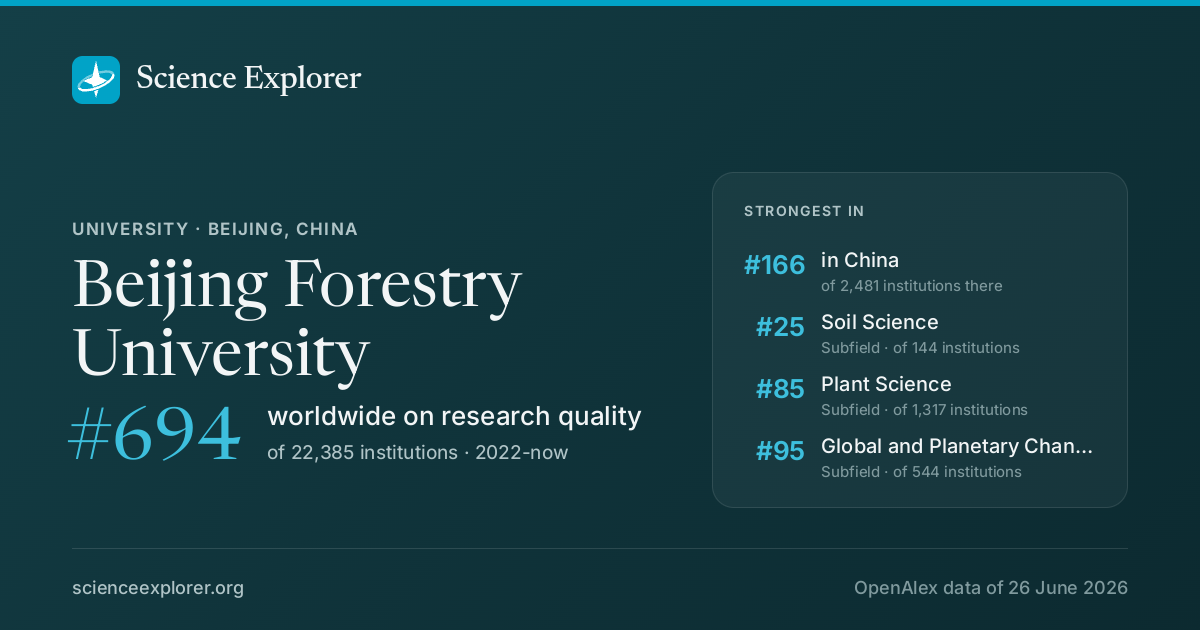
In research, Beijing Forestry University stands highest in Environmental Science (#105 of 3,334 worldwide), Physical Sciences (#393 of 10,670 worldwide) and Agricultural and Biological Sciences (#122 of 3,157 worldwide), 2022-now. Relative to its size it is most specialised in Nature and Landscape Conservation, Global and Planetary Change and Ecological Modeling (Nature and Landscape Conservation is 8.6× its share of world research).
- World rank, 2022-now
- #694 of 22,385 · #1,004 all time
- Rank in China
- #166 of 2,481
- Research works
- 21k ▲ 63% vs 2018-21
- Citations
- 318k 15.2 per fractional work
- Top-10% rate
- 14.1% all institutions 10.0%
- vs its own fields
- 1.12× 1.00× is exactly expected
- Open access
- 37% world 40%
- International
- 10% world 18%
What is Beijing Forestry University known for in research?
The fields where it stands highest, 2022-now, ranked among every institution above the floor in each field.
| Field | World rank | Where that sits | Top-10% rate | Works | All time |
|---|---|---|---|---|---|
| Environmental ScienceField | #105 of 3,334 | 14.3% | 1,430 | #225 | |
| Physical SciencesDomain | #393 of 10,670 | 15.4% | 3,351 | #798 | |
| Agricultural and Biological SciencesField | #122 of 3,157 | 13.6% | 1,165 | #291 | |
| Plant ScienceSubfield | #85 of 1,317 | 12.6% | 645 | #219 | |
| EngineeringField | #479 of 5,901 | 16.9% | 807 | #860 | |
| Life SciencesDomain | #668 of 6,403 | 12.5% | 1,822 | #924 | |
| Materials ScienceField | #305 of 2,276 | 18.7% | 430 | #531 | |
| Biomedical EngineeringSubfield | #233 of 1,539 | 17.9% | 275 | #447 | |
| Social SciencesDomain | #1,551 of 9,585 | 15.3% | 504 | #1743 | |
| Soil ScienceSubfield | #25 of 144 | 14.5% | 139 | #88 |
Each strip is that field's whole ranked pool, with the notch where Beijing Forestry University sits in it, in the colour of the band that rank falls in. The track under the rate is the rate itself: it carries no average mark, because the average differs by field (from about 6% in Dentistry to 21% in Economics).
Which of those standings moved
The same fields on both windows: where it stood over the whole record, and where it stands in 2022-now. The distance is the story, and it is the one thing the two rank columns above cannot show.
- Environmental Science#225 #105
- Physical Sciences#798 #393
- Agricultural and Biological Sciences#291 #122
- Plant Science#219 #85
- Engineering#860 #479
- Life Sciences#924 #668
- Materials Science#531 #305
- Biomedical Engineering#447 #233
- Social Sciences#1,743 #1,551
- Soil Science#88 #25
A dot further right is a better standing. Fields it was not ranked in over the whole record are left out.
Which fields of science does Beijing Forestry University work in?
In 2022-now, 57% of research at Beijing Forestry University is in Physical Sciences, 31% in Life Sciences. Its largest fields are Environmental Science (24%), Agricultural and Biological Sciences (20%), Engineering (14%). It does 2.4× the world's share of Life Sciences.
Each ring splits the one inside it: the four domains of science, their fields, their subfields. Size is fractional works in 2022-now. Every slice is a page; the interactive view zooms down to single topics and colours each by how much more of it this institution does than the world.
Its 4 domains and 26 fields, with their numbers
- Physical Sciences3,80056.7%
- Environmental Science1,63024.3%
- Engineering91213.6%
- Materials Science4777.1%
- Computer Science2674.0%
- Earth and Planetary Sciences1792.7%
- Energy1291.9%
- Chemistry1201.8%
- Chemical Engineering410.6%
- Mathematics250.4%
- Physics and Astronomy190.3%
- Life Sciences2,08431.1%
- Social Sciences5758.6%
- Social Sciences1902.8%
- Economics, Econometrics and Finance1281.9%
- Psychology941.4%
- Business, Management and Accounting851.3%
- Arts and Humanities510.8%
- Decision Sciences270.4%
- Health Sciences2463.7%
- Medicine1802.7%
- Nursing410.6%
- Health Professions180.3%
- Veterinary50.1%
- Dentistry10.0%
What does Beijing Forestry University specialise in?
Where its research is concentrated relative to its size: Nature and Landscape Conservation takes 8.6× the share of its output that it takes of world research.
- Nature and Landscape ConservationSubfield · 136.8 works8.6×
- Global and Planetary ChangeSubfield · 429.7 works8.4×
- Ecological ModelingSubfield · 40.7 works8.0×
- Soil ScienceSubfield · 159.1 works7.9×
- Plant ScienceSubfield · 737.6 works6.3×
- EcologySubfield · 326.1 works6.2×
- BiomaterialsSubfield · 174.8 works6.1×
- Ecology, Evolution, Behavior and SystematicsSubfield · 189.2 works6.0×
Location quotient, a volume reading rather than an impact one. It surfaces small, lopsided specialities.
Field profile
Location quotient across every field it publishes in: outside the ring is more than an institution of this size would be expected to publish, inside it is less.
Rings at 0.5×, 1× and 2×. Widest outward: Environmental Science, 4.9×. Every wedge is a field page.
All 26 fields, with their numbers
- Environmental Science4.89×1,630 works
- Agricultural and Biological Sciences4.21×1,342 works
- Energy2.09×129 works
- Materials Science2.04×477 works
- Biochemistry, Genetics and Molecular Biology1.89×676 works
- Chemical Engineering1.76×41 works
- Earth and Planetary Sciences1.71×179 works
- Nursing1.24×41 works
- Chemistry1.14×120 works
- Engineering0.91×912 works
- Economics, Econometrics and Finance0.89×128 works
- Veterinary0.60×6 works
- Computer Science0.51×267 works
- Psychology0.46×94 works
- Decision Sciences0.42×27 works
- Neuroscience0.39×42 works
- Pharmacology, Toxicology and Pharmaceutics0.39×9 works
- Business, Management and Accounting0.39×85 works
- Mathematics0.31×25 works
- Arts and Humanities0.26×51 works
- Social Sciences0.22×190 works
- Immunology and Microbiology0.21×14 works
- Medicine0.14×180 works
- Physics and Astronomy0.13×19 works
- Health Professions0.10×18 works
- Dentistry0.04×1 works
- Environmental Science 4.9×
- Agricultural and Biological Sciences 4.2×
- Energy 2.1×
- Materials Science 2.0×
- Biochemistry, Genetics and Molecular Biology 1.9×
- Chemical Engineering 1.8×
- Earth and Planetary Sciences 1.7×
- Nursing 1.2×
- Chemistry 1.1×
- Engineering 0.9×
- Economics, Econometrics and Finance 0.9×
- Veterinary 0.6×
- Computer Science 0.5×
- Psychology 0.5×
- Decision Sciences 0.4×
- Neuroscience 0.4×
- Pharmacology, Toxicology and Pharmaceutics 0.4×
- Business, Management and Accounting 0.4×
- Mathematics 0.3×
- Arts and Humanities 0.3×
- Social Sciences 0.2×
- Immunology and Microbiology 0.2×
- Medicine 0.1×
- Physics and Astronomy 0.1×
- Health Professions 0.1×
- Dentistry 0.0×
Who are the top researchers at Beijing Forestry University?
Ranked on the quality score, Tong‐Qi Yuan, Jia‐Long Wen and Guoyong Song lead among researchers whose main affiliation is Beijing Forestry University.
- 1
Tong‐Qi Yuan
 China · #17,123 worldwide
13k citations · 196 works
- 2
Jia‐Long Wen
China · #22,831 worldwide
12k citations · 240 works
- 3
Guoyong Song
China · #41,707 worldwide
11k citations · 134 works
- 4
Sanwei Hao
China · #50,353 worldwide
2.6k citations · 49 works
- 5
Run‐Cang Sun
China · #57,209 worldwide
63k citations · 1,021 works
- 6
Jun He Yang
China · #62,033 worldwide
12k citations · 198 works
- 7
Zhimin Xue
China · #65,126 worldwide
9.5k citations · 155 works
- 8
Qingjin Fu
China · #66,175 worldwide
2.6k citations · 40 works
- 9
Feng Xu
China · #73,486 worldwide
18k citations · 371 works
- 10
Qiang Gao
China · #75,242 worldwide
10k citations · 263 works
Which keywords describe research at Beijing Forestry University?
By fractional works in 2022-now, weighted toward what it does more of than the world: Climate Change, Biodiversity Conservation, Land Use Change, Ecosystem Services, Remote Sensing, Urbanization, Invasive Species and Transcription Factors.
- MYB
- Metabolic Pathways
- Forest Management
- Auxin
- MicroRNA
- Habitat Fragmentation
- DNA Barcoding
- Conservation
- Ecosystem Resilience
- Human-Nature Interactions
- Global Impact
- Environmental Policy
- Ecosystem Functioning
- Global Change
- Transcription Factors
- Environmental Impact
- Biodiversity
- Ecosystem Services
- Remote Sensing
- Sustainability
- Climate Change
- Biodiversity Conservation
- Land Use Change
- Biomedical Applications
- Urbanization
- Invasive Species
- Gene Expression
- Biomass Estimation
- Phylogenetic Analysis
- Nanocomposites
- Social-Ecological Systems
- Spatial Dynamics
- Ionic Liquids
- Epigenetic Regulation
- Aboveground Biomass
- Anthocyanins
- Biogeography
- Plant
- Biological Invasions
- Flavonoid Biosynthesis
Size is fractional works in 2022-now in the topics tagged with each word; colour is the word's share of this institution's work against its share of the world's. The 40 words are chosen for being large and distinctive. Each links to the topic it comes from most.
All 40 words, with their numbers
- Climate Change814▲ 4.5×96 topics
- Sustainability360▲ 2.2×73 topics
- Biodiversity Conservation351▲ 14×16 topics
- Remote Sensing337▲ 4.1×36 topics
- Land Use Change329▲ 16×8 topics
- Ecosystem Services306▲ 12×12 topics
- Biomedical Applications276▲ 3.5×33 topics
- Biodiversity237▲ 4.6×31 topics
- Urbanization232▲ 8.6×9 topics
- Environmental Impact226▲ 1.98×53 topics
- Invasive Species217▲ 7.6×21 topics
- Transcription Factors211▲ 24×4 topics
- Gene Expression210▲ 5.0×17 topics
- Global Change204▲ 11×7 topics
- Biomass Estimation190▲ 18×3 topics
- Ecosystem Functioning181▲ 13×7 topics
- Phylogenetic Analysis164▲ 7.8×16 topics
- Environmental Policy163▲ 12×8 topics
- Nanocomposites160▲ 3.0×19 topics
- Global Impact154▲ 14×3 topics
- Social-Ecological Systems153▲ 16×3 topics
- Human-Nature Interactions152▲ 25×1 topic
- Spatial Dynamics152▲ 25×1 topic
- Ecosystem Resilience146▲ 14×5 topics
- Ionic Liquids145▲ 7.7×10 topics
- Conservation129▲ 4.5×21 topics
- Epigenetic Regulation124▲ 8.8×5 topics
- DNA Barcoding118▲ 10×8 topics
- Aboveground Biomass117▲ 20×2 topics
- Habitat Fragmentation116▲ 8.0×5 topics
- Anthocyanins114▲ 24×3 topics
- MicroRNA109▲ 14×2 topics
- Biogeography109▲ 5.8×20 topics
- Auxin108▲ 34×1 topic
- Plant108▲ 34×1 topic
- Forest Management104▲ 26×4 topics
- Biological Invasions102▲ 17×3 topics
- Metabolic Pathways99▲ 26×3 topics
- Flavonoid Biosynthesis96▲ 48×1 topic
- MYB96▲ 48×1 topic
Which research topics does Beijing Forestry University publish most on?
By volume in 2022-now: Land Use and Ecosystem Services, Plant Molecular Biology Research, Plant Gene Expression Analysis and Lignin and Wood Chemistry.
Area is fractional works; colour is the subfield each topic belongs to.
- 1 Land Use and Ecosystem Services Global and Planetary Change 152 works
- 2 Plant Molecular Biology Research Plant Science 108 works
- 3 Plant Gene Expression Analysis Molecular Biology 96 works
- 4 Lignin and Wood Chemistry Biomedical Engineering 90 works
- 5 Plant Water Relations and Carbon Dynamics Global and Planetary Change 87 works
- 6 Mycorrhizal Fungi and Plant Interactions Plant Science 73 works
- 7 Remote Sensing in Agriculture Ecology 73 works
- 8 Advanced Cellulose Research Studies Biomaterials 72 works
- 9 Ecology and Vegetation Dynamics Studies Nature and Landscape Conservation 68 works
- 10 Remote Sensing and LiDAR Applications Environmental Engineering 67 works
How open and international is its research?
Against the world's own shares: the tick on each track. Both are shares of its output, so they sit on one scale and can be read against each other as well as against the world.
World: 40% of research is openly available.
World: 18% is written across borders.
How has Beijing Forestry University's research output changed?
Output in 2022-2025 was 63% higher than in 2018-2021.
The same series as a ribbon: one cell per year, darker for more. The line above answers how much; this answers when.
Its share of all research
Growing output can still be a shrinking share: all of science grows. This is Beijing Forestry University as a percentage of every work published that year, 0.026% in 2024.
Fractional works of Beijing Forestry University over all fractional works that year. How the balance of science has shifted.
How much of it reaches the world top 10%
Year by year, against all institutions in the same year.
Of each year's output, the share that reached the world's 10% most cited for its field and year. Peak 15.2% in 2024.
Other research institutions in Beijing
- Chinese Academy of Sciences
- Tsinghua University
- Peking University
- Chinese Academy of Agricultural Sciences
- University of Chinese Academy of Sciences
- Beihang University
- Beijing Institute of Technology
- Capital Medical University

Compare Beijing Forestry University with
- vs
 Swedish University of Agricultural Sciences
- vs
 Johnson & Johnson (United States)
- vs Tencent (China)
- vs Beijing Jiaotong University
- vs
 Carleton University
- vs
 Novartis (Switzerland)
Share Beijing Forestry University's ranking



Research measures only: rankings here say nothing about teaching, admissions or student experience. Comparable institutions and collaboration partners have tabs of their own, above.
Discussion
Ask a question or share a note about Beijing Forestry University. Posts are plain text and can be reported.