Ecological Modeling research
Ecological Modeling is a subfield of Environmental Science. Science Explorer counts 96k research works in it since 1950. 9.9% of them reached the world's top 10% most cited for their field and year.
In short: computational or theoretical approach to ecology.
- Research works
- 96k fractional, since 1950
- In the world top 10%
- 9.4k per year above
- Top-10% rate
- 9.9% share of its works in the world top 10%
- Topics
- 3
- Growth, 2018-21 → 2022-25
- +15% the tick is no change
- Largest producer
 China
35% of the 10 largest, 2022-now
What is Ecological Modeling research about, and what is growing?
By the world's output in 2021-25, its most used keywords are Climate Change, Species Distribution Modeling, Erosion, Solid Particle, Analytic Hierarchy Process, Fuzzy Modeling. Gaining share since 2011-15: Climate Change, Species Distribution Modeling, Erosion, Solid Particle. Losing share: Analytic Hierarchy Process, Fuzzy Modeling.
- Fuzzy Modeling
- Solid Particle
- Species Distribution Modeling
- Climate Change
- Erosion
- Analytic Hierarchy Process
Size is the world's fractional works in 2021-25 in the topics tagged with each word; colour compares the word's share of this field with 2011-15. Each links to the topic it comes from most.
All 6 words, with their numbers
- Climate Change16k▲ 1.89×1 topic
- Species Distribution Modeling16k▲ 1.89×1 topic
- Erosion2,610▲ 1.80×1 topic
- Solid Particle2,610▲ 1.80×1 topic
- Analytic Hierarchy Process2,178▼ 0.20×1 topic
- Fuzzy Modeling2,178▼ 0.20×1 topic
Which countries lead Ecological Modeling research?
On research quality in 2022-now, China, the United States and the United Kingdom rank highest in Ecological Modeling. By volume, China and the United States publish the most (4.5k and 2.9k works in 2022-now).
By research quality, 2022-now
- 1
China #1 all time
1.16× citation excellence · 0.99× journals · 100% breadth
12.3% top 10% · 3.9k works
- 2
 United States #2 all time
0.94× citation excellence · 1.51× journals · 100% breadth
10.1% top 10% · 2.6k works
- 3
 United Kingdom #3 all time
1.19× citation excellence · 1.46× journals · 100% breadth
12.6% top 10% · 672 works
- 4
 Germany #4 all time
1.35× citation excellence · 1.41× journals · 100% breadth
14.4% top 10% · 548 works
- 5
 Australia #5 all time
1.11× citation excellence · 1.20× journals · 100% breadth
11.7% top 10% · 598 works
- 6
 France #7 all time
1.11× citation excellence · 1.27× journals · 100% breadth
11.5% top 10% · 440 works
- 7
 Canada #8 all time
1.11× citation excellence · 1.22× journals · 100% breadth
11.4% top 10% · 430 works
- 8
 Spain #9 all time
1.10× citation excellence · 0.98× journals · 100% breadth
9.4% top 10% · 430 works
- 9
 Italy #15 all time
1.13× citation excellence · 0.67× journals · 100% breadth
10.5% top 10% · 338 works
- 10
 India #13 all time
0.79× citation excellence · 0.42× journals · 100% breadth
6.5% top 10% · 967 works
The track on each row is that row's top-10% rate. The ranking itself is the quality score, which compares the rate with what each place's own topics predict, adds its share of papers in the Nature Index journals, and counts output and breadth too.
Of 14 countries ranked in Ecological Modeling. Ranked on the quality score for 2022-now; the bracket is the all-time rank.
All countries ranked in Ecological ModelingBy volume, 2022-now
- 1
China
4.5k works
- 2
United States
2.9k works
- 3
India
1.2k works
- 4
United Kingdom
768 works
- 5
Australia
674 works
- 6
Germany
664 works
- 7
 Brazil
636 works
- 8
France
516 works
- 9
Spain
497 works
- 10
Canada
487 works
How concentrated that is
The same countries as shares of everything the list above accounts for. A node where two countries do two thirds of the work and one spread evenly across twelve read alike as a ranking and not at all alike here.
Shares of the rows listed above, not of the whole node.
Which institutions lead Ecological Modeling research?
Chinese Academy of Sciences (China) ranks first in Ecological Modeling on research quality in 2022-now, followed by Centre National de la Recherche Scientifique and Consejo Superior de Investigaciones Científicas.
By research quality, 2022-now
- 1
Chinese Academy of Sciences China · Beijing · #2 all time
15.1% top 10% · 289 works
- 2
Centre National de la Recherche Scientifique France · Paris · #9 all time
11.1% top 10% · 179 works
- 3
Consejo Superior de Investigaciones Científicas Spain · Madrid · #27 all time
8.9% top 10% · 104 works
- 4
Leibniz Association Germany · Berlin · #22 all time
11.2% top 10% · 73 works
- 5
United States Geological Survey United States · Reston · #44 all time
9.2% top 10% · 77 works
- 6
University of Florida United States · Gainesville · #50 all time
11.3% top 10% · 63 works
- 7
United States Department of Agriculture United States · Washington · #81 all time
12.7% top 10% · 64 works
- 8
Consejo Nacional de Investigaciones Científicas y Técnicas
 Argentina · Buenos Aires · #85 all time
4.8% top 10% · 70 works
- 9
Universidad Nacional Autónoma de México
 Mexico · Mexico City · #93 all time
3.7% top 10% · 72 works
- 10
Russian Academy of Sciences
 Russia · Moscow · #100 all time
3.0% top 10% · 112 works






The track on each row is that row's top-10% rate. The ranking itself is the quality score, which compares the rate with what each place's own topics predict, adds its share of papers in the Nature Index journals, and counts output and breadth too.
Of 10 institutions above the floor of 40 fractional works in Ecological Modeling.
Top 100 Ecological Modeling institutionsBy volume, 2022-now
- 1
Chinese Academy of SciencesChina
324 works
- 2
Centre National de la Recherche ScientifiqueFrance
212 works
- 3
Consejo Superior de Investigaciones CientíficasSpain
123 works
- 4
Russian Academy of SciencesRussia
121 works
- 5
Leibniz AssociationGermany
92 works
- 6
United States Geological SurveyUnited States
83 works
- 7
Universidad Nacional Autónoma de MéxicoMexico
81 works
- 8
Consejo Nacional de Investigaciones Científicas y TécnicasArgentina
79 works
- 9
United States Department of AgricultureUnited States
70 works
- 10
University of FloridaUnited States
67 works
Who are the leading researchers in Ecological Modeling?
Counting only their work in Ecological Modeling, Wilfried Thuiller, Antoine Guisan and Hugh P. Possingham have the most papers in the world top 10% for their subfield and year beyond the 10% expected.
- 1
Wilfried Thuiller
France · #290 worldwide overall
70.5 of 116 papers here in the top 10%
- 2
Antoine Guisan
 Switzerland · #4,869 worldwide overall
48.7 of 92 papers here in the top 10%
- 3
Hugh P. Possingham
Australia · #6,728 worldwide overall
45.7 of 89 papers here in the top 10%
- 4
Miguel B. Araújo
Spain · #2,176 worldwide overall
39.6 of 63 papers here in the top 10%
- 5
Jens‐Christian Svenning
 Denmark · #3,331 worldwide overall
41.5 of 94 papers here in the top 10%
- 6
Walter Jetz
United States · #197 worldwide overall
36.2 of 56 papers here in the top 10%
- 7
Niklaus E. Zimmermann
Switzerland · #2,188 worldwide overall
36.2 of 59 papers here in the top 10%
- 8
A. Townsend Peterson
United States · #53,199 worldwide overall
43.7 of 141 papers here in the top 10%
- 9
Jonathan Lenoir
France · #3,917 worldwide overall
33.3 of 63 papers here in the top 10%
- 10
Kevin J. Gaston
United Kingdom · #1,604 worldwide overall
34.3 of 81 papers here in the top 10%
Ranked on their work in Ecological Modeling alone: how many more of their papers here reached the world top 10% for their subfield and year than the 10% expected, among 287,785 ranked researchers with a paper here. Each paper counts once, so many strong papers outrank one famous one, and a long record of ordinary papers does not climb. Identities come from OpenAlex author disambiguation, which occasionally merges or splits people.
Top 100 Ecological Modeling researchersWhere is Ecological Modeling research done?
The largest centres of Ecological Modeling research in 2022-now are Beijing (China), Nanjing (China), Paris (France) and Shanghai (China). Among places with at least 20 works in it, it is an unusually large share of all research in Birmensdorf and Tongren.
Largest cities, 2022-now
Where it is the local speciality
- BirmensdorfCH · 22.5 works37×
- TongrenCN · 21.6 works35×
Location quotient: how much more of its research is in Ecological Modeling than the world average.
Ecological Modeling research by country
The best places for Ecological Modeling research inside each country, with that country's researchers and world standing.
Where is the best place to study Ecological Modeling?
Among universities, judged by research, North China Electric Power University, University of Chinese Academy of Sciences and Tsinghua University score highest, combining standing in the field's ranking, citation excellence, specialisation, size, growth and international reach. Research strength is one signal when choosing where to study; it does not measure teaching.
One dot per university in the first ten of the table below, at the default weights. The upper left is the interesting corner: small places doing unusually strong work.





























Universities only. The score blends standing (50%), citation excellence (20%), size (15%), specialisation (5%), growth (5%), international reach (5%), 2022-now; growth compares 2018-21 with 2022-25 and counts up to +20%, since a jump from a small base is mostly noise. Standing is the score in this field's institution ranking, three quarters over all time and a quarter 2022-now; excellence averages the two windows too. Four years alone undercount fields such as AI, where many conference and arXiv papers from 2022 on carry no affiliation in the data.
Every institution in Ecological Modeling, country by countryIs Ecological Modeling research growing?
Output in 2022-2025 was 15% higher than in 2018-2021, peaking in 2011. The fastest-growing topics are Evaluation Methods in Various Fields, Erosion and Abrasive Machining and Species Distribution and Climate Change.
The same series as a ribbon: one cell per year, darker for more. The line above answers how much; this answers when.
Its share of all research
Growing output can still be a shrinking share: all of science grows. This is Ecological Modeling as a percentage of every work published that year, 0.075% in 2024.
Fractional works of Ecological Modeling over all fractional works that year. How the balance of science has shifted.
How much of it reaches the world top 10%
Year by year.
Of each year's works in it, the share that reached the world's 10% most cited for their field and year. A field is the world for its own topics, so there is no other line to hold it against.
Which topics inside it are moving
Growth and decline on one axis around a shared zero. Two lists side by side hide the thing that matters: whether the growth dwarfs the decline, or the other way round.
- Evaluation Methods in Various Fields+46%
- Erosion and Abrasive Machining+18%
- Species Distribution and Climate Change+11%
Growth in output from 2018-21 to 2022-25. Every topic is a page of its own.
What does Ecological Modeling include?
Share who leads Ecological Modeling
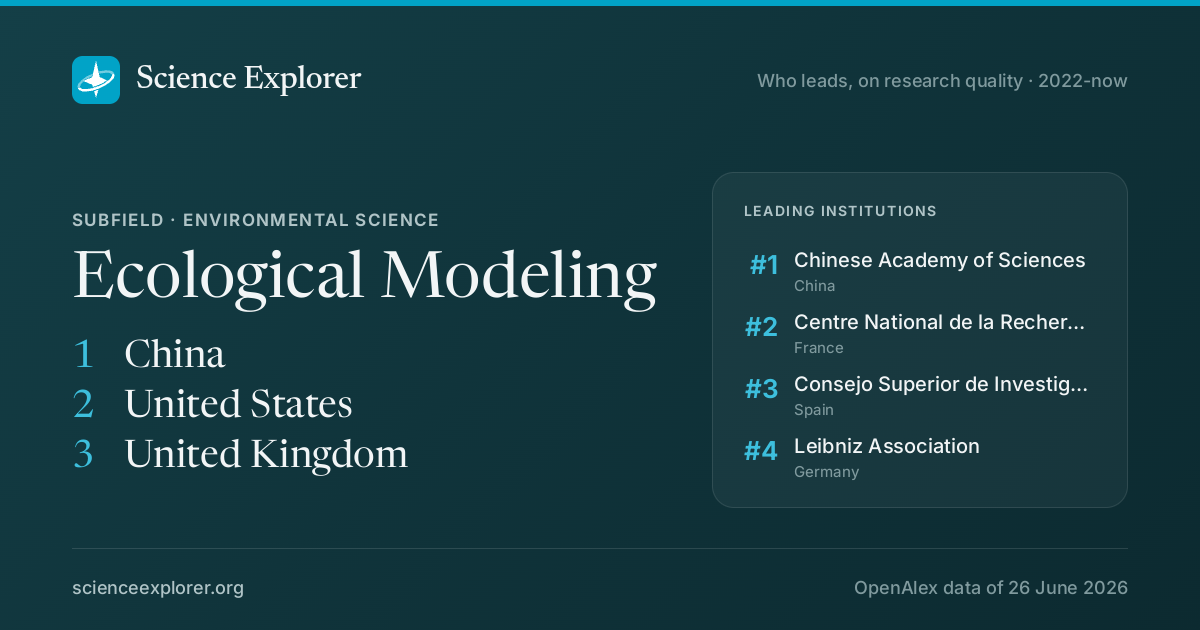
The leading institutions' badges6Each links to that institution's page and updates with every snapshot


Discussion
Ask a question or share a note about Ecological Modeling. Keep it to the research: no personal attacks, advertising or links. Any reader can report a post, which collapses it for everyone until it is opened.