Wuhan University
In research, Wuhan University stands highest in Physical Sciences (#12 of 10,670 worldwide), Engineering (#21 of 5,901 worldwide) and Life Sciences (#39 of 6,403 worldwide), 2022-now. Relative to its size it is most specialised in Media Technology, Cancer Research and Computer Vision and Pattern Recognition (Media Technology is 3.7× its share of world research).
- World rank, 2022-now
- #31 of 22,385 · #55 all time
- Rank in China
- #10 of 2,481
- Research works
- 118k ▲ 37% vs 2018-21
- Citations
- 2.1M 18.1 per fractional work
- Top-10% rate
- 16.4% all institutions 10.0%
- vs its own fields
- 1.49× 1.00× is exactly expected
- Open access
- 30% world 40%
- International
- 12% world 18%
What is Wuhan University known for in research?
The fields where it stands highest, 2022-now, ranked among every institution above the floor in each field.
| Field | World rank | Where that sits | Top-10% rate | Works | All time |
|---|---|---|---|---|---|
| Physical SciencesDomain | #12 of 10,670 | 16.6% | 16,304 | #21 | |
| EngineeringField | #21 of 5,901 | 17.4% | 6,580 | #45 | |
| Life SciencesDomain | #39 of 6,403 | 15.8% | 4,319 | #97 | |
| Environmental ScienceField | #25 of 3,334 | 17.4% | 2,037 | #39 | |
| Health SciencesDomain | #84 of 9,902 | 17.8% | 5,856 | #204 | |
| Computer ScienceField | #38 of 4,417 | 16.2% | 3,212 | #56 | |
| Social SciencesDomain | #83 of 9,585 | 17.6% | 2,983 | #121 | |
| MedicineField | #81 of 8,541 | 17.3% | 5,323 | #194 | |
| Biochemistry, Genetics and Molecular BiologyField | #29 of 2,964 | 15.4% | 2,816 | #73 | |
| Computer Vision and Pattern RecognitionSubfield | #11 of 963 | 18.0% | 1,115 | #23 |
Each strip is that field's whole ranked pool, with the notch where Wuhan University sits in it, in the colour of the band that rank falls in. The track under the rate is the rate itself: it carries no average mark, because the average differs by field (from about 6% in Dentistry to 21% in Economics).
Which of those standings moved
The same fields on both windows: where it stood over the whole record, and where it stands in 2022-now. The distance is the story, and it is the one thing the two rank columns above cannot show.
- Physical Sciences#21 #12
- Engineering#45 #21
- Life Sciences#97 #39
- Environmental Science#39 #25
- Health Sciences#204 #84
- Computer Science#56 #38
- Social Sciences#121 #83
- Medicine#194 #81
- Biochemistry, Genetics and Molecular Biology#73 #29
- Computer Vision and Pattern Recognition#23 #11
A dot further right is a better standing. Fields it was not ranked in over the whole record are left out.
Which fields of science does Wuhan University work in?
In 2022-now, 55% of research at Wuhan University is in Physical Sciences, 20% in Health Sciences. Its largest fields are Engineering (22%), Medicine (18%), Computer Science (11%). It does 1.4× the world's share of Physical Sciences.
Each ring splits the one inside it: the four domains of science, their fields, their subfields. Size is fractional works in 2022-now. Every slice is a page; the interactive view zooms down to single topics and colours each by how much more of it this institution does than the world.
Its 4 domains and 26 fields, with their numbers
- Physical Sciences18k55.3%
- Engineering7,37422.3%
- Computer Science3,65411.0%
- Environmental Science2,2986.9%
- Materials Science1,5084.6%
- Physics and Astronomy9903.0%
- Earth and Planetary Sciences9572.9%
- Chemistry6451.9%
- Energy4371.3%
- Mathematics3231.0%
- Chemical Engineering1290.4%
- Health Sciences6,63020.0%
- Medicine6,02518.2%
- Dentistry2650.8%
- Health Professions2460.7%
- Nursing870.3%
- Veterinary70.0%
- Life Sciences4,88714.8%
- Social Sciences3,2859.9%
- Social Sciences1,3294.0%
- Economics, Econometrics and Finance5741.7%
- Business, Management and Accounting4941.5%
- Psychology4401.3%
- Decision Sciences2660.8%
- Arts and Humanities1820.5%
What does Wuhan University specialise in?
Where its research is concentrated relative to its size: Media Technology takes 3.7× the share of its output that it takes of world research.
- Media TechnologySubfield · 382.7 works3.7×
- Cancer ResearchSubfield · 453.2 works3.1×
- Computer Vision and Pattern RecognitionSubfield · 1,265.3 works3.0×
- Environmental EngineeringSubfield · 497.3 works2.8×
- Atmospheric ScienceSubfield · 366.4 works2.5×
- Biological PsychiatrySubfield · 45.3 works2.5×
- GeologySubfield · 108.5 works2.4×
- Astronomy and AstrophysicsSubfield · 405.4 works2.4×
Location quotient, a volume reading rather than an impact one. It surfaces small, lopsided specialities.
Field profile
Location quotient across every field it publishes in: outside the ring is more than an institution of this size would be expected to publish, inside it is less.
Rings at 0.5×, 1× and 2×. Widest outward: Earth and Planetary Sciences, 1.8×. Every wedge is a field page.
All 26 fields, with their numbers
- Earth and Planetary Sciences1.84×957 works
- Immunology and Microbiology1.80×599 works
- Biochemistry, Genetics and Molecular Biology1.78×3,146 works
- Dentistry1.65×265 works
- Engineering1.48×7,374 works
- Energy1.43×437 works
- Computer Science1.42×3,654 works
- Environmental Science1.40×2,298 works
- Physics and Astronomy1.34×990 works
- Materials Science1.30×1,508 works
- Chemistry1.24×645 works
- Chemical Engineering1.11×128 works
- Neuroscience1.07×572 works
- Medicine0.95×6,025 works
- Pharmacology, Toxicology and Pharmaceutics0.85×100 works
- Mathematics0.83×323 works
- Decision Sciences0.83×266 works
- Economics, Econometrics and Finance0.81×574 works
- Nursing0.53×87 works
- Business, Management and Accounting0.46×494 works
- Psychology0.44×440 works
- Social Sciences0.32×1,329 works
- Agricultural and Biological Sciences0.30×471 works
- Health Professions0.28×246 works
- Arts and Humanities0.19×182 works
- Veterinary0.16×7 works
- Earth and Planetary Sciences 1.8×
- Immunology and Microbiology 1.8×
- Biochemistry, Genetics and Molecular Biology 1.8×
- Dentistry 1.6×
- Engineering 1.5×
- Energy 1.4×
- Computer Science 1.4×
- Environmental Science 1.4×
- Physics and Astronomy 1.3×
- Materials Science 1.3×
- Chemistry 1.2×
- Chemical Engineering 1.1×
- Neuroscience 1.1×
- Medicine 0.9×
- Pharmacology, Toxicology and Pharmaceutics 0.8×
- Mathematics 0.8×
- Decision Sciences 0.8×
- Economics, Econometrics and Finance 0.8×
- Nursing 0.5×
- Business, Management and Accounting 0.5×
- Psychology 0.4×
- Social Sciences 0.3×
- Agricultural and Biological Sciences 0.3×
- Health Professions 0.3×
- Arts and Humanities 0.2×
- Veterinary 0.2×
Who are the top researchers at Wuhan University?
Ranked on the quality score, Weijun Ke, Xinping Ai and Chuanhua Yu lead among researchers whose main affiliation is Wuhan University.
- 1
Weijun Ke
 China · #921 worldwide
20k citations · 215 works
- 2
Xinping Ai
China · #1,046 worldwide
36k citations · 378 works
- 3
Chuanhua Yu
China · #1,323 worldwide
213k citations · 296 works
- 4
Muhammad Zahid Usman
China · #1,367 worldwide
14k citations · 180 works
- 5
Yuliang Cao
China · #1,435 worldwide
49k citations · 499 works
- 6
Hanxi Yang
China · #1,538 worldwide
35k citations · 303 works
- 7
Yongjin Fang
China · #4,721 worldwide
15k citations · 123 works
- 8
Jiangfeng Qian
China · #5,691 worldwide
20k citations · 165 works
- 9
Jiayi Ma
China · #7,145 worldwide
42k citations · 556 works
- 10
Mang Ye
China · #7,149 worldwide
14k citations · 233 works
Which keywords describe research at Wuhan University?
By fractional works in 2022-now, weighted toward what it does more of than the world: Deep Learning, Remote Sensing, Cancer, Inflammation, Machine Learning, Oxidative Stress, Neural Networks and Climate Change.
- Orbit Determination
- Object-Based Analysis
- Change Detection
- GPX4
- Lipid Peroxidation
- Biogenesis
- Cancer Progression
- Hyperspectral
- Reactive Oxygen Species
- Urbanization
- Land Use Change
- Cell Death
- Energy Storage
- Gene Expression
- Nanoparticles
- Renewable Energy
- Neural Networks
- Climate Change
- Cancer
- Remote Sensing
- Deep Learning
- Machine Learning
- Inflammation
- Oxidative Stress
- Epidemiology
- Convolutional Neural Networks
- Tumor Microenvironment
- Biomedical Applications
- Hydrological Modeling
- Regulation
- Feature Extraction
- Immunity
- Support Vector Machines
- Sparse Representation
- Biomass Estimation
- Terrestrial Laser Scanning
- Ferroptosis
- Image Analysis
- Solar Wind
- Spectral Unmixing
Size is fractional works in 2022-now in the topics tagged with each word; colour is the word's share of this institution's work against its share of the world's. The 40 words are chosen for being large and distinctive. Each links to the topic it comes from most.
All 40 words, with their numbers
- Deep Learning2,525▲ 2.2×85 topics
- Remote Sensing1,383▲ 3.4×41 topics
- Machine Learning1,359▲ 1.23×91 topics
- Cancer1,316▲ 3.0×57 topics
- Inflammation1,277▲ 1.81×83 topics
- Climate Change1,155▲ 1.28×100 topics
- Oxidative Stress983▲ 1.80×61 topics
- Neural Networks948▲ 1.85×41 topics
- Epidemiology945▼ 0.72×129 topics
- Renewable Energy709▲ 1.48×48 topics
- Convolutional Neural Networks592▲ 2.5×14 topics
- Nanoparticles577▲ 1.38×44 topics
- Tumor Microenvironment570▲ 3.8×8 topics
- Gene Expression566▲ 2.7×20 topics
- Biomedical Applications519▲ 1.32×36 topics
- Energy Storage477▲ 2.2×13 topics
- Hydrological Modeling429▲ 5.4×5 topics
- Cell Death425▲ 5.3×6 topics
- Regulation412▲ 2.3×23 topics
- Land Use Change404▲ 4.1×9 topics
- Feature Extraction380▲ 2.5×10 topics
- Urbanization379▲ 2.8×11 topics
- Immunity352▲ 2.6×11 topics
- Reactive Oxygen Species346▲ 2.5×14 topics
- Support Vector Machines339▲ 3.2×8 topics
- Hyperspectral316▲ 11×2 topics
- Sparse Representation276▲ 4.4×6 topics
- Cancer Progression275▲ 4.6×8 topics
- Biomass Estimation273▲ 5.3×3 topics
- Biogenesis270▲ 4.8×3 topics
- Terrestrial Laser Scanning250▲ 6.3×2 topics
- Lipid Peroxidation246▲ 6.7×3 topics
- Ferroptosis233▲ 8.6×1 topic
- GPX4233▲ 8.6×1 topic
- Image Analysis233▲ 7.3×2 topics
- Change Detection217▲ 9.5×2 topics
- Solar Wind215▲ 7.1×2 topics
- Object-Based Analysis208▲ 13×1 topic
- Spectral Unmixing208▲ 13×1 topic
- Orbit Determination203▲ 14×2 topics
Which research topics does Wuhan University publish most on?
By volume in 2022-now: Ferroptosis and cancer prognosis, Remote-Sensing Image Classification, GNSS positioning and interference and RNA modifications and cancer.
Area is fractional works; colour is the subfield each topic belongs to.
- 1 Ferroptosis and cancer prognosis Pulmonary and Respiratory Medicine 233 works
- 2 Remote-Sensing Image Classification Media Technology 208 works
- 3 GNSS positioning and interference Aerospace Engineering 187 works
- 4 RNA modifications and cancer Molecular Biology 168 works
- 5 Ionosphere and magnetosphere dynamics Astronomy and Astrophysics 165 works
- 6 Advanced Neural Network Applications Computer Vision and Pattern Recognition 159 works
- 7 Cancer-related molecular mechanisms research Cancer Research 156 works
- 8 Robotics and Sensor-Based Localization Aerospace Engineering 155 works
- 9 Advanced Image and Video Retrieval Techniques Computer Vision and Pattern Recognition 150 works
- 10 Nanoplatforms for cancer theranostics Biomedical Engineering 147 works
How open and international is its research?
Against the world's own shares: the tick on each track. Both are shares of its output, so they sit on one scale and can be read against each other as well as against the world.
World: 40% of research is openly available.
World: 18% is written across borders.
How has Wuhan University's research output changed?
Output in 2022-2025 was 37% higher than in 2018-2021.
The same series as a ribbon: one cell per year, darker for more. The line above answers how much; this answers when.
Its share of all research
Growing output can still be a shrinking share: all of science grows. This is Wuhan University as a percentage of every work published that year, 0.13% in 2024.
Fractional works of Wuhan University over all fractional works that year. How the balance of science has shifted.
How much of it reaches the world top 10%
Year by year, against all institutions in the same year.
Of each year's output, the share that reached the world's 10% most cited for its field and year. Peak 17.2% in 2023.
Other research institutions in Wuhan
- Huazhong University of Science and Technology
- Wuhan University of Technology
- China University of Geosciences
- Huazhong Agricultural University
- Central China Normal University
- Wuhan University of Science and Technology
- Naval University of Engineering
- Hubei University
Which institutions have research most like Wuhan University's?
Among the world's leading institutions, Nanjing University has the research profile closest to Wuhan University's, with both strong in Earth and Planetary Sciences.
- 1
Nanjing UniversityChina · Both strong in Earth and Planetary Sciences, Immunology and Microbiology, Biochemistry, Genetics and Molecular Biology
0.90 Compare
- 2
Shandong UniversityChina · Both strong in Biochemistry, Genetics and Molecular Biology, Engineering, Energy
0.88 Compare
- 3
Peking UniversityChina · Both strong in Immunology and Microbiology, Biochemistry, Genetics and Molecular Biology, Earth and Planetary Sciences
0.88 Compare
- 4
Tongji UniversityChina · Both strong in Earth and Planetary Sciences, Engineering, Energy
0.87 Compare
- 5
Central South UniversityChina · Both strong in Immunology and Microbiology, Biochemistry, Genetics and Molecular Biology, Engineering
0.85 Compare


Similarity is the correlation of each side's location quotients across every field it publishes in, on a log scale: 1 is the same shape of research, 0 is unrelated. It ignores size. How it is measured.
Compare Wuhan University with
- vs
 New York University
- vs National Institutes of Health
- vs University of California San Diego
- vs University of California, Los Angeles
- vs Princeton University
- vs Fudan University
Share Wuhan University's ranking
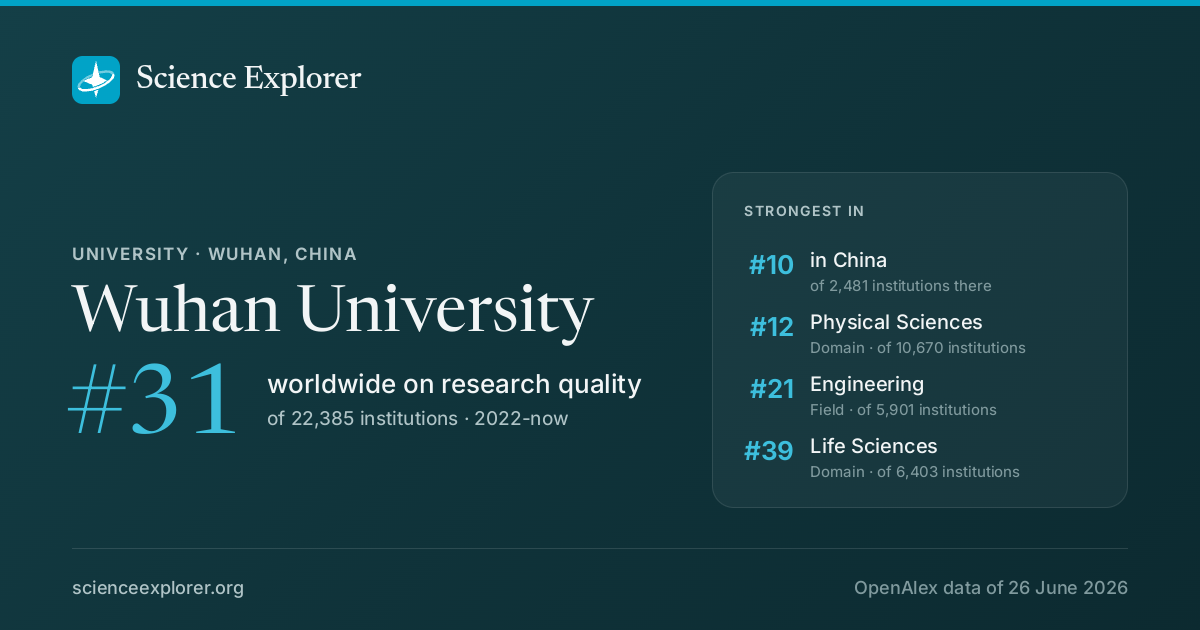
Badges for a website10Each links back here and updates with every snapshot
Its overall standing, then the domains, fields and subfields where Wuhan University is in the world's top ten or its top 1%. Each has an image of its own.
Overall

Domains


Fields


Subfields


Research measures only: rankings here say nothing about teaching, admissions or student experience. Comparable institutions and collaboration partners have tabs of their own, above.
Discussion
Ask a question or share a note about Wuhan University. Keep it to the research: no personal attacks, advertising or links. Any reader can report a post, which collapses it for everyone until it is opened.