- Research works
- 246k fractional, since 1950
- In the world top 10%
- 25k per year above
- Top-10% rate
- 10.0% share of its works in the world top 10%
- Topics
- 6
- Growth, 2018-21 → 2022-25
- +7% the tick is no change
- Largest producer
 China
32% of the 10 largest, 2022-now
This ranks research output and citation impact. It says nothing about the quality of diagnosis, treatment or care.
What is Hepatology research about, and what is growing?
By the world's output in 2021-25, its most used keywords are Treatment, Diagnosis, Management, Epidemiology, Hepatocellular Carcinoma, Liver Cancer. Gaining share since 2011-15: Autoimmune Hepatitis, Primary Biliary Cirrhosis, Hepatic Encephalopathy, Liver Cirrhosis, Diagnosis. Losing share: Hepatitis C Virus, Ribavirin, Hepatic Stellate Cells, Liver Regeneration.
- Zoonotic Transmission
- Liver Regeneration
- Primary Biliary Cirrhosis
- Ribavirin
- Liver Cirrhosis
- Liver Cancer
- Epidemiology
- Diagnosis
- Treatment
- Management
- Hepatocellular Carcinoma
- Hepatic Encephalopathy
- Hepatitis C Virus
- Autoimmune Hepatitis
- Hepatic Stellate Cells
- Hepatitis E Virus
Size is the world's fractional works in 2021-25 in the topics tagged with each word; colour compares the word's share of this field with 2011-15. Each links to the topic it comes from most.
All 16 words, with their numbers
- Treatment25k◆ 0.91×2 topics
- Diagnosis20k▲ 1.25×2 topics
- Management20k▲ 1.25×2 topics
- Epidemiology18k▼ 0.80×3 topics
- Hepatocellular Carcinoma15k▲ 1.22×1 topic
- Liver Cancer15k▲ 1.22×1 topic
- Hepatic Encephalopathy15k▲ 1.29×1 topic
- Liver Cirrhosis15k▲ 1.29×1 topic
- Hepatitis C Virus9,685▼ 0.65×1 topic
- Ribavirin9,685▼ 0.65×1 topic
- Autoimmune Hepatitis5,133▲ 1.33×1 topic
- Primary Biliary Cirrhosis5,133▲ 1.33×1 topic
- Hepatic Stellate Cells4,580▼ 0.78×1 topic
- Liver Regeneration4,580▼ 0.78×1 topic
- Hepatitis E Virus3,625▼ 0.82×1 topic
- Zoonotic Transmission3,625▼ 0.82×1 topic
Which countries lead Hepatology research?
On research quality in 2022-now, the United States, China and France rank highest in Hepatology. By volume, China and the United States publish the most (11k and 9.1k works in 2022-now).
By research quality, 2022-now
- 1
 United States #1 all time
1.01× citation excellence · 1.66× journals · 100% breadth
11.5% top 10% · 7.8k works
- 2
China #5 all time
1.24× citation excellence · 0.83× journals · 100% breadth
12.2% top 10% · 9.4k works
- 3
 France #2 all time
1.45× citation excellence · 2.24× journals · 100% breadth
12.3% top 10% · 1.1k works
- 4
 Germany #3 all time
1.32× citation excellence · 1.78× journals · 100% breadth
10.7% top 10% · 1.5k works
- 5
 United Kingdom #4 all time
1.11× citation excellence · 1.47× journals · 100% breadth
13.4% top 10% · 1.3k works
- 6
 Netherlands #8 all time
1.59× citation excellence · 1.89× journals · 100% breadth
14.6% top 10% · 418 works
- 7
 Spain #6 all time
1.33× citation excellence · 1.31× journals · 100% breadth
12.4% top 10% · 998 works
- 8
 Italy #9 all time
1.42× citation excellence · 0.89× journals · 100% breadth
13.7% top 10% · 1.6k works
- 9
 Switzerland #7 all time
1.43× citation excellence · 2.21× journals · 100% breadth
13.6% top 10% · 290 works
- 10
 Canada #10 all time
1.12× citation excellence · 1.41× journals · 100% breadth
11.8% top 10% · 671 works
The track on each row is that row's top-10% rate. The ranking itself is the quality score, which compares the rate with what each place's own topics predict, adds its share of papers in the Nature Index journals, and counts output and breadth too.
Of 31 countries ranked in Hepatology. Ranked on the quality score for 2022-now; the bracket is the all-time rank.
All countries ranked in HepatologyBy volume, 2022-now
- 1
China
11k works
- 2
United States
9.1k works
- 3
 Japan
2.7k works
- 4
 India
2.5k works
- 5
Italy
1.8k works
- 6
Germany
1.7k works
- 7
United Kingdom
1.5k works
- 8
 South Korea
1.5k works
- 9
France
1.2k works
- 10
Spain
1.1k works
How concentrated that is
The same countries as shares of everything the list above accounts for. A node where two countries do two thirds of the work and one spread evenly across twelve read alike as a ranking and not at all alike here.
Shares of the rows listed above, not of the whole node.
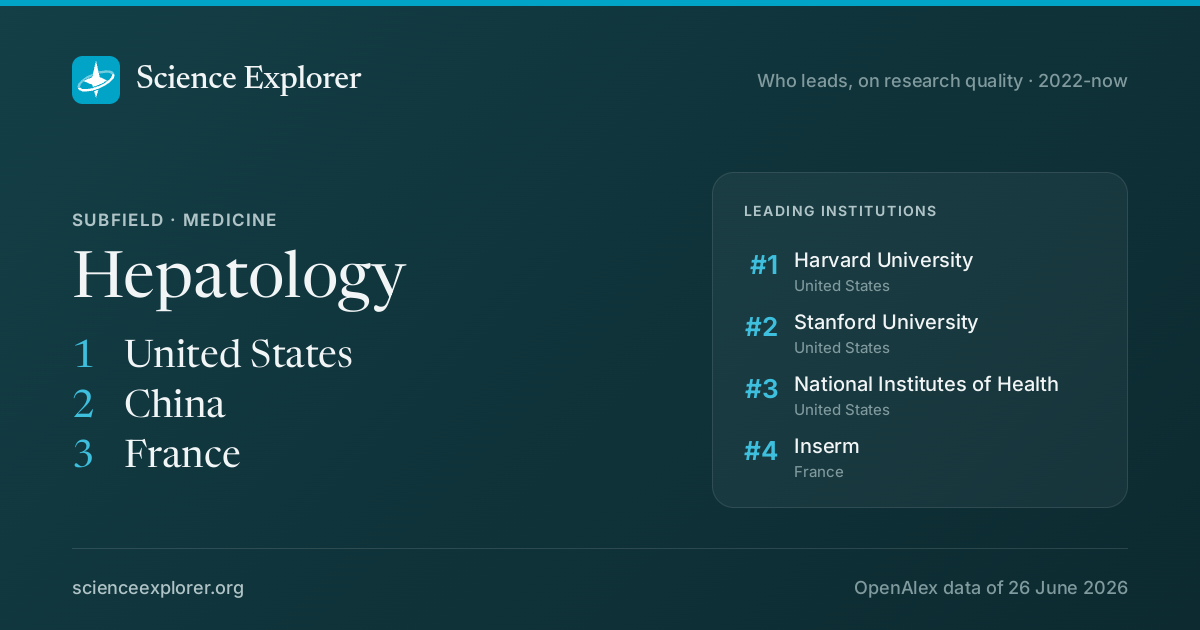
Which institutions lead Hepatology research?
Harvard University (United States) ranks first in Hepatology on research quality in 2022-now, followed by Stanford University and National Institutes of Health.
By research quality, 2022-now
- 1
Harvard University United States · Cambridge · #1 all time
14.4% top 10% · 245 works
- 2
Stanford University United States · Stanford · #4 all time
19.2% top 10% · 134 works
- 3
National Institutes of Health United States · Bethesda · #2 all time
21.7% top 10% · 93 works
- 4
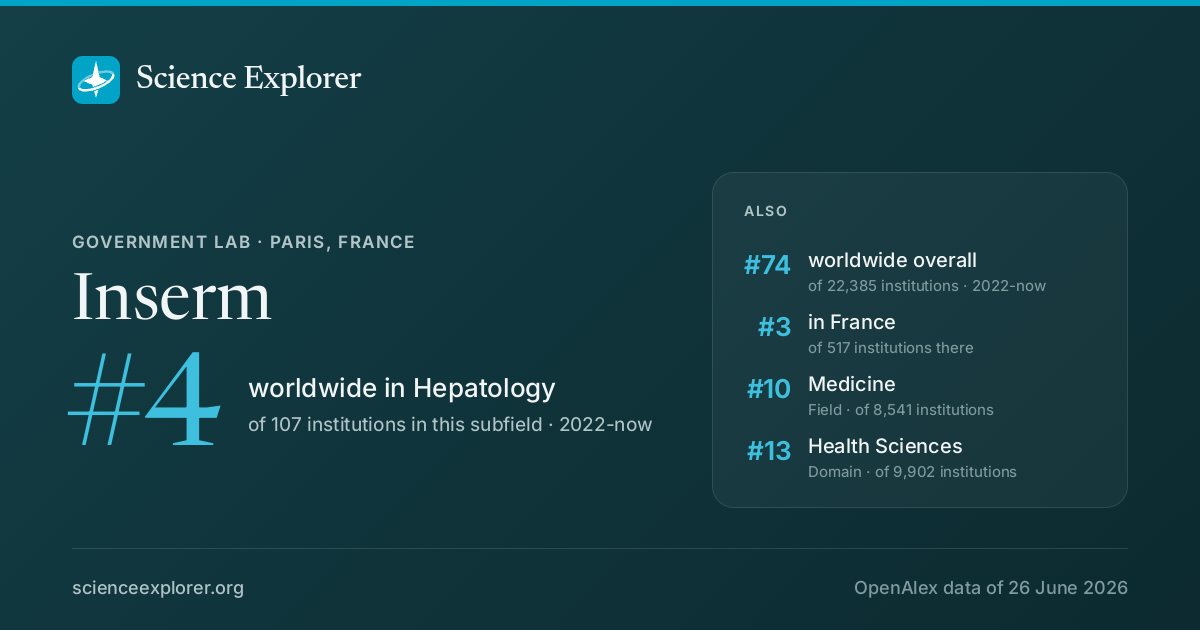
Inserm France · Paris · #3 all time
15.5% top 10% · 166 works
- 5
Sun Yat-sen University China · Guangzhou · #27 all time
12.1% top 10% · 472 works
- 6
University of California San Diego United States · San Diego · #7 all time
26.6% top 10% · 76 works
- 7
Université Paris Cité France · Paris · #8 all time
14.8% top 10% · 106 works
- 8
University of Pennsylvania United States · Philadelphia · #15 all time
17.5% top 10% · 97 works
- 9
University of California, San Francisco United States · San Francisco · #10 all time
11.3% top 10% · 111 works
- 10
Fudan University China · Shanghai · #41 all time
12.8% top 10% · 229 works





The track on each row is that row's top-10% rate. The ranking itself is the quality score, which compares the rate with what each place's own topics predict, adds its share of papers in the Nature Index journals, and counts output and breadth too.
Of 107 institutions above the floor of 40 fractional works in Hepatology.
Top 100 Hepatology institutionsBy volume, 2022-now
- 1
Sun Yat-sen UniversityChina
541 works
- 2
Capital Medical UniversityChina
326 works
- 3
Sichuan UniversityChina
311 works
- 4
Zhejiang UniversityChina
283 works
- 5
Harvard UniversityUnited States
282 works
- 6
Fudan UniversityChina
258 works
- 7
Mayo ClinicUnited States
251 works
- 8
Shanghai Jiao Tong UniversityChina
221 works
- 9
Peking UniversityChina
219 works
- 10
Huazhong University of Science and TechnologyChina
199 works
Who are the leading researchers in Hepatology?
Counting only their work in Hepatology, Rohit Seth Loomba, Arun Jayant Sanyal and Vincent Wai‐Sun Wong have the most papers in the world top 10% for their subfield and year beyond the 10% expected.
- 1
Rohit Seth Loomba
United States · #2,023 worldwide overall
100.0 of 180 papers here in the top 10%
- 2
Arun Jayant Sanyal
United States · #3,037 worldwide overall
103.7 of 231 papers here in the top 10%
- 3
Vincent Wai‐Sun Wong
China · #5,866 worldwide overall
102.1 of 252 papers here in the top 10%
- 4
Masatoshi Kudo
Japan · #95,747 worldwide overall
121.4 of 416 papers here in the top 10%
- 5
Michael Peter Manns
Germany · #100,220 worldwide overall
110.9 of 465 papers here in the top 10%
- 6
Amit G. Singal
United States · #14,515 worldwide overall
80.9 of 198 papers here in the top 10%
- 7
Zobair M. Younossi
United States · #25,117 worldwide overall
95.1 of 342 papers here in the top 10%
- 8
Anna S. Lok
United States · #27,785 worldwide overall
84.7 of 256 papers here in the top 10%
- 9
Josep Maria Llovet
United States · #3,316 worldwide overall
72.8 of 150 papers here in the top 10%
- 10
Scott L. Friedman
United States · #7,622 worldwide overall
70.3 of 132 papers here in the top 10%
Ranked on their work in Hepatology alone: how many more of their papers here reached the world top 10% for their subfield and year than the 10% expected, among 835,949 ranked researchers with a paper here. Each paper counts once, so many strong papers outrank one famous one, and a long record of ordinary papers does not climb. Identities come from OpenAlex author disambiguation, which occasionally merges or splits people.
Top 100 Hepatology researchersWhere is Hepatology research done?
The largest centres of Hepatology research in 2022-now are Beijing (China), Guangzhou (China), Shanghai (China) and Seoul (South Korea). Among places with at least 20 works in it, it is an unusually large share of all research in Ōgaki, Clichy and Doylestown.
Largest cities, 2022-now
Where it is the local speciality
- ŌgakiJP · 20.5 works37×
- ClichyFR · 35.9 works32×
- DoylestownUS · 22.1 works28×
- Foster CityUS · 30.8 works22×
- Kashihara-shiJP · 35.3 works12×
Location quotient: how much more of its research is in Hepatology than the world average.
Hepatology research by country
The best places for Hepatology research inside each country, with that country's researchers and world standing.
 Australia
 Greece
 Brazil
 Mexico
Where is the best place to study Hepatology?
Among universities, judged by research, Harvard University, Stanford University and University of California San Diego score highest, combining standing in the field's ranking, citation excellence, specialisation, size, growth and international reach. Research strength is one signal when choosing where to study; it does not measure teaching.
One dot per university in the first ten of the table below, at the default weights. The upper left is the interesting corner: small places doing unusually strong work.
| # | University | Score | Rank in field (all time) | Top 10% | Specialisation | Works | Growth |
|---|---|---|---|---|---|---|---|
| 1 | Harvard UniversityUnited States |
80.5 | #1 (#1) | 14.4% | 2.2× | 282 | -14.5% |
| 2 | Stanford UniversityUnited States |
70.4 | #2 (#4) | 18.4% | 2.5× | 152 | +5.3% |
| 3 | University of California San DiegoUnited States |
65.6 | #6 (#7) | 24.9% | 2.3× | 91 | -7.1% |
| 4 | Université Paris CitéFrance |
59.1 | #7 (#8) | 15.1% | 3.9× | 120 | -6.7% |
| 5 | Sun Yat-sen UniversityChina |
58.3 | #5 (#27) | 11.9% | 6.4× | 541 | +23.2% |
| 6 | Johns Hopkins UniversityUnited States |
58.0 | #11 (#6) | 11.3% | 2.3× | 144 | -12.1% |
| 7 | Chinese University of Hong KongChina |
57.3 | #16 (#18) | 22.5% | 3.1× | 93 | -9.2% |
| 8 | University of California, San FranciscoUnited States |
55.9 | #9 (#10) | 11.4% | 4.4× | 128 | -9.8% |
| 9 | University of TorontoCanada |
53.7 | #14 (#13) | 14.2% | 1.7× | 144 | -11.1% |
| 10 | University of PennsylvaniaUnited States |
53.1 | #8 (#15) | 17.0% | 2.5× | 109 | -14.4% |
| 11 | University of MichiganUnited States |
52.6 | #15 (#17) | 14.9% | 1.8× | 110 | +9.0% |
| 12 | University College LondonUnited Kingdom |
52.1 | #18 (#14) | 16.7% | 1.7× | 111 | -21.3% |
| 13 | University of Hong KongChina |
51.3 | #29 (#21) | 17.1% | 2.2× | 82 | -10.4% |
| 14 | Fudan UniversityChina |
49.2 | #10 (#41) | 12.8% | 4.0× | 258 | +7.5% |
| 15 | Medical University of Vienna Austria |
48.7 | #28 (#34) | 16.1% | 7.5× | 98 | +6.7% |
| 16 | Karolinska Institutet Sweden |
47.7 | #24 (#49) | 18.5% | 3.9× | 90 | +3.5% |
| 17 | Universitat de BarcelonaSpain |
47.0 | #49 (#16) | 14.7% | 2.8× | 86 | -22.3% |
| 18 | Heidelberg UniversityGermany |
46.2 | #27 (#19) | 11.2% | 3.9× | 122 | -24.1% |
| 19 | Yale UniversityUnited States |
46.0 | #19 (#26) | 10.7% | 2.6× | 117 | -0.1% |
| 20 | Zhejiang UniversityChina |
45.2 | #13 (#59) | 13.6% | 2.6× | 283 | -0.7% |
| 21 | Virginia Commonwealth UniversityUnited States |
45.2 | #48 (#54) | 21.2% | 5.7× | 79 | -1.3% |
| 22 | Baylor College of MedicineUnited States |
44.5 | #35 (#32) | 13.4% | 4.1× | 84 | -2.6% |
| 23 | Sorbonne UniversitéFrance |
44.5 | #46 (#23) | 12.5% | 2.5× | 68 | -5.3% |
| 24 | Sichuan UniversityChina |
43.2 | #26 (#70) | 10.9% | 3.4× | 311 | +28.7% |
| 25 | Shanghai Jiao Tong UniversityChina |
43.0 | #12 (#68) | 11.8% | 1.9× | 222 | +14.2% |
| 26 | Peking UniversityChina |
42.6 | #22 (#76) | 11.6% | 2.6× | 219 | +21.1% |
| 27 | Erasmus University RotterdamNetherlands |
42.1 | - (#31) | 20.2% | 3.1× | 65 | -16.1% |
| 28 | National University of Singapore Singapore |
42.0 | #25 (#63) | 19.5% | 1.4× | 70 | -8.1% |
| 29 | University of California, Los AngelesUnited States |
41.8 | #44 (#28) | 10.2% | 2.4× | 114 | -6.7% |
| 30 | Northwestern UniversityUnited States |
41.3 | #33 (#33) | 10.9% | 3.1× | 105 | -15.4% |
| 31 | University of OxfordUnited Kingdom |
40.9 | - (#24) | 16.8% | 1.0× | 55 | -19.0% |
| 32 | University of Southern CaliforniaUnited States |
40.8 | #50 (#46) | 11.9% | 2.2× | 74 | +8.6% |
| 33 | Seoul National UniversitySouth Korea |
40.7 | #45 (#38) | 10.4% | 3.8× | 174 | -16.4% |
| 34 | Cornell UniversityUnited States |
40.6 | #31 (#40) | 10.0% | 2.1× | 114 | -3.4% |
| 35 | National Taiwan University Taiwan |
40.3 | #65 (#44) | 14.9% | 3.7× | 98 | -9.2% |
| 36 | King's College LondonUnited Kingdom |
39.1 | #51 (#50) | 12.1% | 2.6× | 93 | -10.5% |
| 37 | Chinese Academy of Medical Sciences & Peking Union Medical CollegeChina |
38.8 | #42 (#118) | 12.9% | 4.6× | 198 | +59.2% |
| 38 | Universität HamburgGermany |
38.8 | #40 (#29) | 12.3% | 2.6× | 78 | -30.7% |
| 39 | Yonsei UniversitySouth Korea |
38.1 | #43 (#78) | 14.8% | 4.5× | 168 | -13.2% |
| 40 | The Ohio State UniversityUnited States |
38.1 | #34 (#92) | 13.7% | 2.4× | 118 | +7.4% |
| 41 | Medizinische Hochschule HannoverGermany |
37.9 | #55 (#61) | 12.2% | 9.4× | 100 | +0.8% |
| 42 | Huazhong University of Science and TechnologyChina |
37.5 | #36 (#129) | 13.9% | 2.7× | 199 | +38.6% |
| 43 | University of ChicagoUnited States |
34.8 | - (#79) | 15.7% | 1.7× | 59 | +36.1% |
| 44 | Xiamen UniversityChina |
34.2 | - (#94) | 16.1% | 1.8× | 63 | +77.4% |
| 45 | Southern Medical UniversityChina |
34.1 | #60 (#158) | 12.9% | 5.9× | 150 | +23.6% |
| 46 | Imperial College LondonUnited Kingdom |
33.9 | - (#74) | 18.8% | 1.3× | 54 | -14.3% |
| 47 | Newcastle UniversityUnited Kingdom |
33.7 | - (#106) | 23.3% | 1.9× | 38 | -9.7% |
| 48 | Capital Medical UniversityChina |
33.0 | #68 (#222) | 8.2% | 7.5× | 326 | +39.7% |
| 49 | Jilin UniversityChina |
33.0 | #64 (#159) | 17.3% | 1.9× | 90 | +23.2% |
| 50 | Humanitas UniversityItaly |
32.8 | - (#105) | 11.6% | 11.2× | 66 | -0.3% |
| 51 | University of BernSwitzerland |
32.5 | - (#65) | 17.8% | 2.1× | 46 | -30.1% |
| 52 | University of UlsanSouth Korea |
31.7 | #75 (#109) | 12.1% | 9.7× | 76 | -10.9% |
| 53 | Second Military Medical UniversityChina |
28.6 | #81 (#220) | 12.7% | 16.0× | 74 | +15.3% |
| 54 | Guangxi Medical UniversityChina |
27.0 | #97 (#334) | 11.0% | 12.6× | 130 | +90.7% |
| 55 | Ulsan CollegeSouth Korea |
26.2 | - (#151) | 12.1% | 14.9× | 58 | -18.2% |
| 56 | University of GenevaSwitzerland |
25.4 | - (#99) | 9.1% | 1.6× | 28 | -26.9% |
| 57 | Maastricht UniversityNetherlands |
24.6 | - (#178) | 14.6% | 1.7× | 27 | -15.3% |
| 58 | Radboud University NijmegenNetherlands |
23.3 | - (#120) | 8.8% | 1.1× | 28 | -16.6% |
| 59 | Chang Gung UniversityTaiwan |
20.8 | - (#269) | 7.8% | 9.2× | 53 | -10.4% |
| 60 | University of Chinese Academy of SciencesChina |
17.6 | - | 19.7% | 0.4× | 24 | -1.5% |
| 61 | Kurume UniversityJapan |
16.3 | - (#353) | 12.6% | 13.3× | 30 | -19.1% |
| 62 | Menoufia University Egypt |
15.3 | #106 (#409) | 2.3% | 9.4× | 88 | -14.2% |
| 63 | King Saud University Saudi Arabia |
15.2 | - (#382) | 6.2% | 0.7× | 29 | +16.8% |
| 64 | Nara Medical UniversityJapan |
13.6 | - (#374) | 5.8% | 12.5× | 37 | -10.6% |






Universities only. The score blends standing (50%), citation excellence (20%), size (15%), specialisation (5%), growth (5%), international reach (5%), 2022-now; growth compares 2018-21 with 2022-25 and counts up to +20%, since a jump from a small base is mostly noise. Standing is the score in this field's institution ranking, three quarters over all time and a quarter 2022-now; excellence averages the two windows too. Four years alone undercount fields such as AI, where many conference and arXiv papers from 2022 on carry no affiliation in the data.
Every institution in Hepatology, country by countryIs Hepatology research growing?
Output in 2022-2025 was 7% higher than in 2018-2021, peaking in 2025. The fastest-growing topics are Liver Diseases and Immunity, Liver Disease and Transplantation and Hepatocellular Carcinoma Treatment and Prognosis.
The same series as a ribbon: one cell per year, darker for more. The line above answers how much; this answers when.
Its share of all research
Growing output can still be a shrinking share: all of science grows. This is Hepatology as a percentage of every work published that year, 0.19% in 2024.
Fractional works of Hepatology over all fractional works that year. How the balance of science has shifted.
How much of it reaches the world top 10%
Year by year.
Of each year's works in it, the share that reached the world's 10% most cited for their field and year. A field is the world for its own topics, so there is no other line to hold it against.
Which topics inside it are moving
Growth and decline on one axis around a shared zero. Two lists side by side hide the thing that matters: whether the growth dwarfs the decline, or the other way round.
- Liver Diseases and Immunity+33%
- Liver Disease and Transplantation+18%
- Hepatocellular Carcinoma Treatment and Prognosis+13%
- Liver physiology and pathology+6%
- Hepatitis Viruses Studies and Epidemiology-8%
- Hepatitis C virus research-16%
Growth in output from 2018-21 to 2022-25. Every topic is a page of its own.
What does Hepatology include?
Area is fractional works in that topic. Every name below is a page of its own.
Share who leads Hepatology
The leading institutions' badges6Each links to that institution's page and updates with every snapshot







Discussion
Ask a question or share a note about Hepatology. Keep it to the research: no personal attacks, advertising or links. Any reader can report a post, which collapses it for everyone until it is opened.