Yonsei University
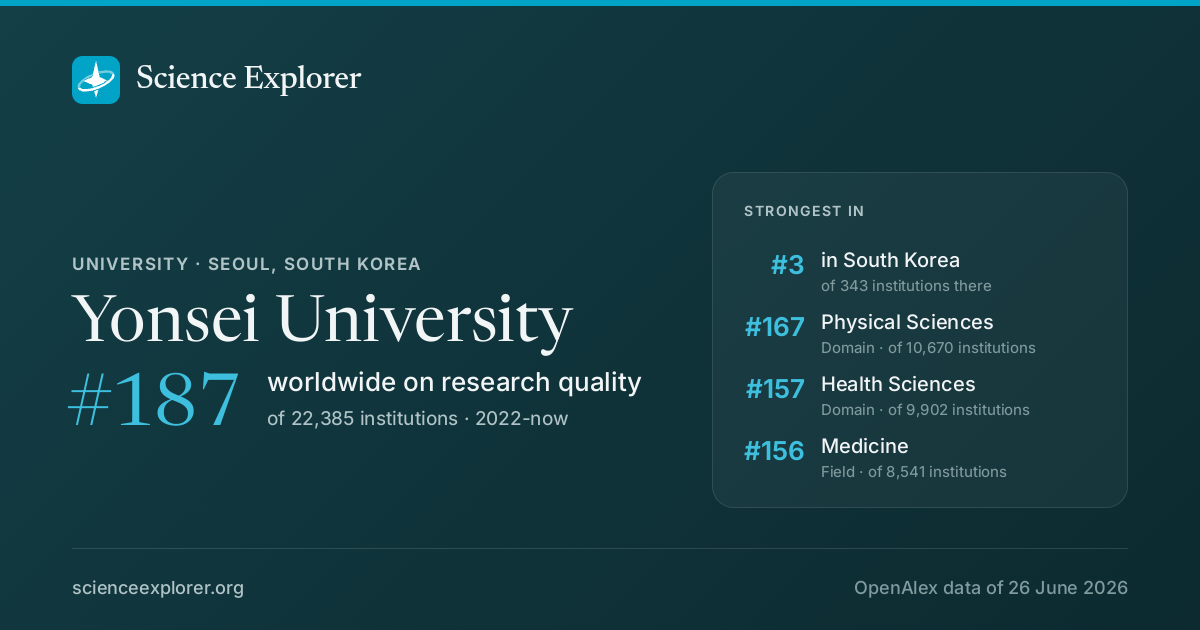
In research, Yonsei University stands highest in Physical Sciences (#167 of 10,670 worldwide), Health Sciences (#157 of 9,902 worldwide) and Medicine (#156 of 8,541 worldwide), 2022-now. Relative to its size it is most specialised in Leadership and Management, Orthodontics and Transplantation (Leadership and Management is 6.3× its share of world research).
- World rank, 2022-now
- #187 of 22,385 · #285 all time
- Rank in South Korea
- #3 of 343
- Research works
- 98k ▲ 6% vs 2018-21
- Citations
- 1.9M 19.6 per fractional work
- Top-10% rate
- 12.3% all institutions 10.0%
- vs its own fields
- 1.02× 1.00× is exactly expected
- Open access
- 52% world 40%
- International
- 15% world 18%
What is Yonsei University known for in research?
The fields where it stands highest, 2022-now, ranked among every institution above the floor in each field.
| Field | World rank | Where that sits | Top-10% rate | Works | All time |
|---|---|---|---|---|---|
| Physical SciencesDomain | #167 of 10,670 | 12.8% | 6,399 | #310 | |
| Health SciencesDomain | #157 of 9,902 | 12.2% | 8,255 | #236 | |
| MedicineField | #156 of 8,541 | 11.9% | 7,271 | #234 | |
| EngineeringField | #119 of 5,901 | 13.9% | 2,781 | #165 | |
| Computer ScienceField | #146 of 4,417 | 13.2% | 1,310 | #221 | |
| Social SciencesDomain | #428 of 9,585 | 13.2% | 2,166 | #415 | |
| Life SciencesDomain | #288 of 6,403 | 10.7% | 2,195 | #389 | |
| DentistryField | #19 of 405 | 16.3% | 353 | #47 | |
| Health ProfessionsField | #91 of 1,895 | 13.5% | 506 | #216 | |
| SurgerySubfield | #84 of 1,532 | 12.9% | 1,049 | #126 |
Each strip is that field's whole ranked pool, with the notch where Yonsei University sits in it, in the colour of the band that rank falls in. The track under the rate is the rate itself: it carries no average mark, because the average differs by field (from about 6% in Dentistry to 21% in Economics).
Which of those standings moved
The same fields on both windows: where it stood over the whole record, and where it stands in 2022-now. The distance is the story, and it is the one thing the two rank columns above cannot show.
- Physical Sciences#310 #167
- Health Sciences#236 #157
- Medicine#234 #156
- Engineering#165 #119
- Computer Science#221 #146
- Social Sciences#415 #428
- Life Sciences#389 #288
- Dentistry#47 #19
- Health Professions#216 #91
- Surgery#126 #84
A dot further right is a better standing. Fields it was not ranked in over the whole record are left out.
Which fields of science does Yonsei University work in?
In 2022-now, 43% of research at Yonsei University is in Health Sciences, 34% in Physical Sciences. Its largest fields are Medicine (38%), Engineering (14%), Computer Science (7%). It does 1.9× the world's share of Health Sciences.
Each ring splits the one inside it: the four domains of science, their fields, their subfields. Size is fractional works in 2022-now. Every slice is a page; the interactive view zooms down to single topics and colours each by how much more of it this institution does than the world.
Its 4 domains and 26 fields, with their numbers
- Health Sciences9,27543.3%
- Medicine8,16438.1%
- Health Professions5672.6%
- Dentistry4071.9%
- Nursing1290.6%
- Veterinary80.0%
- Physical Sciences7,20733.7%
- Engineering3,08314.4%
- Computer Science1,5237.1%
- Materials Science8774.1%
- Environmental Science5152.4%
- Physics and Astronomy4021.9%
- Chemistry2221.0%
- Earth and Planetary Sciences1880.9%
- Energy1720.8%
- Mathematics1440.7%
- Chemical Engineering820.4%
- Life Sciences2,48311.6%
- Social Sciences2,45211.4%
- Social Sciences9364.4%
- Psychology6583.1%
- Business, Management and Accounting3121.5%
- Economics, Econometrics and Finance2611.2%
- Arts and Humanities1560.7%
- Decision Sciences1290.6%
What does Yonsei University specialise in?
Where its research is concentrated relative to its size: Leadership and Management takes 6.3× the share of its output that it takes of world research.
- Leadership and ManagementSubfield · 20.7 works6.3×
- OrthodonticsSubfield · 129.1 works5.4×
- TransplantationSubfield · 49.2 works5.2×
- Complementary and Manual TherapySubfield · 40.8 works4.6×
- HepatologySubfield · 168.3 works4.1×
- Oral SurgerySubfield · 168.3 works4.1×
- DentistryField · 407.3 works3.9×
- DermatologySubfield · 175.1 works3.1×
Location quotient, a volume reading rather than an impact one. It surfaces small, lopsided specialities.
Field profile
Location quotient across every field it publishes in: outside the ring is more than an institution of this size would be expected to publish, inside it is less.
Rings at 0.5×, 1× and 2×. Widest outward: Dentistry, 3.9×. Every wedge is a field page.
All 26 fields, with their numbers
- Dentistry3.92×407 works
- Medicine1.98×8,164 works
- Neuroscience1.45×504 works
- Immunology and Microbiology1.31×282 works
- Biochemistry, Genetics and Molecular Biology1.30×1,489 works
- Nursing1.23×129 works
- Materials Science1.17×877 works
- Chemical Engineering1.09×82 works
- Psychology1.01×658 works
- Health Professions1.00×567 works
- Engineering0.96×3,083 works
- Pharmacology, Toxicology and Pharmaceutics0.91×69 works
- Computer Science0.91×1,523 works
- Energy0.87×172 works
- Physics and Astronomy0.84×402 works
- Chemistry0.66×222 works
- Decision Sciences0.62×129 works
- Mathematics0.57×144 works
- Economics, Econometrics and Finance0.57×261 works
- Earth and Planetary Sciences0.56×188 works
- Environmental Science0.48×515 works
- Business, Management and Accounting0.45×312 works
- Social Sciences0.35×936 works
- Veterinary0.27×8 works
- Arts and Humanities0.25×156 works
- Agricultural and Biological Sciences0.14×138 works
- Dentistry 3.9×
- Medicine 2.0×
- Neuroscience 1.4×
- Immunology and Microbiology 1.3×
- Biochemistry, Genetics and Molecular Biology 1.3×
- Nursing 1.2×
- Materials Science 1.2×
- Chemical Engineering 1.1×
- Psychology 1.0×
- Health Professions 1.0×
- Engineering 1.0×
- Pharmacology, Toxicology and Pharmaceutics 0.9×
- Computer Science 0.9×
- Energy 0.9×
- Physics and Astronomy 0.8×
- Chemistry 0.7×
- Decision Sciences 0.6×
- Mathematics 0.6×
- Economics, Econometrics and Finance 0.6×
- Earth and Planetary Sciences 0.6×
- Environmental Science 0.5×
- Business, Management and Accounting 0.5×
- Social Sciences 0.3×
- Veterinary 0.3×
- Arts and Humanities 0.2×
- Agricultural and Biological Sciences 0.1×
Who are the top researchers at Yonsei University?
Ranked on the quality score, Biswajit Sarkar, Jang‐Ung Park and Ki Jun Yu lead among researchers whose main affiliation is Yonsei University.
- 1
Biswajit Sarkar
 South Korea · #2,781 worldwide
19k citations · 436 works
- 2
Jang‐Ung Park
South Korea · #5,169 worldwide
20k citations · 219 works
- 3
Ki Jun Yu
South Korea · #12,834 worldwide
17k citations · 135 works
- 4
Shude Liu
South Korea · #13,062 worldwide
12k citations · 158 works
- 5
Jong‐Hyun Ahn
South Korea · #19,300 worldwide
53k citations · 398 works
- 6
Byoung Chul Cho
South Korea · #22,406 worldwide
70k citations · 1,620 works
- 7
Jeonghun Kim
South Korea · #26,866 worldwide
24k citations · 340 works
- 8
Jinwoo Cheon
South Korea · #30,561 worldwide
31k citations · 292 works
- 9
Jae Il Shin
South Korea · #31,218 worldwide
100k citations · 968 works
- 10
Jooho Moon
South Korea · #44,135 worldwide
24k citations · 414 works
Which keywords describe research at Yonsei University?
By fractional works in 2022-now, weighted toward what it does more of than the world: Epidemiology, Inflammation, Deep Learning, Quality of Life, Chemotherapy, Cardiovascular Disease, Treatment and Clinical Practice Guidelines.
- Targeted Therapy
- Hepatocellular Carcinoma
- Surgical Management
- Precision Medicine
- Radiotherapy
- Prognostic Factors
- Guidelines
- Global Burden
- Complications
- Tumor Microenvironment
- Obesity
- Biomarkers
- Clinical Trials
- Metabolic Syndrome
- Risk Factors
- Neural Networks
- Cancer
- Cardiovascular Disease
- Quality of Life
- Inflammation
- Epidemiology
- Deep Learning
- Machine Learning
- Treatment
- Oxidative Stress
- Chemotherapy
- Clinical Practice Guidelines
- Diagnosis
- Immunotherapy
- Biomedical Applications
- Management
- Aging
- Social Support
- Neurological Disorders
- Insulin Resistance
- Medical Imaging
- Mortality
- Rehabilitation
- Survival Analysis
- Neoadjuvant Therapy
Size is fractional works in 2022-now in the topics tagged with each word; colour is the word's share of this institution's work against its share of the world's. The 40 words are chosen for being large and distinctive. Each links to the topic it comes from most.
All 40 words, with their numbers
- Epidemiology1,394▲ 1.63×128 topics
- Inflammation932▲ 2.0×83 topics
- Deep Learning921▲ 1.25×83 topics
- Quality of Life649▲ 2.1×54 topics
- Machine Learning599▼ 0.84×90 topics
- Cardiovascular Disease519▲ 2.1×39 topics
- Treatment517▲ 1.98×51 topics
- Cancer487▲ 1.69×58 topics
- Oxidative Stress483▲ 1.37×61 topics
- Neural Networks451▲ 1.37×40 topics
- Chemotherapy438▲ 2.9×24 topics
- Risk Factors376▲ 1.60×37 topics
- Clinical Practice Guidelines372▲ 3.2×14 topics
- Metabolic Syndrome361▲ 2.1×22 topics
- Diagnosis351▲ 1.76×39 topics
- Clinical Trials351▲ 2.5×19 topics
- Immunotherapy336▲ 2.2×19 topics
- Biomarkers317▲ 2.1×18 topics
- Biomedical Applications310▲ 1.22×36 topics
- Obesity302▲ 1.83×27 topics
- Management293▲ 1.71×34 topics
- Tumor Microenvironment274▲ 2.8×8 topics
- Aging272▲ 2.3×18 topics
- Complications264▲ 2.5×17 topics
- Social Support263▲ 2.3×17 topics
- Global Burden257▲ 2.2×12 topics
- Neurological Disorders247▲ 2.0×20 topics
- Guidelines246▲ 2.4×13 topics
- Insulin Resistance235▲ 2.4×10 topics
- Prognostic Factors234▲ 2.5×14 topics
- Medical Imaging233▲ 2.1×9 topics
- Radiotherapy233▲ 2.8×13 topics
- Mortality230▲ 1.89×13 topics
- Precision Medicine225▲ 2.1×8 topics
- Rehabilitation207▲ 2.4×13 topics
- Surgical Management203▲ 2.3×20 topics
- Survival Analysis199▲ 3.4×7 topics
- Hepatocellular Carcinoma198▲ 4.5×3 topics
- Neoadjuvant Therapy194▲ 3.8×5 topics
- Targeted Therapy160▲ 3.4×5 topics
Which research topics does Yonsei University publish most on?
By volume in 2022-now: Liver Disease Diagnosis and Treatment, Advanced Sensor and Energy Harvesting Materials, Radiomics and Machine Learning in Medical Imaging and Nutrition and Health in Aging.
Area is fractional works; colour is the subfield each topic belongs to.
- 1 Liver Disease Diagnosis and Treatment Epidemiology 104 works
- 2 Advanced Sensor and Energy Harvesting Materials Biomedical Engineering 94 works
- 3 Radiomics and Machine Learning in Medical Imaging Radiology, Nuclear Medicine and Imaging 86 works
- 4 Nutrition and Health in Aging Physiology 85 works
- 5 Cancer Immunotherapy and Biomarkers Oncology 82 works
- 6 Hepatocellular Carcinoma Treatment and Prognosis Hepatology 74 works
- 7 Health and Wellbeing Research General Health Professions 70 works
- 8 Pancreatic and Hepatic Oncology Research Oncology 70 works
- 9 Advancements in Battery Materials Electrical and Electronic Engineering 68 works
- 10 Atrial Fibrillation Management and Outcomes Cardiology and Cardiovascular Medicine 68 works
How open and international is its research?
Against the world's own shares: the tick on each track. Both are shares of its output, so they sit on one scale and can be read against each other as well as against the world.
World: 40% of research is openly available.
World: 18% is written across borders.
How has Yonsei University's research output changed?
Output in 2022-2025 was 6% higher than in 2018-2021.
The same series as a ribbon: one cell per year, darker for more. The line above answers how much; this answers when.
Its share of all research
Growing output can still be a shrinking share: all of science grows. This is Yonsei University as a percentage of every work published that year, 0.083% in 2024.
Fractional works of Yonsei University over all fractional works that year. How the balance of science has shifted.
How much of it reaches the world top 10%
Year by year, against all institutions in the same year.
Of each year's output, the share that reached the world's 10% most cited for its field and year. Peak 13.0% in 2021.
Other research institutions in Seoul
- Seoul National University
- Sungkyunkwan University
- Korea University
- Hanyang University
- Kyung Hee University
- Catholic University of Korea
- Samsung (South Korea)
- Chung-Ang University
Which institutions have research most like Yonsei University's?
Among the world's leading institutions, Sichuan University has the research profile closest to Yonsei University's, with both strong in Dentistry.
- 1
Sichuan University
 China · Both strong in Dentistry, Medicine, Immunology and Microbiology
0.80 Compare
- 2
Shanghai Jiao Tong UniversityChina · Both strong in Neuroscience, Dentistry, Medicine
0.78 Compare
- 3
Fudan UniversityChina · Both strong in Medicine, Neuroscience, Dentistry
0.76 Compare
- 4
Peking UniversityChina · Both strong in Medicine, Neuroscience, Dentistry
0.73 Compare
- 5
Seoul National UniversitySouth Korea · Both strong in Dentistry, Medicine, Neuroscience
0.71 Compare
Similarity is the correlation of each side's location quotients across every field it publishes in, on a log scale: 1 is the same shape of research, 0 is unrelated. It ignores size. How it is measured.
Compare Yonsei University with
- vs
 Queensland University of Technology
- vs
 Weizmann Institute of Science
- vs
 University of Oslo
- vs
 Memorial Sloan Kettering Cancer Center
- vs
 Friedrich-Alexander-Universität Erlangen-Nürnberg
- vs The University of Texas Southwestern Medical Center
Share Yonsei University's ranking



Research measures only: rankings here say nothing about teaching, admissions or student experience. Comparable institutions and collaboration partners have tabs of their own, above.
Discussion
Ask a question or share a note about Yonsei University. Posts are plain text and can be reported.