Health Informatics research
Health Informatics is a subfield of Medicine. Science Explorer counts 42k research works in it since 1954. 9.8% of them reached the world's top 10% most cited for their field and year.
In short: discipline at the intersection of information science, computer science, and health care.
- Research works
- 42k fractional, since 1954
- In the world top 10%
- 4.1k per year above
- Top-10% rate
- 9.8% share of its works in the world top 10%
- Topics
- 1
- Growth, 2018-21 → 2022-25
- +543% the tick is no change
- Largest producer
 United States
38% of the 10 largest, 2022-now
This ranks research output and citation impact. It says nothing about the quality of diagnosis, treatment or care.
Which countries lead Health Informatics research?
On research quality in 2022-now, the United States, Germany and China rank highest in Health Informatics. By volume, the United States and India publish the most (8.7k and 3.4k works in 2022-now).
By research quality, 2022-now
- 1
United States #1 all time
0.91× citation excellence · 1.78× journals · 100% breadth
10.8% top 10% · 6.4k works
- 2
 Germany #2 all time
1.39× citation excellence · 1.63× journals · 100% breadth
12.7% top 10% · 955 works
- 3
 China #4 all time
1.22× citation excellence · 0.90× journals · 100% breadth
11.8% top 10% · 2.2k works
- 4
 United Kingdom #3 all time
1.06× citation excellence · 1.33× journals · 100% breadth
11.5% top 10% · 1.4k works
- 5
 Netherlands #6 all time
1.32× citation excellence · 1.60× journals · 100% breadth
12.7% top 10% · 317 works
- 6
 Australia #7 all time
1.28× citation excellence · 1.05× journals · 100% breadth
16.1% top 10% · 636 works
- 7
 Canada #5 all time
1.07× citation excellence · 1.18× journals · 100% breadth
12.6% top 10% · 698 works
- 8
 Switzerland
1.22× citation excellence · 1.83× journals · 100% breadth
12.2% top 10% · 217 works
- 9
 South Korea #8 all time
1.41× citation excellence · 1.11× journals · 100% breadth
13.5% top 10% · 365 works
- 10
 France #9 all time
1.05× citation excellence · 1.17× journals · 100% breadth
9.1% top 10% · 347 works
The track on each row is that row's top-10% rate. The ranking itself is the quality score, which compares the rate with what each place's own topics predict, adds its share of papers in the Nature Index journals, and counts output and breadth too.
Of 22 countries ranked in Health Informatics. Ranked on the quality score for 2022-now; the bracket is the all-time rank.
All countries ranked in Health InformaticsBy volume, 2022-now
- 1
United States
8.7k works
- 2
 India
3.4k works
- 3
China
3k works
- 4
United Kingdom
1.9k works
- 5
Germany
1.3k works
- 6
 Türkiye
1k works
- 7
Canada
927 works
- 8
Australia
832 works
- 9
 Italy
829 works
- 10
 Indonesia
802 works
How concentrated that is
The same countries as shares of everything the list above accounts for. A node where two countries do two thirds of the work and one spread evenly across twelve read alike as a ranking and not at all alike here.
Shares of the rows listed above, not of the whole node.
Which institutions lead Health Informatics research?
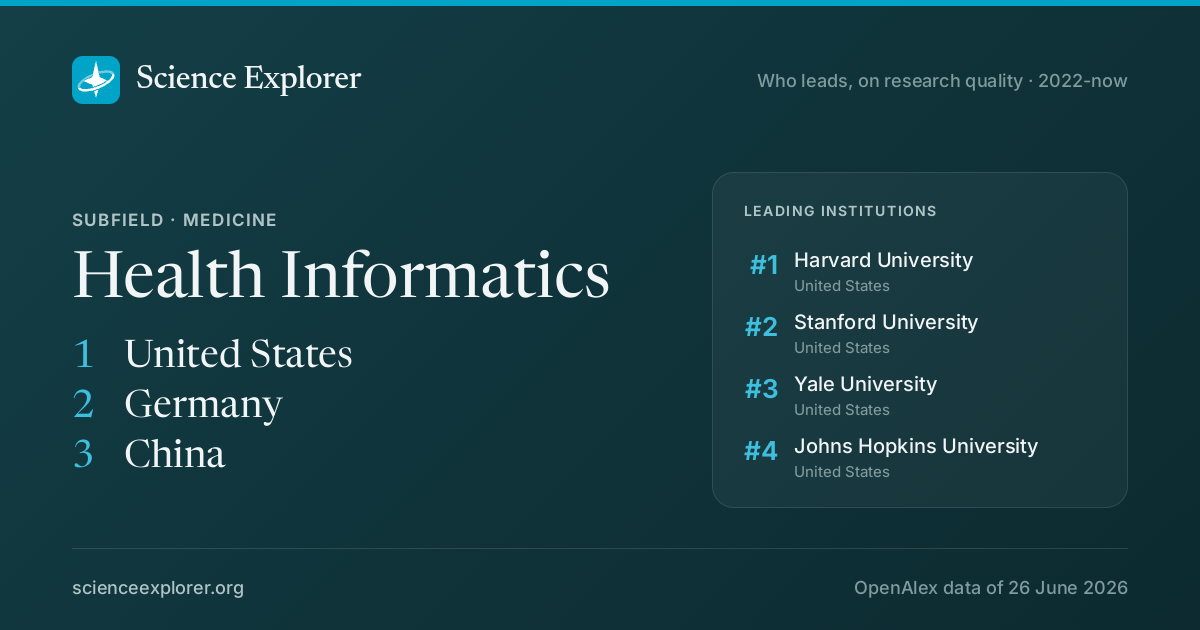
Harvard University (United States) ranks first in Health Informatics on research quality in 2022-now, followed by Stanford University and Yale University.
By research quality, 2022-now
- 1
Harvard University United States · Cambridge · #1 all time
15.9% top 10% · 224 works
- 2
Stanford University United States · Stanford · #2 all time
19.8% top 10% · 123 works
- 3
Yale University United States · New Haven
14.9% top 10% · 74 works
- 4
Johns Hopkins University United States · Baltimore · #3 all time
15.1% top 10% · 81 works
- 5
University of Oxford United Kingdom · Oxford
18.0% top 10% · 61 works
- 6
National University of Singapore
 Singapore · Singapore
20.4% top 10% · 61 works
- 7
University of Toronto Canada · Toronto · #4 all time
14.1% top 10% · 110 works
- 8
New York University United States · New York
12.2% top 10% · 74 works
- 9
University College London United Kingdom · London · #5 all time
12.7% top 10% · 82 works
- 10
Mayo Clinic United States · Rochester · #6 all time
12.5% top 10% · 145 works







The track on each row is that row's top-10% rate. The ranking itself is the quality score, which compares the rate with what each place's own topics predict, adds its share of papers in the Nature Index journals, and counts output and breadth too.
Of 14 institutions above the floor of 40 fractional works in Health Informatics.
Top 100 Health Informatics institutionsBy volume, 2022-now
- 1
Design Intelligence (United States)United States
446 works
- 2
Harvard UniversityUnited States
285 works
- 3
Mayo ClinicUnited States
184 works
- 4
Stanford UniversityUnited States
163 works
- 5
University of TorontoCanada
143 works
- 6
Johns Hopkins UniversityUnited States
113 works
- 7
University College LondonUnited Kingdom
104 works
- 8
New York UniversityUnited States
95 works
- 9
Yale UniversityUnited States
94 works
- 10
University of North Carolina at Chapel HillUnited States
93 works
Who are the leading researchers in Health Informatics?
Counting only their work in Health Informatics, Professor Gary S. Collins, Xiaoxuan Liu and Daniel Shu Wei Ting have the most papers in the world top 10% for their subfield and year beyond the 10% expected.
- 1
Professor Gary S. Collins
United Kingdom · #7,674 worldwide overall
15.8 of 28 papers here in the top 10%
- 2
Xiaoxuan Liu
United Kingdom · #31,925 worldwide overall
12.3 of 24 papers here in the top 10%
- 3
Daniel Shu Wei Ting
Singapore · #2,473 worldwide overall
12.4 of 28 papers here in the top 10%
- 4
Eric J. Topol
United States · #15,524 worldwide overall
11.2 of 20 papers here in the top 10%
- 5
Jakob Nikolas Kather
Germany · #3,109 worldwide overall
12.4 of 32 papers here in the top 10%
- 6
Alastair Keith Denniston
United Kingdom · #35,102 worldwide overall
11.5 of 25 papers here in the top 10%
- 7
Nigam Haresh Shah
United States · #15,388 worldwide overall
11.3 of 24 papers here in the top 10%
- 8
Judy Wawira Gichoya
United States · #69,163 worldwide overall
12.5 of 42 papers here in the top 10%
- 9
Karel G.M. Moons
Netherlands · #7,362 worldwide overall
9.8 of 14 papers here in the top 10%
- 10
Daniel Truhn
Germany · #94,399 worldwide overall
10.5 of 24 papers here in the top 10%
Ranked on their work in Health Informatics alone: how many more of their papers here reached the world top 10% for their subfield and year than the 10% expected, among 200,323 ranked researchers with a paper here. Each paper counts once, so many strong papers outrank one famous one, and a long record of ordinary papers does not climb. Identities come from OpenAlex author disambiguation, which occasionally merges or splits people.
Top 100 Health Informatics researchersWhere is Health Informatics research done?
The largest centres of Health Informatics research in 2022-now are London (United Kingdom), Beijing (China), Norman (United States) and New York (United States). Among places with at least 20 works in it, it is an unusually large share of all research in Issy-les-Moulineaux and Norman.
Largest cities, 2022-now
- 1
LondonUnited Kingdom
585 works
- 2
BeijingChina
485 works
- 3
NormanUnited States
455 works
- 4
New YorkUnited States
452 works
- 5
BostonUnited States
295 works
- 6
SeoulSouth Korea
279 works
- 7
ChennaiIndia
265 works
- 8
ShanghaiChina
265 works
- 9
TorontoCanada
260 works
- 10
SingaporeSingapore
239 works
Where it is the local speciality
- Issy-les-MoulineauxFR · 91.4 works104×
- NormanUS · 454.9 works41×
Location quotient: how much more of its research is in Health Informatics than the world average.
Health Informatics research by country
The best places for Health Informatics research inside each country, with that country's researchers and world standing.
Where is the best place to study Health Informatics?
Among universities, judged by research, Harvard University, Stanford University and Johns Hopkins University score highest, combining standing in the field's ranking, citation excellence, specialisation, size, growth and international reach. Research strength is one signal when choosing where to study; it does not measure teaching.
One dot per university in the first ten of the table below, at the default weights. The upper left is the interesting corner: small places doing unusually strong work.





















Universities only. The score blends standing (50%), citation excellence (20%), size (15%), specialisation (5%), growth (5%), international reach (5%), 2022-now; growth compares 2018-21 with 2022-25 and counts up to +20%, since a jump from a small base is mostly noise. Standing is the score in this field's institution ranking, three quarters over all time and a quarter 2022-now; excellence averages the two windows too. Four years alone undercount fields such as AI, where many conference and arXiv papers from 2022 on carry no affiliation in the data.
Every institution in Health Informatics, country by countryIs Health Informatics research growing?
Output in 2022-2025 was 543% higher than in 2018-2021, peaking in 2025. The fastest-growing topics are Artificial Intelligence in Healthcare and Education.
The same series as a ribbon: one cell per year, darker for more. The line above answers how much; this answers when.
Its share of all research
Growing output can still be a shrinking share: all of science grows. This is Health Informatics as a percentage of every work published that year, 0.13% in 2024.
Fractional works of Health Informatics over all fractional works that year. How the balance of science has shifted.
How much of it reaches the world top 10%
Year by year.
Of each year's works in it, the share that reached the world's 10% most cited for their field and year. A field is the world for its own topics, so there is no other line to hold it against.
Which topics inside it are moving
Growth and decline on one axis around a shared zero. Two lists side by side hide the thing that matters: whether the growth dwarfs the decline, or the other way round.
What does Health Informatics include?
Share who leads Health Informatics
The leading institutions' badges6Each links to that institution's page and updates with every snapshot


Discussion
Ask a question or share a note about Health Informatics. Keep it to the research: no personal attacks, advertising or links. Any reader can report a post, which collapses it for everyone until it is opened.