Hallym University
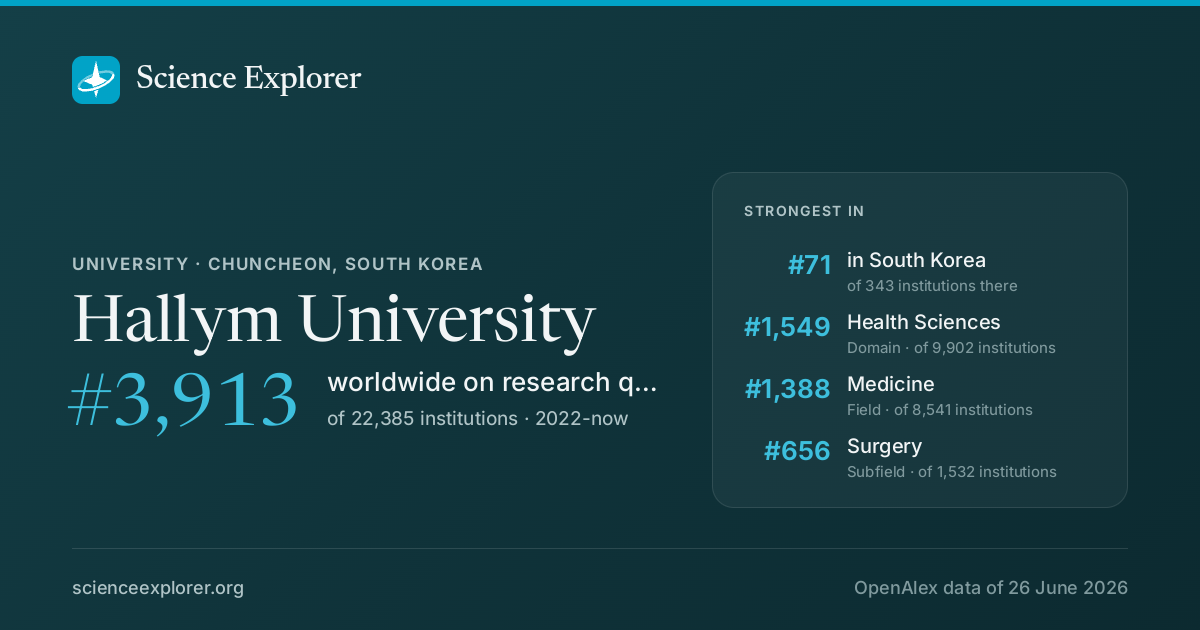
In research, Hallym University stands highest in Health Sciences (#1,549 of 9,902 worldwide), Medicine (#1,388 of 8,541 worldwide) and Surgery (#656 of 1,532 worldwide), 2022-now. Relative to its size it is most specialised in Sensory Systems, Nephrology and Gastroenterology (Sensory Systems is 10.2× its share of world research).
- World rank, 2022-now
- #3,913 of 22,385 · #5,843 all time
- Rank in South Korea
- #71 of 343
- Research works
- 13k ▼ 15% vs 2018-21
- Citations
- 210k 15.7 per fractional work
- Top-10% rate
- 10.4% all institutions 10.0%
- vs its own fields
- 0.92× 1.00× is exactly expected
- Open access
- 60% world 40%
- International
- 16% world 18%
What is Hallym University known for in research?
The fields where it stands highest, 2022-now, ranked among every institution above the floor in each field.
| Field | World rank | Where that sits | Top-10% rate | Works | All time |
|---|---|---|---|---|---|
| Health SciencesDomain | #1,549 of 9,902 | 11.3% | 1,462 | #2021 | |
| MedicineField | #1,388 of 8,541 | 11.2% | 1,338 | #1780 | |
| SurgerySubfield | #656 of 1,532 | 15.4% | 215 | #1331 | |
| Physical SciencesDomain | #5,207 of 10,670 | 8.8% | 325 | #10002 | |
| EpidemiologySubfield | #574 of 927 | 11.1% | 112 | #1065 | |
| Biochemistry, Genetics and Molecular BiologyField | #1,878 of 2,964 | 7.1% | 227 | #3588 | |
| Life SciencesDomain | #4,203 of 6,403 | 7.5% | 432 | #5819 | |
| Pulmonary and Respiratory MedicineSubfield | #728 of 1,037 | 9.8% | 102 | #1323 | |
| Computer ScienceField | #3,304 of 4,417 | 13.2% | 94 | #5010 | |
| Molecular BiologySubfield | #1,416 of 1,880 | 7.4% | 129 | #2743 |
Each strip is that field's whole ranked pool, with the notch where Hallym University sits in it, in the colour of the band that rank falls in. The track under the rate is the rate itself: it carries no average mark, because the average differs by field (from about 6% in Dentistry to 21% in Economics).
Which of those standings moved
The same fields on both windows: where it stood over the whole record, and where it stands in 2022-now. The distance is the story, and it is the one thing the two rank columns above cannot show.
- Health Sciences#2,021 #1,549
- Medicine#1,780 #1,388
- Surgery#1,331 #656
- Physical Sciences#10,002 #5,207
- Epidemiology#1,065 #574
- Biochemistry, Genetics and Molecular Biology#3,588 #1,878
- Life Sciences#5,819 #4,203
- Pulmonary and Respiratory Medicine#1,323 #728
- Computer Science#5,010 #3,304
- Molecular Biology#2,743 #1,416
A dot further right is a better standing. Fields it was not ranked in over the whole record are left out.
Which fields of science does Hallym University work in?
In 2022-now, 61% of research at Hallym University is in Health Sciences, 18% in Life Sciences. Its largest fields are Medicine (56%), Biochemistry, Genetics and Molecular Biology (9%), Neuroscience (5%). It does 2.6× the world's share of Health Sciences.
Each ring splits the one inside it: the four domains of science, their fields, their subfields. Size is fractional works in 2022-now. Every slice is a page; the interactive view zooms down to single topics and colours each by how much more of it this institution does than the world.
Its 4 domains and 26 fields, with their numbers
- Health Sciences1,60961.1%
- Medicine1,47456.0%
- Health Professions823.1%
- Nursing301.1%
- Dentistry220.8%
- Veterinary10.0%
- Life Sciences47718.1%
- Physical Sciences35613.5%
- Engineering1294.9%
- Computer Science1033.9%
- Materials Science351.3%
- Environmental Science351.3%
- Mathematics180.7%
- Chemistry140.5%
- Physics and Astronomy110.4%
- Energy60.2%
- Earth and Planetary Sciences20.1%
- Chemical Engineering20.1%
- Social Sciences1927.3%
- Psychology913.4%
- Social Sciences562.1%
- Decision Sciences130.5%
- Economics, Econometrics and Finance130.5%
- Business, Management and Accounting110.4%
- Arts and Humanities90.3%
What does Hallym University specialise in?
Where its research is concentrated relative to its size: Sensory Systems takes 10.2× the share of its output that it takes of world research.
- Sensory SystemsSubfield · 20.5 works10×
- NephrologySubfield · 40.4 works7.1×
- GastroenterologySubfield · 20.3 works6.5×
- DermatologySubfield · 41.1 works5.9×
Location quotient, a volume reading rather than an impact one. It surfaces small, lopsided specialities.
Field profile
Location quotient across every field it publishes in: outside the ring is more than an institution of this size would be expected to publish, inside it is less.
Rings at 0.5×, 1× and 2×. Widest outward: Neuroscience, 3.4×. Every wedge is a field page.
All 26 fields, with their numbers
- Neuroscience3.37×144 works
- Medicine2.91×1,474 works
- Nursing2.33×30 works
- Biochemistry, Genetics and Molecular Biology1.76×246 works
- Dentistry1.75×22 works
- Immunology and Microbiology1.71×45 works
- Pharmacology, Toxicology and Pharmaceutics1.31×12 works
- Health Professions1.18×82 works
- Psychology1.13×91 works
- Mathematics0.59×18 works
- Computer Science0.50×103 works
- Decision Sciences0.50×13 works
- Materials Science0.38×35 works
- Chemistry0.35×14 works
- Engineering0.33×129 works
- Environmental Science0.26×34 works
- Veterinary0.26×1 works
- Agricultural and Biological Sciences0.23×29 works
- Energy0.23×6 works
- Economics, Econometrics and Finance0.22×13 works
- Chemical Engineering0.20×2 works
- Physics and Astronomy0.19×11 works
- Social Sciences0.17×56 works
- Business, Management and Accounting0.13×11 works
- Arts and Humanities0.12×9 works
- Earth and Planetary Sciences0.05×2 works
- Neuroscience 3.4×
- Medicine 2.9×
- Nursing 2.3×
- Biochemistry, Genetics and Molecular Biology 1.8×
- Dentistry 1.8×
- Immunology and Microbiology 1.7×
- Pharmacology, Toxicology and Pharmaceutics 1.3×
- Health Professions 1.2×
- Psychology 1.1×
- Mathematics 0.6×
- Computer Science 0.5×
- Decision Sciences 0.5×
- Materials Science 0.4×
- Chemistry 0.3×
- Engineering 0.3×
- Environmental Science 0.3×
- Veterinary 0.3×
- Agricultural and Biological Sciences 0.2×
- Energy 0.2×
- Economics, Econometrics and Finance 0.2×
- Chemical Engineering 0.2×
- Physics and Astronomy 0.2×
- Social Sciences 0.2×
- Business, Management and Accounting 0.1×
- Arts and Humanities 0.1×
- Earth and Planetary Sciences 0.1×
Who are the top researchers at Hallym University?
Ranked on the quality score, Yoon Shin Cho, Ji Wan Park and Eun Pyo Hong lead among researchers whose main affiliation is Hallym University.
- 1
Yoon Shin Cho
 South Korea · #85,095 worldwide
23k citations · 180 works
- 2
Ji Wan Park
South Korea · #218,676 worldwide
18k citations · 96 works
- 3
Eun Pyo Hong
South Korea · #233,685 worldwide
6.6k citations · 96 works
- 4
Eun Hee Ahn
South Korea · #295,842 worldwide
2.5k citations · 64 works
- 5
Ok Joo Lee
South Korea · #359,155 worldwide
5k citations · 84 works
- 6
Sang Jun Yoon
South Korea · #365,891 worldwide
2.5k citations · 95 works
- 7
Ji Seung Lee
South Korea · #419,606 worldwide
3.2k citations · 42 works
- 8
Soon Hee Kim
South Korea · #441,941 worldwide
6.6k citations · 109 works
- 9
Md. Tipu Sultan
South Korea · #450,917 worldwide
3.6k citations · 57 works
- 10
Hyung Woo Ju
South Korea · #689,688 worldwide
2.5k citations · 39 works
Which keywords describe research at Hallym University?
By fractional works in 2022-now, weighted toward what it does more of than the world: Epidemiology, Inflammation, Quality of Life, Oxidative Stress, Cardiovascular Disease, Complications, Risk Factors and Metabolic Syndrome.
- Ischemic Stroke
- Cognitive Decline
- Neural Plasticity
- Hearing Loss
- Chronic Kidney Disease
- Neuroinflammation
- Neurodegeneration
- Precision Medicine
- Surgical Management
- Clinical Practice Guidelines
- Chemotherapy
- Rehabilitation
- Neurological Disorders
- Aging
- Management
- Diagnosis
- Treatment
- Cancer
- Oxidative Stress
- Inflammation
- Epidemiology
- Quality of Life
- Cardiovascular Disease
- Risk Factors
- Metabolic Syndrome
- Complications
- Obesity
- Mortality
- Global Burden
- Biomarkers
- Pathogenesis
- Insulin Resistance
- Guidelines
- Neuroimaging
- Neuroprotection
- Prognosis
- Prevention
- Health-related Quality of Life
- Clinical Outcomes
- Language Development
Size is fractional works in 2022-now in the topics tagged with each word; colour is the word's share of this institution's work against its share of the world's. The 40 words are chosen for being large and distinctive. Each links to the topic it comes from most.
All 40 words, with their numbers
- Epidemiology292▲ 2.8×114 topics
- Inflammation210▲ 3.8×81 topics
- Quality of Life120▲ 3.2×44 topics
- Oxidative Stress111▲ 2.6×56 topics
- Cardiovascular Disease95▲ 3.2×36 topics
- Cancer80▲ 2.2×50 topics
- Risk Factors79▲ 2.7×30 topics
- Treatment78▲ 2.4×44 topics
- Metabolic Syndrome68▲ 3.2×23 topics
- Diagnosis66▲ 2.7×32 topics
- Complications60▲ 4.6×17 topics
- Management57▲ 2.7×25 topics
- Obesity56▲ 2.8×23 topics
- Aging56▲ 3.9×17 topics
- Mortality56▲ 3.7×12 topics
- Neurological Disorders56▲ 3.7×19 topics
- Global Burden54▲ 3.7×12 topics
- Rehabilitation52▲ 4.9×12 topics
- Biomarkers51▲ 2.8×18 topics
- Chemotherapy47▲ 2.5×23 topics
- Pathogenesis45▲ 3.3×21 topics
- Clinical Practice Guidelines44▲ 3.1×14 topics
- Insulin Resistance44▲ 3.7×10 topics
- Surgical Management42▲ 3.9×19 topics
- Guidelines41▲ 3.3×13 topics
- Precision Medicine41▲ 3.1×8 topics
- Neuroimaging40▲ 5.5×11 topics
- Neurodegeneration40▲ 5.0×11 topics
- Neuroprotection40▲ 4.3×16 topics
- Neuroinflammation38▲ 5.0×6 topics
- Prognosis38▲ 4.3×9 topics
- Chronic Kidney Disease37▲ 5.7×8 topics
- Prevention37▲ 3.3×14 topics
- Hearing Loss34▲ 11×4 topics
- Health-related Quality of Life32▲ 5.2×5 topics
- Neural Plasticity32▲ 6.5×5 topics
- Clinical Outcomes32▲ 5.6×6 topics
- Cognitive Decline30▲ 9.3×2 topics
- Language Development28▲ 8.6×5 topics
- Ischemic Stroke28▲ 6.9×4 topics
Which research topics does Hallym University publish most on?
By volume in 2022-now: Liver Disease Diagnosis and Treatment, Artificial Intelligence in Healthcare and Education, Dialysis and Renal Disease Management and Gut microbiota and health.
Area is fractional works; colour is the subfield each topic belongs to.
- 1 Liver Disease Diagnosis and Treatment Epidemiology 20 works
- 2 Artificial Intelligence in Healthcare and Education Health Informatics 16 works
- 3 Dialysis and Renal Disease Management Nephrology 16 works
- 4 Gut microbiota and health Molecular Biology 16 works
- 5 Acute Ischemic Stroke Management Epidemiology 16 works
- 6 Nutrition and Health in Aging Physiology 16 works
- 7 Hearing Loss and Rehabilitation Cognitive Neuroscience 15 works
- 8 Dementia and Cognitive Impairment Research Psychiatry and Mental health 15 works
- 9 Hearing, Cochlea, Tinnitus, Genetics Sensory Systems 13 works
- 10 SARS-CoV-2 and COVID-19 Research Infectious Diseases 13 works
How open and international is its research?
Against the world's own shares: the tick on each track. Both are shares of its output, so they sit on one scale and can be read against each other as well as against the world.
World: 40% of research is openly available.
World: 18% is written across borders.
How has Hallym University's research output changed?
Output in 2022-2025 was 15% lower than in 2018-2021.
The same series as a ribbon: one cell per year, darker for more. The line above answers how much; this answers when.
Its share of all research
Growing output can still be a shrinking share: all of science grows. This is Hallym University as a percentage of every work published that year, 0.010% in 2024.
Fractional works of Hallym University over all fractional works that year. How the balance of science has shifted.
How much of it reaches the world top 10%
Year by year, against all institutions in the same year.
Of each year's output, the share that reached the world's 10% most cited for its field and year. Peak 11.0% in 2024.
Other research institutions in Chuncheon
- Kangwon National University
- Hallym Polytechnic University
- STR Biotech (South Korea)
- Songho University
- Chuncheon National University of Education
- Scripps Korea Antibody Institute
- Chuncheon National Hospital
- Boditech Med (South Korea)
Share Hallym University's ranking
Badges for a website1Each links back here and updates with every snapshot

Research measures only: rankings here say nothing about teaching, admissions or student experience. Comparable institutions and collaboration partners have tabs of their own, above.
Discussion
Ask a question or share a note about Hallym University. Posts are plain text and can be reported.