Rheumatology research
Rheumatology is a subfield of Medicine. Science Explorer counts 562k research works in it since 1950. 10.1% of them reached the world's top 10% most cited for their field and year.
In short: medical specialty dealing with autoimmune diseases, especially those of joints and connective tissues, including arthritis.
- Research works
- 562k fractional, since 1950
- In the world top 10%
- 57k per year above
- Top-10% rate
- 10.1% share of its works in the world top 10%
- Topics
- 24
- Growth, 2018-21 → 2022-25
- +11% the tick is no change
- Largest producer
 United States
28% of the 10 largest, 2022-now
This ranks research output and citation impact. It says nothing about the quality of diagnosis, treatment or care.
What is Rheumatology research about, and what is growing?
By the world's output in 2021-25, its most used keywords are Inflammation, Autoantibodies, Quality of Life, Surgical Treatment, Biological Therapy, Epidemiology. Gaining share since 2011-15: Clinical Features, Ankylosing Spondylitis, Spondyloarthritis, Chronic Spontaneous Urticaria, Urticaria. Losing share: Folate, Homocysteine, Biomineralization, Chondrosarcoma.
- Biomineralization
- IgG4-Related Disease
- Pediatric Patients
- Pigmented Villonodular Synovitis
- Desmoid Tumor
- Prostate
- Genetic Mutations
- Radiation Therapy
- Chronic Spontaneous Urticaria
- Fusion Genes
- Chondrosarcoma
- Folate
- Ankylosing Spondylitis
- Urinary Incontinence
- Systemic Lupus Erythematosus
- Osteoarthritis
- Rheumatoid Arthritis
- Epidemiology
- Surgical Treatment
- Autoantibodies
- Inflammation
- Quality of Life
- Biological Therapy
- Disease-Modifying Antirheumatic Drugs
- Cartilage
- Antiphospholipid Syndrome
- Pelvic Floor Dysfunction
- Cardiovascular Disease
- Spondyloarthritis
- Homocysteine
- Chordoma
- Hypereosinophilic Syndrome
- Urticaria
- Radiotherapy
- Angiomyxoma
- Genetic Susceptibility
- Solitary Fibrous Tumor
- Synovial Chondromatosis
- Autoimmune Pancreatitis
- Clinical Features
Size is the world's fractional works in 2021-25 in the topics tagged with each word; colour compares the word's share of this field with 2011-15. Each links to the topic it comes from most.
All 40 words, with their numbers
- Inflammation33k◆ 1.02×4 topics
- Autoantibodies32k◆ 1.01×3 topics
- Quality of Life18k◆ 1.07×2 topics
- Surgical Treatment16k◆ 1.01×2 topics
- Biological Therapy15k◆ 0.99×2 topics
- Epidemiology14k◆ 1.01×2 topics
- Disease-Modifying Antirheumatic Drugs14k◆ 0.97×1 topic
- Rheumatoid Arthritis14k◆ 0.97×1 topic
- Cartilage13k◆ 1.04×1 topic
- Osteoarthritis13k◆ 1.04×1 topic
- Antiphospholipid Syndrome13k◆ 0.98×1 topic
- Systemic Lupus Erythematosus13k◆ 0.98×1 topic
- Pelvic Floor Dysfunction13k◆ 1.02×1 topic
- Urinary Incontinence13k◆ 1.02×1 topic
- Cardiovascular Disease10k◆ 0.95×2 topics
- Ankylosing Spondylitis7,535▲ 1.29×1 topic
- Spondyloarthritis7,535▲ 1.29×1 topic
- Folate7,418▼ 0.80×1 topic
- Homocysteine7,418▼ 0.80×1 topic
- Chondrosarcoma6,633▼ 0.84×1 topic
- Chordoma6,633▼ 0.84×1 topic
- Fusion Genes6,283◆ 0.99×1 topic
- Hypereosinophilic Syndrome6,283◆ 0.99×1 topic
- Chronic Spontaneous Urticaria5,964▲ 1.17×1 topic
- Urticaria5,964▲ 1.17×1 topic
- Radiation Therapy5,541◆ 0.89×2 topics
- Radiotherapy5,388◆ 0.95×2 topics
- Genetic Mutations4,656◆ 1.01×2 topics
- Angiomyxoma4,473◆ 0.87×1 topic
- Prostate4,473◆ 0.87×1 topic
- Genetic Susceptibility4,328◆ 0.97×2 topics
- Desmoid Tumor4,046▼ 0.85×1 topic
- Solitary Fibrous Tumor4,046▼ 0.85×1 topic
- Pigmented Villonodular Synovitis3,863◆ 0.97×1 topic
- Synovial Chondromatosis3,863◆ 0.97×1 topic
- Pediatric Patients3,752◆ 1.03×2 topics
- Autoimmune Pancreatitis3,664◆ 1.11×1 topic
- IgG4-Related Disease3,664◆ 1.11×1 topic
- Clinical Features3,378▲ 1.37×2 topics
- Biomineralization3,250▼ 0.82×1 topic
Which countries lead Rheumatology research?
On research quality in 2022-now, the United States, China and Germany rank highest in Rheumatology. By volume, the United States and China publish the most (21k and 18k works in 2022-now).
By research quality, 2022-now
- 1
United States #1 all time
1.05× citation excellence · 1.65× journals · 100% breadth
11.6% top 10% · 18k works
- 2
 China #4 all time
1.35× citation excellence · 0.99× journals · 100% breadth
14.7% top 10% · 15k works
- 3
 Germany #2 all time
1.59× citation excellence · 1.43× journals · 100% breadth
12.2% top 10% · 3.4k works
- 4
 France #5 all time
1.64× citation excellence · 1.30× journals · 100% breadth
11.8% top 10% · 3.1k works
- 5
 United Kingdom #3 all time
1.12× citation excellence · 1.44× journals · 100% breadth
13.3% top 10% · 4.2k works
- 6
 Netherlands #6 all time
1.44× citation excellence · 1.47× journals · 100% breadth
15.2% top 10% · 1.5k works
- 7
 Switzerland #7 all time
1.50× citation excellence · 1.86× journals · 100% breadth
13.3% top 10% · 923 works
- 8
 Italy #10 all time
1.60× citation excellence · 0.67× journals · 100% breadth
17.3% top 10% · 3.6k works
- 9
 Canada #8 all time
1.19× citation excellence · 1.21× journals · 100% breadth
12.4% top 10% · 1.9k works
- 10
 Australia #9 all time
1.27× citation excellence · 1.20× journals · 100% breadth
13.4% top 10% · 1.5k works
The track on each row is that row's top-10% rate. The ranking itself is the quality score, which compares the rate with what each place's own topics predict, adds its share of papers in the Nature Index journals, and counts output and breadth too.
Of 50 countries ranked in Rheumatology. Ranked on the quality score for 2022-now; the bracket is the all-time rank.
All countries ranked in RheumatologyBy volume, 2022-now
- 1
United States
21k works
- 2
China
18k works
- 3
 India
7.2k works
- 4
 Japan
5.6k works
- 5
United Kingdom
4.9k works
- 6
Italy
4.1k works
- 7
Germany
3.9k works
- 8
France
3.5k works
- 9
 Türkiye
3.4k works
- 10
 Spain
3.2k works
How concentrated that is
The same countries as shares of everything the list above accounts for. A node where two countries do two thirds of the work and one spread evenly across twelve read alike as a ranking and not at all alike here.
Shares of the rows listed above, not of the whole node.
Which institutions lead Rheumatology research?
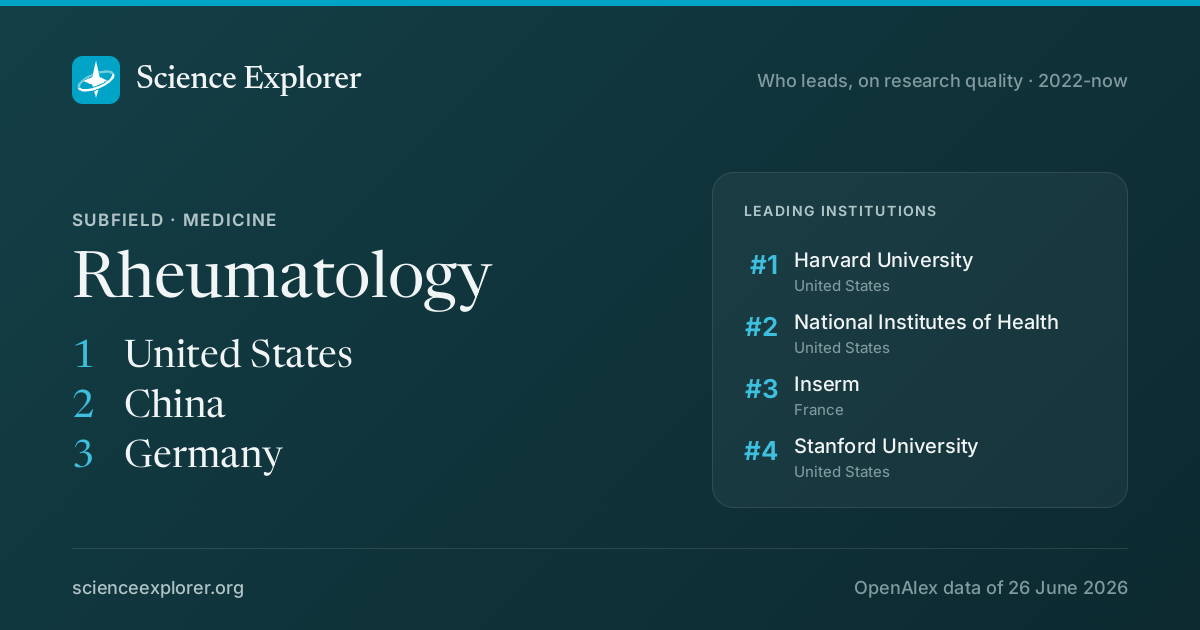
Harvard University (United States) ranks first in Rheumatology on research quality in 2022-now, followed by National Institutes of Health and Inserm.
By research quality, 2022-now
- 1
Harvard University United States · Cambridge · #1 all time
17.9% top 10% · 761 works
- 2
National Institutes of Health United States · Bethesda · #2 all time
25.0% top 10% · 190 works
- 3
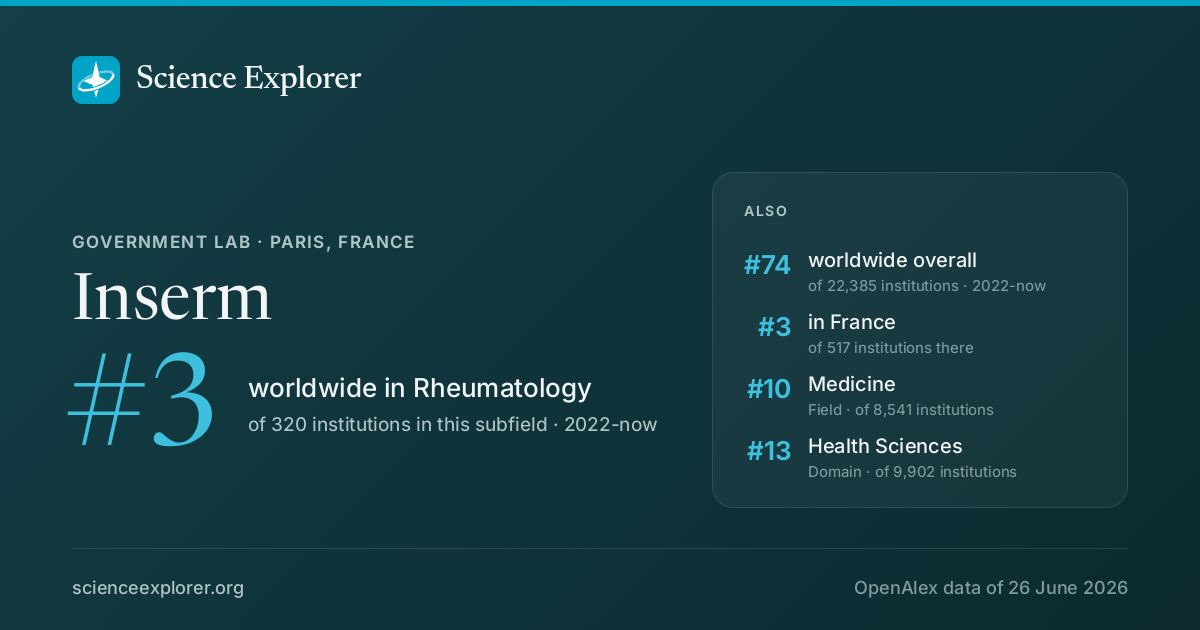
Inserm France · Paris · #9 all time
15.0% top 10% · 382 works
- 4
Stanford University United States · Stanford · #3 all time
16.7% top 10% · 208 works
- 5
Peking University China · Beijing · #25 all time
14.2% top 10% · 515 works
- 6
Université Paris Cité France · Paris · #17 all time
11.4% top 10% · 287 works
- 7
Shanghai Jiao Tong University China · Shanghai · #26 all time
16.4% top 10% · 469 works
- 8
University of Pennsylvania United States · Philadelphia · #8 all time
14.7% top 10% · 238 works
- 9
Johns Hopkins University United States · Baltimore · #4 all time
15.2% top 10% · 293 works
- 10
University of California, San Francisco United States · San Francisco · #6 all time
13.2% top 10% · 202 works








The track on each row is that row's top-10% rate. The ranking itself is the quality score, which compares the rate with what each place's own topics predict, adds its share of papers in the Nature Index journals, and counts output and breadth too.
Of 320 institutions above the floor of 40 fractional works in Rheumatology.
Top 100 Rheumatology institutionsBy volume, 2022-now
- 1
Harvard UniversityUnited States
856 works
- 2
All India Institute of Medical SciencesIndia
604 works
- 3
Peking UniversityChina
586 works
- 4
Sichuan UniversityChina
546 works
- 5
Mayo ClinicUnited States
541 works
- 6
Shanghai Jiao Tong UniversityChina
536 works
- 7
Capital Medical UniversityChina
436 works
- 8
InsermFrance
433 works
- 9
Sun Yat-sen UniversityChina
424 works
- 10
University of TorontoCanada
412 works

Who are the leading researchers in Rheumatology?
Counting only their work in Rheumatology, Désirée M F M van der Heijde, Dafna D. Gladman and Paul E. Emery have the most papers in the world top 10% for their subfield and year beyond the 10% expected.
- 1
Désirée M F M van der Heijde
Netherlands · #9,455 worldwide overall
187.3 of 493 papers here in the top 10%
- 2
Dafna D. Gladman
Canada · #37,096 worldwide overall
161.1 of 516 papers here in the top 10%
- 3
Paul E. Emery
United Kingdom · #21,715 worldwide overall
153.9 of 468 papers here in the top 10%
- 4
David T. Felson
United States · #16,596 worldwide overall
133.0 of 395 papers here in the top 10%
- 5
Michelle Petri
United States · #8,146 worldwide overall
120.3 of 283 papers here in the top 10%
- 6
Ronald van Vollenhoven
 Sweden · #18,473 worldwide overall
103.2 of 272 papers here in the top 10%
- 7
Philip J. Mease
United States · #74,859 worldwide overall
110.4 of 366 papers here in the top 10%
- 8
Joachim Sieper
Germany · #18,429 worldwide overall
99.1 of 272 papers here in the top 10%
- 9
Georg Andreas Schett
Germany · #9,365 worldwide overall
97.0 of 263 papers here in the top 10%
- 10
David John Hunter
Australia · #23,754 worldwide overall
105.7 of 380 papers here in the top 10%
Ranked on their work in Rheumatology alone: how many more of their papers here reached the world top 10% for their subfield and year than the 10% expected, among 1,600,764 ranked researchers with a paper here. Each paper counts once, so many strong papers outrank one famous one, and a long record of ordinary papers does not climb. Identities come from OpenAlex author disambiguation, which occasionally merges or splits people.
Top 100 Rheumatology researchersWhere is Rheumatology research done?
The largest centres of Rheumatology research in 2022-now are Beijing (China), London (United Kingdom), Shanghai (China) and Paris (France). Among places with at least 20 works in it, it is an unusually large share of all research in Herne and Valence.
Largest cities, 2022-now
Where it is the local speciality
- HerneDE · 61.1 works27×
- ValenceFR · 22.5 works21×
Location quotient: how much more of its research is in Rheumatology than the world average.
Rheumatology research by country
The best places for Rheumatology research inside each country, with that country's researchers and world standing.
- United States
- China
- Germany
- France
- United Kingdom
- Netherlands
- Switzerland
- Italy
- Canada
- Australia
- Spain
- Sweden
- Japan
 Denmark
 South Korea
 Israel
 Austria
 Belgium
 Singapore
 Norway
 Taiwan
 Finland
 Poland
- India
 Ireland
 Greece
 Czechia
 Brazil
 Portugal
 Romania
 Thailand
 Saudi Arabia
- Türkiye
 Mexico
 Iran
 Russia
 Bangladesh
 Egypt
 Tunisia
 Indonesia
 Morocco
 Iraq
Where is the best place to study Rheumatology?
Among universities, judged by research, Harvard University, Stanford University and Johns Hopkins University score highest, combining standing in the field's ranking, citation excellence, specialisation, size, growth and international reach. Research strength is one signal when choosing where to study; it does not measure teaching.
One dot per university in the first ten of the table below, at the default weights. The upper left is the interesting corner: small places doing unusually strong work.


















Universities only. The score blends standing (50%), citation excellence (20%), size (15%), specialisation (5%), growth (5%), international reach (5%), 2022-now; growth compares 2018-21 with 2022-25 and counts up to +20%, since a jump from a small base is mostly noise. Standing is the score in this field's institution ranking, three quarters over all time and a quarter 2022-now; excellence averages the two windows too. Four years alone undercount fields such as AI, where many conference and arXiv papers from 2022 on carry no affiliation in the data.
Every institution in Rheumatology, country by countryIs Rheumatology research growing?
Output in 2022-2025 was 11% higher than in 2018-2021, peaking in 2025. The fastest-growing topics are GDF15 and Related Biomarkers, Otitis Media and Relapsing Polychondritis and Hypertrophic osteoarthropathy and related conditions.
The same series as a ribbon: one cell per year, darker for more. The line above answers how much; this answers when.
Its share of all research
Growing output can still be a shrinking share: all of science grows. This is Rheumatology as a percentage of every work published that year, 0.45% in 2024.
Fractional works of Rheumatology over all fractional works that year. How the balance of science has shifted.
How much of it reaches the world top 10%
Year by year.
Of each year's works in it, the share that reached the world's 10% most cited for their field and year. A field is the world for its own topics, so there is no other line to hold it against.
Which topics inside it are moving
Growth and decline on one axis around a shared zero. Two lists side by side hide the thing that matters: whether the growth dwarfs the decline, or the other way round.
- GDF15 and Related Biomarkers+47%
- Otitis Media and Relapsing Polychondritis+31%
- Hypertrophic osteoarthropathy and related conditions+20%
- Omental and Epiploic Conditions+19%
- Dupuytren's Contracture and Treatments+18%
- Spondyloarthritis Studies and Treatments+18%
- Soft tissue tumor case studies-1%
- Urologic and reproductive health conditions-3%
Growth in output from 2018-21 to 2022-25. Every topic is a page of its own.
What does Rheumatology include?
Area is fractional works in that topic. Every name below is a page of its own.
- Pelvic floor disorders treatments
- Rheumatoid Arthritis Research and Therapies
- Osteoarthritis Treatment and Mechanisms
- Systemic Lupus Erythematosus Research
- Folate and B Vitamins Research
- Bone Tumor Diagnosis and Treatments
- Urticaria and Related Conditions
- Spondyloarthritis Studies and Treatments
- Soft tissue tumor case studies
- Bone and Dental Protein Studies
- Eosinophilic Disorders and Syndromes
- Urologic and reproductive health conditions
- Glycogen Storage Diseases and Myoclonus
- IgG4-Related and Inflammatory Diseases
- Musculoskeletal synovial abnormalities and treatments
- Dupuytren's Contracture and Treatments
- Osteomyelitis and Bone Disorders Research
- GDF15 and Related Biomarkers
- Otitis Media and Relapsing Polychondritis
- Moyamoya disease diagnosis and treatment
- Oropharyngeal Anatomy and Pathologies
- Heterotopic Ossification and Related Conditions
- Hypertrophic osteoarthropathy and related conditions
- Omental and Epiploic Conditions
Share who leads Rheumatology
The leading institutions' badges6Each links to that institution's page and updates with every snapshot







Discussion
Ask a question or share a note about Rheumatology. Keep it to the research: no personal attacks, advertising or links. Any reader can report a post, which collapses it for everyone until it is opened.