 Science in Denmark
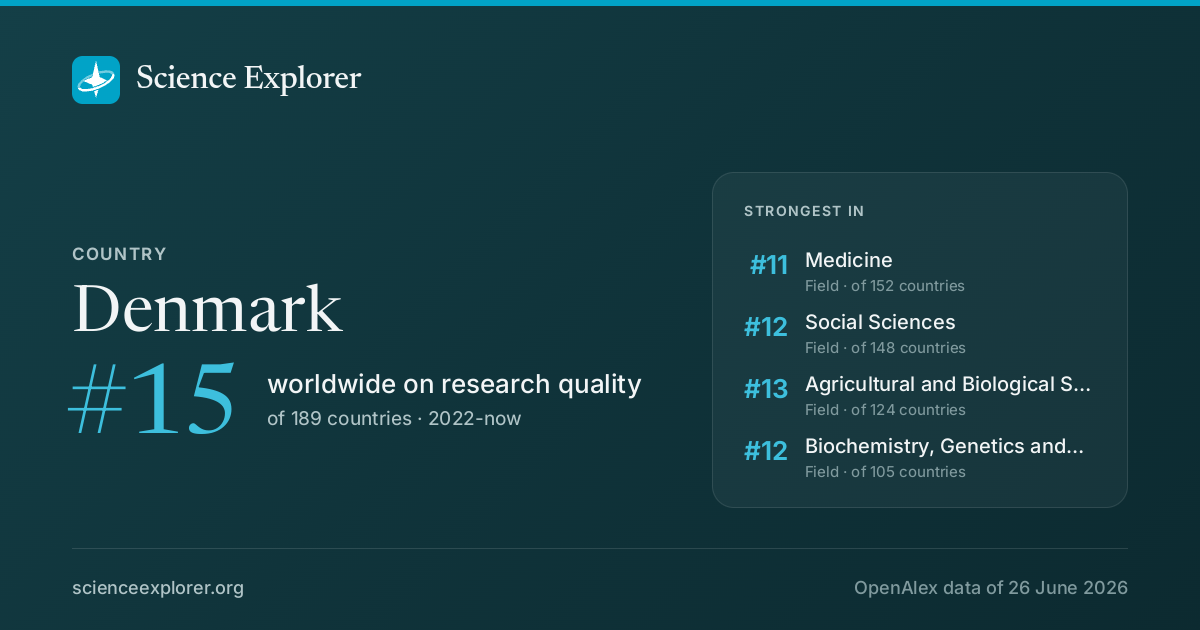
Denmark ranks #15 of 189 countries on research quality in 2022-now (#14 all time), with 99k research works and 12.5% of them in the world's top 10%.
- World rank, 2022-now
- #15 of 189 · #14 all time
- Works, 2022-now
- 99k ▼ 6% vs 2018-21
- Citations
- 17.3M 26.7 per fractional work, all time
- Top-10% rate
- 12.5% all institutions 10.0%
- vs its own fields
- 1.25× 1.00× is exactly expected
- In the world top 100
- 1 8 in the top 1,000
- Open access
- 40% world 40%
- International
- 28% world 18%
DenmarkWhat is Denmark strongest at in science?
On research quality in 2022-now, Denmark ranks highest in Medicine (#11 of 152), Social Sciences (#12 of 148) and Agricultural and Biological Sciences (#13 of 124). Relative to its size it is most specialised in Public Administration, Architecture and Medical Terminology.
| Field | World rank | Where that sits | Top-10% rate | Works | All time | Institutions |
|---|---|---|---|---|---|---|
| MedicineField | #11 of 152 | 14.0% | 26,676 | #12 | Institutions | |
| Social SciencesField | #12 of 148 | 11.3% | 12,222 | #12 | Institutions | |
| Agricultural and Biological SciencesField | #13 of 124 | 15.1% | 3,087 | #13 | Institutions | |
| Biochemistry, Genetics and Molecular BiologyField | #12 of 105 | 13.3% | 6,202 | #13 | Institutions | |
| Environmental ScienceField | #14 of 122 | 12.0% | 4,851 | #13 | Institutions | |
| Health ProfessionsField | #13 of 106 | 11.7% | 3,206 | #13 | Institutions | |
| Sociology and Political ScienceSubfield | #15 of 119 | 12.6% | 3,825 | #18 | Institutions | |
| Political Science and International RelationsSubfield | #12 of 95 | 11.9% | 2,231 | #11 | Institutions | |
| EngineeringField | #17 of 131 | 11.9% | 11,165 | #16 | Institutions | |
| Business, Management and AccountingField | #15 of 110 | 11.8% | 3,165 | #14 | Institutions | |
| Emergency MedicineSubfield | #6 of 43 | 18.9% | 483 | - | Institutions | |
| Computer ScienceField | #18 of 128 | 10.6% | 4,995 | #17 | Institutions |
Where its research is concentrated
Location quotient: how much more (or less) of each node it does than its size predicts. Drawn around 1×, where "twice the world share" and "half of it" are the same distance apart in opposite directions. A volume reading, which on a country axis is largely population and industrial structure.
- Public AdministrationSubfield · 251.5 works · #15 of 186 active here4.2×
- ArchitectureSubfield · 125.2 works · #19 of 166 active here2.9×
- Medical TerminologySubfield · 8.9 works · #17 of 121 active here2.7×
- Endocrinology, Diabetes and MetabolismSubfield · 1,412.4 works · #23 of 214 active here2.4×
- Psychiatry and Mental healthSubfield · 1,256.0 works · #19 of 214 active here2.3×
- Immunology and AllergySubfield · 192.1 works · #19 of 190 active here2.2×
- Family PracticeSubfield · 112.5 works · #22 of 191 active here2.1×
- Small AnimalsSubfield · 283.3 works · #26 of 198 active here2.1×
The whole field profile
All 26 fields at once. A specialist and a generalist produce the same ranked list and a completely different shape.
Rings at 0.5×, 1× and 2×. Widest outward: Veterinary, 2.1×. Every wedge is a field page.
All 26 fields, with their numbers
- Veterinary2.07×311 works
- Psychology1.48×4,971 works
- Medicine1.42×30k works
- Neuroscience1.32×2,372 works
- Health Professions1.22×3,552 works
- Immunology and Microbiology1.21×1,341 works
- Biochemistry, Genetics and Molecular Biology1.20×7,087 works
- Decision Sciences1.12×1,198 works
- Arts and Humanities1.10×3,511 works
- Nursing1.08×582 works
- Earth and Planetary Sciences1.05×1,821 works
- Environmental Science1.01×5,559 works
- Chemical Engineering0.97×373 works
- Social Sciences0.96×13k works
- Business, Management and Accounting0.95×3,398 works
- Pharmacology, Toxicology and Pharmaceutics0.89×345 works
- Energy0.89×908 works
- Physics and Astronomy0.85×2,087 works
- Economics, Econometrics and Finance0.84×1,992 works
- Engineering0.74×12k works
- Agricultural and Biological Sciences0.67×3,495 works
- Mathematics0.67×865 works
- Computer Science0.65×5,601 works
- Chemistry0.62×1,067 works
- Dentistry0.60×322 works
- Materials Science0.49×1,884 works
Which fields of science does Denmark work in?
In 2022-now, 32% of research in Denmark is in Health Sciences, 29% in Physical Sciences. Its largest fields are Medicine (27%), Social Sciences (12%), Engineering (11%). It does 1.4× the world's share of Health Sciences.
Each ring splits the one inside it: the four domains of science, their fields, their subfields. Size is fractional works in 2022-now. Every slice is a page; the interactive view zooms down to single topics and colours each by how much more of it this country does than the world.
Its 4 domains and 26 fields, with their numbers
- Health Sciences35k31.6%
- Medicine30k27.3%
- Health Professions3,5513.2%
- Nursing5820.5%
- Dentistry3220.3%
- Veterinary3110.3%
- Physical Sciences32k29.3%
- Engineering12k11.0%
- Computer Science5,6015.1%
- Environmental Science5,5595.0%
- Physics and Astronomy2,0871.9%
- Materials Science1,8841.7%
- Earth and Planetary Sciences1,8211.6%
- Chemistry1,0671.0%
- Energy9080.8%
- Mathematics8650.8%
- Chemical Engineering3730.3%
- Social Sciences28k25.8%
- Social Sciences13k12.1%
- Psychology4,9714.5%
- Arts and Humanities3,5113.2%
- Business, Management and Accounting3,3973.1%
- Economics, Econometrics and Finance1,9921.8%
- Decision Sciences1,1981.1%
- Life Sciences15k13.3%
- Biochemistry, Genetics and Molecular Biology7,0876.4%
- Agricultural and Biological Sciences3,4953.2%
- Neuroscience2,3722.1%
- Immunology and Microbiology1,3411.2%
- Pharmacology, Toxicology and Pharmaceutics3450.3%
Which keywords describe research in Denmark?
By fractional works in 2022-now, weighted toward what it does more of than the world: Epidemiology, Inflammation, Climate Change, Embodiment, Cardiovascular Disease, Tacit Knowledge, Social Sciences and Quality of Life.
- Quantitative Methods
- Special Education
- Glycemic Control
- Technical Decision-making
- Dementia Care
- Social Science
- Tacit Knowledge
- Guidelines
- Heart Failure
- Pedagogy
- Obesity
- Risk Factors
- Depression
- Environmental Impact
- Public Health
- Renewable Energy
- Cardiovascular Disease
- Quality of Life
- Sustainability
- Climate Change
- Epidemiology
- Inflammation
- Machine Learning
- Globalization
- Education
- Treatment
- Oxidative Stress
- Metabolic Syndrome
- Qualitative Research
- Diagnosis
- Genetics
- Embodiment
- Ethics
- Social Sciences
- Ethical Guidelines
- Pragmatism
- Interactional Expertise
- Discourse Analysis
- Gender Studies
- Methodology
Size is fractional works in 2022-now in the topics tagged with each word; colour is the word's share of this country's work against its share of the world's. The 40 words are chosen for being large and distinctive. Each links to the topic it comes from most.
All 40 words, with their numbers
- Epidemiology5,822▲ 1.32×139 topics
- Climate Change3,473▲ 1.16×126 topics
- Inflammation3,217▲ 1.37×83 topics
- Sustainability2,750◆ 1.02×131 topics
- Machine Learning2,504▼ 0.68×97 topics
- Quality of Life2,278▲ 1.43×60 topics
- Globalization2,263◆ 1.04×176 topics
- Cardiovascular Disease2,174▲ 1.73×39 topics
- Education2,081◆ 1.10×147 topics
- Renewable Energy2,029▲ 1.27×60 topics
- Treatment1,861▲ 1.39×52 topics
- Public Health1,829◆ 1.14×75 topics
- Oxidative Stress1,800◆ 0.99×63 topics
- Environmental Impact1,744◆ 0.93×73 topics
- Metabolic Syndrome1,625▲ 1.82×24 topics
- Depression1,460▲ 1.50×26 topics
- Qualitative Research1,416▲ 1.51×42 topics
- Risk Factors1,404▲ 1.16×37 topics
- Diagnosis1,396▲ 1.36×41 topics
- Obesity1,290▲ 1.52×29 topics
- Genetics1,241▲ 1.59×27 topics
- Pedagogy1,199▲ 2.2×30 topics
- Embodiment1,183▲ 5.7×7 topics
- Heart Failure1,160▲ 2.4×14 topics
- Ethics1,134▲ 2.0×59 topics
- Guidelines1,049▲ 2.0×13 topics
- Social Sciences1,023▲ 6.4×21 topics
- Tacit Knowledge969▲ 19×3 topics
- Ethical Guidelines909▲ 16×4 topics
- Social Science874▲ 22×8 topics
- Pragmatism857▲ 31×4 topics
- Dementia Care831▲ 62×2 topics
- Interactional Expertise826▲ 69×1 topic
- Technical Decision-making826▲ 69×1 topic
- Discourse Analysis817▲ 3.1×11 topics
- Glycemic Control744▲ 4.2×4 topics
- Gender Studies738▲ 4.4×18 topics
- Special Education709▲ 11×6 topics
- Methodology706▲ 13×7 topics
- Quantitative Methods681▲ 47×2 topics
Which research topics does Denmark publish the most in?
Its largest topics in 2022-now are Education, Healthcare and Sociology Research, Social and Educational Sciences, European and International Law Studies.
Area is fractional works in 2022-now; colour is the subfield each topic belongs to. Every tile is a topic page.
- 1 Education, Healthcare and Sociology Research Social Psychology 826 works
- 2 Social and Educational Sciences Education 681 works
- 3 European and International Law Studies Political Science and International Relations 459 works
- 4 Diabetes Treatment and Management Endocrinology, Diabetes and Metabolism 287 works
- 5 Research in Social Sciences Education 286 works
- 6 Microgrid Control and Optimization Control and Systems Engineering 273 works
- 7 Management and Organizational Studies Organizational Behavior and Human Resource Management 247 works
- 8 Musculoskeletal pain and rehabilitation Pharmacology 227 works
- 9 Historical and Archaeological Studies History 219 works
- 10 Diabetes Management and Research Endocrinology, Diabetes and Metabolism 216 works
- 11 Cardiac Arrest and Resuscitation Emergency Medicine 213 works
- 12 Atrial Fibrillation Management and Outcomes Cardiology and Cardiovascular Medicine 212 works
How many world-class institutions does Denmark hold?
Average quality and elite capacity disagree by construction, and both are worth knowing: the first is decided by a country's whole institution population, the second counts the institutions it holds at the top. One square per institution.
| Standing among countries | 2022-now | Where that sits | All time |
|---|---|---|---|
| Average qualityits whole institution population | #15 of 189 | #14 of 203 | |
| Elite capacitythe institutions it holds at the top | #18 of 204 | #19 of 216 |
Elite capacity counts a country's institutions by their worldwide rank, weighted so a place at #1 counts for more than one at #480. Countries under 100 fractional works are left out.
Bands are exclusive, so the squares add up to 8 (the institutions it holds in the world top 1,000), not to four times it.
Which universities in Denmark lead research?
University of Copenhagen, Aarhus University and University of Southern Denmark rank highest in Denmark on research quality in 2022-now.
One dot per institution in the list below. The upper left is the interesting corner.
- 1University of CopenhagenUniversity · Copenhagen · #46 worldwide14.7% top 10% · 20k works
- 2Aarhus UniversityUniversity · Aarhus · #101 worldwide12.2% top 10% · 18k works
- 3University of Southern DenmarkUniversity · Odense · #237 worldwide13.1% top 10% · 8.4k works
- 4Technical University of DenmarkUniversity · Kongens Lyngby · #356 worldwide11.8% top 10% · 11k works
- 5Aalborg UniversityUniversity · Aalborg · #394 worldwide11.1% top 10% · 12k works
- 6Novo Nordisk FoundationResearch facility · Copenhagen · #615 worldwide22.6% top 10% · 696 works
- 7RigshospitaletHospital / health system · Copenhagen · #790 worldwide13.4% top 10% · 2.9k works
- 8Copenhagen Business SchoolUniversity · Copenhagen · #918 worldwide11.7% top 10% · 3.4k works
- 9Novo Nordisk (Denmark)Company · Copenhagen · #1,045 worldwide15.9% top 10% · 888 works
- 10Roskilde UniversityUniversity · Roskilde · #1,193 worldwide10.3% top 10% · 2.5k works
- 11Frederiksberg HospitalHospital / health system · Frederiksberg · #1,750 worldwide13.2% top 10% · 729 works
- 12IT University of CopenhagenUniversity · Copenhagen · #1,813 worldwide10.5% top 10% · 1.1k works
- 13Steno Diabetes CentersHospital / health system · Charlottenlund · #2,036 worldwide15.2% top 10% · 581 works
- 14Statens Serum InstitutResearch facility · Copenhagen · #2,130 worldwide17.8% top 10% · 426 works
- 15Hvidovre HospitalHospital / health system · Hvidovre · #2,180 worldwide15.0% top 10% · 537 works



The track on each row is its top-10% rate; the tick is the average of all institutions, 10.0% (how it is set): teal above it, red below.
All ranked institutions in DenmarkWho are the top researchers in Denmark?
Kannan Govindan, Jens K. Nørskov and Eske Willerslev rank highest among researchers based in Denmark.
- 1 Kannan Govindan #15 worldwide 54k citations · 477 works
- 2 Jens K. Nørskov #52 worldwide 260k citations · 883 works
- 3 Eske Willerslev #151 worldwide 74k citations · 463 works
- 4 Benjamin Kenneth Sovacool #435 worldwide 71k citations · 1,014 works
- 5 Seiji Fujimoto #675 worldwide 14k citations · 418 works
- 6 Vasily Kokorev #730 worldwide 7.2k citations · 274 works
- 7 M. Thomas P. Gilbert #1,234 worldwide 66k citations · 756 works
- 8 Gabriel Brammer #1,890 worldwide 39k citations · 777 works
- 9 P. R. Christensen #2,431 worldwide 60k citations · 247 works
- 10 Jens‐Christian Svenning #3,331 worldwide 65k citations · 1,019 works
Which cities in Denmark are research hubs?
- 1
CopenhagenDenmark
238k works
- 2
AarhusDenmark
131k works
- 3
Kongens LyngbyDenmark
74k works
- 4
AalborgDenmark
66k works
- 5
OdenseDenmark
46k works
- 6
RoskildeDenmark
24k works
How much of it is in the largest
The same cities as shares of everything these twelve account for.
Shares of the rows listed above, not of the whole node.
How open and international is Denmark's research?
40% of its research is openly available (world: 40%), and 28% is written with international co-authors (world: 18%).
World: 40% of research is openly available.
World: 18% is written across borders.
In 2022-now, 68% of its research is openly available (world 63%) and 38% is written with co-authors abroad (world 22%). Against what its own mix of topics predicts, that is 1.11× the expected open access and 1.61× the expected international share, which puts it #84 of 173 countries on openness.
How has Denmark's research grown?
Output in 2022-2025 was 6% lower than in 2018-2021.
The same series as a ribbon: one cell per year, darker for more. The line above answers how much; this answers when.
Its share of all research
Growing output can still be a shrinking share: all of science grows. This is Denmark as a percentage of every work published that year, 0.44% in 2024.
Fractional works of Denmark over all fractional works that year. How the balance of science has shifted.
How much of it reaches the world top 10%
Over the whole record, 12.1% of its 646k works since 1950 reached the world top 10% for their field and year.
Of each year's output, the share that reached the world's 10% most cited for its field and year. Peak 13.6% in 2007.
Which countries have research most like Denmark's?
Australia is Denmark's closest research twin: of all countries, its research is spread across the fields most like Denmark's, with both strong in Veterinary.
- 1
 AustraliaBoth strong in Veterinary, Psychology, Neuroscience
0.85 Compare
- 2
 NetherlandsBoth strong in Psychology, Veterinary, Medicine
0.85 Compare
- 3
 CanadaBoth strong in Psychology, Veterinary, Neuroscience
0.79 Compare
- 4
 IrelandBoth strong in Veterinary, Psychology, Medicine
0.78 Compare
- 5
 United KingdomBoth strong in Veterinary, Psychology, Neuroscience
0.77 Compare
Similarity is the correlation of each side's location quotients across every field it publishes in, on a log scale: 1 is the same shape of research, 0 is unrelated. It ignores size. How it is measured.
Compare Denmark with
 South Korea
 Japan
 Singapore
 Austria
 Sweden
 India
Share Denmark's ranking



Research fields in Denmark
- Health Sciences
- Medicine
- Social Sciences
- Life Sciences
- Social Sciences
- Agricultural and Biological Sciences
- Biochemistry, Genetics and Molecular Biology
- Environmental Science
- Physical Sciences
- Health Professions
- Sociology and Political Science
- Political Science and International Relations
- Engineering
- Business, Management and Accounting
- Emergency Medicine
- Computer Science
- Energy
- Molecular Biology
- General Health Professions
- Epidemiology
- Economics, Econometrics and Finance
- Surgery
- Education
- Public Health, Environmental and Occupational Health
- Arts and Humanities
- Electrical and Electronic Engineering
- Psychology
- Cardiology and Cardiovascular Medicine
- Infectious Diseases
- Economics and Econometrics
- Clinical Psychology
- Ecology
- Endocrinology, Diabetes and Metabolism
- Plant Science
- Social Psychology
- Genetics
- Control and Systems Engineering
- Food Science
- Pulmonary and Respiratory Medicine
- Strategy and Management
- Pediatrics, Perinatology and Child Health
- Oncology
- Ecology, Evolution, Behavior and Systematics
- Biomedical Engineering
- Artificial Intelligence
- Decision Sciences
- Building and Construction
- Earth and Planetary Sciences
- Neurology
- Physiology
- Nutrition and Dietetics
- Mechanical Engineering
- Pathology and Forensic Medicine
- Nursing
- Radiology, Nuclear Medicine and Imaging
- Communication
- Physics and Astronomy
- Neuroscience
- Immunology and Microbiology
- Psychiatry and Mental health
Questions people ask
What is Denmark strongest at in science?
On research quality in 2022-now, Denmark ranks highest in Medicine (#11 of 152), Social Sciences (#12 of 148) and Agricultural and Biological Sciences (#13 of 124). Relative to its size it is most specialised in Public Administration, Architecture and Medical Terminology.
See the full answerDiscussion
Ask a question or share a note about Denmark. Keep it to the research: no personal attacks, advertising or links. Any reader can report a post, which collapses it for everyone until it is opened.