Duke University
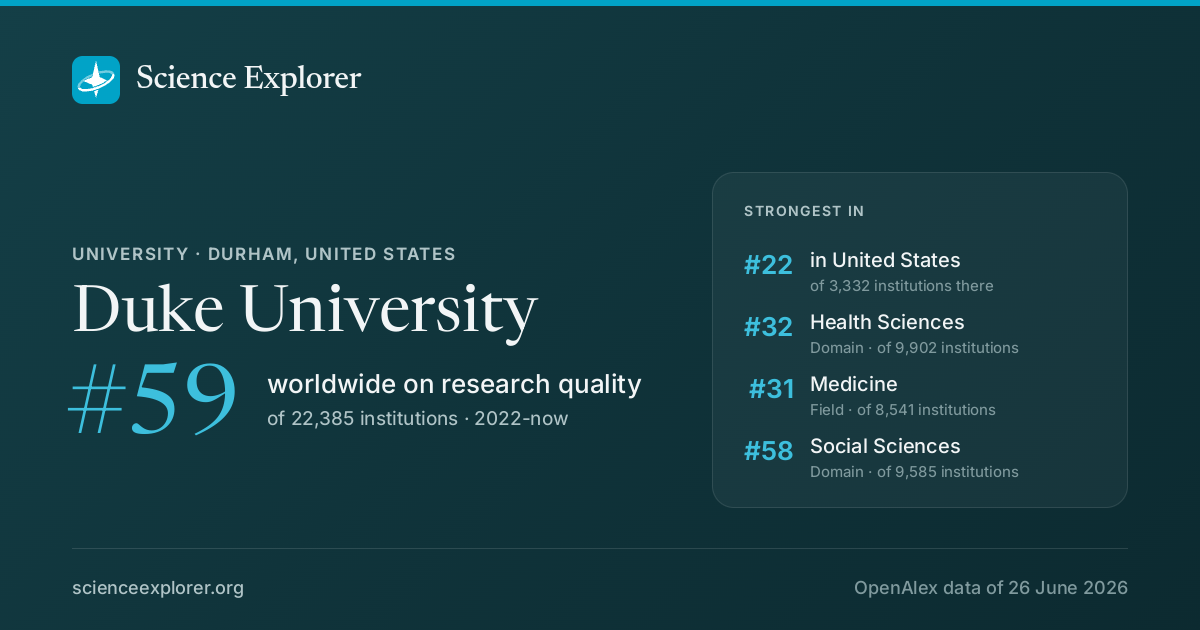
In research, Duke University stands highest in Health Sciences (#32 of 9,902 worldwide), Medicine (#31 of 8,541 worldwide) and Social Sciences (#58 of 9,585 worldwide), 2022-now. Relative to its size it is most specialised in Transplantation, Aging and Statistics and Probability (Transplantation is 5.7× its share of world research).
- World rank, 2022-now
- #59 of 22,385 · #36 all time
- Rank in United States
- #22 of 3,332
- Research works
- 124k ◆ 0% vs 2018-21
- Citations
- 5.4M 43.7 per fractional work
- Top-10% rate
- 12.8% all institutions 10.0%
- vs its own fields
- 1.18× 1.00× is exactly expected
- Open access
- 37% world 40%
- International
- 14% world 18%
What is Duke University known for in research?
The fields where it stands highest, 2022-now, ranked among every institution above the floor in each field.
| Field | World rank | Where that sits | Top-10% rate | Works | All time |
|---|---|---|---|---|---|
| Health SciencesDomain | #32 of 9,902 | 13.4% | 7,116 | #26 | |
| MedicineField | #31 of 8,541 | 13.5% | 6,334 | #24 | |
| Social SciencesDomain | #58 of 9,585 | 13.7% | 3,632 | #27 | |
| Life SciencesDomain | #67 of 6,403 | 12.0% | 2,560 | #32 | |
| Physical SciencesDomain | #119 of 10,670 | 12.2% | 3,734 | #113 | |
| Social SciencesField | #69 of 5,988 | 13.9% | 1,579 | #33 | |
| Economics, Econometrics and FinanceField | #21 of 1,798 | 14.3% | 487 | #23 | |
| Economics and EconometricsSubfield | #18 of 1,307 | 13.2% | 382 | #25 | |
| SurgerySubfield | #24 of 1,532 | 15.2% | 913 | #31 | |
| Health ProfessionsField | #31 of 1,895 | 12.2% | 662 | #27 |
Each strip is that field's whole ranked pool, with the notch where Duke University sits in it, in the colour of the band that rank falls in. The track under the rate is the rate itself: it carries no average mark, because the average differs by field (from about 6% in Dentistry to 21% in Economics).
Which of those standings moved
The same fields on both windows: where it stood over the whole record, and where it stands in 2022-now. The distance is the story, and it is the one thing the two rank columns above cannot show.
- Health Sciences#26 #32
- Medicine#24 #31
- Social Sciences#27 #58
- Life Sciences#32 #67
- Physical Sciences#113 #119
- Social Sciences#33 #69
- Economics, Econometrics and Finance#23 #21
- Economics and Econometrics#25 #18
- Surgery#31 #24
- Health Professions#27 #31
A dot further right is a better standing. Fields it was not ranked in over the whole record are left out.
Which fields of science does Duke University work in?
In 2022-now, 42% of research at Duke University is in Health Sciences, 22% in Physical Sciences. Its largest fields are Medicine (38%), Social Sciences (9%), Biochemistry, Genetics and Molecular Biology (9%). It does 1.8× the world's share of Health Sciences.
Each ring splits the one inside it: the four domains of science, their fields, their subfields. Size is fractional works in 2022-now. Every slice is a page; the interactive view zooms down to single topics and colours each by how much more of it this institution does than the world.
Its 4 domains and 26 fields, with their numbers
- Health Sciences8,13142.1%
- Medicine7,25137.5%
- Health Professions7373.8%
- Nursing1050.5%
- Dentistry220.1%
- Veterinary160.1%
- Physical Sciences4,21121.8%
- Engineering1,2396.4%
- Computer Science1,0665.5%
- Environmental Science6553.4%
- Physics and Astronomy3952.0%
- Mathematics3221.7%
- Materials Science2401.2%
- Earth and Planetary Sciences1320.7%
- Chemistry1060.5%
- Energy440.2%
- Chemical Engineering140.1%
- Social Sciences4,00320.7%
- Social Sciences1,7369.0%
- Psychology7704.0%
- Arts and Humanities5232.7%
- Economics, Econometrics and Finance5142.7%
- Business, Management and Accounting2701.4%
- Decision Sciences1901.0%
- Life Sciences2,97315.4%
What does Duke University specialise in?
Where its research is concentrated relative to its size: Transplantation takes 5.7× the share of its output that it takes of world research.
- TransplantationSubfield · 48.8 works5.7×
- AgingSubfield · 23.5 works5.0×
- Statistics and ProbabilitySubfield · 167.8 works4.1×
- Family PracticeSubfield · 34.6 works3.8×
Location quotient, a volume reading rather than an impact one. It surfaces small, lopsided specialities.
Field profile
Location quotient across every field it publishes in: outside the ring is more than an institution of this size would be expected to publish, inside it is less.
Rings at 0.5×, 1× and 2×. Widest outward: Neuroscience, 2.1×. Every wedge is a field page.
All 26 fields, with their numbers
- Neuroscience2.09×655 works
- Medicine1.95×7,251 works
- Immunology and Microbiology1.79×349 works
- Biochemistry, Genetics and Molecular Biology1.65×1,696 works
- Health Professions1.45×737 works
- Mathematics1.41×322 works
- Psychology1.31×770 works
- Economics, Econometrics and Finance1.24×514 works
- Nursing1.11×105 works
- Decision Sciences1.02×190 works
- Arts and Humanities0.94×523 works
- Physics and Astronomy0.92×395 works
- Computer Science0.71×1,066 works
- Social Sciences0.71×1,736 works
- Environmental Science0.68×655 works
- Veterinary0.62×16 works
- Pharmacology, Toxicology and Pharmaceutics0.57×39 works
- Earth and Planetary Sciences0.43×132 works
- Engineering0.43×1,239 works
- Business, Management and Accounting0.43×270 works
- Materials Science0.36×240 works
- Chemistry0.35×106 works
- Agricultural and Biological Sciences0.26×234 works
- Energy0.25×44 works
- Dentistry0.23×22 works
- Chemical Engineering0.21×14 works
- Neuroscience 2.1×
- Medicine 1.9×
- Immunology and Microbiology 1.8×
- Biochemistry, Genetics and Molecular Biology 1.6×
- Health Professions 1.4×
- Mathematics 1.4×
- Psychology 1.3×
- Economics, Econometrics and Finance 1.2×
- Nursing 1.1×
- Decision Sciences 1.0×
- Arts and Humanities 0.9×
- Physics and Astronomy 0.9×
- Computer Science 0.7×
- Social Sciences 0.7×
- Environmental Science 0.7×
- Veterinary 0.6×
- Pharmacology, Toxicology and Pharmaceutics 0.6×
- Earth and Planetary Sciences 0.4×
- Engineering 0.4×
- Business, Management and Accounting 0.4×
- Materials Science 0.4×
- Chemistry 0.3×
- Agricultural and Biological Sciences 0.3×
- Energy 0.2×
- Dentistry 0.2×
- Chemical Engineering 0.2×
Who are the top researchers at Duke University?
Ranked on the quality score, Ru‐Rong Ji, Kenneth A. Dodge and Tim Bollerslev lead among researchers whose main affiliation is Duke University.
- 1
Ru‐Rong Ji
 United States · #1,381 worldwide
51k citations · 421 works
- 2
Kenneth A. Dodge
United States · #1,801 worldwide
95k citations · 615 works
- 3
Tim Bollerslev
United States · #2,548 worldwide
76k citations · 138 works
- 4
Xinnian Dong
United States · #2,789 worldwide
37k citations · 143 works
- 5
Philip N. Benfey
United States · #4,276 worldwide
41k citations · 385 works
- 6
Renate Houts
United States · #4,287 worldwide
29k citations · 179 works
- 7
Campbell R. Harvey
United States · #4,315 worldwide
82k citations · 462 works
- 8
David B. Mitzi
United States · #4,568 worldwide
49k citations · 394 works
- 9
E. Jane Costello
United States · #4,883 worldwide
58k citations · 314 works
- 10
Jason W. Locasale
United States · #5,282 worldwide
45k citations · 433 works
Which keywords describe research at Duke University?
By fractional works in 2022-now, weighted toward what it does more of than the world: Epidemiology, Inflammation, Quality of Life, Risk Factors, Cardiovascular Disease, Public Health, Immunotherapy and Treatment.
- Academic Medicine
- Health Disparities
- Health-related Quality of Life
- Genetic Mutations
- Medical Education
- Precision Medicine
- Primary Care
- Neurological Disorders
- Aging
- Complications
- Management
- Guidelines
- Biomarkers
- Diagnosis
- Cancer
- Cardiovascular Disease
- Mental Health
- Oxidative Stress
- Machine Learning
- Inflammation
- Epidemiology
- Deep Learning
- Quality of Life
- Public Health
- Risk Factors
- Treatment
- Immunotherapy
- Depression
- Heart Failure
- Mortality
- Clinical Trials
- Chemotherapy
- Metabolic Syndrome
- Radiotherapy
- Gene Expression
- Rehabilitation
- Anxiety
- Patient Satisfaction
- Ethical Considerations
- Mortality Risk
Size is fractional works in 2022-now in the topics tagged with each word; colour is the word's share of this institution's work against its share of the world's. The 40 words are chosen for being large and distinctive. Each links to the topic it comes from most.
All 40 words, with their numbers
- Epidemiology1,349▲ 1.75×137 topics
- Inflammation621▲ 1.51×82 topics
- Deep Learning575▼ 0.86×82 topics
- Machine Learning549▼ 0.85×87 topics
- Quality of Life494▲ 1.77×55 topics
- Oxidative Stress422▲ 1.33×62 topics
- Public Health419▲ 1.49×66 topics
- Mental Health401▲ 1.45×43 topics
- Risk Factors392▲ 1.85×37 topics
- Cardiovascular Disease384▲ 1.74×39 topics
- Treatment377▲ 1.60×51 topics
- Cancer346▲ 1.33×53 topics
- Immunotherapy316▲ 2.3×19 topics
- Diagnosis307▲ 1.70×41 topics
- Depression299▲ 1.76×25 topics
- Biomarkers279▲ 2.1×18 topics
- Heart Failure260▲ 3.0×14 topics
- Guidelines248▲ 2.7×13 topics
- Mortality243▲ 2.2×13 topics
- Management234▲ 1.52×35 topics
- Clinical Trials229▲ 1.78×19 topics
- Complications222▲ 2.3×17 topics
- Chemotherapy219▲ 1.60×25 topics
- Aging215▲ 2.0×19 topics
- Metabolic Syndrome215▲ 1.38×24 topics
- Neurological Disorders208▲ 1.88×20 topics
- Radiotherapy204▲ 2.7×13 topics
- Primary Care200▲ 2.8×15 topics
- Gene Expression199▲ 1.64×20 topics
- Precision Medicine197▲ 2.0×8 topics
- Rehabilitation196▲ 2.5×13 topics
- Medical Education176▲ 3.4×13 topics
- Anxiety175▲ 1.91×12 topics
- Genetic Mutations175▲ 2.1×23 topics
- Patient Satisfaction168▲ 2.8×9 topics
- Health-related Quality of Life167▲ 3.7×6 topics
- Ethical Considerations164▲ 2.5×20 topics
- Health Disparities149▲ 3.0×9 topics
- Mortality Risk138▲ 3.0×6 topics
- Academic Medicine94▲ 6.3×3 topics
Which research topics does Duke University publish most on?
By volume in 2022-now: Health Systems, Economic Evaluations, Quality of Life, Total Knee Arthroplasty Outcomes, Shoulder Injury and Treatment and Transplantation: Methods and Outcomes.
Area is fractional works; colour is the subfield each topic belongs to.
- 1 Health Systems, Economic Evaluations, Quality of Life Economics and Econometrics 67 works
- 2 Total Knee Arthroplasty Outcomes Surgery 61 works
- 3 Shoulder Injury and Treatment Surgery 59 works
- 4 Transplantation: Methods and Outcomes Surgery 59 works
- 5 Diversity and Career in Medicine Gender Studies 59 works
- 6 Artificial Intelligence in Healthcare and Education Health Informatics 56 works
- 7 Glioma Diagnosis and Treatment Genetics 54 works
- 8 Heart Failure Treatment and Management Cardiology and Cardiovascular Medicine 54 works
- 9 Palliative Care and End-of-Life Issues Public Health, Environmental and Occupational Health 52 works
- 10 Healthcare Policy and Management Economics and Econometrics 51 works
How open and international is its research?
Against the world's own shares: the tick on each track. Both are shares of its output, so they sit on one scale and can be read against each other as well as against the world.
World: 40% of research is openly available.
World: 18% is written across borders.
How has Duke University's research output changed?
Output in 2022-2025 was 0% lower than in 2018-2021.
The same series as a ribbon: one cell per year, darker for more. The line above answers how much; this answers when.
Its share of all research
Growing output can still be a shrinking share: all of science grows. This is Duke University as a percentage of every work published that year, 0.079% in 2024.
Fractional works of Duke University over all fractional works that year. How the balance of science has shifted.
How much of it reaches the world top 10%
Year by year, against all institutions in the same year.
Of each year's output, the share that reached the world's 10% most cited for its field and year. Peak 19.8% in 2009.
Other research institutions in Durham
- Duke Medical Center
- Research Triangle Park Foundation
- RTI International
- IQVIA (United States)
- North Carolina Central University
- Durham Technical Community College
- Burroughs Wellcome Fund
- Southern Research Institute

Which institutions have research most like Duke University's?
Among the world's leading institutions, Vanderbilt University has the research profile closest to Duke University's, with both strong in Neuroscience.
- 1
Vanderbilt UniversityUnited States · Both strong in Neuroscience, Medicine, Immunology and Microbiology
0.90 Compare
- 2
Washington University in St. LouisUnited States · Both strong in Neuroscience, Medicine, Immunology and Microbiology
0.90 Compare
- 3
Emory UniversityUnited States · Both strong in Neuroscience, Medicine, Immunology and Microbiology
0.89 Compare
- 4
Dartmouth CollegeUnited States · Both strong in Neuroscience, Immunology and Microbiology, Medicine
0.88 Compare
- 5
Columbia UniversityUnited States · Both strong in Neuroscience, Medicine, Biochemistry, Genetics and Molecular Biology
0.88 Compare

Similarity is the correlation of each side's location quotients across every field it publishes in, on a log scale: 1 is the same shape of research, 0 is unrelated. It ignores size. How it is measured.
Compare Duke University with
- vs
 University of British Columbia
- vs
 Radboud University Nijmegen
- vs University of Wisconsin–Madison
- vs University of Illinois Urbana-Champaign
- vs McGill University
- vs
 Nankai University
Share Duke University's ranking



Research measures only: rankings here say nothing about teaching, admissions or student experience. Comparable institutions and collaboration partners have tabs of their own, above.
Discussion
Ask a question or share a note about Duke University. Keep it to the research: no personal attacks, advertising or links. Any reader can report a post, which collapses it for everyone until it is opened.