Research Triangle Park Foundation
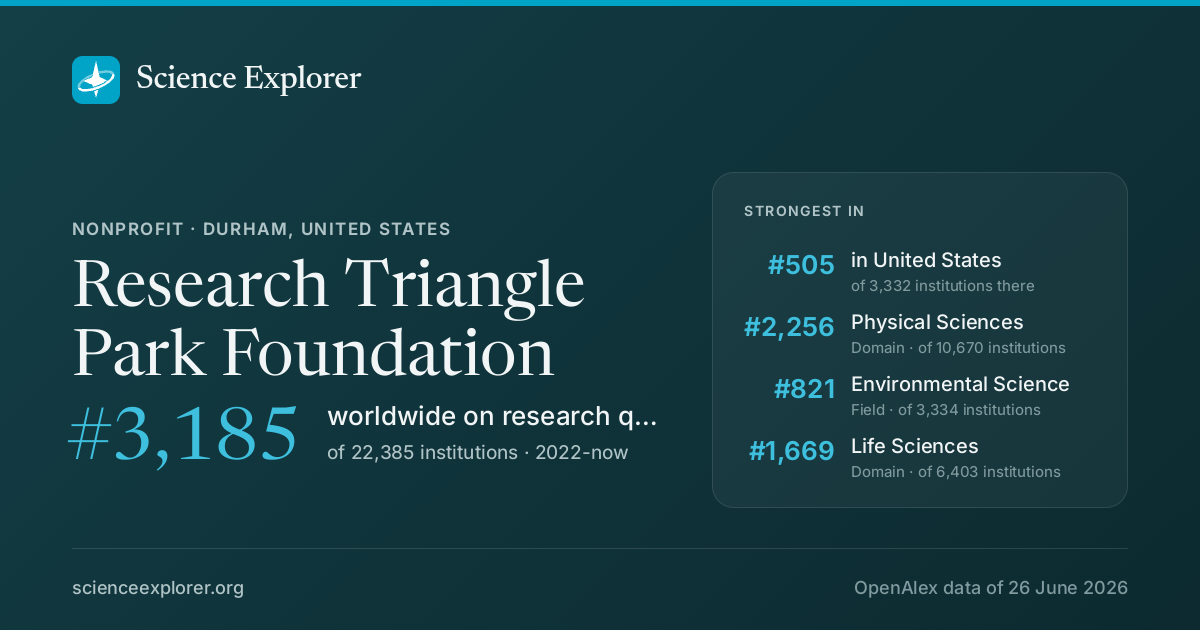
In research, Research Triangle Park Foundation stands highest in Physical Sciences (#2,256 of 10,670 worldwide), Environmental Science (#821 of 3,334 worldwide) and Life Sciences (#1,669 of 6,403 worldwide), 2022-now. Relative to its size it is most specialised in Health, Toxicology and Mutagenesis and Environmental Science (Health, Toxicology and Mutagenesis is 28.9× its share of world research).
- World rank, 2022-now
- #3,185 of 22,385 · #1,830 all time
- Rank in United States
- #505 of 3,332
- Research works
- 12k ▼ 33% vs 2018-21
- Citations
- 565k 47.9 per fractional work
- Top-10% rate
- 14.6% all institutions 10.0%
- vs its own fields
- 1.11× 1.00× is exactly expected
- Open access
- 25% world 40%
- International
- 14% world 18%
What is Research Triangle Park Foundation known for in research?
The fields where it stands highest, 2022-now, ranked among every institution above the floor in each field.
| Field | World rank | Where that sits | Top-10% rate | Works | All time |
|---|---|---|---|---|---|
| Physical SciencesDomain | #2,256 of 10,670 | 15.9% | 149 | #1620 | |
| Environmental ScienceField | #821 of 3,334 | 13.7% | 97 | #842 | |
| Life SciencesDomain | #1,669 of 6,403 | 12.5% | 74 | #2100 | |
| Health SciencesDomain | #2,755 of 9,902 | 13.4% | 87 | #1981 | |
| MedicineField | #2,722 of 8,541 | 11.8% | 73 | #1878 |
Each strip is that field's whole ranked pool, with the notch where Research Triangle Park Foundation sits in it, in the colour of the band that rank falls in. The track under the rate is the rate itself: it carries no average mark, because the average differs by field (from about 6% in Dentistry to 21% in Economics).
Which of those standings moved
The same fields on both windows: where it stood over the whole record, and where it stands in 2022-now. The distance is the story, and it is the one thing the two rank columns above cannot show.
- Physical Sciences#1,620 #2,256
- Environmental Science#842 #821
- Life Sciences#2,100 #1,669
- Health Sciences#1,981 #2,755
- Medicine#1,878 #2,722
A dot further right is a better standing. Fields it was not ranked in over the whole record are left out.
Which fields of science does Research Triangle Park Foundation work in?
In 2022-now, 46% of research at Research Triangle Park Foundation is in Physical Sciences, 26% in Health Sciences. Its largest fields are Environmental Science (30%), Medicine (22%), Biochemistry, Genetics and Molecular Biology (14%). It does 1.7× the world's share of Life Sciences.
Each ring splits the one inside it: the four domains of science, their fields, their subfields. Size is fractional works in 2022-now. Every slice is a page; the interactive view zooms down to single topics and colours each by how much more of it this institution does than the world.
Its 4 domains and 26 fields, with their numbers
- Physical Sciences16045.7%
- Environmental Science10429.7%
- Engineering174.8%
- Earth and Planetary Sciences174.8%
- Computer Science92.7%
- Chemistry51.4%
- Materials Science30.8%
- Mathematics20.6%
- Chemical Engineering10.4%
- Physics and Astronomy10.3%
- Energy10.3%
- Health Sciences9226.1%
- Medicine7722.0%
- Health Professions61.7%
- Veterinary61.7%
- Nursing20.6%
- Dentistry00.1%
- Life Sciences8123.3%
- Social Sciences174.9%
What does Research Triangle Park Foundation specialise in?
Where its research is concentrated relative to its size: Health, Toxicology and Mutagenesis takes 28.9× the share of its output that it takes of world research.
- Health, Toxicology and MutagenesisSubfield · 53.8 works29×
- Environmental ScienceField · 104.0 works6.0×
Location quotient, a volume reading rather than an impact one. It surfaces small, lopsided specialities.
Field profile
Location quotient across every field it publishes in: outside the ring is more than an institution of this size would be expected to publish, inside it is less.
Rings at 0.5×, 1× and 2×. Widest outward: Veterinary, 12.6×. Every wedge is a field page.
All 26 fields, with their numbers
- Veterinary12.55×6 works
- Environmental Science5.98×104 works
- Earth and Planetary Sciences3.03×17 works
- Biochemistry, Genetics and Molecular Biology2.58×48 works
- Pharmacology, Toxicology and Pharmaceutics2.16×3 works
- Immunology and Microbiology1.87×7 works
- Neuroscience1.61×9 works
- Nursing1.21×2 works
- Medicine1.14×77 works
- Chemical Engineering1.06×1 works
- Chemistry0.92×5 works
- Agricultural and Biological Sciences0.89×15 works
- Health Professions0.66×6 works
- Decision Sciences0.57×2 works
- Mathematics0.54×2 works
- Economics, Econometrics and Finance0.51×4 works
- Computer Science0.35×9 works
- Engineering0.32×17 works
- Energy0.29×1 works
- Dentistry0.29×0 works
- Materials Science0.23×3 works
- Psychology0.19×2 works
- Social Sciences0.18×8 works
- Physics and Astronomy0.12×1 works
- Arts and Humanities0.09×1 works
- Business, Management and Accounting0.07×1 works
- Veterinary 12.6×
- Environmental Science 6.0×
- Earth and Planetary Sciences 3.0×
- Biochemistry, Genetics and Molecular Biology 2.6×
- Pharmacology, Toxicology and Pharmaceutics 2.2×
- Immunology and Microbiology 1.9×
- Neuroscience 1.6×
- Nursing 1.2×
- Medicine 1.1×
- Chemical Engineering 1.1×
- Chemistry 0.9×
- Agricultural and Biological Sciences 0.9×
- Health Professions 0.7×
- Decision Sciences 0.6×
- Mathematics 0.5×
- Economics, Econometrics and Finance 0.5×
- Computer Science 0.3×
- Engineering 0.3×
- Energy 0.3×
- Dentistry 0.3×
- Materials Science 0.2×
- Psychology 0.2×
- Social Sciences 0.2×
- Physics and Astronomy 0.1×
- Arts and Humanities 0.1×
- Business, Management and Accounting 0.1×
Who are the top researchers at Research Triangle Park Foundation?
Ranked on the quality score, Timothy Mark Willson, Julie Yates and Bryan J. Goodwin lead among researchers whose main affiliation is Research Triangle Park Foundation.
- 1
Timothy Mark Willson
 United States · #9,214 worldwide
70k citations · 422 works
- 2
Julie Yates
United States · #28,215 worldwide
17k citations · 143 works
- 3
Bryan J. Goodwin
United States · #69,418 worldwide
18k citations · 83 works
- 4
Jon L. Collins
United States · #73,722 worldwide
14k citations · 105 works
- 5
Nisha S. Sipes
United States · #96,528 worldwide
6.3k citations · 65 works
- 6
Pedro Cuatrecasas
United States · #103,750 worldwide
44k citations · 425 works
- 7
Lisa D Edwards
United States · #139,462 worldwide
11k citations · 140 works
- 8
Courtney C. Crim
United States · #149,135 worldwide
12k citations · 186 works
- 9
Steven W. Yancey
United States · #176,497 worldwide
13k citations · 166 works
- 10
Tadeusz E. Kleindienst
United States · #179,999 worldwide
13k citations · 205 works
Which keywords describe research at Research Triangle Park Foundation?
By fractional works in 2022-now, weighted toward what it does more of than the world: Health Effects, Environmental Exposure, Oxidative Stress, Mortality, Global Distribution, Particulate Matter, Toxicity and Cardiovascular Disease.
- Publication Bias
- Pharmacokinetics
- Polyfluoroalkyl Compounds
- Biological Monitoring
- Environmental Contamination
- Genetics
- Wastewater Treatment
- Polycyclic Aromatic Hydrocarbons
- Black Carbon
- Endocrine-Disrupting Chemicals
- Biomarkers
- Bioaccumulation
- Public Health
- Fine Particulate Air Pollution
- Global Burden of Disease
- Toxicity
- Global Distribution
- Cardiovascular Disease
- Epidemiology
- Oxidative Stress
- Health Effects
- Environmental Exposure
- Climate Change
- Mortality
- Particulate Matter
- Air Pollution
- Exposure Assessment
- Air Quality
- Inflammation
- Metabolic Disorders
- Bisphenol A
- Atmospheric Aerosols
- Brominated Flame Retardants
- Water Quality
- Environmental Monitoring
- Risk Assessment
- Exposure Pathways
- Perfluoroalkyl Substances
- Medicinal Chemistry
- Biomonitoring
Size is fractional works in 2022-now in the topics tagged with each word; colour is the word's share of this institution's work against its share of the world's. The 40 words are chosen for being large and distinctive. Each links to the topic it comes from most.
All 40 words, with their numbers
- Health Effects43▲ 20×19 topics
- Oxidative Stress26▲ 4.4×34 topics
- Environmental Exposure25▲ 65×3 topics
- Epidemiology21▲ 1.50×56 topics
- Climate Change20▲ 2.1×48 topics
- Cardiovascular Disease19▲ 4.8×22 topics
- Mortality19▲ 9.5×6 topics
- Global Distribution19▲ 80×2 topics
- Particulate Matter19▲ 36×2 topics
- Toxicity16▲ 11×15 topics
- Air Pollution15▲ 34×3 topics
- Global Burden of Disease15▲ 17×2 topics
- Exposure Assessment15▲ 47×1 topic
- Fine Particulate Air Pollution15▲ 47×1 topic
- Air Quality14▲ 21×5 topics
- Public Health13▲ 2.6×25 topics
- Inflammation13▲ 1.79×51 topics
- Bioaccumulation13▲ 42×3 topics
- Metabolic Disorders12▲ 28×3 topics
- Biomarkers11▲ 4.7×15 topics
- Bisphenol A11▲ 85×1 topic
- Endocrine-Disrupting Chemicals11▲ 85×1 topic
- Atmospheric Aerosols11▲ 55×1 topic
- Black Carbon11▲ 55×1 topic
- Brominated Flame Retardants10▲ 82×1 topic
- Polycyclic Aromatic Hydrocarbons10▲ 56×1 topic
- Water Quality10▲ 7.0×10 topics
- Wastewater Treatment10▲ 11×6 topics
- Environmental Monitoring9▲ 6.8×9 topics
- Genetics9▲ 3.7×13 topics
- Risk Assessment9▲ 3.7×10 topics
- Environmental Contamination8▲ 65×2 topics
- Exposure Pathways8▲ 58×2 topics
- Biological Monitoring8▲ 96×2 topics
- Perfluoroalkyl Substances8▲ 126×1 topic
- Polyfluoroalkyl Compounds8▲ 126×1 topic
- Medicinal Chemistry8▲ 8.0×5 topics
- Pharmacokinetics7▲ 7.9×4 topics
- Biomonitoring7▲ 24×4 topics
- Publication Bias6▲ 37×3 topics
Which research topics does Research Triangle Park Foundation publish most on?
By volume in 2022-now: Air Quality and Health Impacts, Effects and risks of endocrine disrupting chemicals, Atmospheric chemistry and aerosols and Toxic Organic Pollutants Impact.
Area is fractional works; colour is the subfield each topic belongs to.
- 1 Air Quality and Health Impacts Health, Toxicology and Mutagenesis 15 works
- 2 Effects and risks of endocrine disrupting chemicals Health, Toxicology and Mutagenesis 11 works
- 3 Atmospheric chemistry and aerosols Atmospheric Science 11 works
- 4 Toxic Organic Pollutants Impact Health, Toxicology and Mutagenesis 10 works
- 5 Per- and polyfluoroalkyl substances research Environmental Chemistry 8 works
- 6 Computational Drug Discovery Methods Computational Theory and Mathematics 6 works
- 7 Animal testing and alternatives Small Animals 6 works
- 8 Asthma and respiratory diseases Physiology 4 works
- 9 Carcinogens and Genotoxicity Assessment Cancer Research 4 works
- 10 Air Quality Monitoring and Forecasting Environmental Engineering 4 works
How open and international is its research?
Against the world's own shares: the tick on each track. Both are shares of its output, so they sit on one scale and can be read against each other as well as against the world.
World: 40% of research is openly available.
World: 18% is written across borders.
How has Research Triangle Park Foundation's research output changed?
Output in 2022-2025 was 33% lower than in 2018-2021.
The same series as a ribbon: one cell per year, darker for more. The line above answers how much; this answers when.
Its share of all research
Growing output can still be a shrinking share: all of science grows. This is Research Triangle Park Foundation as a percentage of every work published that year, 0.0014% in 2024.
Fractional works of Research Triangle Park Foundation over all fractional works that year. How the balance of science has shifted.
How much of it reaches the world top 10%
Year by year, against all institutions in the same year.
Of each year's output, the share that reached the world's 10% most cited for its field and year. Peak 19.1% in 2021.
Other research institutions in Durham
- Duke University
- Duke Medical Center
- RTI International
- IQVIA (United States)
- North Carolina Central University
- Durham Technical Community College
- Burroughs Wellcome Fund
- Southern Research Institute

Share Research Triangle Park Foundation's ranking
Badges for a website1Each links back here and updates with every snapshot

Research measures only: rankings here say nothing about teaching, admissions or student experience. Comparable institutions and collaboration partners have tabs of their own, above.
Discussion
Ask a question or share a note about Research Triangle Park Foundation. Posts are plain text and can be reported.