 Science in Switzerland
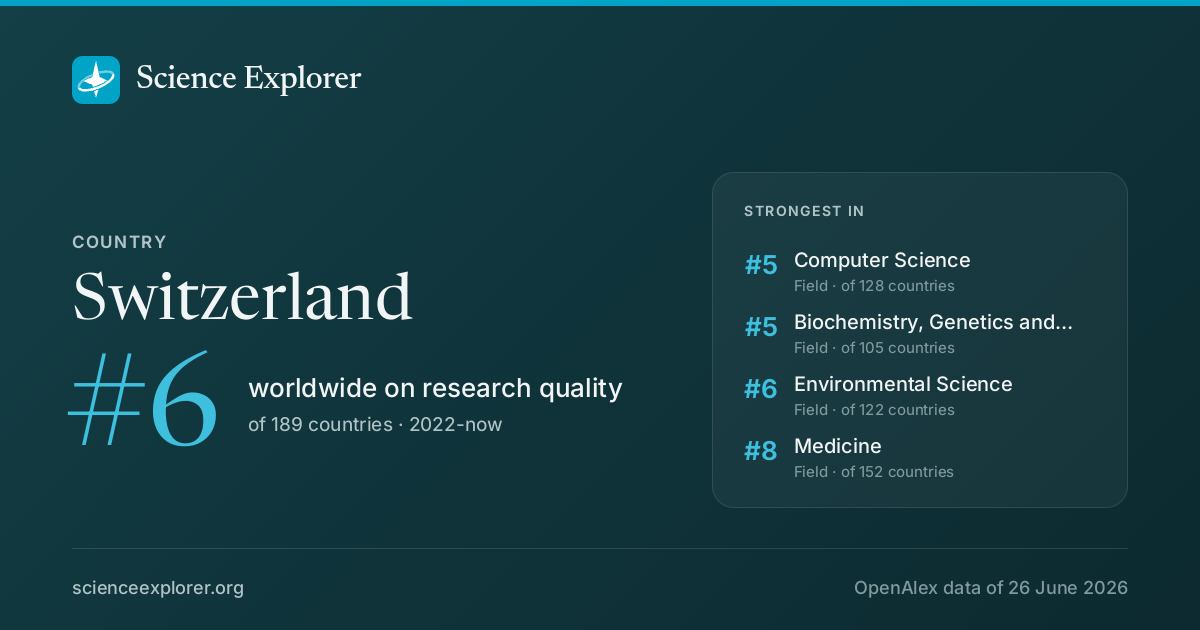
Switzerland ranks #6 of 189 countries on research quality in 2022-now (#6 all time), with 142k research works and 13.3% of them in the world's top 10%.
- World rank, 2022-now
- #6 of 189 · #6 all time
- Works, 2022-now
- 142k ◆ 0% vs 2018-21
- Citations
- 30.5M 31.9 per fractional work, all time
- Top-10% rate
- 13.3% all institutions 10.0%
- vs its own fields
- 1.42× 1.00× is exactly expected
- In the world top 100
- 5 19 in the top 1,000
- Open access
- 47% world 40%
- International
- 34% world 18%
SwitzerlandWhat is Switzerland strongest at in science?
On research quality in 2022-now, Switzerland ranks highest in Computer Science (#5 of 128), Biochemistry, Genetics and Molecular Biology (#5 of 105) and Environmental Science (#6 of 122). Relative to its size it is most specialised in Structural Biology, Medical Terminology and Nuclear and High Energy Physics.
| Field | World rank | Where that sits | Top-10% rate | Works | All time | Institutions |
|---|---|---|---|---|---|---|
| Computer ScienceField | #5 of 128 | 13.3% | 8,681 | #6 | Institutions | |
| Biochemistry, Genetics and Molecular BiologyField | #5 of 105 | 13.7% | 8,739 | #5 | Institutions | |
| Environmental ScienceField | #6 of 122 | 14.3% | 6,247 | #7 | Institutions | |
| MedicineField | #8 of 152 | 13.7% | 35,156 | #8 | Institutions | |
| Artificial IntelligenceSubfield | #5 of 87 | 12.9% | 3,226 | #6 | Institutions | |
| Molecular BiologySubfield | #5 of 84 | 13.7% | 4,822 | #5 | Institutions | |
| Social SciencesField | #9 of 148 | 13.3% | 15,769 | #10 | Institutions | |
| Agricultural and Biological SciencesField | #8 of 124 | 15.7% | 3,992 | #8 | Institutions | |
| Economics, Econometrics and FinanceField | #7 of 107 | 13.3% | 3,422 | #8 | Institutions | |
| Sociology and Political ScienceSubfield | #8 of 119 | 12.7% | 6,011 | #9 | Institutions | |
| Arts and HumanitiesField | #7 of 103 | 11.6% | 6,076 | #7 | Institutions | |
| EngineeringField | #9 of 131 | 12.2% | 14,549 | #7 | Institutions |
Where its research is concentrated
Location quotient: how much more (or less) of each node it does than its size predicts. Drawn around 1×, where "twice the world share" and "half of it" are the same distance apart in opposite directions. A volume reading, which on a country axis is largely population and industrial structure.
- Structural BiologySubfield · 87.2 works · #9 of 126 active here3.4×
- Medical TerminologySubfield · 15.9 works · #11 of 121 active here3.3×
- Nuclear and High Energy PhysicsSubfield · 1,526.5 works · #11 of 169 active here3.0×
- EquineSubfield · 60.8 works · #14 of 135 active here2.9×
- ClassicsSubfield · 275.9 works · #11 of 153 active here2.9×
- General Decision SciencesSubfield · 83.0 works · #13 of 147 active here2.7×
- Theoretical Computer ScienceSubfield · 74.2 works · #11 of 143 active here2.7×
- RadiationSubfield · 574.6 works · #12 of 181 active here2.6×
The whole field profile
All 26 fields at once. A specialist and a generalist produce the same ranked list and a completely different shape.
Rings at 0.5×, 1× and 2×. Widest outward: Veterinary, 2.0×. Every wedge is a field page.
All 26 fields, with their numbers
- Veterinary2.04×450 works
- Physics and Astronomy1.78×6,394 works
- Neuroscience1.58×4,152 works
- Arts and Humanities1.46×6,803 works
- Earth and Planetary Sciences1.34×3,412 works
- Medicine1.29×40k works
- Psychology1.29×6,378 works
- Immunology and Microbiology1.26×2,059 works
- Dentistry1.20×942 works
- Biochemistry, Genetics and Molecular Biology1.18×10k works
- Health Professions1.12×4,776 works
- Decision Sciences1.08×1,697 works
- Economics, Econometrics and Finance1.07×3,703 works
- Mathematics1.05×2,007 works
- Chemistry0.93×2,373 works
- Environmental Science0.93×7,484 works
- Business, Management and Accounting0.87×4,548 works
- Social Sciences0.87×18k works
- Pharmacology, Toxicology and Pharmaceutics0.80×459 works
- Computer Science0.80×10k works
- Chemical Engineering0.79×447 works
- Nursing0.72×569 works
- Engineering0.67×16k works
- Agricultural and Biological Sciences0.60×4,638 works
- Materials Science0.60×3,412 works
- Energy0.59×884 works
Which fields of science does Switzerland work in?
In 2022-now, 33% of research in Switzerland is in Physical Sciences, 29% in Health Sciences. Its largest fields are Medicine (25%), Social Sciences (11%), Engineering (10%). It does 1.3× the world's share of Health Sciences.
Each ring splits the one inside it: the four domains of science, their fields, their subfields. Size is fractional works in 2022-now. Every slice is a page; the interactive view zooms down to single topics and colours each by how much more of it this country does than the world.
Its 4 domains and 26 fields, with their numbers
- Physical Sciences53k32.5%
- Engineering16k10.0%
- Computer Science10k6.2%
- Environmental Science7,4844.6%
- Physics and Astronomy6,3943.9%
- Earth and Planetary Sciences3,4122.1%
- Materials Science3,4122.1%
- Chemistry2,3731.5%
- Mathematics2,0071.2%
- Energy8840.5%
- Chemical Engineering4470.3%
- Health Sciences47k28.9%
- Medicine40k24.8%
- Health Professions4,7763.0%
- Dentistry9420.6%
- Nursing5690.4%
- Veterinary4500.3%
- Social Sciences41k25.3%
- Social Sciences18k11.0%
- Arts and Humanities6,8034.2%
- Psychology6,3783.9%
- Business, Management and Accounting4,5482.8%
- Economics, Econometrics and Finance3,7032.3%
- Decision Sciences1,6971.0%
- Life Sciences21k13.3%
- Biochemistry, Genetics and Molecular Biology10k6.3%
- Agricultural and Biological Sciences4,6382.9%
- Neuroscience4,1522.6%
- Immunology and Microbiology2,0591.3%
- Pharmacology, Toxicology and Pharmaceutics4590.3%
Which keywords describe research in Switzerland?
By fractional works in 2022-now, weighted toward what it does more of than the world: Epidemiology, Climate Change, Machine Learning, Inflammation, Public Health, Quality of Life, Deep Learning and Treatment.
- Qualitative Inhaltsanalyse
- Magnetic Resonance Imaging
- Guidelines
- Global Burden
- Ethics
- Neurological Disorders
- Gender
- Immunotherapy
- Identity
- Depression
- Cancer
- Neural Networks
- Artificial Intelligence
- Cardiovascular Disease
- Oxidative Stress
- Treatment
- Public Health
- Sustainability
- Deep Learning
- Climate Change
- Epidemiology
- Machine Learning
- Inflammation
- Globalization
- Quality of Life
- Mental Health
- Sustainable Development
- Diagnosis
- Risk Factors
- Big Data
- Clinical Trials
- Innovation
- Management
- Biodiversity
- Complications
- Rehabilitation
- Mortality
- Global Warming
- Governance
- Biomechanics
Size is fractional works in 2022-now in the topics tagged with each word; colour is the word's share of this country's work against its share of the world's. The 40 words are chosen for being large and distinctive. Each links to the topic it comes from most.
All 40 words, with their numbers
- Epidemiology7,969▲ 1.24×140 topics
- Climate Change5,217▲ 1.19×130 topics
- Machine Learning4,341▼ 0.81×96 topics
- Deep Learning3,854▼ 0.69×84 topics
- Inflammation3,527◆ 1.02×83 topics
- Sustainability3,017▼ 0.76×139 topics
- Globalization2,855◆ 0.90×182 topics
- Public Health2,728▲ 1.16×77 topics
- Quality of Life2,668◆ 1.14×61 topics
- Treatment2,429▲ 1.23×52 topics
- Mental Health2,403◆ 1.04×48 topics
- Oxidative Stress2,245▼ 0.84×63 topics
- Sustainable Development2,080▼ 0.82×10⁷ topics
- Cardiovascular Disease1,986◆ 1.08×39 topics
- Diagnosis1,966▲ 1.30×41 topics
- Artificial Intelligence1,963▼ 0.85×66 topics
- Risk Factors1,952◆ 1.10×37 topics
- Neural Networks1,826▼ 0.73×41 topics
- Big Data1,748◆ 1.13×34 topics
- Cancer1,742▼ 0.80×59 topics
- Clinical Trials1,586▲ 1.47×19 topics
- Depression1,550◆ 1.09×26 topics
- Innovation1,537◆ 0.92×88 topics
- Identity1,526▲ 1.30×80 topics
- Management1,520▲ 1.18×40 topics
- Immunotherapy1,474▲ 1.26×19 topics
- Biodiversity1,400◆ 1.13×38 topics
- Gender1,400▲ 1.61×58 topics
- Complications1,382▲ 1.72×17 topics
- Neurological Disorders1,363▲ 1.47×20 topics
- Rehabilitation1,256▲ 1.94×13 topics
- Ethics1,247▲ 1.52×62 topics
- Mortality1,218▲ 1.32×13 topics
- Global Burden1,158▲ 1.31×12 topics
- Global Warming1,101▲ 1.59×16 topics
- Guidelines1,096▲ 1.43×13 topics
- Governance1,054▲ 2.0×20 topics
- Magnetic Resonance Imaging981▲ 2.4×8 topics
- Biomechanics950▲ 1.92×12 topics
- Qualitative Inhaltsanalyse674▲ 11×2 topics
Which research topics does Switzerland publish the most in?
Its largest topics in 2022-now are Sociology and Education Studies, Particle physics theoretical and experimental studies, Health, Medicine and Society.
Area is fractional works in 2022-now; colour is the subfield each topic belongs to. Every tile is a topic page.
- 1 Sociology and Education Studies Sociology and Political Science 419 works
- 2 Particle physics theoretical and experimental studies Nuclear and High Energy Physics 383 works
- 3 Health, Medicine and Society General Health Professions 364 works
- 4 Education, sociology, and vocational training Sociology and Political Science 341 works
- 5 French Urban and Social Studies Sociology and Political Science 338 works
- 6 Artificial Intelligence in Healthcare and Education Health Informatics 291 works
- 7 Health Systems, Economic Evaluations, Quality of Life Economics and Econometrics 286 works
- 8 Shoulder Injury and Treatment Surgery 284 works
- 9 German Literature and Culture Studies Literature and Literary Theory 264 works
- 10 Healthcare Systems and Practices General Health Professions 264 works
- 11 Particle Detector Development and Performance Nuclear and High Energy Physics 262 works
- 12 Total Knee Arthroplasty Outcomes Surgery 260 works
How many world-class institutions does Switzerland hold?
Average quality and elite capacity disagree by construction, and both are worth knowing: the first is decided by a country's whole institution population, the second counts the institutions it holds at the top. One square per institution.
| Standing among countries | 2022-now | Where that sits | All time |
|---|---|---|---|
| Average qualityits whole institution population | #6 of 189 | #6 of 203 | |
| Elite capacitythe institutions it holds at the top | #10 of 204 | #9 of 216 |
Elite capacity counts a country's institutions by their worldwide rank, weighted so a place at #1 counts for more than one at #480. Countries under 100 fractional works are left out.
Bands are exclusive, so the squares add up to 19 (the institutions it holds in the world top 1,000), not to four times it.
Which universities in Switzerland lead research?
ETH Zurich, University of Zurich and University of Basel rank highest in Switzerland on research quality in 2022-now.
One dot per institution in the list below. The upper left is the interesting corner.
- 1ETH ZurichUniversity · Zurich · #9 worldwide17.6% top 10% · 14k works
- 2University of ZurichUniversity · Zurich · #72 worldwide14.9% top 10% · 15k works
- 3University of BaselUniversity · Basel · #81 worldwide14.8% top 10% · 7.8k works
- 4École Polytechnique Fédérale de LausanneUniversity · Lausanne · #83 worldwide14.3% top 10% · 8.6k works
- 5University of LausanneUniversity · Lausanne · #86 worldwide13.2% top 10% · 9.4k works
- 6University of GenevaUniversity · Geneva · #117 worldwide14.0% top 10% · 8.6k works
- 7University of BernUniversity · Bern · #136 worldwide14.2% top 10% · 11k works
- 8World Health OrganizationGovernment institution · Geneva · #337 worldwide19.1% top 10% · 3.6k works
- 9University of FribourgUniversity · Fribourg · #397 worldwide11.5% top 10% · 3k works
- 10Università della Svizzera italianaUniversity · Lugano · #632 worldwide14.5% top 10% · 1.8k works
- 11Paul Scherrer InstituteResearch facility · Villigen · #669 worldwide11.7% top 10% · 1.8k works
- 12Roche (Switzerland)Company · Basel · #687 worldwide14.9% top 10% · 2.2k works
- 13Novartis (Switzerland)Company · Basel · #697 worldwide14.5% top 10% · 2k works
- 14Bern University of Applied SciencesUniversity · Bern · #739 worldwide12.2% top 10% · 1.5k works
- 15ZHAW Zurich University of Applied SciencesUniversity · Winterthur · #753 worldwide9.6% top 10% · 2.2k works





The track on each row is its top-10% rate; the tick is the average of all institutions, 10.0% (how it is set): teal above it, red below.
All ranked institutions in SwitzerlandWho are the top researchers in Switzerland?
Shubhanshu Tiwari, Thomas Ward Crowther and Michaël Grätzel rank highest among researchers based in Switzerland.
- 1 Shubhanshu Tiwari #202 worldwide 84k citations · 277 works
- 2 Thomas Ward Crowther #324 worldwide 33k citations · 498 works
- 3 Michaël Grätzel #935 worldwide 458k citations · 2,524 works
- 4 Ruedi Aebersold #982 worldwide 176k citations · 1,184 works
- 5 Shinichi Sunagawa #1,118 worldwide 57k citations · 417 works
- 6 Davide Scaramuzza #1,383 worldwide 46k citations · 537 works
- 7 Shaik Mohammed Zakeeruddin #1,430 worldwide 113k citations · 646 works
- 8 Niko Geldner #1,431 worldwide 20k citations · 183 works
- 9 Pascal A. Oesch #1,450 worldwide 29k citations · 552 works
- 10 Karen Louise Scrivener #1,651 worldwide 67k citations · 501 works
Which cities in Switzerland are research hubs?
- 1
ZurichSwitzerland
249k works
- 2
LausanneSwitzerland
151k works
- 3
GenevaSwitzerland
139k works
- 4
BaselSwitzerland
102k works
- 5
BernSwitzerland
94k works
- 6
FribourgSwitzerland
22k works
- 7
St. GallenSwitzerland
20k works
- 8
NeuchâtelSwitzerland
17k works
How much of it is in the largest
The same cities as shares of everything these twelve account for.
Shares of the rows listed above, not of the whole node.
How open and international is Switzerland's research?
47% of its research is openly available (world: 40%), and 34% is written with international co-authors (world: 18%).
World: 40% of research is openly available.
World: 18% is written across borders.
In 2022-now, 72% of its research is openly available (world 63%) and 43% is written with co-authors abroad (world 22%). Against what its own mix of topics predicts, that is 1.19× the expected open access and 1.86× the expected international share, which puts it #16 of 173 countries on openness.
How has Switzerland's research grown?
Output in 2022-2025 was 0% higher than in 2018-2021.
The same series as a ribbon: one cell per year, darker for more. The line above answers how much; this answers when.
Its share of all research
Growing output can still be a shrinking share: all of science grows. This is Switzerland as a percentage of every work published that year, 0.61% in 2024.
Fractional works of Switzerland over all fractional works that year. How the balance of science has shifted.
How much of it reaches the world top 10%
Over the whole record, 13.6% of its 954k works since 1950 reached the world top 10% for their field and year.
Of each year's output, the share that reached the world's 10% most cited for its field and year. Peak 15.8% in 2011.
Which countries have research most like Switzerland's?
United Kingdom is Switzerland's closest research twin: of all countries, its research is spread across the fields most like Switzerland's, with both strong in Veterinary.
- 1
 United KingdomBoth strong in Veterinary, Arts and Humanities, Neuroscience
0.83 Compare
- 2
 United StatesBoth strong in Neuroscience, Veterinary, Medicine
0.81 Compare
- 3
 ItalyBoth strong in Physics and Astronomy, Veterinary, Neuroscience
0.80 Compare
- 4
 BelgiumBoth strong in Veterinary, Arts and Humanities, Neuroscience
0.78 Compare
- 5
 SwedenBoth strong in Veterinary, Neuroscience, Psychology
0.78 Compare
Similarity is the correlation of each side's location quotients across every field it publishes in, on a log scale: 1 is the same shape of research, 0 is unrelated. It ignores size. How it is measured.
Compare Switzerland with
 France
 Australia
 Canada
 Germany
 Netherlands
Share Switzerland's ranking
Badges for a website8Each links back here and updates with every snapshot
Its overall standing, then the domains, fields and subfields where Switzerland is in the world's top ten or its top 1%. Each has an image of its own.
Overall

Domains

Fields


Subfields


Research fields in Switzerland
- Physical Sciences
- Computer Science
- Life Sciences
- Biochemistry, Genetics and Molecular Biology
- Environmental Science
- Medicine
- Social Sciences
- Health Sciences
- Artificial Intelligence
- Molecular Biology
- Social Sciences
- Agricultural and Biological Sciences
- Economics, Econometrics and Finance
- Sociology and Political Science
- Arts and Humanities
- Engineering
- Atomic and Molecular Physics, and Optics
- Political Science and International Relations
- Psychology
- Biomedical Engineering
- Decision Sciences
- Physics and Astronomy
- Dentistry
- Surgery
- Neuroscience
- Immunology and Microbiology
- Chemistry
- Infectious Diseases
- Ecology, Evolution, Behavior and Systematics
- Mathematics
- Computational Theory and Mathematics
- Plant Science
- Education
- Genetics
- Earth and Planetary Sciences
- Business, Management and Accounting
- Materials Science
- Language and Linguistics
- Health Professions
- General Health Professions
- Organic Chemistry
- Global and Planetary Change
- Organizational Behavior and Human Resource Management
- Economics and Econometrics
- Ecology
- Strategy and Management
- Electrical and Electronic Engineering
- Computer Vision and Pattern Recognition
- Philosophy
- Pathology and Forensic Medicine
- Oncology
- Cognitive Neuroscience
- Immunology
- Materials Chemistry
- Cardiology and Cardiovascular Medicine
- Computational Mechanics
- Finance
- Epidemiology
- Public Health, Environmental and Occupational Health
- Neurology
Questions people ask
What is Switzerland strongest at in science?
On research quality in 2022-now, Switzerland ranks highest in Computer Science (#5 of 128), Biochemistry, Genetics and Molecular Biology (#5 of 105) and Environmental Science (#6 of 122). Relative to its size it is most specialised in Structural Biology, Medical Terminology and Nuclear and High Energy Physics.
See the full answerHow open and international is research in Switzerland?
47% of its research is openly available (world: 40%), and 34% is written with international co-authors (world: 18%).
How open and international is Switzerland's research?Who are the top scientists in Switzerland?
Shubhanshu Tiwari, Thomas Ward Crowther and Michaël Grätzel rank highest among researchers based in Switzerland.
Who are the top researchers in Switzerland?Discussion
Ask a question or share a note about Switzerland. Keep it to the research: no personal attacks, advertising or links. Any reader can report a post, which collapses it for everyone until it is opened.