Roche (Switzerland)
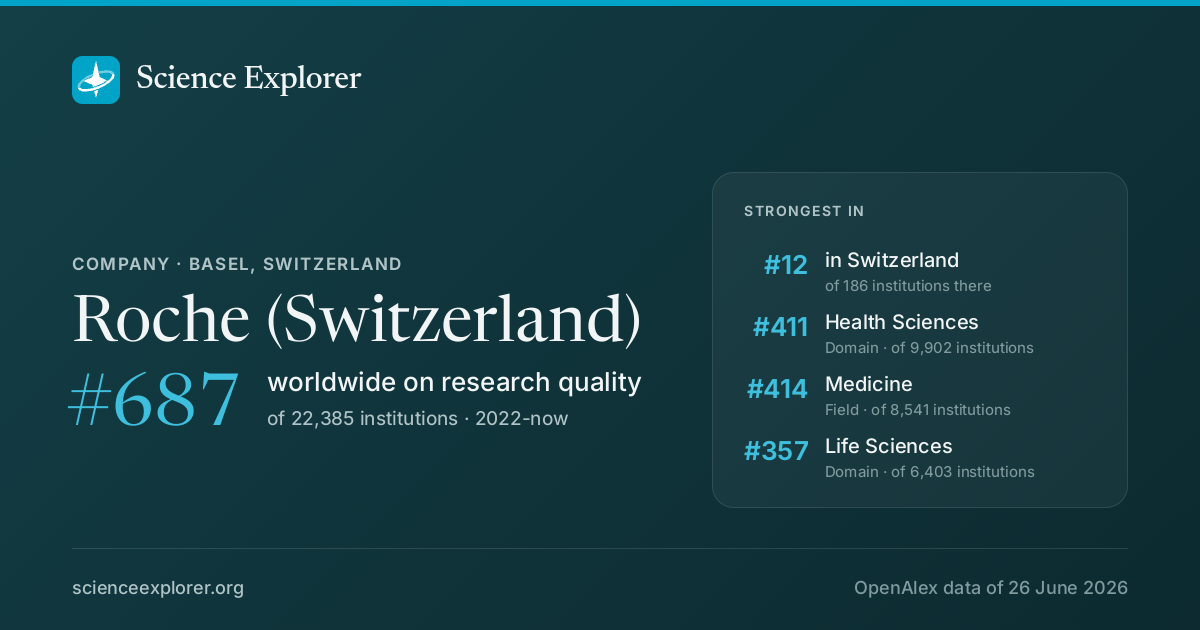
In research, Roche (Switzerland) stands highest in Health Sciences (#411 of 9,902 worldwide), Medicine (#414 of 8,541 worldwide) and Life Sciences (#357 of 6,403 worldwide), 2022-now. Relative to its size it is most specialised in Statistics and Probability, Oncology and Genetics (Statistics and Probability is 8.2× its share of world research).
- World rank, 2022-now
- #687 of 22,385 · #783 all time
- Rank in Switzerland
- #12 of 186
- Research works
- 20k ▲ 5% vs 2018-21
- Citations
- 792k 39.4 per fractional work
- Top-10% rate
- 14.7% all institutions 10.0%
- vs its own fields
- 1.12× 1.00× is exactly expected
- Open access
- 33% world 40%
- International
- 38% world 18%
What is Roche (Switzerland) known for in research?
The fields where it stands highest, 2022-now, ranked among every institution above the floor in each field.
| Field | World rank | Where that sits | Top-10% rate | Works | All time |
|---|---|---|---|---|---|
| Health SciencesDomain | #411 of 9,902 | 16.1% | 1,120 | #325 | |
| MedicineField | #414 of 8,541 | 16.4% | 1,061 | #308 | |
| Life SciencesDomain | #357 of 6,403 | 14.5% | 594 | #405 | |
| Biochemistry, Genetics and Molecular BiologyField | #301 of 2,964 | 14.0% | 378 | #360 | |
| Physical SciencesDomain | #1,203 of 10,670 | 12.2% | 310 | #2004 | |
| Molecular BiologySubfield | #281 of 1,880 | 13.2% | 234 | #339 | |
| OncologySubfield | #119 of 755 | 16.9% | 192 | #153 | |
| Social SciencesDomain | #1,596 of 9,585 | 13.0% | 219 | #3419 | |
| Pulmonary and Respiratory MedicineSubfield | #269 of 1,037 | 17.8% | 116 | #411 | |
| EngineeringField | #1,723 of 5,901 | 13.0% | 81 | #1958 |
Each strip is that field's whole ranked pool, with the notch where Roche (Switzerland) sits in it, in the colour of the band that rank falls in. The track under the rate is the rate itself: it carries no average mark, because the average differs by field (from about 6% in Dentistry to 21% in Economics).
Which of those standings moved
The same fields on both windows: where it stood over the whole record, and where it stands in 2022-now. The distance is the story, and it is the one thing the two rank columns above cannot show.
- Health Sciences#325 #411
- Medicine#308 #414
- Life Sciences#405 #357
- Biochemistry, Genetics and Molecular Biology#360 #301
- Physical Sciences#2,004 #1,203
- Molecular Biology#339 #281
- Oncology#153 #119
- Social Sciences#3,419 #1,596
- Pulmonary and Respiratory Medicine#411 #269
- Engineering#1,958 #1,723
A dot further right is a better standing. Fields it was not ranked in over the whole record are left out.
Which fields of science does Roche (Switzerland) work in?
In 2022-now, 50% of research at Roche (Switzerland) is in Health Sciences, 26% in Life Sciences. Its largest fields are Medicine (47%), Biochemistry, Genetics and Molecular Biology (17%), Economics, Econometrics and Finance (4%). It does 2.1× the world's share of Health Sciences.
Each ring splits the one inside it: the four domains of science, their fields, their subfields. Size is fractional works in 2022-now. Every slice is a page; the interactive view zooms down to single topics and colours each by how much more of it this institution does than the world.
Its 4 domains and 26 fields, with their numbers
- Health Sciences1,25949.7%
- Medicine1,19347.1%
- Health Professions522.1%
- Veterinary80.3%
- Nursing40.1%
- Dentistry20.1%
- Life Sciences66826.4%
- Physical Sciences35414.0%
- Computer Science953.8%
- Engineering913.6%
- Mathematics512.0%
- Chemistry411.6%
- Environmental Science291.1%
- Materials Science190.7%
- Physics and Astronomy170.7%
- Earth and Planetary Sciences80.3%
- Chemical Engineering20.1%
- Energy20.1%
- Social Sciences25310.0%
- Economics, Econometrics and Finance1094.3%
- Social Sciences592.3%
- Psychology281.1%
- Decision Sciences251.0%
- Business, Management and Accounting230.9%
- Arts and Humanities90.4%
What does Roche (Switzerland) specialise in?
Where its research is concentrated relative to its size: Statistics and Probability takes 8.2× the share of its output that it takes of world research.
- Statistics and ProbabilitySubfield · 44.3 works8.2×
- OncologySubfield · 210.1 works7.4×
- GeneticsSubfield · 47.9 works6.9×
- Cancer ResearchSubfield · 71.0 works6.5×
- Pathology and Forensic MedicineSubfield · 75.8 works5.7×
- HematologySubfield · 42.7 works5.6×
- ImmunologySubfield · 97.1 works5.6×
Location quotient, a volume reading rather than an impact one. It surfaces small, lopsided specialities.
Field profile
Location quotient across every field it publishes in: outside the ring is more than an institution of this size would be expected to publish, inside it is less.
Rings at 0.5×, 1× and 2×. Widest outward: Immunology and Microbiology, 4.1×. Every wedge is a field page.
All 26 fields, with their numbers
- Immunology and Microbiology4.07×104 works
- Pharmacology, Toxicology and Pharmaceutics3.97×36 works
- Biochemistry, Genetics and Molecular Biology3.15×426 works
- Medicine2.45×1,193 works
- Veterinary2.37×8 works
- Economics, Econometrics and Finance2.01×109 works
- Neuroscience1.90×78 works
- Mathematics1.70×51 works
- Chemistry1.03×41 works
- Decision Sciences1.03×25 works
- Health Professions0.78×52 works
- Computer Science0.48×96 works
- Psychology0.36×28 works
- Physics and Astronomy0.30×17 works
- Chemical Engineering0.28×2 works
- Nursing0.28×4 works
- Business, Management and Accounting0.28×23 works
- Engineering0.24×91 works
- Environmental Science0.23×29 works
- Agricultural and Biological Sciences0.21×25 works
- Materials Science0.21×19 works
- Earth and Planetary Sciences0.19×8 works
- Social Sciences0.18×59 works
- Dentistry0.17×2 works
- Arts and Humanities0.13×9 works
- Energy0.07×2 works
- Immunology and Microbiology 4.1×
- Pharmacology, Toxicology and Pharmaceutics 4.0×
- Biochemistry, Genetics and Molecular Biology 3.1×
- Medicine 2.5×
- Veterinary 2.4×
- Economics, Econometrics and Finance 2.0×
- Neuroscience 1.9×
- Mathematics 1.7×
- Chemistry 1.0×
- Decision Sciences 1.0×
- Health Professions 0.8×
- Computer Science 0.5×
- Psychology 0.4×
- Physics and Astronomy 0.3×
- Chemical Engineering 0.3×
- Nursing 0.3×
- Business, Management and Accounting 0.3×
- Engineering 0.2×
- Environmental Science 0.2×
- Agricultural and Biological Sciences 0.2×
- Materials Science 0.2×
- Earth and Planetary Sciences 0.2×
- Social Sciences 0.2×
- Dentistry 0.2×
- Arts and Humanities 0.1×
- Energy 0.1×
Who are the top researchers at Roche (Switzerland)?
Ranked on the quality score, Pablo Umaña, Marina Bacac and Gail D. Lewis Phillips lead among researchers whose main affiliation is Roche (Switzerland).
- 1
Pablo Umaña
 Switzerland · #28,225 worldwide
13k citations · 584 works
- 2
Marina Bacac
Switzerland · #31,379 worldwide
8.2k citations · 471 works
- 3
Gail D. Lewis Phillips
Switzerland · #36,507 worldwide
13k citations · 274 works
- 4
Johannes Sam
Switzerland · #49,750 worldwide
2.9k citations · 282 works
- 5
Ravi Jagasia
Switzerland · #56,109 worldwide
5.8k citations · 93 works
- 6
Dheeraj Malhotra
Switzerland · #66,169 worldwide
16k citations · 85 works
- 7
Christian Georg Klein
Switzerland · #69,892 worldwide
29k citations · 1,069 works
- 8
Markus Britschgi
Switzerland · #70,653 worldwide
12k citations · 79 works
- 9
Ciara Metcalfe
Switzerland · #73,799 worldwide
3k citations · 210 works
- 10
Hanno Langen
Switzerland · #73,901 worldwide
14k citations · 127 works
Which keywords describe research at Roche (Switzerland)?
By fractional works in 2022-now, weighted toward what it does more of than the world: Monoclonal Antibodies, Targeted Therapy, Chemotherapy, Immunotherapy, Clinical Trials, Therapeutic Antibodies, Biomarkers and Lymphoma.
- PET Imaging
- CAR T Cells
- PD-1 and PD-L1
- Rituximab
- Tumor Regression
- Cancer Genomics
- Somatic Mutations
- Fc Receptors
- Neurodegeneration
- Prognostic Factors
- Health Utility Measures
- Economic Evaluation
- Tumor Microenvironment
- Glycosylation
- Therapeutic Antibodies
- Quality of Life
- Inflammation
- Immunotherapy
- Targeted Therapy
- Machine Learning
- Epidemiology
- Monoclonal Antibodies
- Chemotherapy
- Clinical Trials
- Biomarkers
- Oxidative Stress
- Lymphoma
- Precision Medicine
- Cancer Immunotherapy
- Cost-effectiveness Analysis
- Biopharmaceuticals
- Immunogenicity
- Antibody Engineering
- Genomic Instability
- Cell-Free DNA
- Mutational Signatures
- Breast Cancer
- Immune Checkpoint Blockade
- Leukemia
- Chimeric Antigen Receptor
Size is fractional works in 2022-now in the topics tagged with each word; colour is the word's share of this institution's work against its share of the world's. The 40 words are chosen for being large and distinctive. Each links to the topic it comes from most.
All 40 words, with their numbers
- Epidemiology132▲ 1.31×120 topics
- Machine Learning126▲ 1.49×55 topics
- Monoclonal Antibodies109▲ 48×3 topics
- Targeted Therapy104▲ 19×5 topics
- Chemotherapy102▲ 5.7×25 topics
- Immunotherapy102▲ 5.5×18 topics
- Clinical Trials96▲ 5.7×17 topics
- Inflammation95▲ 1.77×71 topics
- Biomarkers92▲ 5.2×18 topics
- Quality of Life85▲ 2.3×42 topics
- Oxidative Stress84▲ 2.0×46 topics
- Therapeutic Antibodies80▲ 45×2 topics
- Lymphoma76▲ 19×4 topics
- Glycosylation75▲ 27×3 topics
- Precision Medicine72▲ 5.8×8 topics
- Tumor Microenvironment70▲ 6.2×8 topics
- Cancer Immunotherapy63▲ 16×3 topics
- Economic Evaluation58▲ 20×3 topics
- Cost-effectiveness Analysis58▲ 29×1 topic
- Health Utility Measures58▲ 29×1 topic
- Biopharmaceuticals58▲ 44×3 topics
- Prognostic Factors57▲ 5.2×14 topics
- Immunogenicity56▲ 52×3 topics
- Neurodegeneration53▲ 6.8×9 topics
- Antibody Engineering53▲ 38×1 topic
- Fc Receptors53▲ 38×1 topic
- Genomic Instability50▲ 18×3 topics
- Somatic Mutations49▲ 23×2 topics
- Cell-Free DNA48▲ 20×2 topics
- Cancer Genomics48▲ 26×1 topic
- Mutational Signatures48▲ 26×1 topic
- Tumor Regression48▲ 17×2 topics
- Breast Cancer46▲ 7.3×11 topics
- Rituximab46▲ 13×4 topics
- Immune Checkpoint Blockade46▲ 16×1 topic
- PD-1 and PD-L146▲ 16×1 topic
- Leukemia46▲ 22×2 topics
- CAR T Cells46▲ 25×1 topic
- Chimeric Antigen Receptor46▲ 25×1 topic
- PET Imaging44▲ 11×5 topics
Which research topics does Roche (Switzerland) publish most on?
By volume in 2022-now: Health Systems, Economic Evaluations, Quality of Life, Monoclonal and Polyclonal Antibodies Research, Cancer Genomics and Diagnostics and Cancer Immunotherapy and Biomarkers.
Area is fractional works; colour is the subfield each topic belongs to.
- 1 Health Systems, Economic Evaluations, Quality of Life Economics and Econometrics 58 works
- 2 Monoclonal and Polyclonal Antibodies Research Radiology, Nuclear Medicine and Imaging 53 works
- 3 Cancer Genomics and Diagnostics Cancer Research 48 works
- 4 Cancer Immunotherapy and Biomarkers Oncology 46 works
- 5 CAR-T cell therapy research Oncology 46 works
- 6 Lung Cancer Treatments and Mutations Pulmonary and Respiratory Medicine 35 works
- 7 Biosimilars and Bioanalytical Methods Immunology 29 works
- 8 Lymphoma Diagnosis and Treatment Pathology and Forensic Medicine 29 works
- 9 Protein purification and stability Molecular Biology 27 works
- 10 Computational Drug Discovery Methods Computational Theory and Mathematics 24 works
How open and international is its research?
Against the world's own shares: the tick on each track. Both are shares of its output, so they sit on one scale and can be read against each other as well as against the world.
World: 40% of research is openly available.
World: 18% is written across borders.
How has Roche (Switzerland)'s research output changed?
Output in 2022-2025 was 5% higher than in 2018-2021.
The same series as a ribbon: one cell per year, darker for more. The line above answers how much; this answers when.
Its share of all research
Growing output can still be a shrinking share: all of science grows. This is Roche (Switzerland) as a percentage of every work published that year, 0.0091% in 2024.
Fractional works of Roche (Switzerland) over all fractional works that year. How the balance of science has shifted.
How much of it reaches the world top 10%
Year by year, against all institutions in the same year.
Of each year's output, the share that reached the world's 10% most cited for its field and year. Peak 16.2% in 2024.
Other research institutions in Basel
- University of Basel
- Novartis (Switzerland)
- Swiss Tropical and Public Health Institute
- Multidisciplinary Digital Publishing Institute (Switzerland)
- University Children’s Hospital Basel
- Bank for International Settlements
- Swiss Archaeology
- Syngenta (Switzerland)

Compare Roche (Switzerland) with
- vs
 Chengdu University of Technology
- vs Ministry of Ecology and Environment
- vs
 Rockefeller University
- vs
 University of Coimbra
- vs
 Royal Holloway University of London
- vs University of Aberdeen
Share Roche (Switzerland)'s ranking



Research measures only: rankings here say nothing about teaching, admissions or student experience. Comparable institutions and collaboration partners have tabs of their own, above.
Questions people ask
What does Roche publish research on?
In research, Roche (Switzerland) stands highest in Health Sciences (#411 of 9,902 worldwide), Medicine (#414 of 8,541 worldwide) and Life Sciences (#357 of 6,403 worldwide), 2022-now. Relative to its size it is most specialised in Statistics and Probability, Oncology and Genetics (Statistics and Probability is 8.2× its share of world research).
Discussion
Ask a question or share a note about Roche (Switzerland). Posts are plain text and can be reported.