 Science in Sweden
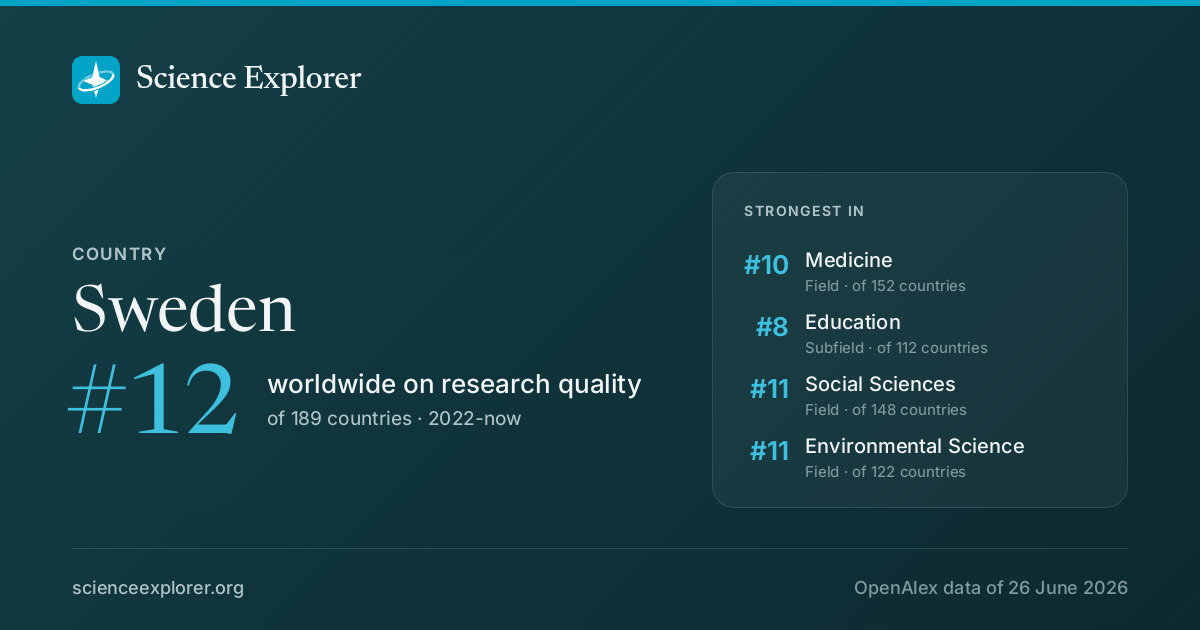
Sweden ranks #12 of 189 countries on research quality in 2022-now (#12 all time), with 121k research works and 13.6% of them in the world's top 10%.
- World rank, 2022-now
- #12 of 189 · #12 all time
- Works, 2022-now
- 121k ◆ 1% vs 2018-21
- Citations
- 30.1M 32.8 per fractional work, all time
- Top-10% rate
- 13.6% all institutions 10.0%
- vs its own fields
- 1.28× 1.00× is exactly expected
- In the world top 100
- 0 12 in the top 1,000
- Open access
- 41% world 40%
- International
- 27% world 18%
SwedenWhat is Sweden strongest at in science?
On research quality in 2022-now, Sweden ranks highest in Medicine (#10 of 152), Education (#8 of 112) and Social Sciences (#11 of 148). Relative to its size it is most specialised in Public Administration, Research and Theory and Equine.
| Field | World rank | Where that sits | Top-10% rate | Works | All time | Institutions |
|---|---|---|---|---|---|---|
| MedicineField | #10 of 152 | 14.9% | 26,826 | #11 | Institutions | |
| EducationSubfield | #8 of 112 | 14.4% | 3,269 | #11 | Institutions | |
| Social SciencesField | #11 of 148 | 15.7% | 15,788 | #13 | Institutions | |
| Environmental ScienceField | #11 of 122 | 12.9% | 6,561 | #11 | Institutions | |
| Sociology and Political ScienceSubfield | #11 of 119 | 15.9% | 5,042 | #13 | Institutions | |
| Agricultural and Biological SciencesField | #12 of 124 | 15.3% | 3,258 | #12 | Institutions | |
| Industrial and Manufacturing EngineeringSubfield | #6 of 60 | 15.4% | 844 | - | Institutions | |
| Health ProfessionsField | #11 of 106 | 13.7% | 4,113 | #11 | Institutions | |
| PsychologyField | #11 of 106 | 12.9% | 5,559 | #11 | Institutions | |
| Biochemistry, Genetics and Molecular BiologyField | #11 of 105 | 12.7% | 6,998 | #11 | Institutions | |
| EngineeringField | #14 of 131 | 11.6% | 15,932 | #14 | Institutions | |
| Business, Management and AccountingField | #12 of 110 | 16.2% | 3,447 | #12 | Institutions |
Where its research is concentrated
Location quotient: how much more (or less) of each node it does than its size predicts. Drawn around 1×, where "twice the world share" and "half of it" are the same distance apart in opposite directions. A volume reading, which on a country axis is largely population and industrial structure.
- Public AdministrationSubfield · 322.9 works · #9 of 186 active here4.3×
- Research and TheorySubfield · 144.1 works · #10 of 183 active here4.0×
- EquineSubfield · 43.4 works · #18 of 135 active here2.4×
- SoftwareSubfield · 209.7 works · #14 of 160 active here2.4×
- Structural BiologySubfield · 51.5 works · #16 of 126 active here2.3×
- Applied PsychologySubfield · 385.5 works · #20 of 199 active here1.9×
- Psychiatry and Mental healthSubfield · 1,301.4 works · #18 of 214 active here1.9×
- Human-Computer InteractionSubfield · 529.9 works · #20 of 193 active here1.9×
The whole field profile
All 26 fields at once. A specialist and a generalist produce the same ranked list and a completely different shape.
Rings at 0.5×, 1× and 2×. Widest outward: Veterinary, 1.6×. Every wedge is a field page.
All 26 fields, with their numbers
- Veterinary1.56×294 works
- Psychology1.52×6,452 works
- Health Professions1.30×4,747 works
- Neuroscience1.29×2,914 works
- Immunology and Microbiology1.24×1,728 works
- Physics and Astronomy1.23×3,807 works
- Medicine1.16×31k works
- Environmental Science1.11×7,638 works
- Biochemistry, Genetics and Molecular Biology1.10×8,153 works
- Decision Sciences1.07×1,444 works
- Social Sciences1.03×18k works
- Mathematics1.00×1,635 works
- Arts and Humanities0.99×3,988 works
- Earth and Planetary Sciences0.95×2,080 works
- Nursing0.91×620 works
- Economics, Econometrics and Finance0.88×2,624 works
- Business, Management and Accounting0.87×3,881 works
- Computer Science0.85×9,199 works
- Engineering0.85×18k works
- Dentistry0.85×576 works
- Chemical Engineering0.84×406 works
- Materials Science0.74×3,576 works
- Energy0.70×890 works
- Chemistry0.65×1,414 works
- Pharmacology, Toxicology and Pharmaceutics0.63×307 works
- Agricultural and Biological Sciences0.59×3,868 works
Which fields of science does Sweden work in?
In 2022-now, 35% of research in Sweden is in Physical Sciences, 27% in Health Sciences. Its largest fields are Medicine (22%), Social Sciences (13%), Engineering (13%).
Each ring splits the one inside it: the four domains of science, their fields, their subfields. Size is fractional works in 2022-now. Every slice is a page; the interactive view zooms down to single topics and colours each by how much more of it this country does than the world.
Its 4 domains and 26 fields, with their numbers
- Physical Sciences48k34.8%
- Engineering18k12.7%
- Computer Science9,1996.6%
- Environmental Science7,6385.5%
- Physics and Astronomy3,8072.7%
- Materials Science3,5762.6%
- Earth and Planetary Sciences2,0801.5%
- Mathematics1,6351.2%
- Chemistry1,4141.0%
- Energy8900.6%
- Chemical Engineering4060.3%
- Health Sciences37k26.7%
- Medicine31k22.2%
- Health Professions4,7473.4%
- Nursing6210.4%
- Dentistry5760.4%
- Veterinary2940.2%
- Social Sciences37k26.3%
- Social Sciences18k13.1%
- Psychology6,4524.6%
- Arts and Humanities3,9882.9%
- Business, Management and Accounting3,8812.8%
- Economics, Econometrics and Finance2,6241.9%
- Decision Sciences1,4441.0%
- Life Sciences17k12.2%
- Biochemistry, Genetics and Molecular Biology8,1535.9%
- Agricultural and Biological Sciences3,8682.8%
- Neuroscience2,9142.1%
- Immunology and Microbiology1,7281.2%
- Pharmacology, Toxicology and Pharmaceutics3070.2%
Which keywords describe research in Sweden?
By fractional works in 2022-now, weighted toward what it does more of than the world: Epidemiology, Climate Change, Inflammation, Sustainability, Globalization, Machine Learning, Quality of Life and Cardiovascular Disease.
- Quantitative Methods
- Gender Studies
- Prevalence
- Neoliberalism
- Learning
- Ethics
- Health Effects
- Obesity
- Biomarkers
- Genetics
- Qualitative Research
- Depression
- Renewable Energy
- Environmental Impact
- Education
- Public Health
- Quality of Life
- Deep Learning
- Sustainability
- Climate Change
- Epidemiology
- Machine Learning
- Inflammation
- Globalization
- Mental Health
- Cardiovascular Disease
- Oxidative Stress
- Treatment
- Risk Factors
- Cancer
- Pedagogy
- Big Data
- Metabolic Syndrome
- Global Burden
- Anxiety
- Resilience
- Social Sciences
- Discourse Analysis
- Special Education
- Methodology
Size is fractional works in 2022-now in the topics tagged with each word; colour is the word's share of this country's work against its share of the world's. The 40 words are chosen for being large and distinctive. Each links to the topic it comes from most.
All 40 words, with their numbers
- Epidemiology6,544▲ 1.18×140 topics
- Climate Change4,486▲ 1.19×130 topics
- Machine Learning3,820▼ 0.83×95 topics
- Sustainability3,715◆ 1.09×137 topics
- Inflammation3,539▲ 1.20×83 topics
- Deep Learning3,371▼ 0.70×84 topics
- Globalization3,192▲ 1.17×178 topics
- Quality of Life2,646▲ 1.32×61 topics
- Mental Health2,575▲ 1.30×48 topics
- Public Health2,428▲ 1.20×74 topics
- Cardiovascular Disease2,363▲ 1.49×39 topics
- Education2,204◆ 0.92×157 topics
- Oxidative Stress2,176◆ 0.95×63 topics
- Environmental Impact2,085◆ 0.88×72 topics
- Treatment1,949◆ 1.15×52 topics
- Renewable Energy1,903◆ 0.95×61 topics
- Risk Factors1,892▲ 1.24×37 topics
- Depression1,857▲ 1.52×26 topics
- Cancer1,618◆ 0.87×59 topics
- Qualitative Research1,570▲ 1.33×44 topics
- Pedagogy1,566▲ 2.2×30 topics
- Genetics1,468▲ 1.49×27 topics
- Big Data1,423◆ 1.07×36 topics
- Biomarkers1,375▲ 1.42×18 topics
- Metabolic Syndrome1,372▲ 1.22×24 topics
- Obesity1,261▲ 1.18×29 topics
- Global Burden1,216▲ 1.61×12 topics
- Health Effects1,214▲ 1.44×24 topics
- Anxiety1,175▲ 1.78×12 topics
- Ethics1,128▲ 1.60×61 topics
- Resilience1,072▲ 1.57×19 topics
- Learning985▲ 2.4×17 topics
- Social Sciences983▲ 4.9×23 topics
- Neoliberalism978▲ 1.95×29 topics
- Discourse Analysis974▲ 2.9×11 topics
- Prevalence974▲ 1.71×15 topics
- Special Education874▲ 11×6 topics
- Gender Studies862▲ 4.1×20 topics
- Methodology806▲ 12×7 topics
- Quantitative Methods780▲ 43×2 topics
Which research topics does Sweden publish the most in?
Its largest topics in 2022-now are Social and Educational Sciences, Education, Innovation and Language Studies, Dementia and Cognitive Impairment Research.
Area is fractional works in 2022-now; colour is the subfield each topic belongs to. Every tile is a topic page.
- 1 Social and Educational Sciences Education 779 works
- 2 Education, Innovation and Language Studies Education 400 works
- 3 Dementia and Cognitive Impairment Research Psychiatry and Mental health 346 works
- 4 Economic and Industrial Development Economics and Econometrics 279 works
- 5 Alzheimer's disease research and treatments Physiology 272 works
- 6 Sustainability and Climate Change Governance Global and Planetary Change 271 works
- 7 Ethics and Social Impacts of AI Safety Research 265 works
- 8 Digital Transformation in Industry Industrial and Manufacturing Engineering 258 works
- 9 COVID-19 and Mental Health Clinical Psychology 257 works
- 10 Sustainable Supply Chain Management Strategy and Management 248 works
- 11 Workplace Health and Well-being General Health Professions 242 works
- 12 Employment and Welfare Studies General Health Professions 240 works
How many world-class institutions does Sweden hold?
Average quality and elite capacity disagree by construction, and both are worth knowing: the first is decided by a country's whole institution population, the second counts the institutions it holds at the top. One square per institution.
| Standing among countries | 2022-now | Where that sits | All time |
|---|---|---|---|
| Average qualityits whole institution population | #12 of 189 | #12 of 203 | |
| Elite capacitythe institutions it holds at the top | #14 of 204 | #14 of 216 |
Elite capacity counts a country's institutions by their worldwide rank, weighted so a place at #1 counts for more than one at #480. Countries under 100 fractional works are left out.
Bands are exclusive, so the squares add up to 12 (the institutions it holds in the world top 1,000), not to four times it.
Which universities in Sweden lead research?
Karolinska Institutet, Uppsala University and University of Gothenburg rank highest in Sweden on research quality in 2022-now.
One dot per institution in the list below. The upper left is the interesting corner.
- 1Karolinska InstitutetUniversity · Stockholm · #121 worldwide16.4% top 10% · 12k works
- 2Uppsala UniversityUniversity · Uppsala · #154 worldwide13.3% top 10% · 11k works
- 3University of GothenburgUniversity · Gothenburg · #165 worldwide14.4% top 10% · 9.8k works
- 4Lund UniversityUniversity · Lund · #176 worldwide13.0% top 10% · 12k works
- 5Stockholm UniversityUniversity · Stockholm · #180 worldwide14.7% top 10% · 7.1k works
- 6Chalmers University of TechnologyUniversity · Gothenburg · #285 worldwide12.9% top 10% · 5.3k works
- 7KTH Royal Institute of TechnologyUniversity · Stockholm · #301 worldwide13.4% top 10% · 7.8k works
- 8Umeå UniversityUniversity · Umeå · #325 worldwide13.2% top 10% · 5.2k works
- 9Linköping UniversityUniversity · Linköping · #334 worldwide13.5% top 10% · 5.7k works
- 10Science for Life LaboratoryResearch facility · Stockholm · #633 worldwide18.0% top 10% · 847 works
- 11Örebro UniversityUniversity · Örebro · #659 worldwide14.2% top 10% · 2.2k works
- 12Swedish University of Agricultural SciencesUniversity · Uppsala · #693 worldwide15.5% top 10% · 3.2k works
- 13Luleå University of TechnologyUniversity · Luleå · #1,001 worldwide14.1% top 10% · 2.5k works
- 14Linnaeus UniversityUniversity · Vaxjo · #1,270 worldwide12.4% top 10% · 2k works
- 15Mälardalen UniversityUniversity · Västerås · #1,284 worldwide13.7% top 10% · 1.1k works




The track on each row is its top-10% rate; the tick is the average of all institutions, 10.0% (how it is set): teal above it, red below.
All ranked institutions in SwedenWho are the top researchers in Sweden?
Fredrik Bäckhed, Carl Folke and Patrik K. E. Magnusson rank highest among researchers based in Sweden.
- 1 Fredrik Bäckhed #256 worldwide 117k citations · 348 works
- 2 Carl Folke #294 worldwide 182k citations · 488 works
- 3 Patrik K. E. Magnusson #1,844 worldwide 120k citations · 734 works
- 4 Anna Maria Langkilde #2,063 worldwide 23k citations · 310 works
- 5 Garry Peterson #2,140 worldwide 33k citations · 234 works
- 6 Stefan Gößling #2,203 worldwide 27k citations · 323 works
- 7 Johan Rockström #2,648 worldwide 128k citations · 488 works
- 8 Anders Hagfeldt #2,788 worldwide 137k citations · 835 works
- 9 T. Ylinen #3,558 worldwide 23k citations · 106 works
- 10 Karl B Swedberg #4,009 worldwide 104k citations · 685 works
Which cities in Sweden are research hubs?
- 1
StockholmSweden
290k works
- 2
GothenburgSweden
134k works
- 3
UppsalaSweden
133k works
- 4
LundSweden
120k works
- 5
LinköpingSweden
48k works
- 6
UmeåSweden
44k works
How much of it is in the largest
The same cities as shares of everything these twelve account for.
Shares of the rows listed above, not of the whole node.
How open and international is Sweden's research?
41% of its research is openly available (world: 40%), and 27% is written with international co-authors (world: 18%).
World: 40% of research is openly available.
World: 18% is written across borders.
In 2022-now, 78% of its research is openly available (world 63%) and 40% is written with co-authors abroad (world 22%). Against what its own mix of topics predicts, that is 1.28× the expected open access and 1.70× the expected international share, which puts it #5 of 173 countries on openness.
How has Sweden's research grown?
Output in 2022-2025 was 1% higher than in 2018-2021.
The same series as a ribbon: one cell per year, darker for more. The line above answers how much; this answers when.
Its share of all research
Growing output can still be a shrinking share: all of science grows. This is Sweden as a percentage of every work published that year, 0.55% in 2024.
Fractional works of Sweden over all fractional works that year. How the balance of science has shifted.
How much of it reaches the world top 10%
Over the whole record, 13.3% of its 916k works since 1950 reached the world top 10% for their field and year.
Of each year's output, the share that reached the world's 10% most cited for its field and year. Peak 14.8% in 2013.
Which countries have research most like Sweden's?
Netherlands is Sweden's closest research twin: of all countries, its research is spread across the fields most like Sweden's, with both strong in Psychology.
- 1
 NetherlandsBoth strong in Psychology, Veterinary, Neuroscience
0.88 Compare
- 2
 United KingdomBoth strong in Veterinary, Psychology, Health Professions
0.85 Compare
- 3
 CanadaBoth strong in Psychology, Veterinary, Health Professions
0.84 Compare
- 4
 United StatesBoth strong in Psychology, Veterinary, Neuroscience
0.84 Compare
- 5
 SwitzerlandBoth strong in Veterinary, Neuroscience, Psychology
0.78 Compare
Similarity is the correlation of each side's location quotients across every field it publishes in, on a log scale: 1 is the same shape of research, 0 is unrelated. It ignores size. How it is measured.
Compare Sweden with
 Italy
 Singapore
 Spain
 South Korea
 Denmark
Share Sweden's ranking



Research fields in Sweden
- Health Sciences
- Medicine
- Social Sciences
- Education
- Social Sciences
- Life Sciences
- Environmental Science
- Sociology and Political Science
- Agricultural and Biological Sciences
- Industrial and Manufacturing Engineering
- Health Professions
- Psychology
- Physical Sciences
- Biochemistry, Genetics and Molecular Biology
- Engineering
- Business, Management and Accounting
- Computer Science
- Economics, Econometrics and Finance
- Political Science and International Relations
- Economics and Econometrics
- Arts and Humanities
- Epidemiology
- General Health Professions
- Molecular Biology
- Public Health, Environmental and Occupational Health
- Decision Sciences
- Mathematics
- Electrical and Electronic Engineering
- Surgery
- Infectious Diseases
- Global and Planetary Change
- Clinical Psychology
- Social Psychology
- Pulmonary and Respiratory Medicine
- Earth and Planetary Sciences
- Pediatrics, Perinatology and Child Health
- Neurology
- Information Systems
- Strategy and Management
- Ecology, Evolution, Behavior and Systematics
- Ecology
- Genetics
- Plant Science
- Physics and Astronomy
- Materials Science
- Artificial Intelligence
- Mechanical Engineering
- Physiology
- Neuroscience
- Language and Linguistics
- Oncology
- Cardiology and Cardiovascular Medicine
- Developmental and Educational Psychology
- Biomedical Engineering
- Communication
- Health, Toxicology and Mutagenesis
- Literature and Literary Theory
- Immunology and Microbiology
- Building and Construction
- Demography
Questions people ask
What is Sweden strongest at in science?
On research quality in 2022-now, Sweden ranks highest in Medicine (#10 of 152), Education (#8 of 112) and Social Sciences (#11 of 148). Relative to its size it is most specialised in Public Administration, Research and Theory and Equine.
See the full answerDiscussion
Ask a question or share a note about Sweden. Keep it to the research: no personal attacks, advertising or links. Any reader can report a post, which collapses it for everyone until it is opened.