Uppsala University

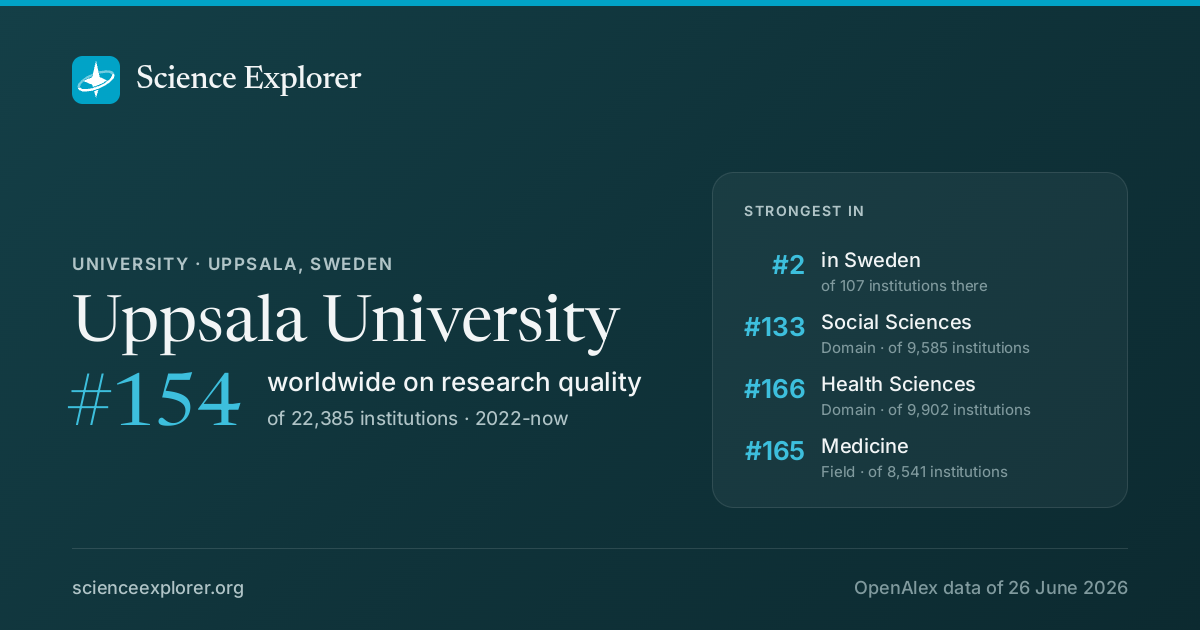
In research, Uppsala University stands highest in Social Sciences (#133 of 9,585 worldwide), Health Sciences (#166 of 9,902 worldwide) and Social Sciences (#113 of 5,988 worldwide), 2022-now. Relative to its size it is most specialised in Public Administration, Physical and Theoretical Chemistry and Nuclear and High Energy Physics (Public Administration is 4.3× its share of world research).
- World rank, 2022-now
- #154 of 22,385 · #210 all time
- Rank in Sweden
- #2 of 107
- Research works
- 98k ◆ 2% vs 2018-21
- Citations
- 3.4M 35.1 per fractional work
- Top-10% rate
- 13.0% all institutions 10.0%
- vs its own fields
- 1.29× 1.00× is exactly expected
- Open access
- 39% world 40%
- International
- 25% world 18%
What is Uppsala University known for in research?
The fields where it stands highest, 2022-now, ranked among every institution above the floor in each field.
| Field | World rank | Where that sits | Top-10% rate | Works | All time |
|---|---|---|---|---|---|
| Social SciencesDomain | #133 of 9,585 | 15.0% | 3,005 | #241 | |
| Health SciencesDomain | #166 of 9,902 | 14.5% | 2,971 | #209 | |
| Social SciencesField | #113 of 5,988 | 15.9% | 1,506 | #213 | |
| MedicineField | #165 of 8,541 | 14.3% | 2,579 | #196 | |
| Physical SciencesDomain | #210 of 10,670 | 11.5% | 3,889 | #247 | |
| Business, Management and AccountingField | #81 of 2,581 | 18.3% | 200 | #294 | |
| Life SciencesDomain | #214 of 6,403 | 12.6% | 1,459 | #246 | |
| Sociology and Political ScienceSubfield | #105 of 2,526 | 17.2% | 494 | #205 | |
| Health ProfessionsField | #90 of 1,895 | 14.8% | 314 | #186 | |
| Biochemistry, Genetics and Molecular BiologyField | #166 of 2,964 | 12.8% | 828 | #193 |
Each strip is that field's whole ranked pool, with the notch where Uppsala University sits in it, in the colour of the band that rank falls in. The track under the rate is the rate itself: it carries no average mark, because the average differs by field (from about 6% in Dentistry to 21% in Economics).
Which of those standings moved
The same fields on both windows: where it stood over the whole record, and where it stands in 2022-now. The distance is the story, and it is the one thing the two rank columns above cannot show.
- Social Sciences#241 #133
- Health Sciences#209 #166
- Social Sciences#213 #113
- Medicine#196 #165
- Physical Sciences#247 #210
- Business, Management and Accounting#294 #81
- Life Sciences#246 #214
- Sociology and Political Science#205 #105
- Health Professions#186 #90
- Biochemistry, Genetics and Molecular Biology#193 #166
A dot further right is a better standing. Fields it was not ranked in over the whole record are left out.
Which fields of science does Uppsala University work in?
In 2022-now, 34% of research at Uppsala University is in Physical Sciences, 27% in Social Sciences. Its largest fields are Medicine (23%), Social Sciences (13%), Engineering (9%).
Each ring splits the one inside it: the four domains of science, their fields, their subfields. Size is fractional works in 2022-now. Every slice is a page; the interactive view zooms down to single topics and colours each by how much more of it this institution does than the world.
Its 4 domains and 26 fields, with their numbers
- Physical Sciences4,35833.8%
- Engineering1,2219.5%
- Computer Science6655.2%
- Physics and Astronomy5664.4%
- Materials Science5073.9%
- Environmental Science4663.6%
- Earth and Planetary Sciences2902.3%
- Mathematics2612.0%
- Chemistry2381.9%
- Energy1140.9%
- Chemical Engineering290.2%
- Social Sciences3,41726.5%
- Social Sciences1,71213.3%
- Arts and Humanities6064.7%
- Psychology5494.3%
- Economics, Econometrics and Finance2171.7%
- Business, Management and Accounting2171.7%
- Decision Sciences1150.9%
- Health Sciences3,41226.5%
- Medicine2,95823.0%
- Health Professions3622.8%
- Nursing570.4%
- Dentistry220.2%
- Veterinary140.1%
- Life Sciences1,69813.2%
What does Uppsala University specialise in?
Where its research is concentrated relative to its size: Public Administration takes 4.3× the share of its output that it takes of world research.
- Public AdministrationSubfield · 29.6 works4.3×
- Physical and Theoretical ChemistrySubfield · 35.8 works3.5×
- Nuclear and High Energy PhysicsSubfield · 128.2 works3.2×
- PaleontologySubfield · 48.2 works3.1×
- Condensed Matter PhysicsSubfield · 54.3 works2.6×
Location quotient, a volume reading rather than an impact one. It surfaces small, lopsided specialities.
Field profile
Location quotient across every field it publishes in: outside the ring is more than an institution of this size would be expected to publish, inside it is less.
Rings at 0.5×, 1× and 2×. Widest outward: Physics and Astronomy, 2.0×. Every wedge is a field page.
All 26 fields, with their numbers
- Physics and Astronomy1.98×566 works
- Mathematics1.72×261 works
- Arts and Humanities1.63×606 works
- Earth and Planetary Sciences1.44×290 works
- Biochemistry, Genetics and Molecular Biology1.41×968 works
- Psychology1.40×549 works
- Neuroscience1.39×290 works
- Immunology and Microbiology1.26×163 works
- Medicine1.19×2,958 works
- Chemistry1.18×238 works
- Materials Science1.13×508 works
- Health Professions1.07×362 works
- Social Sciences1.05×1,712 works
- Energy0.97×114 works
- Pharmacology, Toxicology and Pharmaceutics0.95×43 works
- Decision Sciences0.93×115 works
- Nursing0.90×56 works
- Veterinary0.83×14 works
- Economics, Econometrics and Finance0.79×217 works
- Environmental Science0.73×466 works
- Computer Science0.66×665 works
- Chemical Engineering0.64×29 works
- Engineering0.63×1,221 works
- Business, Management and Accounting0.52×217 works
- Agricultural and Biological Sciences0.38×235 works
- Dentistry0.34×22 works
- Physics and Astronomy 2.0×
- Mathematics 1.7×
- Arts and Humanities 1.6×
- Earth and Planetary Sciences 1.4×
- Biochemistry, Genetics and Molecular Biology 1.4×
- Psychology 1.4×
- Neuroscience 1.4×
- Immunology and Microbiology 1.3×
- Medicine 1.2×
- Chemistry 1.2×
- Materials Science 1.1×
- Health Professions 1.1×
- Social Sciences 1.1×
- Energy 1.0×
- Pharmacology, Toxicology and Pharmaceutics 0.9×
- Decision Sciences 0.9×
- Nursing 0.9×
- Veterinary 0.8×
- Economics, Econometrics and Finance 0.8×
- Environmental Science 0.7×
- Computer Science 0.7×
- Chemical Engineering 0.6×
- Engineering 0.6×
- Business, Management and Accounting 0.5×
- Agricultural and Biological Sciences 0.4×
- Dentistry 0.3×
Who are the top researchers at Uppsala University?
Ranked on the quality score, Anders Hagfeldt, Erik Ingelsson and Zhihan Lv lead among researchers whose main affiliation is Uppsala University.
- 1
Anders Hagfeldt
 Sweden · #2,788 worldwide
137k citations · 835 works
- 2
Erik Ingelsson
Sweden · #4,292 worldwide
92k citations · 653 works
- 3
Zhihan Lv
Sweden · #6,219 worldwide
27k citations · 649 works
- 4
Vilmantas Giedraitis
Sweden · #11,533 worldwide
37k citations · 227 works
- 5
Johan Sundström
Sweden · #11,855 worldwide
117k citations · 747 works
- 6
Taija Mäkinen
Sweden · #13,407 worldwide
19k citations · 159 works
- 7
Mattias Jakobsson
Sweden · #13,838 worldwide
29k citations · 226 works
- 8
Lars J. Tranvik
Sweden · #15,229 worldwide
42k citations · 303 works
- 9
Johan Ärnlöv
Sweden · #21,855 worldwide
231k citations · 601 works
- 10
Stefan Karl James
Sweden · #24,854 worldwide
119k citations · 888 works
Which keywords describe research at Uppsala University?
By fractional works in 2022-now, weighted toward what it does more of than the world: Epidemiology, Globalization, Inflammation, Climate Change, Special Education, Social Sciences, Mental Health and Methodology.
- Quantitative Methods
- Health Disparities
- Gender Studies
- Learning
- Democracy
- Social Sciences
- Pedagogy
- Lithium-ion Batteries
- Neoliberalism
- Biomarkers
- Immunotherapy
- Management
- Human Rights
- Oxidative Stress
- Public Health
- Education
- Cardiovascular Disease
- Mental Health
- Inflammation
- Climate Change
- Epidemiology
- Globalization
- Machine Learning
- Quality of Life
- Treatment
- Depression
- Cancer
- Renewable Energy
- Genetics
- Qualitative Research
- Ethics
- Cathode Materials
- Anxiety
- Global Burden
- Discourse Analysis
- Religion
- Global Governance
- Special Education
- Neuroinflammation
- Methodology
Size is fractional works in 2022-now in the topics tagged with each word; colour is the word's share of this institution's work against its share of the world's. The 40 words are chosen for being large and distinctive. Each links to the topic it comes from most.
All 40 words, with their numbers
- Epidemiology601▲ 1.17×134 topics
- Climate Change351◆ 1.00×99 topics
- Globalization334▲ 1.32×121 topics
- Inflammation330▲ 1.21×82 topics
- Machine Learning314▼ 0.73×86 topics
- Mental Health238▲ 1.29×39 topics
- Quality of Life207◆ 1.11×53 topics
- Cardiovascular Disease207▲ 1.41×39 topics
- Treatment188▲ 1.20×49 topics
- Education187▼ 0.85×91 topics
- Depression187▲ 1.65×23 topics
- Public Health184◆ 0.98×62 topics
- Cancer182◆ 1.05×57 topics
- Oxidative Stress182▼ 0.86×59 topics
- Renewable Energy172◆ 0.92×44 topics
- Human Rights165▲ 1.25×64 topics
- Genetics141▲ 1.55×27 topics
- Management140▲ 1.36×34 topics
- Qualitative Research140▲ 1.28×27 topics
- Immunotherapy132▲ 1.42×19 topics
- Ethics132▲ 2.0×41 topics
- Biomarkers128▲ 1.42×18 topics
- Cathode Materials126▲ 2.5×3 topics
- Neoliberalism123▲ 2.6×26 topics
- Anxiety120▲ 1.96×12 topics
- Lithium-ion Batteries110▲ 2.1×4 topics
- Global Burden110▲ 1.57×12 topics
- Pedagogy108▲ 1.68×21 topics
- Discourse Analysis107▲ 3.4×8 topics
- Social Sciences106▲ 5.7×9 topics
- Religion103▲ 1.72×32 topics
- Democracy102▲ 2.3×21 topics
- Global Governance95▲ 3.1×19 topics
- Learning94▲ 2.5×8 topics
- Special Education92▲ 12×6 topics
- Gender Studies89▲ 4.5×10 topics
- Neuroinflammation86▲ 2.3×6 topics
- Health Disparities86▲ 2.5×9 topics
- Methodology85▲ 14×5 topics
- Quantitative Methods83▲ 49×1 topic
Which research topics does Uppsala University publish most on?
By volume in 2022-now: Social and Educational Sciences, Advancements in Battery Materials, Advanced Battery Materials and Technologies and Advanced Battery Technologies Research.
Area is fractional works; colour is the subfield each topic belongs to.
- 1 Social and Educational Sciences Education 83 works
- 2 Advancements in Battery Materials Electrical and Electronic Engineering 60 works
- 3 Advanced Battery Materials and Technologies Electrical and Electronic Engineering 50 works
- 4 Advanced Battery Technologies Research Automotive Engineering 37 works
- 5 Migration, Health and Trauma Clinical Psychology 35 works
- 6 Maternal Mental Health During Pregnancy and Postpartum Public Health, Environmental and Occupational Health 34 works
- 7 Perovskite Materials and Applications Electrical and Electronic Engineering 34 works
- 8 Chronic Obstructive Pulmonary Disease (COPD) Research Pulmonary and Respiratory Medicine 33 works
- 9 Asthma and respiratory diseases Physiology 32 works
- 10 Historical and Archaeological Studies History 30 works
How open and international is its research?
Against the world's own shares: the tick on each track. Both are shares of its output, so they sit on one scale and can be read against each other as well as against the world.
World: 40% of research is openly available.
World: 18% is written across borders.
How has Uppsala University's research output changed?
Output in 2022-2025 was 2% higher than in 2018-2021.
The same series as a ribbon: one cell per year, darker for more. The line above answers how much; this answers when.
Its share of all research
Growing output can still be a shrinking share: all of science grows. This is Uppsala University as a percentage of every work published that year, 0.050% in 2024.
Fractional works of Uppsala University over all fractional works that year. How the balance of science has shifted.
How much of it reaches the world top 10%
Year by year, against all institutions in the same year.
Of each year's output, the share that reached the world's 10% most cited for its field and year. Peak 16.3% in 2011.
Other research institutions in Uppsala
- Swedish University of Agricultural Sciences
- Swedish Veterinary Agency
- Geological Survey of Sweden
- Akademiska Barnsjukhuset
- National Food Administration
- Swedish Collegium for Advanced Study
- Quantum Technologies (Sweden)
- Forestry Research Institute of Sweden
Which institutions have research most like Uppsala University's?
Among the world's leading institutions, University of California System has the research profile closest to Uppsala University's, with both strong in Physics and Astronomy.
- 1
University of California System
 United States · Both strong in Physics and Astronomy, Arts and Humanities, Psychology
0.86 Compare
- 2
University of Oxford
 United Kingdom · Both strong in Physics and Astronomy, Mathematics, Arts and Humanities
0.83 Compare
- 3
University of ChicagoUnited States · Both strong in Physics and Astronomy, Mathematics, Arts and Humanities
0.80 Compare
- 4
Stanford UniversityUnited States · Both strong in Physics and Astronomy, Biochemistry, Genetics and Molecular Biology, Neuroscience
0.77 Compare
- 5
University of CambridgeUnited Kingdom · Both strong in Physics and Astronomy, Mathematics, Arts and Humanities
0.76 Compare




Similarity is the correlation of each side's location quotients across every field it publishes in, on a log scale: 1 is the same shape of research, 0 is unrelated. It ignores size. How it is measured.
Compare Uppsala University with
- vs
 University of Cologne
- vs Alphabet (United States)
- vs University of Utah
- vs Purdue University West Lafayette
- vs
 Australian National University
- vs Georgia Institute of Technology
Share Uppsala University's ranking



Research measures only: rankings here say nothing about teaching, admissions or student experience. Comparable institutions and collaboration partners have tabs of their own, above.
Discussion
Ask a question or share a note about Uppsala University. Posts are plain text and can be reported.