Mayo Clinic
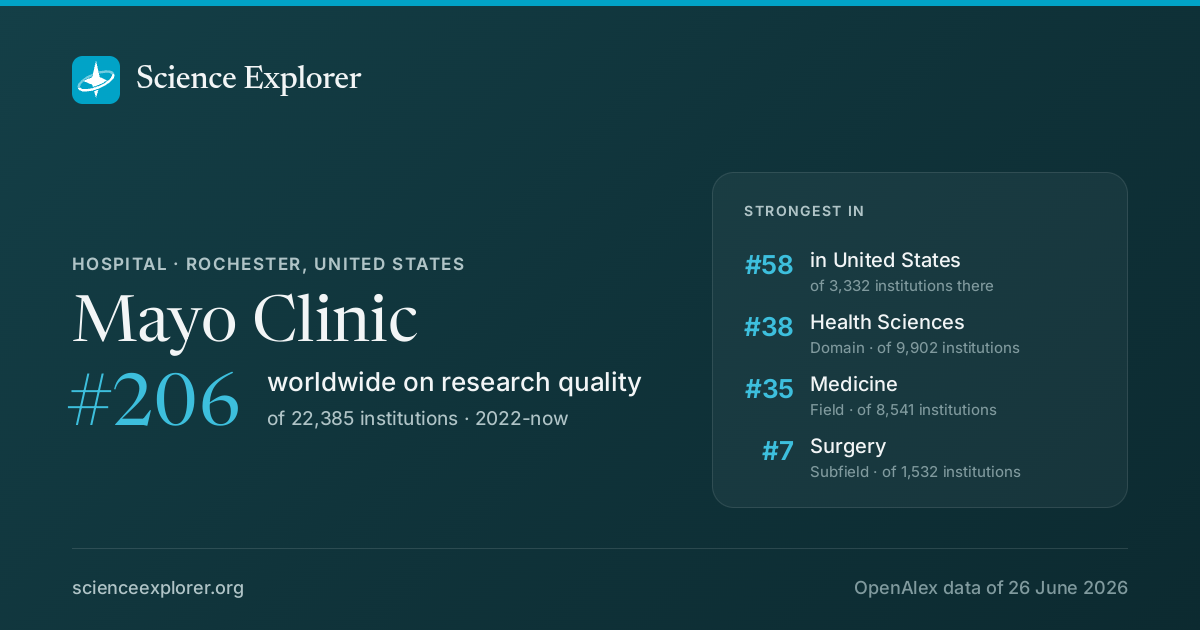
In research, Mayo Clinic stands highest in Health Sciences (#38 of 9,902 worldwide), Medicine (#35 of 8,541 worldwide) and Surgery (#7 of 1,532 worldwide), 2022-now. Relative to its size it is most specialised in Transplantation, Cardiology and Cardiovascular Medicine and Gastroenterology (Transplantation is 9.9× its share of world research).
- World rank, 2022-now
- #206 of 22,385 · #127 all time
- Rank in United States
- #58 of 3,332
- Research works
- 150k ▲ 10% vs 2018-21
- Citations
- 5.9M 39.0 per fractional work
- Top-10% rate
- 13.2% all institutions 10.0%
- vs its own fields
- 1.13× 1.00× is exactly expected
- Open access
- 35% world 40%
- International
- 12% world 18%
What is Mayo Clinic known for in research?
The fields where it stands highest, 2022-now, ranked among every institution above the floor in each field.
| Field | World rank | Where that sits | Top-10% rate | Works | All time |
|---|---|---|---|---|---|
| Health SciencesDomain | #38 of 9,902 | 13.8% | 19,839 | #19 | |
| MedicineField | #35 of 8,541 | 13.9% | 18,908 | #17 | |
| SurgerySubfield | #7 of 1,532 | 16.1% | 3,261 | #2 | |
| Cardiology and Cardiovascular MedicineSubfield | #9 of 736 | 13.3% | 1,830 | #4 | |
| Pulmonary and Respiratory MedicineSubfield | #17 of 1,037 | 13.0% | 1,781 | #9 | |
| NeurologySubfield | #8 of 405 | 15.2% | 877 | #7 | |
| Life SciencesDomain | #175 of 6,403 | 11.8% | 3,557 | #124 | |
| EpidemiologySubfield | #33 of 927 | 13.0% | 1,301 | #16 | |
| Health ProfessionsField | #85 of 1,895 | 12.9% | 745 | #63 | |
| Biochemistry, Genetics and Molecular BiologyField | #144 of 2,964 | 11.6% | 2,245 | #86 |
Each strip is that field's whole ranked pool, with the notch where Mayo Clinic sits in it, in the colour of the band that rank falls in. The track under the rate is the rate itself: it carries no average mark, because the average differs by field (from about 6% in Dentistry to 21% in Economics).
Which of those standings moved
The same fields on both windows: where it stood over the whole record, and where it stands in 2022-now. The distance is the story, and it is the one thing the two rank columns above cannot show.
- Health Sciences#19 #38
- Medicine#17 #35
- Surgery#2 #7
- Cardiology and Cardiovascular Medicine#4 #9
- Pulmonary and Respiratory Medicine#9 #17
- Neurology#7 #8
- Life Sciences#124 #175
- Epidemiology#16 #33
- Health Professions#63 #85
- Biochemistry, Genetics and Molecular Biology#86 #144
A dot further right is a better standing. Fields it was not ranked in over the whole record are left out.
Which fields of science does Mayo Clinic work in?
In 2022-now, 77% of research at Mayo Clinic is in Health Sciences, 14% in Life Sciences. Its largest fields are Medicine (73%), Biochemistry, Genetics and Molecular Biology (9%), Health Professions (3%). It does 3.3× the world's share of Health Sciences.
Each ring splits the one inside it: the four domains of science, their fields, their subfields. Size is fractional works in 2022-now. Every slice is a page; the interactive view zooms down to single topics and colours each by how much more of it this institution does than the world.
Its 4 domains and 26 fields, with their numbers
- Health Sciences23k76.9%
- Medicine22k73.3%
- Health Professions8412.8%
- Nursing1170.4%
- Dentistry680.2%
- Veterinary280.1%
- Life Sciences4,15614.1%
- Physical Sciences1,4394.9%
- Engineering6532.2%
- Computer Science3601.2%
- Physics and Astronomy1250.4%
- Environmental Science970.3%
- Materials Science670.2%
- Mathematics610.2%
- Chemistry580.2%
- Earth and Planetary Sciences110.0%
- Energy40.0%
- Chemical Engineering30.0%
- Social Sciences1,2244.1%
- Psychology4421.5%
- Social Sciences4101.4%
- Economics, Econometrics and Finance1980.7%
- Decision Sciences690.2%
- Business, Management and Accounting530.2%
- Arts and Humanities520.2%
What does Mayo Clinic specialise in?
Where its research is concentrated relative to its size: Transplantation takes 9.9× the share of its output that it takes of world research.
- TransplantationSubfield · 129.9 works9.9×
- Cardiology and Cardiovascular MedicineSubfield · 2,116.0 works6.8×
- GastroenterologySubfield · 221.7 works6.4×
- GeneticsSubfield · 498.5 works6.2×
- NeurologySubfield · 986.5 works5.8×
- SurgerySubfield · 3,701.9 works5.3×
- HematologySubfield · 478.0 works5.3×
Location quotient, a volume reading rather than an impact one. It surfaces small, lopsided specialities.
Field profile
Location quotient across every field it publishes in: outside the ring is more than an institution of this size would be expected to publish, inside it is less.
Rings at 0.5×, 1× and 2×. Widest outward: Medicine, 3.8×. Every wedge is a field page.
All 26 fields, with their numbers
- Medicine3.81×22k works
- Immunology and Microbiology2.05×610 works
- Biochemistry, Genetics and Molecular Biology1.66×2,614 works
- Neuroscience1.65×790 works
- Health Professions1.08×841 works
- Nursing0.81×117 works
- Pharmacology, Toxicology and Pharmaceutics0.72×75 works
- Veterinary0.69×28 works
- Psychology0.49×442 works
- Dentistry0.48×68 works
- Economics, Econometrics and Finance0.31×198 works
- Decision Sciences0.24×69 works
- Physics and Astronomy0.19×125 works
- Mathematics0.18×61 works
- Computer Science0.16×360 works
- Engineering0.15×653 works
- Chemistry0.13×58 works
- Social Sciences0.11×410 works
- Environmental Science0.07×97 works
- Materials Science0.06×67 works
- Arts and Humanities0.06×52 works
- Business, Management and Accounting0.06×53 works
- Agricultural and Biological Sciences0.05×68 works
- Chemical Engineering0.03×3 works
- Earth and Planetary Sciences0.02×10 works
- Energy0.01×4 works
- Medicine 3.8×
- Immunology and Microbiology 2.0×
- Biochemistry, Genetics and Molecular Biology 1.7×
- Neuroscience 1.6×
- Health Professions 1.1×
- Nursing 0.8×
- Pharmacology, Toxicology and Pharmaceutics 0.7×
- Veterinary 0.7×
- Psychology 0.5×
- Dentistry 0.5×
- Economics, Econometrics and Finance 0.3×
- Decision Sciences 0.2×
- Physics and Astronomy 0.2×
- Mathematics 0.2×
- Computer Science 0.2×
- Engineering 0.1×
- Chemistry 0.1×
- Social Sciences 0.1×
- Environmental Science 0.1×
- Materials Science 0.1×
- Arts and Humanities 0.1×
- Business, Management and Accounting 0.1×
- Agricultural and Biological Sciences 0.1×
- Chemical Engineering 0.0×
- Earth and Planetary Sciences 0.0×
- Energy 0.0×
Who are the top researchers at Mayo Clinic?
Ranked on the quality score, Mohammad Hassan Murad, Liselotte N. Dyrbye and Barry A. Borlaug lead among researchers whose main affiliation is Mayo Clinic.
- 1
Mohammad Hassan Murad
 United States · #432 worldwide
172k citations · 1,319 works
- 2
Liselotte N. Dyrbye
United States · #1,225 worldwide
52k citations · 245 works
- 3
Barry A. Borlaug
United States · #3,755 worldwide
58k citations · 832 works
- 4
L. Joseph Melton
United States · #4,455 worldwide
49k citations · 239 works
- 5
Claudia Francesca Lucchinetti
United States · #4,839 worldwide
59k citations · 311 works
- 6
Gloria M. Petersen
United States · #4,865 worldwide
100k citations · 758 works
- 7
Nathan K. LeBrasseur
United States · #5,451 worldwide
37k citations · 428 works
- 8
Terry M. Therneau
United States · #6,013 worldwide
88k citations · 578 works
- 9
Fares Alahdab
United States · #6,157 worldwide
159k citations · 289 works
- 10
Veronique Lee Roger
United States · #6,365 worldwide
120k citations · 706 works
Which keywords describe research at Mayo Clinic?
By fractional works in 2022-now, weighted toward what it does more of than the world: Epidemiology, Diagnosis, Treatment, Immunotherapy, Prognostic Factors, Heart Failure, Chemotherapy and Inflammation.
- Catheter Ablation
- Immunosuppressive Therapy
- Neuroimaging
- Rituximab
- Myocardial Infarction
- Surgery
- Mortality
- Precision Medicine
- Obesity
- Neurological Disorders
- Surgical Management
- Cancer
- Echocardiography
- Cardiovascular Disease
- Oxidative Stress
- Prognostic Factors
- Risk Factors
- Quality of Life
- Diagnosis
- Inflammation
- Epidemiology
- Treatment
- Immunotherapy
- Chemotherapy
- Management
- Heart Failure
- Genetic Mutations
- Guidelines
- Complications
- Clinical Practice Guidelines
- Biomarkers
- Radiotherapy
- Clinical Trials
- Prognosis
- Cardiovascular Risk
- Rehabilitation
- Neoadjuvant Therapy
- Survival Analysis
- Lymphoma
- Cardiac Imaging
Size is fractional works in 2022-now in the topics tagged with each word; colour is the word's share of this institution's work against its share of the world's. The 40 words are chosen for being large and distinctive. Each links to the topic it comes from most.
All 40 words, with their numbers
- Epidemiology3,151▲ 2.7×135 topics
- Inflammation1,407▲ 2.2×83 topics
- Treatment1,336▲ 3.7×50 topics
- Diagnosis1,300▲ 4.7×41 topics
- Immunotherapy1,072▲ 5.0×19 topics
- Quality of Life980▲ 2.3×54 topics
- Chemotherapy965▲ 4.6×25 topics
- Risk Factors893▲ 2.8×37 topics
- Management858▲ 3.6×32 topics
- Prognostic Factors854▲ 6.7×14 topics
- Heart Failure842▲ 6.4×13 topics
- Oxidative Stress802▲ 1.65×60 topics
- Genetic Mutations790▲ 6.1×23 topics
- Cardiovascular Disease768▲ 2.3×38 topics
- Guidelines758▲ 5.4×13 topics
- Echocardiography750▲ 9.1×8 topics
- Complications736▲ 5.0×17 topics
- Cancer702▲ 1.77×54 topics
- Clinical Practice Guidelines684▲ 4.2×14 topics
- Surgical Management676▲ 5.6×20 topics
- Biomarkers666▲ 3.2×18 topics
- Neurological Disorders646▲ 3.8×20 topics
- Radiotherapy634▲ 5.4×13 topics
- Obesity607▲ 2.7×26 topics
- Clinical Trials554▲ 2.8×19 topics
- Precision Medicine554▲ 3.8×8 topics
- Prognosis492▲ 5.0×9 topics
- Mortality479▲ 2.9×13 topics
- Cardiovascular Risk472▲ 5.1×9 topics
- Surgery427▲ 4.2×12 topics
- Rehabilitation409▲ 3.5×13 topics
- Myocardial Infarction406▲ 5.8×7 topics
- Neoadjuvant Therapy382▲ 5.4×5 topics
- Rituximab379▲ 8.9×4 topics
- Survival Analysis378▲ 4.7×7 topics
- Neuroimaging370▲ 4.5×11 topics
- Lymphoma339▲ 7.2×4 topics
- Immunosuppressive Therapy328▲ 5.8×8 topics
- Cardiac Imaging317▲ 8.9×3 topics
- Catheter Ablation306▲ 8.4×2 topics
Which research topics does Mayo Clinic publish most on?
By volume in 2022-now: Cardiac Valve Diseases and Treatments, Cardiovascular Function and Risk Factors, Artificial Intelligence in Healthcare and Education and Atrial Fibrillation Management and Outcomes.
Area is fractional works; colour is the subfield each topic belongs to.
- 1 Cardiac Valve Diseases and Treatments Cardiology and Cardiovascular Medicine 243 works
- 2 Cardiovascular Function and Risk Factors Cardiology and Cardiovascular Medicine 232 works
- 3 Artificial Intelligence in Healthcare and Education Health Informatics 184 works
- 4 Atrial Fibrillation Management and Outcomes Cardiology and Cardiovascular Medicine 172 works
- 5 CAR-T cell therapy research Oncology 167 works
- 6 Total Knee Arthroplasty Outcomes Surgery 158 works
- 7 Glioma Diagnosis and Treatment Genetics 156 works
- 8 Lymphoma Diagnosis and Treatment Pathology and Forensic Medicine 156 works
- 9 Dementia and Cognitive Impairment Research Psychiatry and Mental health 150 works
- 10 Cardiac Imaging and Diagnostics Radiology, Nuclear Medicine and Imaging 149 works
How open and international is its research?
Against the world's own shares: the tick on each track. Both are shares of its output, so they sit on one scale and can be read against each other as well as against the world.
World: 40% of research is openly available.
World: 18% is written across borders.
How has Mayo Clinic's research output changed?
Output in 2022-2025 was 10% higher than in 2018-2021.
The same series as a ribbon: one cell per year, darker for more. The line above answers how much; this answers when.
Its share of all research
Growing output can still be a shrinking share: all of science grows. This is Mayo Clinic as a percentage of every work published that year, 0.12% in 2024.
Fractional works of Mayo Clinic over all fractional works that year. How the balance of science has shifted.
How much of it reaches the world top 10%
Year by year, against all institutions in the same year.
Of each year's output, the share that reached the world's 10% most cited for its field and year. Peak 22.0% in 1992.
Other research institutions in Rochester
- University of Minnesota Rochester
- Olmsted Medical Center
- North Central Cancer Treatment Group
- Crossroads College
- Rochester Community and Technical College
- Mazda (United States)
- Apri Health
- History Center of Olmsted County
Which institutions have research most like Mayo Clinic's?
Among the world's leading institutions, The University of Texas Southwestern Medical Center has the research profile closest to Mayo Clinic's, with both strong in Medicine.
- 1
The University of Texas Southwestern Medical CenterUnited States · Both strong in Medicine, Immunology and Microbiology, Biochemistry, Genetics and Molecular Biology
0.97 Compare
- 2
Baylor College of MedicineUnited States · Both strong in Medicine, Immunology and Microbiology, Biochemistry, Genetics and Molecular Biology
0.97 Compare
- 3
University of Massachusetts Chan Medical SchoolUnited States · Both strong in Medicine, Immunology and Microbiology, Biochemistry, Genetics and Molecular Biology
0.96 Compare
- 4
University of California, San FranciscoUnited States · Both strong in Medicine, Immunology and Microbiology, Biochemistry, Genetics and Molecular Biology
0.96 Compare
- 5
Assistance Publique – Hôpitaux de Paris
 France · Both strong in Medicine, Immunology and Microbiology, Neuroscience
0.94 Compare

Similarity is the correlation of each side's location quotients across every field it publishes in, on a log scale: 1 is the same shape of research, 0 is unrelated. It ignores size. How it is measured.
Compare Mayo Clinic with
- vs North Carolina State University
- vs
 Technische Universität Berlin
- vs
 University of Calgary
- vs
 Sapienza University of Rome
- vs
 Beihang University
- vs Lawrence Berkeley National Laboratory
Share Mayo Clinic's ranking



Research measures only: rankings here say nothing about teaching, admissions or student experience. Comparable institutions and collaboration partners have tabs of their own, above.
Questions people ask
What does the Mayo Clinic research?
In research, Mayo Clinic stands highest in Health Sciences (#38 of 9,902 worldwide), Medicine (#35 of 8,541 worldwide) and Surgery (#7 of 1,532 worldwide), 2022-now. Relative to its size it is most specialised in Transplantation, Cardiology and Cardiovascular Medicine and Gastroenterology (Transplantation is 9.9× its share of world research).
Discussion
Ask a question or share a note about Mayo Clinic. Posts are plain text and can be reported.