Yale University

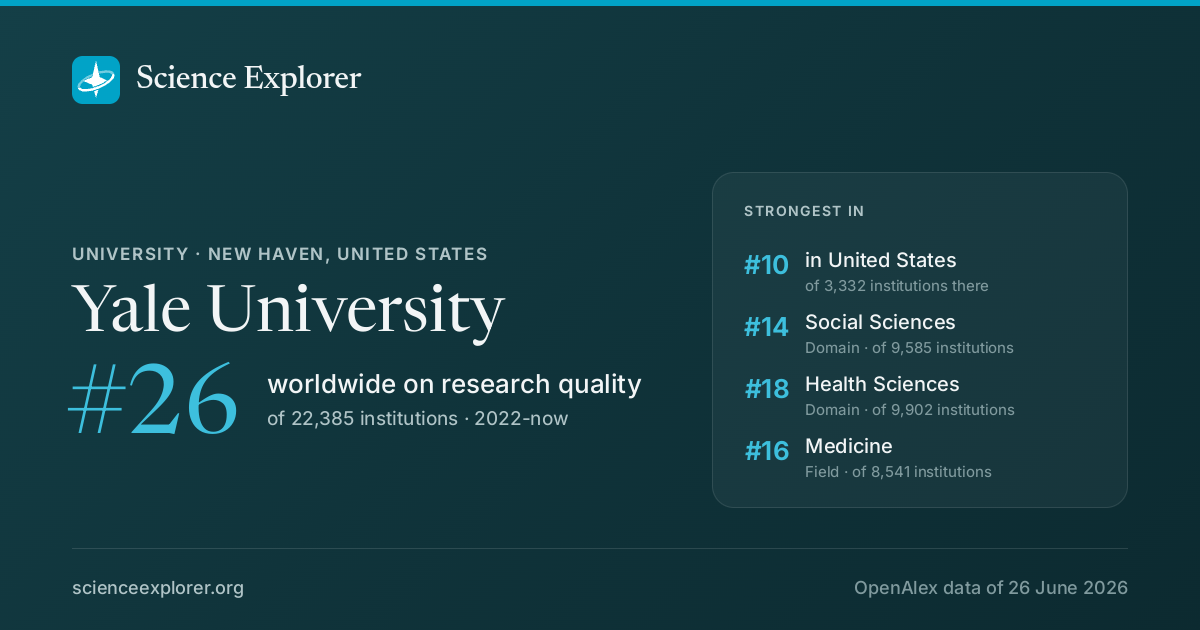
In research, Yale University stands highest in Social Sciences (#14 of 9,585 worldwide), Health Sciences (#18 of 9,902 worldwide) and Medicine (#16 of 8,541 worldwide), 2022-now. Relative to its size it is most specialised in Behavioral Neuroscience, Internal Medicine and Transplantation (Behavioral Neuroscience is 3.9× its share of world research).
- World rank, 2022-now
- #26 of 22,385 · #17 all time
- Rank in United States
- #10 of 3,332
- Research works
- 189k ◆ 1% vs 2018-21
- Citations
- 9M 47.7 per fractional work
- Top-10% rate
- 13.2% all institutions 10.0%
- vs its own fields
- 1.26× 1.00× is exactly expected
- Open access
- 37% world 40%
- International
- 13% world 18%
What is Yale University known for in research?
The fields where it stands highest, 2022-now, ranked among every institution above the floor in each field.
| Field | World rank | Where that sits | Top-10% rate | Works | All time |
|---|---|---|---|---|---|
| Social SciencesDomain | #14 of 9,585 | 13.2% | 5,327 | #8 | |
| Health SciencesDomain | #18 of 9,902 | 12.8% | 9,825 | #15 | |
| MedicineField | #16 of 8,541 | 12.8% | 8,936 | #15 | |
| Social SciencesField | #19 of 5,988 | 13.7% | 2,245 | #8 | |
| Life SciencesDomain | #22 of 6,403 | 13.4% | 3,820 | #18 | |
| PsychologyField | #8 of 2,121 | 13.4% | 1,230 | #6 | |
| Physical SciencesDomain | #69 of 10,670 | 15.5% | 3,688 | #52 | |
| Clinical PsychologySubfield | #5 of 767 | 13.6% | 538 | #2 | |
| Biochemistry, Genetics and Molecular BiologyField | #23 of 2,964 | 13.1% | 2,086 | #16 | |
| Economics, Econometrics and FinanceField | #16 of 1,798 | 12.8% | 677 | #15 |
Each strip is that field's whole ranked pool, with the notch where Yale University sits in it, in the colour of the band that rank falls in. The track under the rate is the rate itself: it carries no average mark, because the average differs by field (from about 6% in Dentistry to 21% in Economics).
Which of those standings moved
The same fields on both windows: where it stood over the whole record, and where it stands in 2022-now. The distance is the story, and it is the one thing the two rank columns above cannot show.
- Social Sciences#8 #14
- Health Sciences#15 #18
- Medicine#15 #16
- Social Sciences#8 #19
- Life Sciences#18 #22
- Psychology#6 #8
- Physical Sciences#52 #69
- Clinical Psychology#2 #5
- Biochemistry, Genetics and Molecular Biology#16 #23
- Economics, Econometrics and Finance#15 #16
A dot further right is a better standing. Fields it was not ranked in over the whole record are left out.
Which fields of science does Yale University work in?
In 2022-now, 44% of research at Yale University is in Health Sciences, 23% in Social Sciences. Its largest fields are Medicine (40%), Social Sciences (10%), Biochemistry, Genetics and Molecular Biology (9%). It does 1.9× the world's share of Health Sciences.
Each ring splits the one inside it: the four domains of science, their fields, their subfields. Size is fractional works in 2022-now. Every slice is a page; the interactive view zooms down to single topics and colours each by how much more of it this institution does than the world.
Its 4 domains and 26 fields, with their numbers
- Health Sciences11k43.8%
- Medicine10k39.9%
- Health Professions8313.2%
- Nursing1040.4%
- Dentistry330.1%
- Veterinary240.1%
- Social Sciences5,87922.8%
- Social Sciences2,4589.5%
- Psychology1,4085.5%
- Arts and Humanities8203.2%
- Economics, Econometrics and Finance7122.8%
- Business, Management and Accounting3041.2%
- Decision Sciences1780.7%
- Life Sciences4,44117.2%
- Physical Sciences4,16016.2%
- Computer Science9263.6%
- Engineering8213.2%
- Environmental Science6652.6%
- Physics and Astronomy6132.4%
- Mathematics3261.3%
- Chemistry2320.9%
- Materials Science2180.8%
- Earth and Planetary Sciences2150.8%
- Energy1010.4%
- Chemical Engineering420.2%
What does Yale University specialise in?
Where its research is concentrated relative to its size: Behavioral Neuroscience takes 3.9× the share of its output that it takes of world research.
- Behavioral NeuroscienceSubfield · 39.6 works3.9×
- Internal MedicineSubfield · 57.8 works3.7×
- TransplantationSubfield · 41.0 works3.6×
- Family PracticeSubfield · 41.6 works3.4×
- Emergency MedicineSubfield · 200.6 works3.2×
- Cognitive NeuroscienceSubfield · 575.0 works3.1×
Location quotient, a volume reading rather than an impact one. It surfaces small, lopsided specialities.
Field profile
Location quotient across every field it publishes in: outside the ring is more than an institution of this size would be expected to publish, inside it is less.
Rings at 0.5×, 1× and 2×. Widest outward: Neuroscience, 2.6×. Every wedge is a field page.
All 26 fields, with their numbers
- Neuroscience2.65×1,107 works
- Medicine2.08×10k works
- Immunology and Microbiology1.97×512 works
- Psychology1.79×1,408 works
- Biochemistry, Genetics and Molecular Biology1.77×2,436 works
- Economics, Econometrics and Finance1.29×712 works
- Health Professions1.22×831 works
- Arts and Humanities1.10×820 works
- Mathematics1.08×326 works
- Physics and Astronomy1.07×613 works
- Pharmacology, Toxicology and Pharmaceutics1.02×93 works
- Nursing0.82×104 works
- Social Sciences0.75×2,458 works
- Decision Sciences0.72×178 works
- Veterinary0.68×24 works
- Chemistry0.57×232 works
- Earth and Planetary Sciences0.53×215 works
- Environmental Science0.52×665 works
- Chemical Engineering0.46×42 works
- Computer Science0.46×926 works
- Energy0.43×101 works
- Business, Management and Accounting0.37×304 works
- Dentistry0.27×33 works
- Agricultural and Biological Sciences0.24×294 works
- Materials Science0.24×218 works
- Engineering0.21×822 works
- Neuroscience 2.6×
- Medicine 2.1×
- Immunology and Microbiology 2.0×
- Psychology 1.8×
- Biochemistry, Genetics and Molecular Biology 1.8×
- Economics, Econometrics and Finance 1.3×
- Health Professions 1.2×
- Arts and Humanities 1.1×
- Mathematics 1.1×
- Physics and Astronomy 1.1×
- Pharmacology, Toxicology and Pharmaceutics 1.0×
- Nursing 0.8×
- Social Sciences 0.8×
- Decision Sciences 0.7×
- Veterinary 0.7×
- Chemistry 0.6×
- Earth and Planetary Sciences 0.5×
- Environmental Science 0.5×
- Chemical Engineering 0.5×
- Computer Science 0.5×
- Energy 0.4×
- Business, Management and Accounting 0.4×
- Dentistry 0.3×
- Agricultural and Biological Sciences 0.2×
- Materials Science 0.2×
- Engineering 0.2×
Who are the top researchers at Yale University?
Ranked on the quality score, Menachem Elimelech, Walter Jetz and Ari Helenius lead among researchers whose main affiliation is Yale University.
- 1
Menachem Elimelech
 United States · #4 worldwide
151k citations · 747 works
- 2
Walter Jetz
United States · #197 worldwide
57k citations · 367 works
- 3
Ari Helenius
United States · #221 worldwide
52k citations · 238 works
- 4
Nenad Šestan
United States · #792 worldwide
43k citations · 277 works
- 5
T. Aronsson
United States · #1,020 worldwide
16k citations · 93 works
- 6
Ruslan M. Medzhitov
United States · #1,033 worldwide
133k citations · 348 works
- 7
Akiko Iwasaki
United States · #1,063 worldwide
78k citations · 635 works
- 8
Chandrani Sinha Roy
United States · #1,074 worldwide
29k citations · 211 works
- 9
Karen C. Seto
United States · #1,284 worldwide
43k citations · 266 works
- 10
Pietro V. De Camilli
United States · #1,316 worldwide
71k citations · 565 works
Which keywords describe research at Yale University?
By fractional works in 2022-now, weighted toward what it does more of than the world: Epidemiology, Risk Factors, Inflammation, Treatment, Depression, Public Health, Diagnosis and Neurological Disorders.
- Substance Use Disorders
- Global Burden of Disease
- Health Disparities
- Clinical Guidelines
- Emotion Regulation
- Prognostic Factors
- Precision Medicine
- Heart Failure
- Gene Expression
- Obesity
- Management
- Metabolic Syndrome
- Immunotherapy
- Chemotherapy
- Cardiovascular Disease
- Diagnosis
- Cancer
- Mental Health
- Treatment
- Inflammation
- Epidemiology
- Risk Factors
- Public Health
- Quality of Life
- Oxidative Stress
- Depression
- Neurological Disorders
- Genetics
- Clinical Trials
- Guidelines
- Biomarkers
- Mortality
- Clinical Practice Guidelines
- Global Burden
- Anxiety
- Genetic Mutations
- Neurobiology
- Mortality Risk
- Echocardiography
- Psychiatric Disorders
Size is fractional works in 2022-now in the topics tagged with each word; colour is the word's share of this institution's work against its share of the world's. The 40 words are chosen for being large and distinctive. Each links to the topic it comes from most.
All 40 words, with their numbers
- Epidemiology1,908▲ 1.86×134 topics
- Inflammation823▲ 1.50×82 topics
- Risk Factors690▲ 2.4×37 topics
- Treatment662▲ 2.1×50 topics
- Public Health623▲ 1.66×67 topics
- Mental Health601▲ 1.63×46 topics
- Quality of Life569▲ 1.53×57 topics
- Cancer537▲ 1.55×55 topics
- Oxidative Stress526▲ 1.24×60 topics
- Diagnosis522▲ 2.2×41 topics
- Depression522▲ 2.3×25 topics
- Cardiovascular Disease516▲ 1.76×39 topics
- Neurological Disorders430▲ 2.9×20 topics
- Chemotherapy419▲ 2.3×25 topics
- Genetics405▲ 2.2×27 topics
- Immunotherapy400▲ 2.1×19 topics
- Clinical Trials377▲ 2.2×19 topics
- Metabolic Syndrome370▲ 1.77×23 topics
- Guidelines368▲ 3.0×13 topics
- Management368▲ 1.79×34 topics
- Biomarkers362▲ 2.0×18 topics
- Obesity344▲ 1.73×24 topics
- Mortality337▲ 2.3×13 topics
- Gene Expression299▲ 1.85×19 topics
- Clinical Practice Guidelines298▲ 2.1×14 topics
- Heart Failure292▲ 2.5×14 topics
- Global Burden277▲ 1.97×12 topics
- Precision Medicine276▲ 2.2×8 topics
- Anxiety273▲ 2.2×12 topics
- Prognostic Factors269▲ 2.4×14 topics
- Genetic Mutations263▲ 2.3×23 topics
- Emotion Regulation246▲ 3.0×9 topics
- Neurobiology239▲ 3.5×10 topics
- Clinical Guidelines234▲ 3.1×9 topics
- Mortality Risk230▲ 3.7×6 topics
- Health Disparities212▲ 3.2×9 topics
- Echocardiography211▲ 3.0×8 topics
- Global Burden of Disease208▲ 3.3×4 topics
- Psychiatric Disorders197▲ 5.6×4 topics
- Substance Use Disorders175▲ 9.0×2 topics
Which research topics does Yale University publish most on?
By volume in 2022-now: Functional Brain Connectivity Studies, Cancer Immunotherapy and Biomarkers, Artificial Intelligence in Healthcare and Education and Substance Abuse Treatment and Outcomes.
Area is fractional works; colour is the subfield each topic belongs to.
- 1 Functional Brain Connectivity Studies Cognitive Neuroscience 112 works
- 2 Cancer Immunotherapy and Biomarkers Oncology 99 works
- 3 Artificial Intelligence in Healthcare and Education Health Informatics 94 works
- 4 Substance Abuse Treatment and Outcomes Epidemiology 90 works
- 5 Opioid Use Disorder Treatment Public Health, Environmental and Occupational Health 85 works
- 6 Diversity and Career in Medicine Gender Studies 82 works
- 7 Peripheral Artery Disease Management Surgery 81 works
- 8 Child and Adolescent Psychosocial and Emotional Development Clinical Psychology 80 works
- 9 Acute Ischemic Stroke Management Epidemiology 75 works
- 10 Cardiac, Anesthesia and Surgical Outcomes Cardiology and Cardiovascular Medicine 73 works
How open and international is its research?
Against the world's own shares: the tick on each track. Both are shares of its output, so they sit on one scale and can be read against each other as well as against the world.
World: 40% of research is openly available.
World: 18% is written across borders.
How has Yale University's research output changed?
Output in 2022-2025 was 1% higher than in 2018-2021.
The same series as a ribbon: one cell per year, darker for more. The line above answers how much; this answers when.
Its share of all research
Growing output can still be a shrinking share: all of science grows. This is Yale University as a percentage of every work published that year, 0.10% in 2024.
Fractional works of Yale University over all fractional works that year. How the balance of science has shifted.
How much of it reaches the world top 10%
Year by year, against all institutions in the same year.
Of each year's output, the share that reached the world's 10% most cited for its field and year. Peak 19.2% in 1992.
Other research institutions in New Haven
- Southern Connecticut State University
- Connecticut Agricultural Experiment Station
- Yale New Haven Health System
- Connecticut Mental Health Center
- New Haven Public Schools
- Institute for Neurodegenerative Disorders
- Endangered Language Fund
- John B. Pierce Laboratory
Which institutions have research most like Yale University's?
Among the world's leading institutions, Washington University in St. Louis has the research profile closest to Yale University's, with both strong in Neuroscience.
- 1
Washington University in St. LouisUnited States · Both strong in Neuroscience, Medicine, Immunology and Microbiology
0.94 Compare
- 2
Vanderbilt UniversityUnited States · Both strong in Neuroscience, Medicine, Immunology and Microbiology
0.89 Compare
- 3
Duke UniversityUnited States · Both strong in Neuroscience, Medicine, Immunology and Microbiology
0.88 Compare
- 4
Leiden University
 Netherlands · Both strong in Immunology and Microbiology, Neuroscience, Psychology
0.88 Compare
- 5
Johns Hopkins UniversityUnited States · Both strong in Neuroscience, Medicine, Immunology and Microbiology
0.88 Compare


Similarity is the correlation of each side's location quotients across every field it publishes in, on a log scale: 1 is the same shape of research, 0 is unrelated. It ignores size. How it is measured.
Compare Yale University with
- vs University of Washington
- vs
 University of Chinese Academy of Sciences
- vs Sun Yat-sen University
- vs Princeton University
- vs
 University of Toronto
- vs University of California San Diego
Share Yale University's ranking
Badges for a website10Each links back here and updates with every snapshot
Its overall standing, then the domains, fields and subfields where Yale University is in the world's top ten or its top 1%. Each has an image of its own.
Overall

Domains


Fields


Subfields


Research measures only: rankings here say nothing about teaching, admissions or student experience. Comparable institutions and collaboration partners have tabs of their own, above.
Questions people ask
What is Yale University known for in research?
In research, Yale University stands highest in Social Sciences (#14 of 9,585 worldwide), Health Sciences (#18 of 9,902 worldwide) and Medicine (#16 of 8,541 worldwide), 2022-now. Relative to its size it is most specialised in Behavioral Neuroscience, Internal Medicine and Transplantation (Behavioral Neuroscience is 3.9× its share of world research).
Discussion
Ask a question or share a note about Yale University. Keep it to the research: no personal attacks, advertising or links. Any reader can report a post, which collapses it for everyone until it is opened.