Science Explorer Back to mapMap
Discussion
University · New Haven · United States

New Haven Public Schools

In research, New Haven Public Schools stands highest in Health Sciences (#2,855 of 16,688 worldwide), Medicine (#2,537 of 14,558 worldwide) and Social Sciences (#4,991 of 14,833 worldwide), over all time.

World rank, all time
#5,648
of 34,923
Rank in United States
#1,208
of 7,310
Research works
1k
▼ 17% vs 2018-21
Citations
74k
70.5 per fractional work
Top-10% rate
19.2%
all institutions 10.0%
vs its own fields
1.27×
1.00× is exactly expected
Open access
7%
world 40%
International
2%
world 18%

What is New Haven Public Schools known for in research?

The fields where it stands highest, over all time, ranked among every institution above the floor in each field.

FieldWorld rankWhere that sitsTop-10% rateWorks
Health SciencesDomain #2,855 of 16,688 18.9%598
MedicineField #2,537 of 14,558 19.2%540
Social SciencesDomain #4,991 of 14,833 10.3%253

Each strip is that field's whole ranked pool, with the notch where New Haven Public Schools sits in it, in the colour of the band that rank falls in. The track under the rate is the rate itself: it carries no average mark, because the average differs by field (from about 6% in Dentistry to 21% in Economics).

Which fields of science does New Haven Public Schools work in?

In all years, 57% of research at New Haven Public Schools is in Health Sciences, 24% in Social Sciences. Its largest fields are Medicine (52%), Social Sciences (10%), Arts and Humanities (7%). It does 2.4× the world's share of Health Sciences.

Health Sciences: 598 fractional works · 57.0% of its workMedicine: 540 fractional works · 51.5% of its workSurgery: 89 fractional works · 8.5% of its workPulmonary and Respiratory Medicine: 52 fractional works · 5.0% of its workEpidemiology: 43 fractional works · 4.1% of its workPhysiology: 29 fractional works · 2.8% of its workCardiology and Cardiovascular Medicine: 28 fractional works · 2.7% of its workNeurology: 28 fractional works · 2.7% of its workRadiology, Nuclear Medicine and Imaging: 22 fractional works · 2.1% of its workOncology: 20 fractional works · 1.9% of its workPublic Health, Environmental and Occupational Health: 20 fractional works · 1.9% of its workOphthalmology: 17 fractional works · 1.6% of its workGenetics: 16 fractional works · 1.6% of its workPathology and Forensic Medicine: 15 fractional works · 1.4% of its workInfectious Diseases: 15 fractional works · 1.4% of its workPediatrics, Perinatology and Child Health: 13 fractional works · 1.3% of its workDermatology: 13 fractional works · 1.3% of its workOtorhinolaryngology: 11 fractional works · 1.1% of its workEndocrinology, Diabetes and Metabolism: 11 fractional works · 1.0% of its workRheumatology: 11 fractional works · 1.0% of its workEmergency Medicine: 10 fractional works · 1.0% of its workHepatology: 9 fractional works · 0.8% of its workNephrology: 9 fractional works · 0.8% of its workHematology: 8 fractional works · 0.8% of its workGastroenterology: 8 fractional works · 0.7% of its workPsychiatry and Mental health: 8 fractional works · 0.7% of its workObstetrics and Gynecology: 6 fractional works · 0.5% of its workAnesthesiology and Pain Medicine: 5 fractional works · 0.5% of its workPharmacology: 4 fractional works · 0.4% of its workCritical Care and Intensive Care Medicine: 4 fractional works · 0.4% of its workComplementary and alternative medicine: 3 fractional works · 0.3% of its workFamily Practice: 3 fractional works · 0.3% of its workReproductive Medicine: 3 fractional works · 0.3% of its workSmaller subfields together: 8 fractional works · 0.8% of its workHealth Professions: 42 fractional works · 4.0% of its workGeneral Health Professions: 21 fractional works · 2.0% of its workSpeech and Hearing: 10 fractional works · 1.0% of its workEmergency Medical Services: 5 fractional works · 0.5% of its workSmaller subfields together: 5 fractional works · 0.5% of its workNursing: 11 fractional works · 1.0% of its workNutrition and Dietetics: 8 fractional works · 0.7% of its workIssues, ethics and legal aspects: 3 fractional works · 0.3% of its workDentistry: 4 fractional works · 0.4% of its workOral Surgery: 4 fractional works · 0.4% of its workSmaller subfields together: 1 fractional works · 0.1% of its workVeterinary: 1 fractional works · 0.1% of its workSocial Sciences: 253 fractional works · 24.1% of its workSocial Sciences: 100 fractional works · 9.5% of its workEducation: 40 fractional works · 3.8% of its workSociology and Political Science: 20 fractional works · 1.9% of its workPolitical Science and International Relations: 17 fractional works · 1.7% of its workAnthropology: 6 fractional works · 0.6% of its workCultural Studies: 5 fractional works · 0.4% of its workSmaller subfields together: 12 fractional works · 1.1% of its workArts and Humanities: 74 fractional works · 7.1% of its workHistory: 31 fractional works · 2.9% of its workHistory and Philosophy of Science: 11 fractional works · 1.0% of its workLiterature and Literary Theory: 8 fractional works · 0.7% of its workPhilosophy: 7 fractional works · 0.7% of its workReligious studies: 4 fractional works · 0.4% of its workLanguage and Linguistics: 4 fractional works · 0.4% of its workClassics: 3 fractional works · 0.3% of its workMusic: 2 fractional works · 0.2% of its workArcheology: 2 fractional works · 0.2% of its workSmaller subfields together: 2 fractional works · 0.2% of its workPsychology: 45 fractional works · 4.3% of its workClinical Psychology: 24 fractional works · 2.3% of its workSocial Psychology: 7 fractional works · 0.6% of its workDevelopmental and Educational Psychology: 6 fractional works · 0.6% of its workExperimental and Cognitive Psychology: 4 fractional works · 0.4% of its workNeuropsychology and Physiological Psychology: 3 fractional works · 0.3% of its workSmaller subfields together: 1 fractional works · 0.1% of its workEconomics, Econometrics and Finance: 27 fractional works · 2.6% of its workEconomics and Econometrics: 26 fractional works · 2.5% of its workSmaller subfields together: 1 fractional works · 0.1% of its workBusiness, Management and Accounting: 3 fractional works · 0.3% of its workDecision Sciences: 3 fractional works · 0.3% of its workLife Sciences: 108 fractional works · 10.3% of its workBiochemistry, Genetics and Molecular Biology: 63 fractional works · 6.0% of its workMolecular Biology: 26 fractional works · 2.5% of its workGenetics: 18 fractional works · 1.7% of its workCell Biology: 7 fractional works · 0.6% of its workClinical Biochemistry: 5 fractional works · 0.5% of its workCancer Research: 3 fractional works · 0.3% of its workSmaller subfields together: 5 fractional works · 0.5% of its workNeuroscience: 16 fractional works · 1.5% of its workCellular and Molecular Neuroscience: 4 fractional works · 0.4% of its workCognitive Neuroscience: 4 fractional works · 0.4% of its workEndocrine and Autonomic Systems: 3 fractional works · 0.3% of its workNeurology: 2 fractional works · 0.2% of its workSmaller subfields together: 2 fractional works · 0.2% of its workImmunology and Microbiology: 15 fractional works · 1.4% of its workImmunology: 7 fractional works · 0.7% of its workParasitology: 3 fractional works · 0.3% of its workMicrobiology: 2 fractional works · 0.2% of its workSmaller subfields together: 2 fractional works · 0.2% of its workAgricultural and Biological Sciences: 10 fractional works · 1.0% of its workEcology, Evolution, Behavior and Systematics: 3 fractional works · 0.3% of its workPlant Science: 3 fractional works · 0.2% of its workSmaller subfields together: 5 fractional works · 0.5% of its workPharmacology, Toxicology and Pharmaceutics: 3 fractional works · 0.3% of its workPharmacology: 3 fractional works · 0.3% of its workSmaller subfields together: 0 fractional works · 0.0% of its workPhysical Sciences: 91 fractional works · 8.6% of its workEngineering: 30 fractional works · 2.9% of its workAerospace Engineering: 17 fractional works · 1.6% of its workBiomedical Engineering: 5 fractional works · 0.5% of its workSmaller subfields together: 8 fractional works · 0.8% of its workComputer Science: 16 fractional works · 1.5% of its workArtificial Intelligence: 6 fractional works · 0.5% of its workInformation Systems: 3 fractional works · 0.3% of its workComputational Theory and Mathematics: 3 fractional works · 0.2% of its workSmaller subfields together: 4 fractional works · 0.4% of its workEnvironmental Science: 14 fractional works · 1.3% of its workHealth, Toxicology and Mutagenesis: 5 fractional works · 0.5% of its workManagement, Monitoring, Policy and Law: 2 fractional works · 0.2% of its workEcology: 2 fractional works · 0.2% of its workSmaller subfields together: 4 fractional works · 0.4% of its workEarth and Planetary Sciences: 9 fractional works · 0.8% of its workAtmospheric Science: 4 fractional works · 0.3% of its workSmaller subfields together: 5 fractional works · 0.5% of its workChemistry: 6 fractional works · 0.6% of its workPhysical and Theoretical Chemistry: 2 fractional works · 0.2% of its workOrganic Chemistry: 2 fractional works · 0.2% of its workSmaller subfields together: 2 fractional works · 0.1% of its workMathematics: 6 fractional works · 0.5% of its workStatistics and Probability: 4 fractional works · 0.4% of its workSmaller subfields together: 2 fractional works · 0.1% of its workPhysics and Astronomy: 4 fractional works · 0.4% of its workAtomic and Molecular Physics, and Optics: 2 fractional works · 0.2% of its workSmaller subfields together: 2 fractional works · 0.2% of its workMaterials Science: 3 fractional works · 0.3% of its workChemical Engineering: 2 fractional works · 0.2% of its workEnergy: 1 fractional works · 0.1% of its workALL ITS WORKNew Haven PublicSchools1,049fractional works, all years
Life Sciences10%Physical Sciences9%Health Sciences57%Social Sciences24%

Each ring splits the one inside it: the four domains of science, their fields, their subfields. Size is fractional works in all years. Every slice is a page; the interactive view zooms down to single topics and colours each by how much more of it this institution does than the world.

Its 4 domains and 26 fields, with their numbers
    1. Medicine54051.5%
    2. Health Professions424.0%
    3. Nursing111.0%
    4. Dentistry40.4%
    5. Veterinary10.1%
    1. Social Sciences1009.5%
    2. Arts and Humanities747.1%
    3. Psychology454.3%
    4. Economics, Econometrics and Finance272.6%
    5. Business, Management and Accounting30.3%
    6. Decision Sciences30.3%
    1. Biochemistry, Genetics and Molecular Biology636.0%
    2. Neuroscience161.5%
    3. Immunology and Microbiology151.4%
    4. Agricultural and Biological Sciences101.0%
    5. Pharmacology, Toxicology and Pharmaceutics30.3%
    1. Engineering302.9%
    2. Computer Science161.5%
    3. Environmental Science141.3%
    4. Earth and Planetary Sciences90.8%
    5. Chemistry60.6%
    6. Mathematics60.5%
    7. Physics and Astronomy40.4%
    8. Materials Science30.3%
    9. Chemical Engineering20.2%
    10. Energy10.1%
All of science, and how each field's share has moved since 1950: the Science domain explorer

Field profile

Location quotient across every field it publishes in: outside the ring is more than an institution of this size would be expected to publish, inside it is less.

Agricultural and Biological Sciences: 0.12× its world share, 0 worksAgricultural and Bio…Biochemistry, Genetics and Molecular Biology: 0.98× its world share, 1 worksBiochemistry, Geneti…Immunology and Microbiology: 1.48× its world share, 0 worksImmunology and Micro…Neuroscience: 2.17× its world share, 1 worksNeurosciencePharmacology, Toxicology and Pharmaceutics: 2.49× its world share, 0 worksPharmacology, Toxico…Computer Science: 0.68× its world share, 1 worksComputer ScienceEngineering: 0.16× its world share, 0 worksEngineeringEnvironmental Science: 0.12× its world share, 0 worksEnvironmental SciencePhysics and Astronomy: 1.19× its world share, 0 worksPhysics and AstronomyHealth Professions: 1.26× its world share, 1 worksHealth ProfessionsMedicine: 1.67× its world share, 6 worksMedicineNursing: 0.60× its world share, 0 worksNursingArts and Humanities: 5.18× its world share, 3 worksArts and HumanitiesEconomics, Econometrics and Finance: 0.10× its world share, 0 worksEconomics, Econometr…Psychology: 1.36× its world share, 1 worksPsychologySocial Sciences: 1.78× its world share, 4 worksSocial Sciences1×world share
more than its size predictsabout as predictedless

Rings at 0.5×, 1× and 2×. Widest outward: Arts and Humanities, 5.2×. Every wedge is a field page.

All 16 fields, with their numbers
  1. Arts and Humanities5.18×3 works
  2. Pharmacology, Toxicology and Pharmaceutics2.49×0 works
  3. Neuroscience2.17×1 works
  4. Social Sciences1.78×4 works
  5. Medicine1.67×6 works
  6. Immunology and Microbiology1.48×0 works
  7. Psychology1.36×1 works
  8. Health Professions1.26×1 works
  9. Physics and Astronomy1.19×0 works
  10. Biochemistry, Genetics and Molecular Biology0.98×1 works
  11. Computer Science0.68×1 works
  12. Nursing0.60×0 works
  13. Engineering0.16×0 works
  14. Agricultural and Biological Sciences0.12×0 works
  15. Environmental Science0.12×0 works
  16. Economics, Econometrics and Finance0.10×0 works

Who are the top researchers at New Haven Public Schools?

Ranked on the quality score, Ben Shephard, Sergei G. Pushkarev and Susan M. Peters lead among researchers whose main affiliation is New Haven Public Schools.

  1. 1 Ben Shephard United States · #1,813,303 worldwide 726 citations · 29 works
  2. 2 Sergei G. Pushkarev United States · #2,061,042 worldwide 226 citations · 66 works
  3. 3 Susan M. Peters United States · #2,272,752 worldwide 790 citations · 18 works
  4. 4 Catherine McCaslin United States · #2,467,170 worldwide 863 citations · 16 works
  5. 5 E.M. Blake United States · #2,590,640 worldwide 128 citations · 64 works
  6. 6 Henry Barrett Hinckley United States · #3,479,006 worldwide 29 citations · 18 works
  7. 7 William Low Russell United States · #3,714,703 worldwide 251 citations · 39 works
  8. 8 Rocko Michael Fasanella United States · #3,837,800 worldwide 458 citations · 37 works
  9. 9 Marie A. McNamara United States · #4,009,030 worldwide 18 citations · 26 works
  10. 10 M. L. RICCITELLI United States · #5,612,400 worldwide 310 citations · 49 works
All ranked researchers at New Haven Public Schools

What are the most cited papers from New Haven Public Schools?

The most cited paper from New Haven Public Schools is "The Discovery of Grounded Theory; Strategies for Qualitative Research" (Barney G. Glaser, Anselm L. Strauss, Elizabeth Strutzel, 1968), with 39,410 citations. Next come "TNM Classification of Malignant Tumors" (6,356) and "Adenocarcinoma of the hepatic duct at its bifurcation within the porta hepatis" (827).

Most cited papers
#PaperReleasedCitations
1 The Discovery of Grounded Theory; Strategies for Qualitative Research Barney G. Glaser, Anselm L. Strauss, Elizabeth Strutzel · Nursing Research Jul 1968 39,410
2 TNM Classification of Malignant Tumors Darryl Carter · The American Journal of Surgical Pathology Oct 1998 6,356
3 Adenocarcinoma of the hepatic duct at its bifurcation within the porta hepatis Gerald Klatskin · The American Journal of Medicine Feb 1965 827
4 The Clinical Evolution of Lyme Arthritis Allen C. Steere, ROBERT T. SCHOEN, ELISE TAYLOR · Annals of Internal Medicine Nov 1987 795
5 Infection and labor V. Prevalence, microbiology, and clinical significance of intraamniotic infection in women with preterm labor and intact membranes Roberto J. Romero, M Sirtori, Enrique Oyarzún et al. · American Journal of Obstetrics and Gynecology Sep 1989 688
All 60 most cited papers, with filters and sorting

Which keywords describe research at New Haven Public Schools?

By fractional works in all years, weighted toward what it does more of than the world: Epidemiology, Inflammation, Economic Evaluation, Student Achievement, Quality of Life, Treatment, Diagnosis and Asset Pricing.

▲ more of its work than of the world's◆ about the world's share▼ less than the world's

Size is fractional works in all years in the topics tagged with each word; colour is the word's share of this institution's work against its share of the world's. The 40 words are chosen for being large and distinctive. Each links to the topic it comes from most.

All 40 words, with their numbers
  1. Epidemiology112▲ 2.6×96 topics
  2. Inflammation50▲ 2.0×52 topics
  3. Quality of Life36▲ 2.5×35 topics
  4. Treatment35▲ 2.5×36 topics
  5. Public Health34▲ 2.4×32 topics
  6. Diagnosis31▲ 2.9×28 topics
  7. Metabolic Syndrome25▲ 2.8×18 topics
  8. Surgical Management23▲ 4.8×19 topics
  9. Economic Evaluation22▲ 17×2 topics
  10. Complications22▲ 4.1×15 topics
  11. Management21▲ 2.6×23 topics
  12. Neurological Disorders21▲ 3.0×15 topics
  13. Pathogenesis20▲ 3.4×19 topics
  14. Student Achievement20▲ 22×4 topics
  15. Genetic Mutations20▲ 3.7×18 topics
  16. Organizational Culture20▲ 6.8×6 topics
  17. Monetary Policy19▲ 6.6×4 topics
  18. Chemotherapy19▲ 2.6×20 topics
  19. Surgery19▲ 5.6×9 topics
  20. Asset Pricing19▲ 13×2 topics
  21. Meta-Analysis18▲ 3.2×14 topics
  22. Financial Analysis18▲ 21×1 topic
  23. Panel Data Models18▲ 36×1 topic
  24. Prognosis18▲ 5.3×8 topics
  25. Educational Leadership18▲ 18×2 topics
  26. Hypersonic Effect17▲ 67×1 topic
  27. Radiotherapy17▲ 4.3×9 topics
  28. Ultrasonic Perception17▲ 67×1 topic
  29. Leadership Development17▲ 37×3 topics
  30. Learning Environment16▲ 76×2 topics
  31. Cultural Diversity16▲ 8.1×1 topic
  32. Teacher Perspectives16▲ 55×1 topic
  33. Parkinson's Disease14▲ 5.8×5 topics
  34. Mechanical Ventilation14▲ 10×2 topics
  35. Dysphonia12▲ 41×1 topic
  36. Voice Disorders12▲ 41×1 topic
  37. Hepatocellular Carcinoma12▲ 5.5×3 topics
  38. Airway Stenosis12▲ 18×1 topic
  39. Tracheostomy12▲ 18×1 topic
  40. Historical Figures11▲ 27×2 topics

Which research topics does New Haven Public Schools publish most on?

By volume in 2022-now: Political Philosophy and Ethics, Disaster Management and Resilience, Classical Antiquity Studies and Quantum Mechanics and Applications.

  1. 1 Political Philosophy and Ethics Political Science and International Relations 1 works
  2. 2 Disaster Management and Resilience Sociology and Political Science 1 works
  3. 3 Classical Antiquity Studies Anthropology 1 works
  4. 4 Quantum Mechanics and Applications Atomic and Molecular Physics, and Optics 0 works
  5. 5 Music and Audio Processing Signal Processing 0 works
  6. 6 Music Technology and Sound Studies Computer Vision and Pattern Recognition 0 works
  7. 7 American Constitutional Law and Politics Political Science and International Relations 0 works
  8. 8 Glioma Diagnosis and Treatment Genetics 0 works
  9. 9 Historical, Religious, and Philosophical Studies Archeology 0 works
  10. 10 Total Knee Arthroplasty Outcomes Surgery 0 works

How open and international is its research?

Against the world's own shares: the tick on each track. Both are shares of its output, so they sit on one scale and can be read against each other as well as against the world.

openly available7.2%not open92.8%

World: 40% of research is openly available.

with international co-authors1.6%domestic only98.4%

World: 18% is written across borders.

How has New Haven Public Schools's research output changed?

Output in 2022-2025 was 17% lower than in 2018-2021.

still counting1990200020102020
grewheldshrank

The same series as a ribbon: one cell per year, darker for more. The line above answers how much; this answers when.

Its share of all research

Growing output can still be a shrinking share: all of science grows. This is New Haven Public Schools as a percentage of every work published that year, 0.000033% in 2024.

still counting0.0050%0.010%New Haven Public Schools0.00010% in 202519801990200020102020

Fractional works of New Haven Public Schools over all fractional works that year. How the balance of science has shifted.

Other research institutions in New Haven

All research institutions in New Haven

Share New Haven Public Schools's ranking
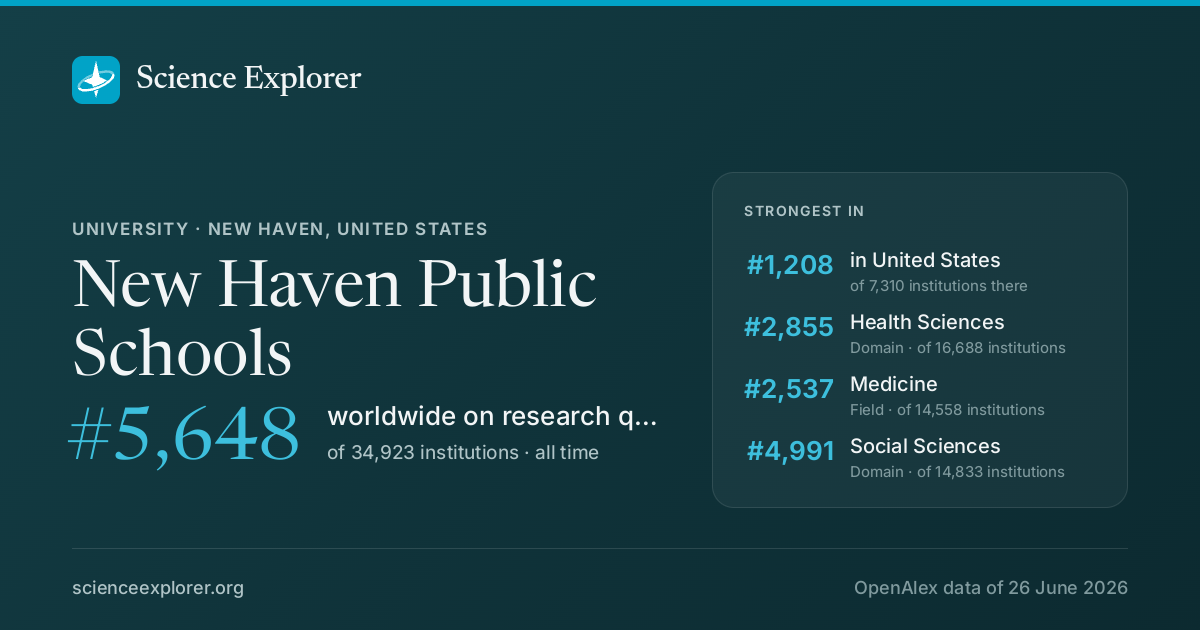
New Haven Public Schools on Science Explorer

A card with New Haven Public Schools's standing and the fields it leads in, for a post or a slide. A link to this page previews as the same card.

Download the card

1200 × 630 PNG, sized for social posts, drawn from the latest snapshot.

Badges for a website1Each links back here and updates with every snapshot

Research measures only: rankings here say nothing about teaching, admissions or student experience. Comparable institutions and collaboration partners have tabs of their own, above.

Discussion

Ask a question or share a note about New Haven Public Schools. Posts are plain text and can be reported.