John B. Pierce Laboratory
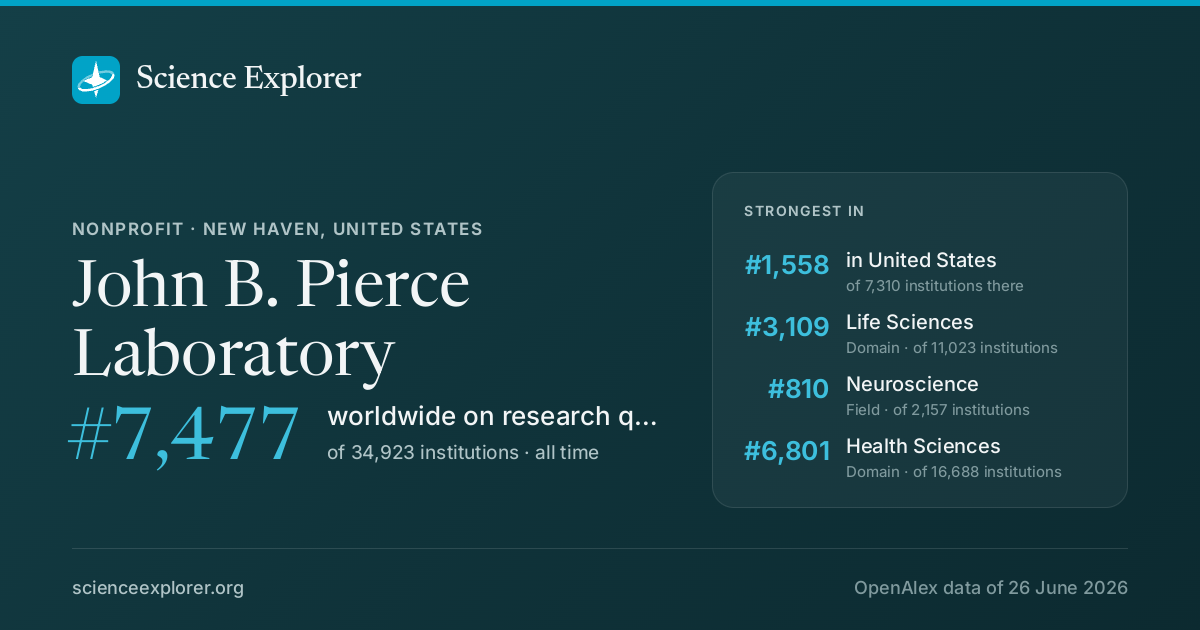
In research, John B. Pierce Laboratory stands highest in Life Sciences (#3,109 of 11,023 worldwide), Neuroscience (#810 of 2,157 worldwide) and Health Sciences (#6,801 of 16,688 worldwide), over all time.
- World rank, all time
- #7,477 of 34,923
- Rank in United States
- #1,558 of 7,310
- Research works
- 740 ▼ 19% vs 2018-21
- Citations
- 47k 63.6 per fractional work
- Top-10% rate
- 18.5% all institutions 10.0%
- vs its own fields
- 1.20× 1.00× is exactly expected
- Open access
- 29% world 40%
- International
- 8% world 18%
What is John B. Pierce Laboratory known for in research?
The fields where it stands highest, over all time, ranked among every institution above the floor in each field.
| Field | World rank | Where that sits | Top-10% rate | Works |
|---|---|---|---|---|
| Life SciencesDomain | #3,109 of 11,023 | 20.7% | 238 | |
| NeuroscienceField | #810 of 2,157 | 23.2% | 153 | |
| Health SciencesDomain | #6,801 of 16,688 | 18.0% | 318 | |
| MedicineField | #7,693 of 14,558 | 16.9% | 266 |
Each strip is that field's whole ranked pool, with the notch where John B. Pierce Laboratory sits in it, in the colour of the band that rank falls in. The track under the rate is the rate itself: it carries no average mark, because the average differs by field (from about 6% in Dentistry to 21% in Economics).
Which fields of science does John B. Pierce Laboratory work in?
In all years, 43% of research at John B. Pierce Laboratory is in Health Sciences, 32% in Life Sciences. Its largest fields are Medicine (36%), Neuroscience (21%), Engineering (8%). It does 2.1× the world's share of Life Sciences.
Each ring splits the one inside it: the four domains of science, their fields, their subfields. Size is fractional works in all years. Every slice is a page; the interactive view zooms down to single topics and colours each by how much more of it this institution does than the world.
Its 4 domains and 26 fields, with their numbers
- Health Sciences31843.0%
- Medicine26635.9%
- Nursing425.6%
- Health Professions111.4%
- Veterinary10.1%
- Dentistry00.0%
- Life Sciences23832.1%
- Physical Sciences11916.1%
- Engineering638.4%
- Environmental Science314.1%
- Chemistry60.8%
- Computer Science60.7%
- Physics and Astronomy60.7%
- Earth and Planetary Sciences30.4%
- Materials Science20.3%
- Chemical Engineering20.2%
- Mathematics10.2%
- Energy00.1%
- Social Sciences658.8%
Field profile
Location quotient across every field it publishes in: outside the ring is more than an institution of this size would be expected to publish, inside it is less.
Rings at 0.5×, 1× and 2×. Widest outward: Neuroscience, 9.1×. Every wedge is a field page.
All 17 fields, with their numbers
- Neuroscience9.08×3 works
- Health Professions2.73×1 works
- Medicine2.44×9 works
- Nursing2.02×0 works
- Decision Sciences1.75×0 works
- Biochemistry, Genetics and Molecular Biology0.94×1 works
- Agricultural and Biological Sciences0.83×1 works
- Business, Management and Accounting0.79×0 works
- Physics and Astronomy0.63×0 works
- Arts and Humanities0.59×0 works
- Psychology0.56×0 works
- Engineering0.51×2 works
- Environmental Science0.37×0 works
- Computer Science0.18×0 works
- Materials Science0.16×0 works
- Immunology and Microbiology0.14×0 works
- Social Sciences0.04×0 works
- Neuroscience 9.1×
- Health Professions 2.7×
- Medicine 2.4×
- Nursing 2.0×
- Decision Sciences 1.8×
- Biochemistry, Genetics and Molecular Biology 0.9×
- Agricultural and Biological Sciences 0.8×
- Business, Management and Accounting 0.8×
- Physics and Astronomy 0.6×
- Arts and Humanities 0.6×
- Psychology 0.6×
- Engineering 0.5×
- Environmental Science 0.4×
- Computer Science 0.2×
- Materials Science 0.2×
- Immunology and Microbiology 0.1×
- Social Sciences 0.0×
Who are the top researchers at John B. Pierce Laboratory?
Ranked on the quality score, B. Bigland-Ritchie, Joseph C. Stevens and ETHAN R. NADEL lead among researchers whose main affiliation is John B. Pierce Laboratory.
- 1
B. Bigland-Ritchie
 United States · #68,395 worldwide
9.7k citations · 55 works
- 2
Joseph C. Stevens
United States · #131,753 worldwide
6.5k citations · 123 works
- 3
ETHAN R. NADEL
United States · #150,380 worldwide
10k citations · 153 works
- 4
J. J. Woods
United States · #182,955 worldwide
5.7k citations · 28 works
- 5
William S. Cain
United States · #194,810 worldwide
11k citations · 188 works
- 6
A. Pharo Gagge
United States · #262,758 worldwide
7.4k citations · 65 works
- 7
Mark Laubach
United States · #276,501 worldwide
6.4k citations · 103 works
- 8
C. B. Wenger
United States · #388,095 worldwide
3.3k citations · 42 works
- 9
Lawrence E. Marks
United States · #463,433 worldwide
13k citations · 256 works
- 10
Barry G. Green
United States · #497,765 worldwide
7.3k citations · 136 works
Which keywords describe research at John B. Pierce Laboratory?
By fractional works in all years, weighted toward what it does more of than the world: Neural Processing, Olfactory System, Quality of Life, COVID-19, Pheromones, Anosmia, Olfactory Dysfunction and Thermoregulation.
- Asthma
- Breast Cancer Detection
- Infrared Thermography
- Emotion Regulation
- Multisensory Integration
- High-Intensity Interval Training
- Obesity
- Electronic Nose
- Treatment
- Neuronal Oscillations
- Cortical Connectivity
- Sweet Taste
- Gut Microbiota
- Fluid Replacement
- Hyperthermia
- Cardiovascular Disease
- Olfactory Dysfunction
- Pheromones
- Olfactory System
- Quality of Life
- Neural Processing
- Inflammation
- COVID-19
- Anosmia
- Thermoregulation
- Cerebral Blood Flow
- Exercise Performance
- Heat Stroke
- Volatile Organic Compounds
- Taste Receptors
- Health Effects
- Lung Cancer
- Breath Analysis
- Genetics
- Neural Correlates
- Crossmodal Processing
- Vascular Function
- Heart Rate Variability
- Thermal Imaging
- Medical Imaging
Size is fractional works in all years in the topics tagged with each word; colour is the word's share of this institution's work against its share of the world's. The 40 words are chosen for being large and distinctive. Each links to the topic it comes from most.
All 40 words, with their numbers
- Neural Processing63▲ 87×2 topics
- Quality of Life61▲ 6.1×13 topics
- Inflammation55▲ 3.2×39 topics
- Olfactory System55▲ 74×2 topics
- COVID-1954▲ 11×4 topics
- Pheromones53▲ 107×2 topics
- Anosmia50▲ 149×1 topic
- Olfactory Dysfunction50▲ 149×1 topic
- Thermoregulation46▲ 60×3 topics
- Cardiovascular Disease44▲ 5.3×20 topics
- Cerebral Blood Flow38▲ 60×2 topics
- Hyperthermia38▲ 93×2 topics
- Exercise Performance38▲ 81×2 topics
- Fluid Replacement37▲ 183×1 topic
- Heat Stroke37▲ 183×1 topic
- Gut Microbiota36▲ 14×4 topics
- Volatile Organic Compounds35▲ 41×3 topics
- Sweet Taste35▲ 102×1 topic
- Taste Receptors35▲ 102×1 topic
- Cortical Connectivity35▲ 62×2 topics
- Health Effects33▲ 7.4×11 topics
- Neuronal Oscillations31▲ 42×2 topics
- Lung Cancer28▲ 23×2 topics
- Treatment28▲ 2.9×15 topics
- Breath Analysis28▲ 27×1 topic
- Electronic Nose28▲ 46×1 topic
- Genetics27▲ 4.7×11 topics
- Obesity25▲ 4.5×16 topics
- Neural Correlates23▲ 32×4 topics
- High-Intensity Interval Training23▲ 29×2 topics
- Crossmodal Processing22▲ 132×1 topic
- Multisensory Integration22▲ 132×1 topic
- Vascular Function21▲ 21×3 topics
- Emotion Regulation21▲ 8.7×4 topics
- Heart Rate Variability18▲ 21×2 topics
- Infrared Thermography17▲ 52×2 topics
- Thermal Imaging17▲ 52×2 topics
- Breast Cancer Detection16▲ 54×1 topic
- Medical Imaging16▲ 8.1×1 topic
- Asthma16▲ 17×3 topics
Which research topics does John B. Pierce Laboratory publish most on?
By volume in 2022-now: Ovarian function and disorders, Hormonal and reproductive studies, Olfactory and Sensory Function Studies and Neural dynamics and brain function.
Area is fractional works; colour is the subfield each topic belongs to.
- 1 Ovarian function and disorders Reproductive Medicine 1 works
- 2 Hormonal and reproductive studies Endocrinology, Diabetes and Metabolism 1 works
- 3 Olfactory and Sensory Function Studies Sensory Systems 1 works
- 4 Neural dynamics and brain function Cognitive Neuroscience 1 works
- 5 Endometriosis Research and Treatment Reproductive Medicine 1 works
- 6 Sensory Analysis and Statistical Methods Food Science 1 works
- 7 Smoking Behavior and Cessation Physiology 1 works
- 8 Traumatic Brain Injury and Neurovascular Disturbances Neurology 0 works
- 9 Consumer Packaging Perceptions and Trends Marketing 0 works
- 10 3D Printing in Biomedical Research Biomedical Engineering 0 works
How open and international is its research?
Against the world's own shares: the tick on each track. Both are shares of its output, so they sit on one scale and can be read against each other as well as against the world.
World: 40% of research is openly available.
World: 18% is written across borders.
How has John B. Pierce Laboratory's research output changed?
Output in 2022-2025 was 19% lower than in 2018-2021.
The same series as a ribbon: one cell per year, darker for more. The line above answers how much; this answers when.
Its share of all research
Growing output can still be a shrinking share: all of science grows. This is John B. Pierce Laboratory as a percentage of every work published that year, 0.000065% in 2024.
Fractional works of John B. Pierce Laboratory over all fractional works that year. How the balance of science has shifted.
Other research institutions in New Haven
- Yale University
- Southern Connecticut State University
- Connecticut Agricultural Experiment Station
- Yale New Haven Health System
- Connecticut Mental Health Center
- New Haven Public Schools
- Institute for Neurodegenerative Disorders
- Endangered Language Fund

Share John B. Pierce Laboratory's ranking
Badges for a website1Each links back here and updates with every snapshot

Research measures only: rankings here say nothing about teaching, admissions or student experience. Comparable institutions and collaboration partners have tabs of their own, above.
Discussion
Ask a question or share a note about John B. Pierce Laboratory. Posts are plain text and can be reported.