 Science in Saudi Arabia
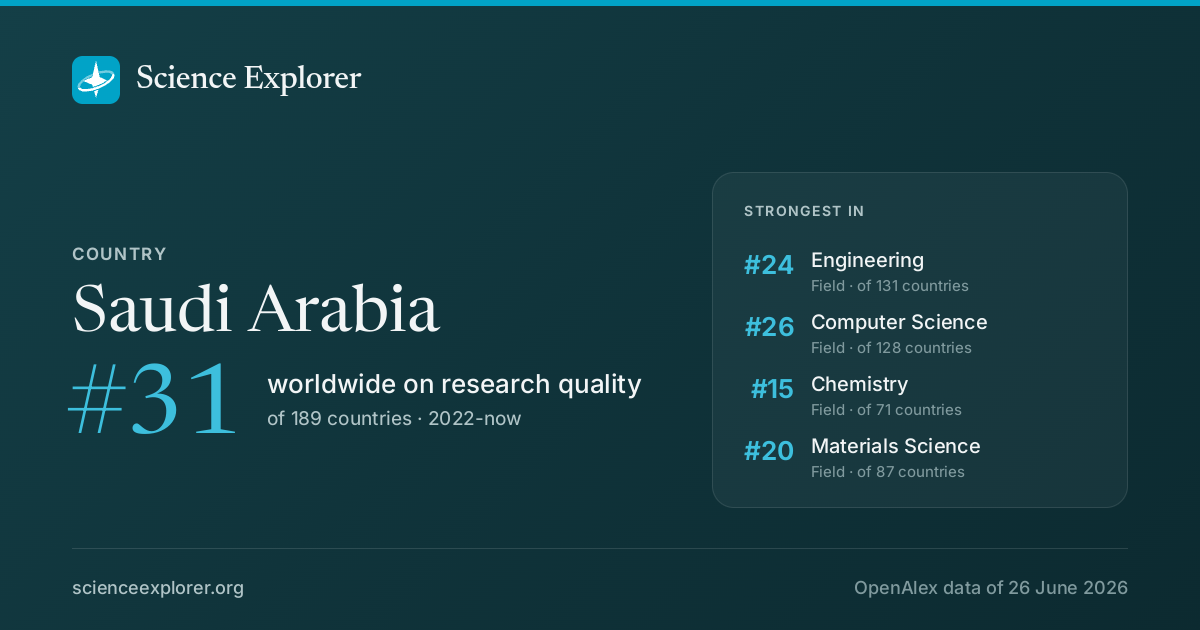
Saudi Arabia ranks #31 of 189 countries on research quality in 2022-now (#29 all time), with 156k research works and 14.4% of them in the world's top 10%.
- World rank, 2022-now
- #31 of 189 · #29 all time
- Works, 2022-now
- 156k ▲ 72% vs 2018-21
- Citations
- 6.4M 16.5 per fractional work, all time
- Top-10% rate
- 14.4% all institutions 10.0%
- vs its own fields
- 1.18× 1.00× is exactly expected
- In the world top 100
- 0 2 in the top 1,000
- Open access
- 57% world 40%
- International
- 43% world 18%
Saudi ArabiaWhat is Saudi Arabia strongest at in science?
On research quality in 2022-now, Saudi Arabia ranks highest in Engineering (#24 of 131), Computer Science (#26 of 128) and Chemistry (#15 of 71). Relative to its size it is most specialised in General Dentistry, Orthodontics and Modeling and Simulation.
| Field | World rank | Where that sits | Top-10% rate | Works | All time | Institutions |
|---|---|---|---|---|---|---|
| EngineeringField | #24 of 131 | 16.2% | 25,788 | #26 | Institutions | |
| Computer ScienceField | #26 of 128 | 19.3% | 14,309 | #27 | Institutions | |
| ChemistryField | #15 of 71 | 16.4% | 4,496 | #15 | Institutions | |
| Materials ScienceField | #20 of 87 | 14.6% | 9,813 | #18 | Institutions | |
| Organic ChemistrySubfield | #15 of 63 | 16.7% | 2,552 | #15 | Institutions | |
| Environmental ScienceField | #30 of 122 | 16.5% | 6,030 | #30 | Institutions | |
| Agricultural and Biological SciencesField | #31 of 124 | 18.3% | 5,889 | #31 | Institutions | |
| Business, Management and AccountingField | #28 of 110 | 20.2% | 3,985 | #27 | Institutions | |
| Electrical and Electronic EngineeringSubfield | #22 of 86 | 16.5% | 6,609 | #23 | Institutions | |
| EnergyField | #20 of 71 | 13.0% | 3,028 | #22 | Institutions | |
| MedicineField | #43 of 152 | 9.4% | 33,480 | - | Institutions | |
| Health ProfessionsField | #30 of 106 | 15.0% | 4,171 | #27 | Institutions |
Where its research is concentrated
Location quotient: how much more (or less) of each node it does than its size predicts. Drawn around 1×, where "twice the world share" and "half of it" are the same distance apart in opposite directions. A volume reading, which on a country axis is largely population and industrial structure.
- General DentistrySubfield · 438.1 works · #6 of 177 active here5.6×
- OrthodonticsSubfield · 1,027.6 works · #7 of 173 active here5.1×
- Modeling and SimulationSubfield · 1,204.8 works · #4 of 206 active here4.8×
- DentistryField · 3,752.9 works · #5 of 204 active here4.3×
- Oral SurgerySubfield · 1,452.9 works4.2×
- Numerical AnalysisSubfield · 561.8 works · #7 of 173 active here3.7×
- Research and TheorySubfield · 163.9 works · #8 of 183 active here3.5×
- PeriodonticsSubfield · 834.2 works3.4×
The whole field profile
All 26 fields at once. A specialist and a generalist produce the same ranked list and a completely different shape.
Rings at 0.5×, 1× and 2×. Widest outward: Dentistry, 4.3×. Every wedge is a field page.
All 26 fields, with their numbers
- Dentistry4.32×3,753 works
- Mathematics2.57×5,411 works
- Pharmacology, Toxicology and Pharmaceutics2.26×1,430 works
- Energy2.16×3,552 works
- Materials Science1.80×11k works
- Chemistry1.78×4,992 works
- Chemical Engineering1.73×1,085 works
- Nursing1.31×1,152 works
- Decision Sciences1.21×2,098 works
- Computer Science1.18×16k works
- Medicine1.12×39k works
- Engineering1.09×29k works
- Health Professions1.00×4,719 works
- Immunology and Microbiology0.90×1,630 works
- Biochemistry, Genetics and Molecular Biology0.89×8,506 works
- Psychology0.87×4,737 works
- Environmental Science0.80×7,100 works
- Business, Management and Accounting0.80×4,639 works
- Agricultural and Biological Sciences0.79×6,694 works
- Neuroscience0.79×2,286 works
- Physics and Astronomy0.77×3,086 works
- Veterinary0.75×183 works
- Economics, Econometrics and Finance0.68×2,625 works
- Earth and Planetary Sciences0.58×1,640 works
- Arts and Humanities0.48×2,472 works
- Social Sciences0.43×9,714 works
Which fields of science does Saudi Arabia work in?
In 2022-now, 47% of research in Saudi Arabia is in Physical Sciences, 27% in Health Sciences. Its largest fields are Medicine (22%), Engineering (16%), Computer Science (9%).
Each ring splits the one inside it: the four domains of science, their fields, their subfields. Size is fractional works in 2022-now. Every slice is a page; the interactive view zooms down to single topics and colours each by how much more of it this country does than the world.
Its 4 domains and 26 fields, with their numbers
- Physical Sciences84k46.8%
- Engineering29k16.4%
- Computer Science16k9.2%
- Materials Science11k6.3%
- Environmental Science7,1004.0%
- Mathematics5,4113.0%
- Chemistry4,9922.8%
- Energy3,5522.0%
- Physics and Astronomy3,0861.7%
- Earth and Planetary Sciences1,6400.9%
- Chemical Engineering1,0850.6%
- Health Sciences48k27.1%
- Medicine39k21.6%
- Health Professions4,7192.6%
- Dentistry3,7532.1%
- Nursing1,1520.6%
- Veterinary1830.1%
- Social Sciences26k14.7%
- Social Sciences9,7145.4%
- Psychology4,7372.6%
- Business, Management and Accounting4,6392.6%
- Economics, Econometrics and Finance2,6251.5%
- Arts and Humanities2,4721.4%
- Decision Sciences2,0981.2%
- Life Sciences21k11.5%
- Biochemistry, Genetics and Molecular Biology8,5064.7%
- Agricultural and Biological Sciences6,6943.7%
- Neuroscience2,2871.3%
- Immunology and Microbiology1,6310.9%
- Pharmacology, Toxicology and Pharmaceutics1,4310.8%
Which keywords describe research in Saudi Arabia?
By fractional works in 2022-now, weighted toward what it does more of than the world: Machine Learning, Deep Learning, Epidemiology, Nanomaterials, Heat Transfer, Nanoparticles, Experimental Investigation and Healthcare.
- Random Walk
- Anomalous Diffusion
- Enhancement
- Viscosity
- Nanofluids
- Green Synthesis
- Solar Energy
- Nonlinear Equations
- Water Splitting
- IoT Security
- Toxicity
- Antioxidant
- Nanocomposites
- COVID-19
- Heat Transfer
- Quality of Life
- Healthcare
- Nanoparticles
- Nanomaterials
- Epidemiology
- Machine Learning
- Deep Learning
- Inflammation
- Renewable Energy
- Oxidative Stress
- Environmental Impact
- Biomedical Applications
- Graphene
- Supply Chain Management
- Synthesis
- Nanostructures
- Smart Cities
- Experimental Investigation
- Applications
- Antimicrobial
- Thermal Conductivity
- Review
- Convective Transport
- Fractional Calculus
- Homotopy Analysis Method
Size is fractional works in 2022-now in the topics tagged with each word; colour is the word's share of this country's work against its share of the world's. The 40 words are chosen for being large and distinctive. Each links to the topic it comes from most.
All 40 words, with their numbers
- Machine Learning9,377▲ 1.57×97 topics
- Epidemiology8,606▲ 1.20×140 topics
- Deep Learning8,212▲ 1.33×85 topics
- Nanomaterials4,903▲ 2.6×21 topics
- Inflammation4,358◆ 1.14×83 topics
- Nanoparticles4,169▲ 1.85×44 topics
- Renewable Energy3,548▲ 1.37×61 topics
- Healthcare3,546▲ 1.73×38 topics
- Oxidative Stress3,515▲ 1.19×63 topics
- Quality of Life3,402▲ 1.31×58 topics
- Environmental Impact3,365◆ 1.10×72 topics
- Heat Transfer3,190▲ 3.6×20 topics
- Biomedical Applications3,145▲ 1.48×36 topics
- COVID-192,875▲ 1.23×33 topics
- Graphene2,614▲ 2.2×12 topics
- Nanocomposites2,530▲ 1.79×22 topics
- Supply Chain Management2,398▲ 1.49×26 topics
- Antioxidant2,358▲ 1.92×51 topics
- Synthesis1,863▲ 2.8×37 topics
- Toxicity1,816▲ 2.3×20 topics
- Nanostructures1,774▲ 2.4×17 topics
- IoT Security1,724▲ 3.1×3 topics
- Smart Cities1,649▲ 3.5×8 topics
- Water Splitting1,646▲ 2.5×4 topics
- Experimental Investigation1,634▲ 8.8×5 topics
- Nonlinear Equations1,616▲ 7.0×6 topics
- Applications1,601▲ 3.3×8 topics
- Solar Energy1,585▲ 2.8×5 topics
- Antimicrobial1,475▲ 2.9×14 topics
- Green Synthesis1,351▲ 4.0×5 topics
- Thermal Conductivity1,290▲ 4.5×8 topics
- Nanofluids1,272▲ 8.6×2 topics
- Review1,231▲ 5.7×5 topics
- Viscosity1,059▲ 8.3×4 topics
- Convective Transport1,015▲ 12×1 topic
- Enhancement1,015▲ 12×1 topic
- Fractional Calculus1,005▲ 9.9×2 topics
- Anomalous Diffusion942▲ 9.4×2 topics
- Homotopy Analysis Method910▲ 11×1 topic
- Random Walk910▲ 11×1 topic
Which research topics does Saudi Arabia publish the most in?
Its largest topics in 2022-now are Nanofluid Flow and Heat Transfer, Fractional Differential Equations Solutions, Advanced Photocatalysis Techniques.
Area is fractional works in 2022-now; colour is the subfield each topic belongs to. Every tile is a topic page.
- 1 Nanofluid Flow and Heat Transfer Biomedical Engineering 1k works
- 2 Fractional Differential Equations Solutions Modeling and Simulation 910 works
- 3 Advanced Photocatalysis Techniques Renewable Energy, Sustainability and the Environment 898 works
- 4 Socioeconomic Development in MENA Sociology and Political Science 711 works
- 5 Organizational and Employee Performance Artificial Intelligence 706 works
- 6 Nanoparticles: synthesis and applications Materials Chemistry 699 works
- 7 Network Security and Intrusion Detection Computer Networks and Communications 682 works
- 8 IoT and Edge/Fog Computing Computer Networks and Communications 592 works
- 9 Dental materials and restorations Orthodontics 586 works
- 10 Adsorption and biosorption for pollutant removal Water Science and Technology 574 works
- 11 Blockchain Technology Applications and Security Information Systems 567 works
- 12 Heat Transfer Mechanisms Mechanical Engineering 556 works
How many world-class institutions does Saudi Arabia hold?
Average quality and elite capacity disagree by construction, and both are worth knowing: the first is decided by a country's whole institution population, the second counts the institutions it holds at the top. One square per institution.
| Standing among countries | 2022-now | Where that sits | All time |
|---|---|---|---|
| Average qualityits whole institution population | #31 of 189 | #29 of 203 | |
| Elite capacitythe institutions it holds at the top | #34 of 204 | #31 of 216 |
Elite capacity counts a country's institutions by their worldwide rank, weighted so a place at #1 counts for more than one at #480. Countries under 100 fractional works are left out.
Bands are exclusive, so the squares add up to 2 (the institutions it holds in the world top 1,000), not to four times it.
Which universities in Saudi Arabia lead research?
King Abdullah University of Science and Technology, King Abdulaziz University and University of Business and Technology rank highest in Saudi Arabia on research quality in 2022-now.
One dot per institution in the list below. The upper left is the interesting corner.
- 1King Abdullah University of Science and TechnologyUniversity · Jeddah · #221 worldwide17.4% top 10% · 5.7k works
- 2King Abdulaziz UniversityUniversity · Jeddah · #933 worldwide13.8% top 10% · 11k works
- 3University of Business and TechnologyUniversity · Jeddah · #1,038 worldwide22.6% top 10% · 2k works
- 4King Saud UniversityUniversity · Riyadh · #1,051 worldwide14.1% top 10% · 20k works
- 5Ministry of EducationGovernment institution · Riyadh · #1,144 worldwide19.1% top 10% · 655 works
- 6King Fahd University of Petroleum and MineralsUniversity · Dhahran · #1,157 worldwide16.9% top 10% · 7.2k works
- 7Prince Sultan UniversityUniversity · Riyadh · #1,338 worldwide22.1% top 10% · 2.3k works
- 8Jouf UniversityUniversity · Sakakah · #1,637 worldwide18.6% top 10% · 2.7k works
- 9Saudi Electronic UniversityUniversity · Riyadh · #1,726 worldwide18.0% top 10% · 1.1k works
- 10King Faisal UniversityUniversity · Hofuf · #1,820 worldwide16.1% top 10% · 5.2k works
- 11Princess Nourah bint Abdulrahman UniversityUniversity · Riyadh · #1,985 worldwide18.1% top 10% · 5.3k works
- 12Majmaah UniversityUniversity · Riyadh · #2,354 worldwide15.4% top 10% · 1.9k works
- 13Saudi Aramco (Saudi Arabia)Company · Dhahran · #2,395 worldwide4.3% top 10% · 3.5k works
- 14University of BishaUniversity · Bisha · #2,479 worldwide16.5% top 10% · 1.2k works
- 15King Khalid UniversityUniversity · Abhā · #2,482 worldwide17.5% top 10% · 7.7k works
The track on each row is its top-10% rate; the tick is the average of all institutions, 10.0% (how it is set): teal above it, red below.
All ranked institutions in Saudi ArabiaWho are the top researchers in Saudi Arabia?
Xuping Sun, Arunodaya Raj Mishra and Osman M. Bakr rank highest among researchers based in Saudi Arabia.
- 1 Xuping Sun #352 worldwide 82k citations · 678 works
- 2 Arunodaya Raj Mishra #507 worldwide 9.8k citations · 215 works
- 3 Osman M. Bakr #703 worldwide 62k citations · 539 works
- 4 Mohamed Eddaoudi #1,507 worldwide 97k citations · 772 works
- 5 Pratibha Rani #1,724 worldwide 8.6k citations · 204 works
- 6 Youssef Belmabkhout #2,939 worldwide 24k citations · 287 works
- 7 Husam Niman Alshareef #3,390 worldwide 72k citations · 741 works
- 8 Ingo Pinnau #3,633 worldwide 26k citations · 274 works
- 9 Stefaan De Wolf #3,793 worldwide 39k citations · 432 works
- 10 Parvaiz Ahmad #4,024 worldwide 41k citations · 550 works
Which cities in Saudi Arabia are research hubs?
- 1
RiyadhSaudi Arabia
143k works
- 2
JeddahSaudi Arabia
71k works
- 3
DhahranSaudi Arabia
33k works
How open and international is Saudi Arabia's research?
57% of its research is openly available (world: 40%), and 43% is written with international co-authors (world: 18%).
World: 40% of research is openly available.
World: 18% is written across borders.
In 2022-now, 68% of its research is openly available (world 63%) and 49% is written with co-authors abroad (world 22%). Against what its own mix of topics predicts, that is 1.16× the expected open access and 2.04× the expected international share, which puts it #23 of 173 countries on openness.
How has Saudi Arabia's research grown?
Output in 2022-2025 was 72% higher than in 2018-2021.
The same series as a ribbon: one cell per year, darker for more. The line above answers how much; this answers when.
Its share of all research
Growing output can still be a shrinking share: all of science grows. This is Saudi Arabia as a percentage of every work published that year, 0.74% in 2024.
Fractional works of Saudi Arabia over all fractional works that year. How the balance of science has shifted.
How much of it reaches the world top 10%
Over the whole record, 12.4% of its 390k works since 1950 reached the world top 10% for their field and year.
Of each year's output, the share that reached the world's 10% most cited for its field and year. Peak 15.0% in 2025.
Which countries have research most like Saudi Arabia's?
India is Saudi Arabia's closest research twin: of all countries, its research is spread across the fields most like Saudi Arabia's, with both strong in Pharmacology, Toxicology and Pharmaceutics.
- 1
 IndiaBoth strong in Pharmacology, Toxicology and Pharmaceutics, Dentistry, Chemistry
0.81 Compare
- 2
 IranBoth strong in Dentistry, Chemistry, Pharmacology, Toxicology and Pharmaceutics
0.78 Compare
- 3
 IraqBoth strong in Dentistry, Pharmacology, Toxicology and Pharmaceutics, Chemistry
0.75 Compare
- 4
 EgyptBoth strong in Dentistry, Pharmacology, Toxicology and Pharmaceutics, Chemistry
0.67 Compare
- 5
 YemenBoth strong in Dentistry, Mathematics, Pharmacology, Toxicology and Pharmaceutics
0.64 Compare
Similarity is the correlation of each side's location quotients across every field it publishes in, on a log scale: 1 is the same shape of research, 0 is unrelated. It ignores size. How it is measured.
Compare Saudi Arabia with
 Ireland
 Hungary
 South Africa
 Chile
 Brazil
 Greece
Share Saudi Arabia's ranking



Research fields in Saudi Arabia
- Physical Sciences
- Engineering
- Computer Science
- Chemistry
- Materials Science
- Life Sciences
- Organic Chemistry
- Environmental Science
- Agricultural and Biological Sciences
- Business, Management and Accounting
- Electrical and Electronic Engineering
- Energy
- Medicine
- Health Professions
- Health Sciences
- Artificial Intelligence
- Information Systems
- Social Sciences
- Plant Science
- Renewable Energy, Sustainability and the Environment
- Biochemistry, Genetics and Molecular Biology
- Earth and Planetary Sciences
- Materials Chemistry
- Sociology and Political Science
- Psychology
- Biomedical Engineering
- Water Science and Technology
- Mathematics
- Mechanical Engineering
- Control and Systems Engineering
- Computer Networks and Communications
- Education
- Molecular Biology
- Social Sciences
- Building and Construction
- Civil and Structural Engineering
- Computer Vision and Pattern Recognition
- Economics, Econometrics and Finance
- Decision Sciences
- General Health Professions
- Applied Mathematics
- Dentistry
- Economics and Econometrics
- Accounting
- Public Health, Environmental and Occupational Health
- Mechanics of Materials
- Environmental Engineering
- Polymers and Plastics
- Strategy and Management
- Chemical Engineering
- Inorganic Chemistry
- Modeling and Simulation
- Surgery
- Food Science
- Pollution
- Management Science and Operations Research
- Analytical Chemistry
- Computational Theory and Mathematics
- Arts and Humanities
- Clinical Psychology
Questions people ask
What is Saudi Arabia strongest at in science?
On research quality in 2022-now, Saudi Arabia ranks highest in Engineering (#24 of 131), Computer Science (#26 of 128) and Chemistry (#15 of 71). Relative to its size it is most specialised in General Dentistry, Orthodontics and Modeling and Simulation.
See the full answerHow fast is research in Saudi Arabia growing?
Output in 2022-2025 was 72% higher than in 2018-2021.
How has Saudi Arabia's research grown?Who are the top scientists in Saudi Arabia?
Xuping Sun, Arunodaya Raj Mishra and Osman M. Bakr rank highest among researchers based in Saudi Arabia.
Who are the top researchers in Saudi Arabia?Discussion
Ask a question or share a note about Saudi Arabia. Keep it to the research: no personal attacks, advertising or links. Any reader can report a post, which collapses it for everyone until it is opened.