Orthodontics research
Orthodontics is a subfield of Dentistry. Science Explorer counts 111k research works in it since 1950. 9.9% of them reached the world's top 10% most cited for their field and year.
In short: specialty of dentistry that deals with the diagnosis, prevention, and correction of malpositioned teeth and jaws, and misaligned bite patterns.
- Research works
- 111k fractional, since 1950
- In the world top 10%
- 11k per year above
- Top-10% rate
- 9.9% share of its works in the world top 10%
- Topics
- 3
- Growth, 2018-21 → 2022-25
- +23% the tick is no change
- Largest producer
 India
19% of the 10 largest, 2022-now
This ranks research output and citation impact. It says nothing about the quality of diagnosis, treatment or care.
What is Orthodontics research about, and what is growing?
By the world's output in 2021-25, its most used keywords are Dental Materials, Restorative Dentistry, Orthodontic Tooth Movement, Orthognathic Surgery, Dental Erosion, Tooth Whitening.
- Tooth Whitening
- Orthognathic Surgery
- Restorative Dentistry
- Dental Materials
- Orthodontic Tooth Movement
- Dental Erosion
Size is the world's fractional works in 2021-25 in the topics tagged with each word; colour compares the word's share of this field with 2011-15. Each links to the topic it comes from most.
All 6 words, with their numbers
- Dental Materials15k◆ 0.99×1 topic
- Restorative Dentistry15k◆ 0.99×1 topic
- Orthodontic Tooth Movement10k◆ 1.08×1 topic
- Orthognathic Surgery10k◆ 1.08×1 topic
- Dental Erosion5,696◆ 0.90×1 topic
- Tooth Whitening5,696◆ 0.90×1 topic
Which countries lead Orthodontics research?
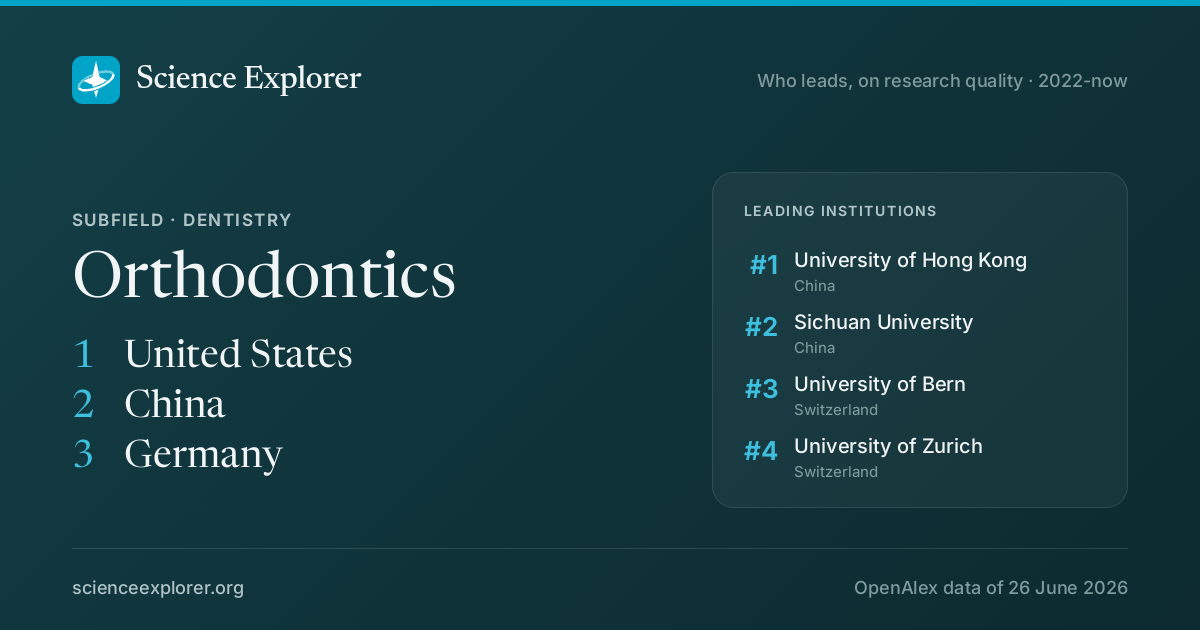
On research quality in 2022-now, the United States, China and Germany rank highest in Orthodontics. By volume, India and Brazil publish the most (3.4k and 2.8k works in 2022-now).
By research quality, 2022-now
- 1
 United States #1 all time
1.16× citation excellence · 1.53× journals · 100% breadth
12.4% top 10% · 1.9k works
- 2
 China #2 all time
1.33× citation excellence · 1.06× journals · 100% breadth
15.4% top 10% · 2.1k works
- 3
 Germany #3 all time
1.60× citation excellence · 1.40× journals · 100% breadth
16.4% top 10% · 652 works
- 4
 Switzerland #4 all time
1.94× citation excellence · 1.86× journals · 100% breadth
20.6% top 10% · 268 works
- 5
 United Kingdom #5 all time
1.18× citation excellence · 1.44× journals · 100% breadth
12.0% top 10% · 524 works
- 6
 Italy #8 all time
1.87× citation excellence · 0.67× journals · 100% breadth
21.0% top 10% · 748 works
- 7
 Spain #7 all time
1.70× citation excellence · 0.99× journals · 100% breadth
17.7% top 10% · 410 works
- 8
 Australia #10 all time
1.89× citation excellence · 1.20× journals · 100% breadth
21.1% top 10% · 209 works
- 9
 France #12 all time
1.38× citation excellence · 1.26× journals · 100% breadth
13.0% top 10% · 244 works
- 10
 South Korea #13 all time
0.94× citation excellence · 0.91× journals · 100% breadth
10.1% top 10% · 598 works
The track on each row is that row's top-10% rate. The ranking itself is the quality score, which compares the rate with what each place's own topics predict, adds its share of papers in the Nature Index journals, and counts output and breadth too.
Of 24 countries ranked in Orthodontics. Ranked on the quality score for 2022-now; the bracket is the all-time rank.
All countries ranked in OrthodonticsBy volume, 2022-now
- 1
India
3.4k works
- 2
 Brazil
2.8k works
- 3
China
2.5k works
- 4
United States
2.2k works
- 5
 Türkiye
2k works
- 6
 Egypt
1.2k works
- 7
 Saudi Arabia
1k works
- 8
Italy
851 works
- 9
 Iran
800 works
- 10
Germany
740 works
How concentrated that is
The same countries as shares of everything the list above accounts for. A node where two countries do two thirds of the work and one spread evenly across twelve read alike as a ranking and not at all alike here.
Shares of the rows listed above, not of the whole node.
Which institutions lead Orthodontics research?
University of Hong Kong (China) ranks first in Orthodontics on research quality in 2022-now, followed by Sichuan University and University of Bern.
By research quality, 2022-now
- 1
University of Hong Kong China · Pok Fu Lam · #1 all time
23.7% top 10% · 81 works
- 2
Sichuan University China · Chengdu · #4 all time
16.5% top 10% · 180 works
- 3
University of Bern Switzerland · Bern · #5 all time
24.1% top 10% · 78 works
- 4
University of Zurich Switzerland · Zurich · #2 all time
19.2% top 10% · 87 works
- 5
Ludwig-Maximilians-Universität München Germany · Munich · #6 all time
21.8% top 10% · 62 works
- 6
Seoul National University South Korea · Seoul · #16 all time
17.5% top 10% · 88 works
- 7
Stomatology Hospital China · Xi'an · #35 all time
14.3% top 10% · 180 works
- 8
Peking University China · Beijing · #14 all time
14.7% top 10% · 64 works
- 9
Shanghai Jiao Tong University China · Shanghai · #20 all time
15.7% top 10% · 84 works
- 10
Yonsei University South Korea · Seoul · #25 all time
14.1% top 10% · 112 works


The track on each row is that row's top-10% rate. The ranking itself is the quality score, which compares the rate with what each place's own topics predict, adds its share of papers in the Nature Index journals, and counts output and breadth too.
Of 44 institutions above the floor of 40 fractional works in Orthodontics.
Top 100 Orthodontics institutionsBy volume, 2022-now
- 1
Universidade de São PauloBrazil
285 works
- 2
Saveetha UniversityIndia
242 works
- 3
Stomatology HospitalChina
217 works
- 4
Sichuan UniversityChina
196 works
- 5
Universidade Estadual Paulista (Unesp)Brazil
189 works
- 6
King Saud UniversitySaudi Arabia
188 works
- 7
Cairo UniversityEgypt
174 works
- 8
Mansoura UniversityEgypt
151 works
- 9
Alexandria UniversityEgypt
136 works
- 10
Kamineni Institute of Dental SciencesIndia
133 works

Who are the leading researchers in Orthodontics?
Counting only their work in Orthodontics, Franklin R. Tay, Bart Van Meerbeek and Marta Revilla‐León have the most papers in the world top 10% for their subfield and year beyond the 10% expected.
- 1
Franklin R. Tay
United States · #10,435 worldwide overall
102.6 of 289 papers here in the top 10%
- 2
Bart Van Meerbeek
 Belgium · #68,550 worldwide overall
74.2 of 230 papers here in the top 10%
- 3
Marta Revilla‐León
United States · #11,578 worldwide overall
54.8 of 108 papers here in the top 10%
- 4
David Henry Pashley
United States · #49,340 worldwide overall
52.5 of 176 papers here in the top 10%
- 5
Jack L. Ferracane
United States · #45,946 worldwide overall
45.4 of 124 papers here in the top 10%
- 6
Hockin H.K. Xu
United States · #9,086 worldwide overall
42.0 of 97 papers here in the top 10%
- 7
Lorenzo Breschi
Italy · #255,758 worldwide overall
51.5 of 199 papers here in the top 10%
- 8
David H. Pashley
United States · #49,762 worldwide overall
44.4 of 100 papers here in the top 10%
- 9
Michael D. Weir
United States · #13,565 worldwide overall
37.5 of 89 papers here in the top 10%
- 10
Mutlu Özcan
Switzerland · #585,957 worldwide overall
71.3 of 334 papers here in the top 10%
Ranked on their work in Orthodontics alone: how many more of their papers here reached the world top 10% for their subfield and year than the 10% expected, among 198,335 ranked researchers with a paper here. Each paper counts once, so many strong papers outrank one famous one, and a long record of ordinary papers does not climb. Identities come from OpenAlex author disambiguation, which occasionally merges or splits people.
Top 100 Orthodontics researchersWhere is Orthodontics research done?
The largest centres of Orthodontics research in 2022-now are São Paulo (Brazil), Chennai (India), Istanbul (Türkiye) and Cairo (Egypt). Among places with at least 20 works in it, it is an unusually large share of all research in Creve Coeur, Medak and Sinchon-dong.
Largest cities, 2022-now
Where it is the local speciality
- Creve CoeurUS · 46.7 works149×
- MedakIN · 65.0 works100×
- Sinchon-dong29.1 works92×
- NalgondaIN · 132.9 works87×
- BauruBR · 28.0 works54×
- Rāj-NāndgaonIN · 25.4 works50×
Location quotient: how much more of its research is in Orthodontics than the world average.
Orthodontics research by country
The best places for Orthodontics research inside each country, with that country's researchers and world standing.
 Japan
 Thailand
 Iraq
Where is the best place to study Orthodontics?
Among universities, judged by research, University of Hong Kong, University of Bern and University of Zurich score highest, combining standing in the field's ranking, citation excellence, specialisation, size, growth and international reach. Research strength is one signal when choosing where to study; it does not measure teaching.
One dot per university in the first ten of the table below, at the default weights. The upper left is the interesting corner: small places doing unusually strong work.


















Universities only. The score blends standing (50%), citation excellence (20%), size (15%), specialisation (5%), growth (5%), international reach (5%), 2022-now; growth compares 2018-21 with 2022-25 and counts up to +20%, since a jump from a small base is mostly noise. Standing is the score in this field's institution ranking, three quarters over all time and a quarter 2022-now; excellence averages the two windows too. Four years alone undercount fields such as AI, where many conference and arXiv papers from 2022 on carry no affiliation in the data.
Every institution in Orthodontics, country by countryIs Orthodontics research growing?
Output in 2022-2025 was 23% higher than in 2018-2021, peaking in 2025. The fastest-growing topics are Orthodontics and Dentofacial Orthopedics, Dental Erosion and Treatment and Dental materials and restorations.
The same series as a ribbon: one cell per year, darker for more. The line above answers how much; this answers when.
Its share of all research
Growing output can still be a shrinking share: all of science grows. This is Orthodontics as a percentage of every work published that year, 0.11% in 2024.
Fractional works of Orthodontics over all fractional works that year. How the balance of science has shifted.
How much of it reaches the world top 10%
Year by year.
Of each year's works in it, the share that reached the world's 10% most cited for their field and year. A field is the world for its own topics, so there is no other line to hold it against.
Which topics inside it are moving
Growth and decline on one axis around a shared zero. Two lists side by side hide the thing that matters: whether the growth dwarfs the decline, or the other way round.
- Orthodontics and Dentofacial Orthopedics+34%
- Dental Erosion and Treatment+19%
- Dental materials and restorations+17%
Growth in output from 2018-21 to 2022-25. Every topic is a page of its own.
What does Orthodontics include?
Share who leads Orthodontics
The leading institutions' badges6Each links to that institution's page and updates with every snapshot


Discussion
Ask a question or share a note about Orthodontics. Keep it to the research: no personal attacks, advertising or links. Any reader can report a post, which collapses it for everyone until it is opened.