Science Explorer Back to mapMap
University · Ajman · United Arab Emirates

Ajman University

In research, Ajman University stands highest in Physical Sciences (#2,034 of 10,670 worldwide), Computer Science (#1,178 of 4,417 worldwide) and Health Sciences (#3,210 of 9,902 worldwide), 2022-now. Relative to its size it is most specialised in Orthodontics, Dentistry and Oral Surgery (Orthodontics is 18.8× its share of world research).

World rank, 2022-now
#2,110
of 22,385 · #3,365 all time
Rank in United Arab Emirates
#9
of 60
Research works
3.1k
▲ 126% vs 2018-21
Citations
41k
13.5 per fractional work
Top-10% rate
17.5%
all institutions 10.0%
vs its own fields
1.36×
1.00× is exactly expected
Open access
62%
world 40%
International
56%
world 18%

What is Ajman University known for in research?

The fields where it stands highest, 2022-now, ranked among every institution above the floor in each field.

FieldWorld rankWhere that sitsTop-10% rateWorksAll time
Physical SciencesDomain #2,034 of 10,670 18.5%674 #3236
Computer ScienceField #1,178 of 4,417 23.6%201 #1977
Health SciencesDomain #3,210 of 9,902 14.5%455 #5113
DentistryField #148 of 405 14.6%123 #362
EngineeringField #2,218 of 5,901 15.6%242 #3623
MedicineField #3,482 of 8,541 14.5%267 #4924
Social SciencesDomain #4,995 of 9,585 21.1%319 #6728
Artificial IntelligenceSubfield #1,065 of 1,862 23.9%74 #1694
Life SciencesDomain #4,322 of 6,403 16.6%153 #6158
Biochemistry, Genetics and Molecular BiologyField #2,019 of 2,964 17.2%67 -

Each strip is that field's whole ranked pool, with the notch where Ajman University sits in it, in the colour of the band that rank falls in. The track under the rate is the rate itself: it carries no average mark, because the average differs by field (from about 6% in Dentistry to 21% in Economics).

Which of those standings moved

The same fields on both windows: where it stood over the whole record, and where it stands in 2022-now. The distance is the story, and it is the one thing the two rank columns above cannot show.

  1. Physical Sciences#3,236 #2,034
  2. Computer Science#1,977 #1,178
  3. Health Sciences#5,113 #3,210
  4. Dentistry#362 #148
  5. Engineering#3,623 #2,218
  6. Medicine#4,924 #3,482
  7. Social Sciences#6,728 #4,995
  8. Artificial Intelligence#1,694 #1,065
  9. Life Sciences#6,158 #4,322
all time2022-now, better2022-now, worse

A dot further right is a better standing. Fields it was not ranked in over the whole record are left out.

Which fields of science does Ajman University work in?

In 2022-now, 41% of research at Ajman University is in Physical Sciences, 29% in Health Sciences. Its largest fields are Medicine (17%), Engineering (14%), Computer Science (13%). It does 1.3× the world's share of Health Sciences.

Physical Sciences: 767 fractional works · 41.2% of its workEngineering: 270 fractional works · 14.5% of its workElectrical and Electronic Engineering: 73 fractional works · 3.9% of its workBiomedical Engineering: 43 fractional works · 2.3% of its workBuilding and Construction: 33 fractional works · 1.8% of its workControl and Systems Engineering: 28 fractional works · 1.5% of its workMechanical Engineering: 15 fractional works · 0.8% of its workAerospace Engineering: 14 fractional works · 0.8% of its workAutomotive Engineering: 11 fractional works · 0.6% of its workIndustrial and Manufacturing Engineering: 11 fractional works · 0.6% of its workComputational Mechanics: 10 fractional works · 0.5% of its workCivil and Structural Engineering: 9 fractional works · 0.5% of its workMedia Technology: 8 fractional works · 0.5% of its workArchitecture: 5 fractional works · 0.3% of its workMechanics of Materials: 4 fractional works · 0.2% of its workSmaller subfields together: 6 fractional works · 0.3% of its workComputer Science: 238 fractional works · 12.8% of its workArtificial Intelligence: 92 fractional works · 5.0% of its workInformation Systems: 39 fractional works · 2.1% of its workComputer Networks and Communications: 34 fractional works · 1.9% of its workComputer Vision and Pattern Recognition: 26 fractional works · 1.4% of its workComputational Theory and Mathematics: 15 fractional works · 0.8% of its workSignal Processing: 12 fractional works · 0.7% of its workComputer Science Applications: 9 fractional works · 0.5% of its workHuman-Computer Interaction: 6 fractional works · 0.3% of its workSmaller subfields together: 5 fractional works · 0.3% of its workEnvironmental Science: 64 fractional works · 3.5% of its workEnvironmental Engineering: 18 fractional works · 1.0% of its workHealth, Toxicology and Mutagenesis: 16 fractional works · 0.9% of its workGlobal and Planetary Change: 7 fractional works · 0.4% of its workPollution: 5 fractional works · 0.3% of its workWater Science and Technology: 5 fractional works · 0.3% of its workManagement, Monitoring, Policy and Law: 5 fractional works · 0.3% of its workSmaller subfields together: 8 fractional works · 0.4% of its workMathematics: 59 fractional works · 3.2% of its workModeling and Simulation: 25 fractional works · 1.3% of its workApplied Mathematics: 13 fractional works · 0.7% of its workNumerical Analysis: 12 fractional works · 0.7% of its workStatistics and Probability: 4 fractional works · 0.2% of its workSmaller subfields together: 5 fractional works · 0.3% of its workMaterials Science: 55 fractional works · 3.0% of its workMaterials Chemistry: 30 fractional works · 1.6% of its workBiomaterials: 8 fractional works · 0.4% of its workPolymers and Plastics: 8 fractional works · 0.4% of its workElectronic, Optical and Magnetic Materials: 7 fractional works · 0.4% of its workSmaller subfields together: 2 fractional works · 0.1% of its workPhysics and Astronomy: 32 fractional works · 1.7% of its workStatistical and Nonlinear Physics: 17 fractional works · 0.9% of its workNuclear and High Energy Physics: 6 fractional works · 0.3% of its workAtomic and Molecular Physics, and Optics: 4 fractional works · 0.2% of its workSmaller subfields together: 4 fractional works · 0.2% of its workEnergy: 20 fractional works · 1.1% of its workRenewable Energy, Sustainability and the Environment: 19 fractional works · 1.0% of its workSmaller subfields together: 2 fractional works · 0.1% of its workChemistry: 20 fractional works · 1.1% of its workOrganic Chemistry: 12 fractional works · 0.6% of its workSmaller subfields together: 8 fractional works · 0.4% of its workEarth and Planetary Sciences: 6 fractional works · 0.3% of its workChemical Engineering: 3 fractional works · 0.2% of its workHealth Sciences: 540 fractional works · 29.0% of its workMedicine: 319 fractional works · 17.2% of its workPublic Health, Environmental and Occupational Health: 37 fractional works · 2.0% of its workSurgery: 33 fractional works · 1.8% of its workRadiology, Nuclear Medicine and Imaging: 20 fractional works · 1.1% of its workPhysiology: 19 fractional works · 1.0% of its workPulmonary and Respiratory Medicine: 18 fractional works · 1.0% of its workEpidemiology: 16 fractional works · 0.8% of its workOncology: 12 fractional works · 0.7% of its workHealth Informatics: 12 fractional works · 0.6% of its workInfectious Diseases: 11 fractional works · 0.6% of its workEndocrinology, Diabetes and Metabolism: 11 fractional works · 0.6% of its workCardiology and Cardiovascular Medicine: 10 fractional works · 0.6% of its workPharmacology: 10 fractional works · 0.6% of its workReproductive Medicine: 10 fractional works · 0.5% of its workGeriatrics and Gerontology: 10 fractional works · 0.5% of its workPediatrics, Perinatology and Child Health: 9 fractional works · 0.5% of its workRheumatology: 8 fractional works · 0.4% of its workUrology: 7 fractional works · 0.4% of its workOtorhinolaryngology: 6 fractional works · 0.3% of its workNeurology: 5 fractional works · 0.3% of its workPathology and Forensic Medicine: 5 fractional works · 0.3% of its workComplementary and alternative medicine: 5 fractional works · 0.3% of its workDermatology: 5 fractional works · 0.3% of its workPsychiatry and Mental health: 5 fractional works · 0.3% of its workSmaller subfields together: 35 fractional works · 1.9% of its workDentistry: 147 fractional works · 7.9% of its workOral Surgery: 57 fractional works · 3.1% of its workOrthodontics: 39 fractional works · 2.1% of its workPeriodontics: 35 fractional works · 1.9% of its workGeneral Dentistry: 16 fractional works · 0.9% of its workHealth Professions: 65 fractional works · 3.5% of its workGeneral Health Professions: 27 fractional works · 1.4% of its workEmergency Medical Services: 11 fractional works · 0.6% of its workSpeech and Hearing: 7 fractional works · 0.4% of its workHealth Information Management: 6 fractional works · 0.3% of its workPharmacy: 5 fractional works · 0.3% of its workComplementary and Manual Therapy: 4 fractional works · 0.2% of its workSmaller subfields together: 6 fractional works · 0.3% of its workNursing: 8 fractional works · 0.4% of its workNutrition and Dietetics: 6 fractional works · 0.3% of its workSmaller subfields together: 2 fractional works · 0.1% of its workVeterinary: 1 fractional works · 0.0% of its workSocial Sciences: 376 fractional works · 20.2% of its workSocial Sciences: 158 fractional works · 8.5% of its workSociology and Political Science: 52 fractional works · 2.8% of its workEducation: 38 fractional works · 2.1% of its workCommunication: 10 fractional works · 0.5% of its workPolitical Science and International Relations: 10 fractional works · 0.5% of its workHealth: 10 fractional works · 0.5% of its workSafety Research: 8 fractional works · 0.4% of its workGender Studies: 6 fractional works · 0.3% of its workDemography: 5 fractional works · 0.3% of its workTransportation: 5 fractional works · 0.3% of its workLaw: 4 fractional works · 0.2% of its workSmaller subfields together: 9 fractional works · 0.5% of its workBusiness, Management and Accounting: 78 fractional works · 4.2% of its workAccounting: 18 fractional works · 1.0% of its workStrategy and Management: 17 fractional works · 0.9% of its workMarketing: 13 fractional works · 0.7% of its workOrganizational Behavior and Human Resource Management: 13 fractional works · 0.7% of its workManagement Information Systems: 11 fractional works · 0.6% of its workManagement of Technology and Innovation: 4 fractional works · 0.2% of its workSmaller subfields together: 1 fractional works · 0.0% of its workPsychology: 52 fractional works · 2.8% of its workClinical Psychology: 20 fractional works · 1.1% of its workSocial Psychology: 17 fractional works · 0.9% of its workExperimental and Cognitive Psychology: 6 fractional works · 0.3% of its workDevelopmental and Educational Psychology: 5 fractional works · 0.2% of its workSmaller subfields together: 4 fractional works · 0.2% of its workEconomics, Econometrics and Finance: 34 fractional works · 1.8% of its workEconomics and Econometrics: 26 fractional works · 1.4% of its workFinance: 6 fractional works · 0.3% of its workSmaller subfields together: 1 fractional works · 0.1% of its workArts and Humanities: 33 fractional works · 1.7% of its workArcheology: 11 fractional works · 0.6% of its workPhilosophy: 4 fractional works · 0.2% of its workSmaller subfields together: 17 fractional works · 0.9% of its workDecision Sciences: 22 fractional works · 1.2% of its workManagement Science and Operations Research: 12 fractional works · 0.7% of its workInformation Systems and Management: 8 fractional works · 0.4% of its workSmaller subfields together: 1 fractional works · 0.1% of its workLife Sciences: 177 fractional works · 9.5% of its workBiochemistry, Genetics and Molecular Biology: 77 fractional works · 4.2% of its workMolecular Biology: 50 fractional works · 2.7% of its workCancer Research: 8 fractional works · 0.4% of its workGenetics: 7 fractional works · 0.4% of its workMolecular Medicine: 4 fractional works · 0.2% of its workSmaller subfields together: 9 fractional works · 0.5% of its workNeuroscience: 35 fractional works · 1.9% of its workCognitive Neuroscience: 16 fractional works · 0.8% of its workCellular and Molecular Neuroscience: 7 fractional works · 0.4% of its workNeurology: 6 fractional works · 0.3% of its workSmaller subfields together: 7 fractional works · 0.4% of its workAgricultural and Biological Sciences: 30 fractional works · 1.6% of its workPlant Science: 13 fractional works · 0.7% of its workFood Science: 9 fractional works · 0.5% of its workSmaller subfields together: 9 fractional works · 0.5% of its workPharmacology, Toxicology and Pharmaceutics: 19 fractional works · 1.0% of its workPharmacology: 8 fractional works · 0.4% of its workPharmaceutical Science: 7 fractional works · 0.4% of its workSmaller subfields together: 4 fractional works · 0.2% of its workImmunology and Microbiology: 15 fractional works · 0.8% of its workApplied Microbiology and Biotechnology: 7 fractional works · 0.4% of its workImmunology: 5 fractional works · 0.3% of its workSmaller subfields together: 3 fractional works · 0.2% of its workALL ITS WORKAjman University1,860fractional works, 2022-now
Life Sciences10%Physical Sciences41%Health Sciences29%Social Sciences20%

Each ring splits the one inside it: the four domains of science, their fields, their subfields. Size is fractional works in 2022-now. Every slice is a page; the interactive view zooms down to single topics and colours each by how much more of it this institution does than the world.

Its 4 domains and 26 fields, with their numbers
    1. Engineering27014.5%
    2. Computer Science23812.8%
    3. Environmental Science643.5%
    4. Mathematics593.2%
    5. Materials Science553.0%
    6. Physics and Astronomy321.7%
    7. Energy201.1%
    8. Chemistry201.1%
    9. Earth and Planetary Sciences60.3%
    10. Chemical Engineering30.2%
    1. Medicine31917.2%
    2. Dentistry1477.9%
    3. Health Professions653.5%
    4. Nursing80.4%
    5. Veterinary10.0%
    1. Social Sciences1588.5%
    2. Business, Management and Accounting784.2%
    3. Psychology522.8%
    4. Economics, Econometrics and Finance341.8%
    5. Arts and Humanities331.7%
    6. Decision Sciences221.2%
    1. Biochemistry, Genetics and Molecular Biology774.2%
    2. Neuroscience351.9%
    3. Agricultural and Biological Sciences301.6%
    4. Pharmacology, Toxicology and Pharmaceutics191.0%
    5. Immunology and Microbiology150.8%
All of science, and how each field's share has moved since 1950: the Science domain explorer

What does Ajman University specialise in?

Where its research is concentrated relative to its size: Orthodontics takes 18.8× the share of its output that it takes of world research.

  1. OrthodonticsSubfield · 39.4 works19×
  2. DentistryField · 147.4 works16×
  3. Oral SurgerySubfield · 57.0 works16×
  4. PeriodonticsSubfield · 34.7 works14×
  5. Modeling and SimulationSubfield · 24.5 works9.4×
← less than its size predicts1×more →

Location quotient, a volume reading rather than an impact one. It surfaces small, lopsided specialities.

Field profile

Location quotient across every field it publishes in: outside the ring is more than an institution of this size would be expected to publish, inside it is less.

Agricultural and Biological Sciences: 0.34× its world share, 30 worksAgricultural and Bio…Biochemistry, Genetics and Molecular Biology: 0.78× its world share, 77 worksBiochemistry, Geneti…Immunology and Microbiology: 0.81× its world share, 15 worksImmunology and Micro…Neuroscience: 1.17× its world share, 36 worksNeurosciencePharmacology, Toxicology and Pharmaceutics: 2.85× its world share, 19 worksPharmacology, Toxico…Chemical Engineering: 0.48× its world share, 3 worksChemical EngineeringChemistry: 0.68× its world share, 20 worksChemistryComputer Science: 1.64× its world share, 238 worksComputer ScienceEarth and Planetary Sciences: 0.20× its world share, 6 worksEarth and Planetary …Energy: 1.19× its world share, 20 worksEnergyEngineering: 0.97× its world share, 270 worksEngineeringEnvironmental Science: 0.70× its world share, 64 worksEnvironmental ScienceMaterials Science: 0.85× its world share, 55 worksMaterials ScienceMathematics: 2.68× its world share, 59 worksMathematicsPhysics and Astronomy: 0.76× its world share, 32 worksPhysics and AstronomyDentistry: 16.33× its world share, 147 worksDentistryHealth Professions: 1.34× its world share, 66 worksHealth ProfessionsMedicine: 0.89× its world share, 319 worksMedicineNursing: 0.83× its world share, 8 worksNursingVeterinary: 0.30× its world share, 1 worksVeterinaryArts and Humanities: 0.61× its world share, 32 worksArts and HumanitiesBusiness, Management and Accounting: 1.31× its world share, 78 worksBusiness, Management…Decision Sciences: 1.23× its world share, 22 worksDecision SciencesEconomics, Econometrics and Finance: 0.84× its world share, 34 worksEconomics, Econometr…Psychology: 0.91× its world share, 52 worksPsychologySocial Sciences: 0.67× its world share, 158 worksSocial Sciences1×world share
more than its size predictsabout as predictedless

Rings at 0.5×, 1× and 2×. Widest outward: Dentistry, 16.3×. Every wedge is a field page.

All 26 fields, with their numbers
  1. Dentistry16.33×147 works
  2. Pharmacology, Toxicology and Pharmaceutics2.85×19 works
  3. Mathematics2.68×59 works
  4. Computer Science1.64×238 works
  5. Health Professions1.34×66 works
  6. Business, Management and Accounting1.31×78 works
  7. Decision Sciences1.23×22 works
  8. Energy1.19×20 works
  9. Neuroscience1.17×36 works
  10. Engineering0.97×270 works
  11. Psychology0.91×52 works
  12. Medicine0.89×319 works
  13. Materials Science0.85×55 works
  14. Economics, Econometrics and Finance0.84×34 works
  15. Nursing0.83×8 works
  16. Immunology and Microbiology0.81×15 works
  17. Biochemistry, Genetics and Molecular Biology0.78×77 works
  18. Physics and Astronomy0.76×32 works
  19. Environmental Science0.70×64 works
  20. Chemistry0.68×20 works
  21. Social Sciences0.67×158 works
  22. Arts and Humanities0.61×32 works
  23. Chemical Engineering0.48×3 works
  24. Agricultural and Biological Sciences0.34×30 works
  25. Veterinary0.30×1 works
  26. Earth and Planetary Sciences0.20×6 works

Who are the top researchers at Ajman University?

Ranked on the quality score, Sharif Naser Makhadmeh, Anshuman Sharma and Tamer Elshandidy lead among researchers whose main affiliation is Ajman University.

  1. 1 Sharif Naser Makhadmeh United Arab Emirates · #325,160 worldwide 3.7k citations · 131 works
  2. 2 Anshuman Sharma United Arab Emirates · #499,673 worldwide 2.4k citations · 45 works
  3. 3 Tamer Elshandidy United Arab Emirates · #539,220 worldwide 1.4k citations · 43 works
  4. 4 Omar E Hegazi United Arab Emirates · #610,610 worldwide 21k citations · 29 works
  5. 5 Ammar Abdulrahman Jairoun United Arab Emirates · #612,639 worldwide 25k citations · 219 works
  6. 6 A. Haj Ismail United Arab Emirates · #625,700 worldwide 14k citations · 200 works
  7. 7 Mohd. Elmagzoub Eltahir United Arab Emirates · #696,692 worldwide 2.1k citations · 43 works
  8. 8 Samer O Alalalmeh United Arab Emirates · #718,958 worldwide 21k citations · 28 works
  9. 9 Salam Fraihat United Arab Emirates · #826,642 worldwide 882 citations · 43 works
  10. 10 Mohammad Nisar Khattak United Arab Emirates · #839,454 worldwide 722 citations · 26 works
All ranked researchers at Ajman University

What are the most cited papers from Ajman University?

The most cited paper from Ajman University is "Cancer Incidence, Mortality, Years of Life Lost, Years Lived With Disability, and Disability-Adjusted Life Years for 29 Cancer Groups From 2010 to 2019" (Jonathan Kocarnik et al., 2021), with 2,100 citations. Next come "Reptile Search Algorithm (RSA): A nature-inspired meta-heuristic optimizer" (1,443) and "Origin of Antibiotics and Antibiotic Resistance, and Their Impacts on Drug Development: A Narrative Review" (1,055).

Most cited papers
#PaperReleasedCitations
1 Cancer Incidence, Mortality, Years of Life Lost, Years Lived With Disability, and Disability-Adjusted Life Years for 29 Cancer Groups From 2010 to 2019 Jonathan Kocarnik et al. · JAMA Oncology Open access601 authors 30 Dec 2021 2,100
2 Reptile Search Algorithm (RSA): A nature-inspired meta-heuristic optimizer Laith Abualigah, Mohamed Abd Elaziz, Putra Sumari et al. · Expert Systems with Applications 5 Nov 2021 1,443
3 Origin of Antibiotics and Antibiotic Resistance, and Their Impacts on Drug Development: A Narrative Review Ghazala Muteeb, Md Tabish Rehman, Moyad Jamal Shahwan et al. · Pharmaceuticals ReviewOpen access 15 Nov 2023 1,055
4 Case Study Method: A Step-by-Step Guide for Business Researchers Yasir Rashid, Ammar Ahmed Rashid, Muhammad Akib Warraich et al. · International Journal of Qualitative Methods Open access 2019 799
5 Burden of 375 diseases and injuries, risk-attributable burden of 88 risk factors, and healthy life expectancy in 204 countries and territories, including 660 subnational locations, 1990–2023: a systematic analysis for the Global Burden of Disease Study 2023 Simon I Hay et al. · The Lancet Open access2,780 authors Oct 2025 762
All 59 most cited papers, with filters and sorting

Which keywords describe research at Ajman University?

By fractional works in 2022-now, weighted toward what it does more of than the world: Machine Learning, Deep Learning, Artificial Intelligence, Nonlinear Equations, Healthcare, Epidemiology, Dental Caries and IoT.

▲ more of its work than of the world's◆ about the world's share▼ less than the world's

Size is fractional works in 2022-now in the topics tagged with each word; colour is the word's share of this institution's work against its share of the world's. The 40 words are chosen for being large and distinctive. Each links to the topic it comes from most.

All 40 words, with their numbers
  1. Machine Learning140▲ 2.3×76 topics
  2. Deep Learning117▲ 1.82×75 topics
  3. Epidemiology80◆ 1.07×114 topics
  4. Artificial Intelligence67▲ 2.5×38 topics
  5. Healthcare54▲ 2.5×16 topics
  6. Quality of Life49▲ 1.82×42 topics
  7. COVID-1944▲ 1.83×26 topics
  8. Oxidative Stress43▲ 1.42×56 topics
  9. Neural Networks42▲ 1.45×35 topics
  10. Supply Chain Management39▲ 2.3×17 topics
  11. Clinical Trials35▲ 2.8×19 topics
  12. Internet of Things33▲ 2.1×20 topics
  13. Big Data33▲ 1.85×23 topics
  14. Nonlinear Equations32▲ 14×5 topics
  15. IoT32▲ 4.5×15 topics
  16. Virtual Reality28▲ 3.1×11 topics
  17. Medical Imaging27▲ 2.7×9 topics
  18. Smart Cities26▲ 5.4×7 topics
  19. Dental Caries26▲ 14×2 topics
  20. Dental Materials24▲ 24×1 topic
  21. Restorative Dentistry24▲ 24×1 topic
  22. IoT Security24▲ 4.1×3 topics
  23. Revascularization22▲ 7.5×4 topics
  24. Fractional Calculus22▲ 21×2 topics
  25. Anomalous Diffusion21▲ 21×2 topics
  26. Mineral Trioxide Aggregate20▲ 29×1 topic
  27. Root Canal Irrigants20▲ 29×1 topic
  28. Homotopy Analysis Method20▲ 24×1 topic
  29. Random Walk20▲ 24×1 topic
  30. Thermal Comfort18▲ 7.6×2 topics
  31. Infection Control18▲ 11×2 topics
  32. Osteoporosis18▲ 11×4 topics
  33. Periodontal Disease17▲ 15×2 topics
  34. Evolutionary Algorithms17▲ 8.6×5 topics
  35. Bone Regeneration16▲ 7.6×2 topics
  36. Particle Swarm Optimization16▲ 7.5×4 topics
  37. Dental Practice16▲ 20×1 topic
  38. Transmission Routes16▲ 20×1 topic
  39. Cone-Beam CT16▲ 17×1 topic
  40. Dental Imaging16▲ 17×1 topic

Which research topics does Ajman University publish most on?

By volume in 2022-now: Dental materials and restorations, Endodontics and Root Canal Treatments, Fractional Differential Equations Solutions and Dental Research and COVID-19.

  1. 1 Dental materials and restorations Orthodontics 24 works
  2. 2 Endodontics and Root Canal Treatments Oral Surgery 20 works
  3. 3 Fractional Differential Equations Solutions Modeling and Simulation 20 works
  4. 4 Dental Research and COVID-19 General Dentistry 16 works
  5. 5 Dental Radiography and Imaging Oral Surgery 16 works
  6. 6 Oral microbiology and periodontitis research Periodontics 15 works
  7. 7 Organizational and Employee Performance Artificial Intelligence 15 works
  8. 8 Dental Implant Techniques and Outcomes Oral Surgery 12 works
  9. 9 Artificial Intelligence in Healthcare and Education Health Informatics 12 works
  10. 10 Building Energy and Comfort Optimization Building and Construction 12 works

How open and international is its research?

Against the world's own shares: the tick on each track. Both are shares of its output, so they sit on one scale and can be read against each other as well as against the world.

openly available61.5%not open38.5%

World: 40% of research is openly available.

with international co-authors56.2%domestic only43.8%

World: 18% is written across borders.

How has Ajman University's research output changed?

Output in 2022-2025 was 126% higher than in 2018-2021.

still counting1990200020102020
grewheldshrank

The same series as a ribbon: one cell per year, darker for more. The line above answers how much; this answers when.

Its share of all research

Growing output can still be a shrinking share: all of science grows. This is Ajman University as a percentage of every work published that year, 0.0072% in 2024.

still counting0.0050%0.010%Ajman University0.0088% in 202519801990200020102020

Fractional works of Ajman University over all fractional works that year. How the balance of science has shifted.

How much of it reaches the world top 10%

Year by year, against all institutions in the same year.

still counting10%20%30%Ajman University16.0% in 2025all institutions10.0% in 20252020

Of each year's output, the share that reached the world's 10% most cited for its field and year. Peak 20.0% in 2011.

Other research institutions in Ajman

All research institutions in Ajman

Share Ajman University's ranking
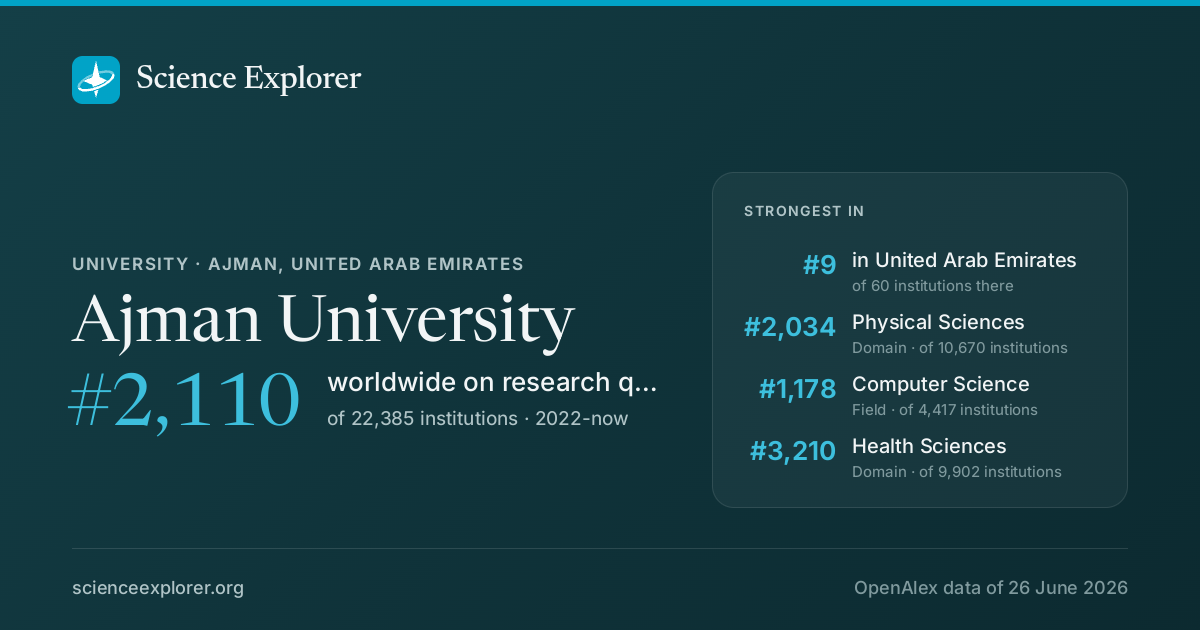
Ajman University on Science Explorer

A card with Ajman University's standing and the fields it leads in, for a post or a slide. A link to this page previews as the same card.

Download the card

1200 × 630 PNG, sized for social posts, drawn from the latest snapshot.

Badges for a website1Each links back here and updates with every snapshot

Research measures only: rankings here say nothing about teaching, admissions or student experience. Comparable institutions and collaboration partners have tabs of their own, above.

Discussion

Ask a question or share a note about Ajman University. Posts are plain text and can be reported.