 Science in Iran
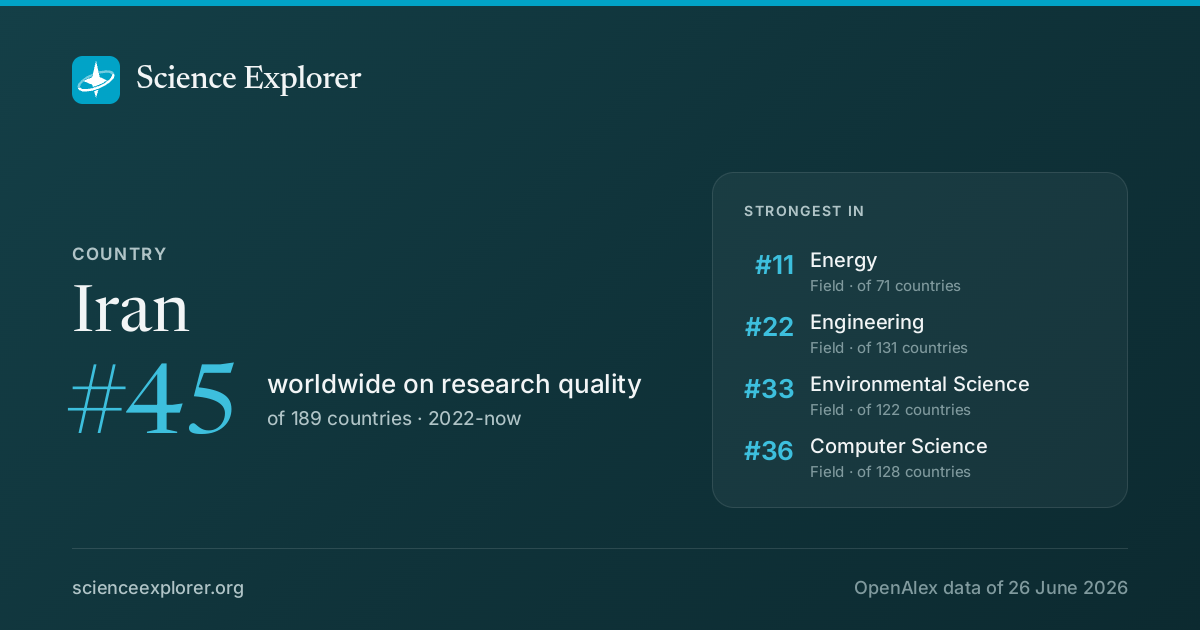
Iran ranks #45 of 189 countries on research quality in 2022-now (#43 all time), with 268k research works and 9.4% of them in the world's top 10%.
- World rank, 2022-now
- #45 of 189 · #43 all time
- Works, 2022-now
- 268k ▼ 17% vs 2018-21
- Citations
- 16.5M 14.5 per fractional work, all time
- Top-10% rate
- 9.4% all institutions 10.0%
- vs its own fields
- 0.85× 1.00× is exactly expected
- In the world top 100
- 0 1 in the top 1,000
- Open access
- 46% world 40%
- International
- 13% world 18%
IranWhat is Iran strongest at in science?
On research quality in 2022-now, Iran ranks highest in Energy (#11 of 71), Engineering (#22 of 131) and Environmental Science (#33 of 122). Relative to its size it is most specialised in Research and Theory, Molecular Medicine and Filtration and Separation.
| Field | World rank | Where that sits | Top-10% rate | Works | All time | Institutions |
|---|---|---|---|---|---|---|
| EnergyField | #11 of 71 | 10.3% | 3,777 | #9 | Institutions | |
| EngineeringField | #22 of 131 | 11.2% | 49,169 | #17 | Institutions | |
| Environmental ScienceField | #33 of 122 | 9.9% | 13,316 | #35 | Institutions | |
| Computer ScienceField | #36 of 128 | 11.6% | 12,631 | #35 | Institutions | |
| Electrical and Electronic EngineeringSubfield | #25 of 86 | 11.0% | 10,747 | #24 | Institutions | |
| Mechanical EngineeringSubfield | #24 of 74 | 12.0% | 6,873 | #18 | Institutions | |
| Agricultural and Biological SciencesField | #45 of 124 | 10.7% | 14,511 | #48 | Institutions | |
| Control and Systems EngineeringSubfield | #27 of 68 | 11.3% | 3,439 | #22 | Institutions | |
| Civil and Structural EngineeringSubfield | #29 of 71 | 11.0% | 5,809 | #28 | Institutions | |
| Renewable Energy, Sustainability and the EnvironmentSubfield | #27 of 66 | 9.9% | 3,263 | #25 | Institutions | |
| Biomedical EngineeringSubfield | #32 of 78 | 10.4% | 8,115 | #31 | Institutions | |
| Artificial IntelligenceSubfield | #36 of 87 | 11.2% | 4,315 | #34 | Institutions |
Where its research is concentrated
Location quotient: how much more (or less) of each node it does than its size predicts. Drawn around 1×, where "twice the world share" and "half of it" are the same distance apart in opposite directions. A volume reading, which on a country axis is largely population and industrial structure.
- Research and TheorySubfield · 281.6 works · #6 of 183 active here3.7×
- Molecular MedicineSubfield · 1,096.8 works · #4 of 200 active here3.4×
- Filtration and SeparationSubfield · 103.1 works · #5 of 134 active here3.2×
- Leadership and ManagementSubfield · 140.0 works · #8 of 135 active here3.1×
- BiomaterialsSubfield · 3,382.8 works · #4 of 199 active here2.7×
- Algebra and Number TheorySubfield · 484.7 works · #8 of 162 active here2.6×
- Oral SurgerySubfield · 1,378.8 works · #8 of 190 active here2.4×
- OrthodonticsSubfield · 799.8 works · #9 of 173 active here2.4×
The whole field profile
All 26 fields at once. A specialist and a generalist produce the same ranked list and a completely different shape.
Rings at 0.5×, 1× and 2×. Widest outward: Dentistry, 2.3×. Every wedge is a field page.
All 26 fields, with their numbers
- Dentistry2.32×3,309 works
- Chemistry1.84×8,491 works
- Nursing1.84×2,650 works
- Pharmacology, Toxicology and Pharmaceutics1.70×1,761 works
- Chemical Engineering1.57×1,614 works
- Energy1.54×4,164 works
- Materials Science1.54×16k works
- Psychology1.48×13k works
- Immunology and Microbiology1.30×3,865 works
- Mathematics1.30×4,515 works
- Engineering1.22×54k works
- Veterinary1.22×488 works
- Biochemistry, Genetics and Molecular Biology1.21×19k works
- Medicine1.16×66k works
- Agricultural and Biological Sciences1.14×16k works
- Neuroscience1.14×5,432 works
- Decision Sciences1.03×2,941 works
- Environmental Science1.01×15k works
- Health Professions0.99×7,704 works
- Physics and Astronomy0.84×5,492 works
- Earth and Planetary Sciences0.63×2,905 works
- Computer Science0.61×14k works
- Business, Management and Accounting0.61×5,795 works
- Economics, Econometrics and Finance0.52×3,270 works
- Arts and Humanities0.41×3,507 works
- Social Sciences0.38×14k works
Which fields of science does Iran work in?
In 2022-now, 43% of research in Iran is in Physical Sciences, 27% in Health Sciences. Its largest fields are Medicine (22%), Engineering (18%), Biochemistry, Genetics and Molecular Biology (6%).
Each ring splits the one inside it: the four domains of science, their fields, their subfields. Size is fractional works in 2022-now. Every slice is a page; the interactive view zooms down to single topics and colours each by how much more of it this country does than the world.
Its 4 domains and 26 fields, with their numbers
- Physical Sciences126k42.7%
- Engineering54k18.2%
- Materials Science16k5.4%
- Environmental Science15k5.0%
- Computer Science14k4.8%
- Chemistry8,4912.9%
- Physics and Astronomy5,4921.9%
- Mathematics4,5151.5%
- Energy4,1641.4%
- Earth and Planetary Sciences2,9051.0%
- Chemical Engineering1,6140.5%
- Health Sciences80k27.1%
- Medicine66k22.3%
- Health Professions7,7042.6%
- Dentistry3,3091.1%
- Nursing2,6500.9%
- Veterinary4880.2%
- Life Sciences46k15.6%
- Biochemistry, Genetics and Molecular Biology19k6.4%
- Agricultural and Biological Sciences16k5.4%
- Neuroscience5,4321.8%
- Immunology and Microbiology3,8651.3%
- Pharmacology, Toxicology and Pharmaceutics1,7610.6%
- Social Sciences43k14.6%
- Social Sciences14k4.8%
- Psychology13k4.5%
- Business, Management and Accounting5,7952.0%
- Arts and Humanities3,5071.2%
- Economics, Econometrics and Finance3,2701.1%
- Decision Sciences2,9411.0%
Which keywords describe research in Iran?
By fractional works in 2022-now, weighted toward what it does more of than the world: Epidemiology, Biomedical Applications, Inflammation, Nanoparticles, Depression, Nanomaterials, Oxidative Stress and Quality of Life.
- Job Stress
- Nursing
- Carbon Nanotubes
- Cancer Therapy
- Self-Efficacy
- Toxicity
- Pandemic
- Treatment
- Social Support
- Graphene
- Mechanical Properties
- Drug Delivery
- Antioxidant
- Cardiovascular Disease
- Climate Change
- Mental Health
- Cancer
- Oxidative Stress
- Biomedical Applications
- Inflammation
- Epidemiology
- Machine Learning
- Nanoparticles
- Quality of Life
- Deep Learning
- Depression
- Nanomaterials
- Environmental Impact
- Renewable Energy
- Nanocomposites
- Tissue Engineering
- COVID-19
- Metabolic Syndrome
- Catalysis
- Stress
- Obesity
- Antioxidant Activity
- Anxiety
- Elderly
- Educational Achievement
Size is fractional works in 2022-now in the topics tagged with each word; colour is the word's share of this country's work against its share of the world's. The 40 words are chosen for being large and distinctive. Each links to the topic it comes from most.
All 40 words, with their numbers
- Epidemiology15k▲ 1.26×139 topics
- Inflammation9,380▲ 1.50×83 topics
- Machine Learning7,841▼ 0.80×97 topics
- Biomedical Applications7,578▲ 2.2×36 topics
- Nanoparticles7,578▲ 2.0×44 topics
- Oxidative Stress7,558▲ 1.56×63 topics
- Quality of Life7,073▲ 1.66×61 topics
- Cancer6,841▲ 1.73×59 topics
- Deep Learning6,820▼ 0.67×85 topics
- Mental Health6,664▲ 1.58×48 topics
- Depression6,460▲ 2.5×26 topics
- Climate Change6,426▼ 0.80×128 topics
- Nanomaterials6,398▲ 2.1×21 topics
- Cardiovascular Disease5,268▲ 1.57×39 topics
- Environmental Impact5,204◆ 1.04×73 topics
- Antioxidant5,082▲ 2.5×51 topics
- Renewable Energy5,075▲ 1.19×61 topics
- Drug Delivery4,938▲ 3.1×16 topics
- Nanocomposites4,905▲ 2.1×22 topics
- Mechanical Properties4,612▲ 1.60×39 topics
- Tissue Engineering4,586▲ 2.6×13 topics
- Graphene4,490▲ 2.3×12 topics
- COVID-194,287◆ 1.12×34 topics
- Social Support4,224▲ 2.7×20 topics
- Metabolic Syndrome4,106▲ 1.72×24 topics
- Treatment3,983◆ 1.11×52 topics
- Catalysis3,957▲ 2.0×29 topics
- Pandemic3,667▲ 1.26×14 topics
- Stress3,476▲ 3.2×11 topics
- Toxicity3,284▲ 2.6×20 topics
- Obesity3,279▲ 1.45×29 topics
- Self-Efficacy3,248▲ 4.2×11 topics
- Antioxidant Activity3,120▲ 1.70×32 topics
- Cancer Therapy3,095▲ 1.85×20 topics
- Anxiety2,756▲ 1.97×12 topics
- Carbon Nanotubes2,542▲ 2.6×9 topics
- Elderly2,301▲ 3.2×8 topics
- Nursing2,113▲ 3.8×8 topics
- Educational Achievement1,862▲ 11×1 topic
- Job Stress1,862▲ 11×1 topic
Which research topics does Iran publish the most in?
Its largest topics in 2022-now are Health and Well-being Studies, COVID-19 and Mental Health, Advanced Photocatalysis Techniques.
Area is fractional works in 2022-now; colour is the subfield each topic belongs to. Every tile is a topic page.
- 1 Health and Well-being Studies Clinical Psychology 1.9k works
- 2 COVID-19 and Mental Health Clinical Psychology 1k works
- 3 Advanced Photocatalysis Techniques Renewable Energy, Sustainability and the Environment 968 works
- 4 COVID-19 Clinical Research Studies Infectious Diseases 914 works
- 5 Electrospun Nanofibers in Biomedical Applications Biomaterials 848 works
- 6 Graphene and Nanomaterials Applications Biomedical Engineering 771 works
- 7 MicroRNA in disease regulation Cancer Research 761 works
- 8 Electrochemical sensors and biosensors Electrical and Electronic Engineering 745 works
- 9 Nanoparticle-Based Drug Delivery Biomaterials 737 works
- 10 Advanced biosensing and bioanalysis techniques Molecular Biology 734 works
- 11 Nanomaterials for catalytic reactions Organic Chemistry 717 works
- 12 Adsorption and biosorption for pollutant removal Water Science and Technology 712 works
How many world-class institutions does Iran hold?
Average quality and elite capacity disagree by construction, and both are worth knowing: the first is decided by a country's whole institution population, the second counts the institutions it holds at the top. One square per institution.
| Standing among countries | 2022-now | Where that sits | All time |
|---|---|---|---|
| Average qualityits whole institution population | #45 of 189 | #43 of 203 | |
| Elite capacitythe institutions it holds at the top | #45 of 204 | #49 of 216 |
Elite capacity counts a country's institutions by their worldwide rank, weighted so a place at #1 counts for more than one at #480. Countries under 100 fractional works are left out.
Bands are exclusive, so the squares add up to 1 (the institutions it holds in the world top 1,000), not to four times it.
Which universities in Iran lead research?
University of Tehran, Sharif University of Technology and Tarbiat Modares University rank highest in Iran on research quality in 2022-now.
One dot per institution in the list below. The upper left is the interesting corner.
- 1University of TehranUniversity · Tehran · #884 worldwide11.7% top 10% · 12k works
- 2Sharif University of TechnologyUniversity · Tehran · #1,759 worldwide11.0% top 10% · 4.2k works
- 3Tarbiat Modares UniversityUniversity · Tehran · #2,123 worldwide10.3% top 10% · 6k works
- 4Shahid Beheshti UniversityUniversity · Tehran · #2,419 worldwide9.6% top 10% · 4.9k works
- 5Iran University of Science and TechnologyUniversity · Tehran · #2,456 worldwide13.9% top 10% · 5.6k works
- 6Amirkabir University of TechnologyUniversity · Tehran · #2,845 worldwide11.7% top 10% · 5.2k works
- 7Institute for Research in Fundamental SciencesResearch facility · Tehran · #3,145 worldwide9.2% top 10% · 738 works
- 8Iranshahr UniversityUniversity · Iranshahr · #3,692 worldwide12.2% top 10% · 1.7k works
- 9Kharazmi UniversityUniversity · Tehran · #3,699 worldwide9.6% top 10% · 1.9k works
- 10Allameh Tabataba'i UniversityUniversity · Tehran · #3,708 worldwide7.4% top 10% · 1.4k works
- 11Ilam UniversityUniversity · Īlām · #3,715 worldwide14.6% top 10% · 1k works
- 12K.N.Toosi University of TechnologyUniversity · Tehran · #3,720 worldwide10.7% top 10% · 2.6k works
- 13University of TabrizUniversity · Tabriz · #3,751 worldwide10.7% top 10% · 4.9k works
- 14Ferdowsi University of MashhadUniversity · Mashhad · #3,833 worldwide9.7% top 10% · 4.5k works
- 15University of Science and CultureUniversity · Tehran · #4,134 worldwide6.9% top 10% · 840 works


The track on each row is its top-10% rate; the tick is the average of all institutions, 10.0% (how it is set): teal above it, red below.
All ranked institutions in IranWho are the top researchers in Iran?
Ali Derakhshan, Jalal Arabloo and Sadaf Ghajarieh Sepanlou rank highest among researchers based in Iran.
- 1 Ali Derakhshan #555 worldwide 12k citations · 318 works
- 2 Jalal Arabloo #591 worldwide 173k citations · 286 works
- 3 Sadaf Ghajarieh Sepanlou #1,137 worldwide 282k citations · 280 works
- 4 Mortaza Aghbashlo #1,278 worldwide 27k citations · 380 works
- 5 Nima Jafari Navimipour #1,362 worldwide 14k citations · 246 works
- 6 Ahmad Rezaee Jordehi #2,744 worldwide 9.7k citations · 138 works
- 7 Rauf Foroutan #3,059 worldwide 9.7k citations · 112 works
- 8 Meisam Tabatabaei #3,209 worldwide 44k citations · 502 works
- 9 Masoud Afrand #3,306 worldwide 26k citations · 322 works
- 10 Sasan Pirouzi #3,395 worldwide 5.7k citations · 78 works
Which cities in Iran are research hubs?
- 1
TehranIran
503k works
- 2
IsfahanIran
65k works
- 3
TabrizIran
57k works
- 4
ShirazIran
53k works
- 5
MashhadIran
49k works
- 6
KermanIran
23k works
- 7
AhvāzIran
20k works
- 8
HamadanIran
19k works
- 9
RashtIran
19k works
- 10
KermanshahIran
18k works
How much of it is in the largest
The same cities as shares of everything these twelve account for.
Shares of the rows listed above, not of the whole node.
How open and international is Iran's research?
46% of its research is openly available (world: 40%), and 13% is written with international co-authors (world: 18%).
World: 40% of research is openly available.
World: 18% is written across borders.
In 2022-now, 58% of its research is openly available (world 63%) and 19% is written with co-authors abroad (world 22%). Against what its own mix of topics predicts, that is 0.97× the expected open access and 0.80× the expected international share, which puts it #166 of 173 countries on openness.
How has Iran's research grown?
Output in 2022-2025 was 17% lower than in 2018-2021.
The same series as a ribbon: one cell per year, darker for more. The line above answers how much; this answers when.
Its share of all research
Growing output can still be a shrinking share: all of science grows. This is Iran as a percentage of every work published that year, 1.2% in 2024.
Fractional works of Iran over all fractional works that year. How the balance of science has shifted.
How much of it reaches the world top 10%
Over the whole record, 8.1% of its 1.1M works since 1950 reached the world top 10% for their field and year.
Of each year's output, the share that reached the world's 10% most cited for its field and year. Peak 9.9% in 2025.
Which countries have research most like Iran's?
Egypt is Iran's closest research twin: of all countries, its research is spread across the fields most like Iran's, with both strong in Dentistry.
- 1
 EgyptBoth strong in Dentistry, Chemistry, Nursing
0.82 Compare
- 2
 South KoreaBoth strong in Chemical Engineering, Materials Science, Nursing
0.79 Compare
- 3
 Saudi ArabiaBoth strong in Dentistry, Chemistry, Pharmacology, Toxicology and Pharmaceutics
0.78 Compare
- 4
 IndiaBoth strong in Dentistry, Chemistry, Pharmacology, Toxicology and Pharmaceutics
0.70 Compare
- 5
 JapanBoth strong in Chemistry, Materials Science, Pharmacology, Toxicology and Pharmaceutics
0.65 Compare
Similarity is the correlation of each side's location quotients across every field it publishes in, on a log scale: 1 is the same shape of research, 0 is unrelated. It ignores size. How it is measured.
Compare Iran with
 Estonia
 Qatar
 Türkiye
 Uganda
 Mexico
 Cyprus
Share Iran's ranking



Research fields in Iran
- Energy
- Engineering
- Physical Sciences
- Environmental Science
- Computer Science
- Electrical and Electronic Engineering
- Mechanical Engineering
- Agricultural and Biological Sciences
- Control and Systems Engineering
- Civil and Structural Engineering
- Renewable Energy, Sustainability and the Environment
- Biomedical Engineering
- Artificial Intelligence
- Materials Science
- Chemistry
- Life Sciences
- Social Sciences
- Energy Engineering and Power Technology
- Health Sciences
- Medicine
- Health Professions
- Mechanics of Materials
- Organic Chemistry
- Environmental Engineering
- Surgery
- Materials Chemistry
- Earth and Planetary Sciences
- Building and Construction
- Water Science and Technology
- Plant Science
- Social Sciences
- Business, Management and Accounting
- Ocean Engineering
- Biochemistry, Genetics and Molecular Biology
- Global and Planetary Change
- Computational Mechanics
- Physics and Astronomy
- Health, Toxicology and Mutagenesis
- Computer Networks and Communications
- Mathematics
- Psychology
- Pollution
- Analytical Chemistry
- Dentistry
- Public Health, Environmental and Occupational Health
- Food Science
- Cardiology and Cardiovascular Medicine
- Automotive Engineering
- Neuroscience
- Aerospace Engineering
- Endocrinology, Diabetes and Metabolism
- Pulmonary and Respiratory Medicine
- Chemical Engineering
- Clinical Psychology
- Biomaterials
- Pharmacology, Toxicology and Pharmaceutics
- Oncology
- Decision Sciences
- General Health Professions
- Sociology and Political Science
Questions people ask
What is Iran strongest at in science?
On research quality in 2022-now, Iran ranks highest in Energy (#11 of 71), Engineering (#22 of 131) and Environmental Science (#33 of 122). Relative to its size it is most specialised in Research and Theory, Molecular Medicine and Filtration and Separation.
See the full answerHow fast is research in Iran growing?
Output in 2022-2025 was 17% lower than in 2018-2021.
How has Iran's research grown?Who are the top scientists in Iran?
Ali Derakhshan, Jalal Arabloo and Sadaf Ghajarieh Sepanlou rank highest among researchers based in Iran.
Who are the top researchers in Iran?Discussion
Ask a question or share a note about Iran. Keep it to the research: no personal attacks, advertising or links. Any reader can report a post, which collapses it for everyone until it is opened.