Science Explorer Back to mapMap
University · Leuven · Belgium

KU Leuven

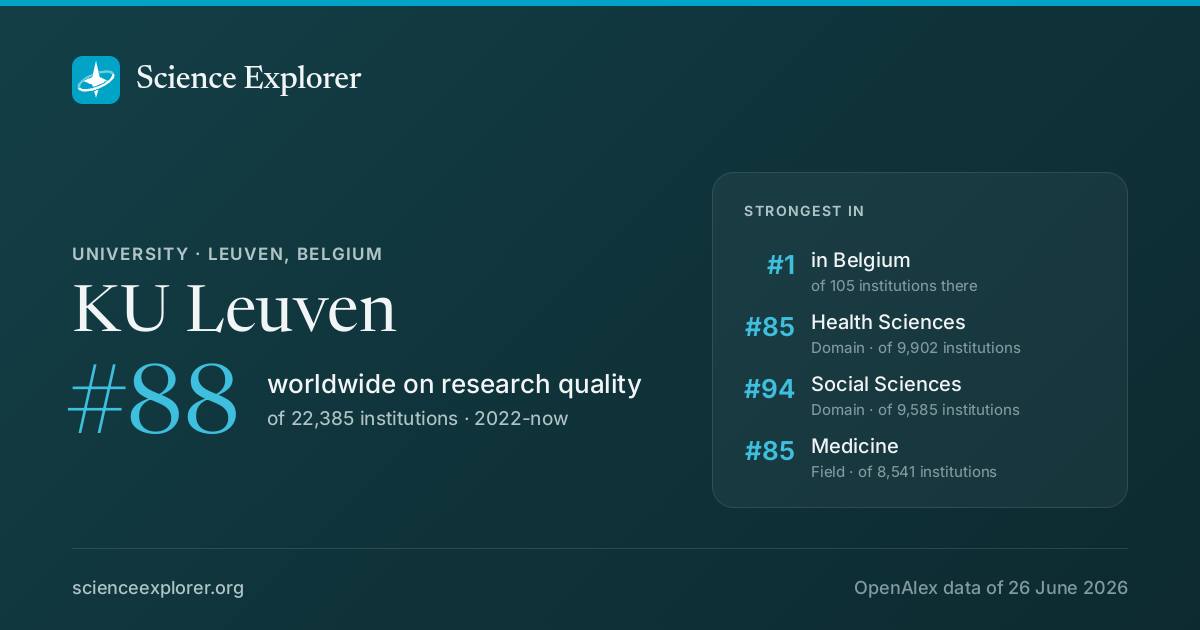
In research, KU Leuven stands highest in Health Sciences (#85 of 9,902 worldwide), Social Sciences (#94 of 9,585 worldwide) and Medicine (#85 of 8,541 worldwide), 2022-now. Relative to its size it is most specialised in Transplantation, Classics and Public Administration (Transplantation is 3.5× its share of world research).

World rank, 2022-now
#88
of 22,385 · #77 all time
Rank in Belgium
#1
of 105
Research works
156k
▼ 21% vs 2018-21
Citations
4.6M
29.7 per fractional work
Top-10% rate
12.9%
all institutions 10.0%
vs its own fields
1.27×
1.00× is exactly expected
Open access
42%
world 40%
International
29%
world 18%

What is KU Leuven known for in research?

The fields where it stands highest, 2022-now, ranked among every institution above the floor in each field.

FieldWorld rankWhere that sitsTop-10% rateWorksAll time
Health SciencesDomain #85 of 9,902 15.6%5,272 #79
Social SciencesDomain #94 of 9,585 13.6%4,731 #61
MedicineField #85 of 8,541 15.3%4,599 #77
Life SciencesDomain #89 of 6,403 13.5%2,696 #72
Social SciencesField #106 of 5,988 13.6%1,987 #71
Physical SciencesDomain #204 of 10,670 10.9%7,268 #174
EngineeringField #134 of 5,901 10.9%3,031 #104
Agricultural and Biological SciencesField #99 of 3,157 14.9%540 #67
Computer ScienceField #153 of 4,417 10.2%1,488 #128
Biochemistry, Genetics and Molecular BiologyField #103 of 2,964 13.8%1,217 #91

Each strip is that field's whole ranked pool, with the notch where KU Leuven sits in it, in the colour of the band that rank falls in. The track under the rate is the rate itself: it carries no average mark, because the average differs by field (from about 6% in Dentistry to 21% in Economics).

Which of those standings moved

The same fields on both windows: where it stood over the whole record, and where it stands in 2022-now. The distance is the story, and it is the one thing the two rank columns above cannot show.

  1. Health Sciences#79 #85
  2. Social Sciences#61 #94
  3. Medicine#77 #85
  4. Life Sciences#72 #89
  5. Social Sciences#71 #106
  6. Physical Sciences#174 #204
  7. Engineering#104 #134
  8. Agricultural and Biological Sciences#67 #99
  9. Computer Science#128 #153
  10. Biochemistry, Genetics and Molecular Biology#91 #103
all time2022-now, better2022-now, worse

A dot further right is a better standing. Fields it was not ranked in over the whole record are left out.

Which fields of science does KU Leuven work in?

In 2022-now, 36% of research at KU Leuven is in Physical Sciences, 26% in Health Sciences. Its largest fields are Medicine (23%), Engineering (15%), Social Sciences (10%).

Physical Sciences: 8,073 fractional works · 36.0% of its workEngineering: 3,320 fractional works · 14.8% of its workElectrical and Electronic Engineering: 946 fractional works · 4.2% of its workBiomedical Engineering: 604 fractional works · 2.7% of its workMechanical Engineering: 390 fractional works · 1.7% of its workCivil and Structural Engineering: 217 fractional works · 1.0% of its workControl and Systems Engineering: 212 fractional works · 0.9% of its workBuilding and Construction: 163 fractional works · 0.7% of its workAerospace Engineering: 161 fractional works · 0.7% of its workMechanics of Materials: 144 fractional works · 0.6% of its workComputational Mechanics: 124 fractional works · 0.6% of its workIndustrial and Manufacturing Engineering: 109 fractional works · 0.5% of its workAutomotive Engineering: 99 fractional works · 0.4% of its workOcean Engineering: 55 fractional works · 0.2% of its workMedia Technology: 47 fractional works · 0.2% of its workSmaller subfields together: 49 fractional works · 0.2% of its workComputer Science: 1,687 fractional works · 7.5% of its workArtificial Intelligence: 646 fractional works · 2.9% of its workComputer Vision and Pattern Recognition: 252 fractional works · 1.1% of its workInformation Systems: 183 fractional works · 0.8% of its workComputer Networks and Communications: 152 fractional works · 0.7% of its workComputational Theory and Mathematics: 131 fractional works · 0.6% of its workSignal Processing: 111 fractional works · 0.5% of its workHardware and Architecture: 73 fractional works · 0.3% of its workHuman-Computer Interaction: 67 fractional works · 0.3% of its workSmaller subfields together: 72 fractional works · 0.3% of its workEnvironmental Science: 755 fractional works · 3.4% of its workEnvironmental Engineering: 125 fractional works · 0.6% of its workEcology: 121 fractional works · 0.5% of its workGlobal and Planetary Change: 105 fractional works · 0.5% of its workWater Science and Technology: 86 fractional works · 0.4% of its workHealth, Toxicology and Mutagenesis: 80 fractional works · 0.4% of its workManagement, Monitoring, Policy and Law: 55 fractional works · 0.2% of its workIndustrial and Manufacturing Engineering: 52 fractional works · 0.2% of its workPollution: 47 fractional works · 0.2% of its workSmaller subfields together: 85 fractional works · 0.4% of its workPhysics and Astronomy: 635 fractional works · 2.8% of its workAstronomy and Astrophysics: 232 fractional works · 1.0% of its workAtomic and Molecular Physics, and Optics: 162 fractional works · 0.7% of its workNuclear and High Energy Physics: 74 fractional works · 0.3% of its workStatistical and Nonlinear Physics: 70 fractional works · 0.3% of its workRadiation: 49 fractional works · 0.2% of its workSmaller subfields together: 48 fractional works · 0.2% of its workMaterials Science: 558 fractional works · 2.5% of its workMaterials Chemistry: 318 fractional works · 1.4% of its workBiomaterials: 70 fractional works · 0.3% of its workElectronic, Optical and Magnetic Materials: 63 fractional works · 0.3% of its workPolymers and Plastics: 63 fractional works · 0.3% of its workSmaller subfields together: 45 fractional works · 0.2% of its workMathematics: 371 fractional works · 1.7% of its workStatistics and Probability: 113 fractional works · 0.5% of its workGeometry and Topology: 52 fractional works · 0.2% of its workMathematical Physics: 48 fractional works · 0.2% of its workSmaller subfields together: 158 fractional works · 0.7% of its workChemistry: 367 fractional works · 1.6% of its workOrganic Chemistry: 170 fractional works · 0.8% of its workInorganic Chemistry: 72 fractional works · 0.3% of its workSpectroscopy: 61 fractional works · 0.3% of its workSmaller subfields together: 64 fractional works · 0.3% of its workEarth and Planetary Sciences: 183 fractional works · 0.8% of its workAtmospheric Science: 52 fractional works · 0.2% of its workSmaller subfields together: 131 fractional works · 0.6% of its workEnergy: 118 fractional works · 0.5% of its workRenewable Energy, Sustainability and the Environment: 102 fractional works · 0.5% of its workSmaller subfields together: 17 fractional works · 0.1% of its workChemical Engineering: 78 fractional works · 0.3% of its workHealth Sciences: 5,912 fractional works · 26.4% of its workMedicine: 5,170 fractional works · 23.1% of its workSurgery: 708 fractional works · 3.2% of its workPulmonary and Respiratory Medicine: 501 fractional works · 2.2% of its workCardiology and Cardiovascular Medicine: 370 fractional works · 1.7% of its workEpidemiology: 350 fractional works · 1.6% of its workOncology: 308 fractional works · 1.4% of its workRadiology, Nuclear Medicine and Imaging: 266 fractional works · 1.2% of its workPublic Health, Environmental and Occupational Health: 265 fractional works · 1.2% of its workPhysiology: 247 fractional works · 1.1% of its workInfectious Diseases: 200 fractional works · 0.9% of its workPsychiatry and Mental health: 180 fractional works · 0.8% of its workPediatrics, Perinatology and Child Health: 169 fractional works · 0.8% of its workNeurology: 154 fractional works · 0.7% of its workRheumatology: 152 fractional works · 0.7% of its workPathology and Forensic Medicine: 113 fractional works · 0.5% of its workGenetics: 90 fractional works · 0.4% of its workEndocrinology, Diabetes and Metabolism: 83 fractional works · 0.4% of its workOrthopedics and Sports Medicine: 81 fractional works · 0.4% of its workPharmacology: 76 fractional works · 0.3% of its workHematology: 73 fractional works · 0.3% of its workGastroenterology: 73 fractional works · 0.3% of its workObstetrics and Gynecology: 59 fractional works · 0.3% of its workOphthalmology: 58 fractional works · 0.3% of its workNephrology: 53 fractional works · 0.2% of its workReproductive Medicine: 52 fractional works · 0.2% of its workHepatology: 50 fractional works · 0.2% of its workSmaller subfields together: 439 fractional works · 2.0% of its workHealth Professions: 455 fractional works · 2.0% of its workGeneral Health Professions: 249 fractional works · 1.1% of its workSpeech and Hearing: 47 fractional works · 0.2% of its workSmaller subfields together: 159 fractional works · 0.7% of its workNursing: 131 fractional works · 0.6% of its workNutrition and Dietetics: 122 fractional works · 0.5% of its workSmaller subfields together: 8 fractional works · 0.0% of its workDentistry: 125 fractional works · 0.6% of its workOral Surgery: 63 fractional works · 0.3% of its workSmaller subfields together: 62 fractional works · 0.3% of its workVeterinary: 31 fractional works · 0.1% of its workSocial Sciences: 5,356 fractional works · 23.9% of its workSocial Sciences: 2,275 fractional works · 10.2% of its workSociology and Political Science: 748 fractional works · 3.3% of its workPolitical Science and International Relations: 420 fractional works · 1.9% of its workEducation: 289 fractional works · 1.3% of its workLaw: 99 fractional works · 0.4% of its workAnthropology: 86 fractional works · 0.4% of its workGender Studies: 85 fractional works · 0.4% of its workSafety Research: 77 fractional works · 0.3% of its workCommunication: 74 fractional works · 0.3% of its workDemography: 64 fractional works · 0.3% of its workCultural Studies: 55 fractional works · 0.2% of its workUrban Studies: 51 fractional works · 0.2% of its workHealth: 46 fractional works · 0.2% of its workSmaller subfields together: 183 fractional works · 0.8% of its workArts and Humanities: 1,057 fractional works · 4.7% of its workPhilosophy: 221 fractional works · 1.0% of its workLanguage and Linguistics: 177 fractional works · 0.8% of its workHistory: 137 fractional works · 0.6% of its workLiterature and Literary Theory: 127 fractional works · 0.6% of its workArcheology: 99 fractional works · 0.4% of its workHistory and Philosophy of Science: 75 fractional works · 0.3% of its workReligious studies: 62 fractional works · 0.3% of its workVisual Arts and Performing Arts: 48 fractional works · 0.2% of its workSmaller subfields together: 112 fractional works · 0.5% of its workPsychology: 933 fractional works · 4.2% of its workClinical Psychology: 259 fractional works · 1.2% of its workSocial Psychology: 257 fractional works · 1.1% of its workExperimental and Cognitive Psychology: 220 fractional works · 1.0% of its workDevelopmental and Educational Psychology: 133 fractional works · 0.6% of its workApplied Psychology: 55 fractional works · 0.2% of its workSmaller subfields together: 9 fractional works · 0.0% of its workEconomics, Econometrics and Finance: 436 fractional works · 1.9% of its workEconomics and Econometrics: 298 fractional works · 1.3% of its workFinance: 100 fractional works · 0.4% of its workSmaller subfields together: 39 fractional works · 0.2% of its workBusiness, Management and Accounting: 423 fractional works · 1.9% of its workStrategy and Management: 112 fractional works · 0.5% of its workAccounting: 65 fractional works · 0.3% of its workOrganizational Behavior and Human Resource Management: 63 fractional works · 0.3% of its workMarketing: 61 fractional works · 0.3% of its workManagement Information Systems: 61 fractional works · 0.3% of its workSmaller subfields together: 61 fractional works · 0.3% of its workDecision Sciences: 232 fractional works · 1.0% of its workManagement Science and Operations Research: 97 fractional works · 0.4% of its workInformation Systems and Management: 64 fractional works · 0.3% of its workStatistics, Probability and Uncertainty: 60 fractional works · 0.3% of its workSmaller subfields together: 11 fractional works · 0.0% of its workLife Sciences: 3,060 fractional works · 13.7% of its workBiochemistry, Genetics and Molecular Biology: 1,383 fractional works · 6.2% of its workMolecular Biology: 754 fractional works · 3.4% of its workGenetics: 279 fractional works · 1.2% of its workCancer Research: 103 fractional works · 0.5% of its workCell Biology: 79 fractional works · 0.4% of its workSmaller subfields together: 167 fractional works · 0.7% of its workNeuroscience: 745 fractional works · 3.3% of its workCognitive Neuroscience: 447 fractional works · 2.0% of its workCellular and Molecular Neuroscience: 113 fractional works · 0.5% of its workNeurology: 71 fractional works · 0.3% of its workSmaller subfields together: 115 fractional works · 0.5% of its workAgricultural and Biological Sciences: 602 fractional works · 2.7% of its workPlant Science: 222 fractional works · 1.0% of its workFood Science: 131 fractional works · 0.6% of its workEcology, Evolution, Behavior and Systematics: 56 fractional works · 0.2% of its workAnimal Science and Zoology: 50 fractional works · 0.2% of its workInsect Science: 49 fractional works · 0.2% of its workSmaller subfields together: 94 fractional works · 0.4% of its workImmunology and Microbiology: 277 fractional works · 1.2% of its workImmunology: 205 fractional works · 0.9% of its workSmaller subfields together: 71 fractional works · 0.3% of its workPharmacology, Toxicology and Pharmaceutics: 54 fractional works · 0.2% of its workALL ITS WORKKU Leuven22kfractional works, 2022-now
Life Sciences14%Physical Sciences36%Health Sciences26%Social Sciences24%

Each ring splits the one inside it: the four domains of science, their fields, their subfields. Size is fractional works in 2022-now. Every slice is a page; the interactive view zooms down to single topics and colours each by how much more of it this institution does than the world.

Its 4 domains and 26 fields, with their numbers
    1. Engineering3,32014.8%
    2. Computer Science1,6877.5%
    3. Environmental Science7553.4%
    4. Physics and Astronomy6352.8%
    5. Materials Science5582.5%
    6. Mathematics3711.7%
    7. Chemistry3671.6%
    8. Earth and Planetary Sciences1830.8%
    9. Energy1180.5%
    10. Chemical Engineering780.3%
  1. Health Sciences5,91226.4%
    1. Medicine5,17023.1%
    2. Health Professions4552.0%
    3. Nursing1310.6%
    4. Dentistry1250.6%
    5. Veterinary310.1%
  2. Social Sciences5,35623.9%
    1. Social Sciences2,27510.2%
    2. Arts and Humanities1,0574.7%
    3. Psychology9334.2%
    4. Economics, Econometrics and Finance4361.9%
    5. Business, Management and Accounting4231.9%
    6. Decision Sciences2321.0%
  3. Life Sciences3,06013.7%
    1. Biochemistry, Genetics and Molecular Biology1,3836.2%
    2. Neuroscience7453.3%
    3. Agricultural and Biological Sciences6022.7%
    4. Immunology and Microbiology2771.2%
    5. Pharmacology, Toxicology and Pharmaceutics540.2%
All of science, and how each field's share has moved since 1950: the Science domain explorer

What does KU Leuven specialise in?

Where its research is concentrated relative to its size: Transplantation takes 3.5× the share of its output that it takes of world research.

  1. TransplantationSubfield · 34.5 works3.5×
  2. ClassicsSubfield · 40.8 works3.1×
  3. Public AdministrationSubfield · 35.0 works2.9×
  4. Hardware and ArchitectureSubfield · 72.9 works2.9×
  5. GastroenterologySubfield · 72.6 works2.8×
← less than its size predicts1×more →

Location quotient, a volume reading rather than an impact one. It surfaces small, lopsided specialities.

Field profile

Location quotient across every field it publishes in: outside the ring is more than an institution of this size would be expected to publish, inside it is less.

Agricultural and Biological Sciences: 0.57× its world share, 602 worksAgricultural and Bio…Biochemistry, Genetics and Molecular Biology: 1.16× its world share, 1,383 worksBiochemistry, Geneti…Immunology and Microbiology: 1.23× its world share, 277 worksImmunology and Micro…Neuroscience: 2.05× its world share, 745 worksNeurosciencePharmacology, Toxicology and Pharmaceutics: 0.68× its world share, 54 worksPharmacology, Toxico…Chemical Engineering: 1.00× its world share, 78 worksChemical EngineeringChemistry: 1.04× its world share, 367 worksChemistryComputer Science: 0.97× its world share, 1,687 worksComputer ScienceEarth and Planetary Sciences: 0.52× its world share, 183 worksEarth and Planetary …Energy: 0.57× its world share, 118 worksEnergyEngineering: 0.99× its world share, 3,320 worksEngineeringEnvironmental Science: 0.68× its world share, 755 worksEnvironmental ScienceMaterials Science: 0.71× its world share, 558 worksMaterials ScienceMathematics: 1.41× its world share, 371 worksMathematicsPhysics and Astronomy: 1.28× its world share, 635 worksPhysics and AstronomyDentistry: 1.15× its world share, 125 worksDentistryHealth Professions: 0.77× its world share, 455 worksHealth ProfessionsMedicine: 1.20× its world share, 5,170 worksMedicineNursing: 1.19× its world share, 131 worksNursingVeterinary: 1.01× its world share, 31 worksVeterinaryArts and Humanities: 1.63× its world share, 1,057 worksArts and HumanitiesBusiness, Management and Accounting: 0.59× its world share, 423 worksBusiness, Management…Decision Sciences: 1.07× its world share, 232 worksDecision SciencesEconomics, Econometrics and Finance: 0.91× its world share, 436 worksEconomics, Econometr…Psychology: 1.37× its world share, 933 worksPsychologySocial Sciences: 0.80× its world share, 2,275 worksSocial Sciences1×world share
more than its size predictsabout as predictedless

Rings at 0.5×, 1× and 2×. Widest outward: Neuroscience, 2.0×. Every wedge is a field page.

All 26 fields, with their numbers
  1. Neuroscience2.05×745 works
  2. Arts and Humanities1.63×1,057 works
  3. Mathematics1.41×371 works
  4. Psychology1.37×933 works
  5. Physics and Astronomy1.28×635 works
  6. Immunology and Microbiology1.23×277 works
  7. Medicine1.20×5,170 works
  8. Nursing1.19×131 works
  9. Biochemistry, Genetics and Molecular Biology1.16×1,383 works
  10. Dentistry1.15×125 works
  11. Decision Sciences1.07×232 works
  12. Chemistry1.04×367 works
  13. Veterinary1.01×31 works
  14. Chemical Engineering1.00×78 works
  15. Engineering0.99×3,320 works
  16. Computer Science0.97×1,687 works
  17. Economics, Econometrics and Finance0.91×436 works
  18. Social Sciences0.80×2,275 works
  19. Health Professions0.77×455 works
  20. Materials Science0.71×558 works
  21. Pharmacology, Toxicology and Pharmaceutics0.68×54 works
  22. Environmental Science0.68×755 works
  23. Business, Management and Accounting0.59×423 works
  24. Agricultural and Biological Sciences0.57×602 works
  25. Energy0.57×118 works
  26. Earth and Planetary Sciences0.52×183 works

Who are the top researchers at KU Leuven?

Ranked on the quality score, Jeroen Raes, Bart De Strooper and Peter Carmeliet lead among researchers whose main affiliation is KU Leuven.

  1. 1 Jeroen Raes Belgium · #1,855 worldwide 126k citations · 470 works
  2. 2 Bart De Strooper Belgium · #10,413 worldwide 80k citations · 700 works
  3. 3 Peter Carmeliet Belgium · #11,059 worldwide 164k citations · 1,354 works
  4. 4 Feili Lai Belgium · #11,532 worldwide 14k citations · 189 works
  5. 5 Gwen Falony Belgium · #11,635 worldwide 39k citations · 171 works
  6. 6 Bart Van der Bruggen Belgium · #12,582 worldwide 40k citations · 659 works
  7. 7 Eric Van Cutsem Belgium · #13,134 worldwide 179k citations · 1,835 works
  8. 8 Johannes V. Swinnen Belgium · #13,538 worldwide 22k citations · 632 works
  9. 9 Sara Vieira‐Silva Belgium · #15,657 worldwide 30k citations · 130 works
  10. 10 Abhishek Dinkarnath Garg Belgium · #15,779 worldwide 41k citations · 355 works
All ranked researchers at KU Leuven

What are the most cited papers from KU Leuven?

The most cited paper from KU Leuven is "The Pascal Visual Object Classes (VOC) Challenge" (Mark Everingham, Luc Van Gool, Christopher K. I. Williams et al., 2009), with 20,137 citations. Next come "Conducting Meta-Analyses in R with the metafor Package" (19,468) and "Recommendations for Cardiac Chamber Quantification by Echocardiography in Adults: An Update from the American Society of Echocardiography and the European Association of Cardiovascular Imaging" (18,398).

Most cited papers
#PaperReleasedCitations
1 The Pascal Visual Object Classes (VOC) Challenge Mark Everingham, Luc Van Gool, Christopher K. I. Williams et al. · International Journal of Computer Vision Open access 8 Sep 2009 20,137
2 Conducting Meta-Analyses in R with the metafor Package Wolfgang Viechtbauer · Journal of Statistical Software Open access 2010 19,468
3 Recommendations for Cardiac Chamber Quantification by Echocardiography in Adults: An Update from the American Society of Echocardiography and the European Association of Cardiovascular Imaging Roberto Miguel Lang, Luigi Paolo Badano, Victor Mor‐Avi et al. · Journal of the American Society of Echocardiography Open access 2015 18,398
4 SURF: Speeded Up Robust Features Herbert Bay, Tinne Tuytelaars, Luc Van Gool · Lecture notes in computer science Conference paperOpen access 2006 14,761
5 2013 ESH/ESC Guidelines for the management of arterial hypertension Authors Task Force Members et al. · European Heart Journal Open access108 authors 14 Jun 2013 13,694
All 60 most cited papers, with filters and sorting

Which keywords describe research at KU Leuven?

By fractional works in 2022-now, weighted toward what it does more of than the world: Epidemiology, Inflammation, Deep Learning, Machine Learning, Globalization, Quality of Life, Genetics and Treatment.

▲ more of its work than of the world's◆ about the world's share▼ less than the world's

Size is fractional works in 2022-now in the topics tagged with each word; colour is the word's share of this institution's work against its share of the world's. The 40 words are chosen for being large and distinctive. Each links to the topic it comes from most.

All 40 words, with their numbers
  1. Epidemiology999◆ 1.12×132 topics
  2. Deep Learning644▼ 0.83×77 topics
  3. Machine Learning596▼ 0.80×87 topics
  4. Inflammation554▲ 1.16×83 topics
  5. Globalization467◆ 1.06×141 topics
  6. Climate Change404▼ 0.66×10⁸ topics
  7. Quality of Life374▲ 1.16×57 topics
  8. Sustainability362▼ 0.66×10⁵ topics
  9. Neural Networks314◆ 0.91×40 topics
  10. Oxidative Stress312▼ 0.85×60 topics
  11. Treatment297◆ 1.09×52 topics
  12. Environmental Impact285▼ 0.75×58 topics
  13. Mental Health271▼ 0.85×46 topics
  14. Cancer269◆ 0.89×58 topics
  15. Genetics262▲ 1.65×27 topics
  16. Diagnosis240◆ 1.15×40 topics
  17. Cardiovascular Disease236◆ 0.93×38 topics
  18. Human Rights229◆ 1.00×77 topics
  19. Management216▲ 1.21×37 topics
  20. Depression206◆ 1.05×26 topics
  21. Ethics203▲ 1.79×55 topics
  22. Energy Efficiency199◆ 0.96×39 topics
  23. Religion198▲ 1.91×42 topics
  24. Chemotherapy195▲ 1.23×25 topics
  25. Neurological Disorders195▲ 1.52×20 topics
  26. Identity182◆ 1.12×67 topics
  27. Clinical Trials181▲ 1.21×19 topics
  28. History180▲ 1.16×61 topics
  29. Catalysis180▲ 1.21×29 topics
  30. Pathogenesis178▲ 1.56×23 topics
  31. Heart Failure176▲ 1.76×14 topics
  32. Emotion Regulation171▲ 2.4×9 topics
  33. Rehabilitation142▲ 1.59×13 topics
  34. Neurodegeneration130▲ 1.90×11 topics
  35. Echocardiography124▲ 1.99×8 topics
  36. Inflammatory Bowel Disease110▲ 4.1×5 topics
  37. Neural Mechanisms92▲ 4.1×4 topics
  38. Immunology88▲ 3.6×3 topics
  39. Cryptanalysis85▲ 4.5×4 topics
  40. Side-Channel Attacks79▲ 6.9×3 topics

Which research topics does KU Leuven publish most on?

By volume in 2022-now: Inflammatory Bowel Disease, Mental Health Research Topics, EEG and Brain-Computer Interfaces and Building Energy and Comfort Optimization.

  1. 1 Inflammatory Bowel Disease Genetics 67 works
  2. 2 Mental Health Research Topics Experimental and Cognitive Psychology 55 works
  3. 3 EEG and Brain-Computer Interfaces Cognitive Neuroscience 54 works
  4. 4 Building Energy and Comfort Optimization Building and Construction 53 works
  5. 5 Transplantation: Methods and Outcomes Surgery 52 works
  6. 6 Cryptographic Implementations and Security Artificial Intelligence 48 works
  7. 7 Chronic Obstructive Pulmonary Disease (COPD) Research Pulmonary and Respiratory Medicine 45 works
  8. 8 Functional Brain Connectivity Studies Cognitive Neuroscience 44 works
  9. 9 Health Systems, Economic Evaluations, Quality of Life Economics and Econometrics 43 works
  10. 10 Cerebral Palsy and Movement Disorders Psychiatry and Mental health 43 works

How open and international is its research?

Against the world's own shares: the tick on each track. Both are shares of its output, so they sit on one scale and can be read against each other as well as against the world.

openly available41.9%not open58.1%

World: 40% of research is openly available.

with international co-authors28.6%domestic only71.4%

World: 18% is written across borders.

How has KU Leuven's research output changed?

Output in 2022-2025 was 21% lower than in 2018-2021.

still counting1990200020102020
grewheldshrank

The same series as a ribbon: one cell per year, darker for more. The line above answers how much; this answers when.

Its share of all research

Growing output can still be a shrinking share: all of science grows. This is KU Leuven as a percentage of every work published that year, 0.089% in 2024.

still counting0.10%0.20%0.30%KU Leuven0.082% in 202519801990200020102020

Fractional works of KU Leuven over all fractional works that year. How the balance of science has shifted.

How much of it reaches the world top 10%

Year by year, against all institutions in the same year.

still counting10%20%KU Leuven12.0% in 2025all institutions10.0% in 2025200020102020

Of each year's output, the share that reached the world's 10% most cited for its field and year. Peak 16.8% in 2011.

Other research institutions in Leuven

All research institutions in Leuven

Which institutions have research most like KU Leuven's?

Among the world's leading institutions, Radboud University Nijmegen has the research profile closest to KU Leuven's, with both strong in Neuroscience.

  1. 1 Radboud University NijmegenNetherlands · Both strong in Neuroscience, Psychology, Arts and Humanities 0.76 Compare
  2. 2 University of PittsburghUnited States · Both strong in Neuroscience, Psychology, Immunology and Microbiology 0.73 Compare
  3. 3 University of FreiburgGermany · Both strong in Neuroscience, Arts and Humanities, Mathematics 0.73 Compare
  4. 4 Tel Aviv UniversityIsrael · Both strong in Neuroscience, Mathematics, Psychology 0.72 Compare
  5. 5 New York UniversityUnited States · Both strong in Neuroscience, Mathematics, Psychology 0.71 Compare

Similarity is the correlation of each side's location quotients across every field it publishes in, on a log scale: 1 is the same shape of research, 0 is unrelated. It ignores size. How it is measured.

Compare KU Leuven with

Compare any two

Share KU Leuven's ranking

KU Leuven on Science Explorer

A card with KU Leuven's standing and the fields it leads in, for a post or a slide. A link to this page previews as the same card.

Download the card

1200 × 630 PNG, sized for social posts, drawn from the latest snapshot.

Badges for a website4Each links back here and updates with every snapshot

Its overall standing, then the domains, fields and subfields where KU Leuven is in the world's top ten or its top 1%. Each has an image of its own.

Overall

Domains

Fields

Research measures only: rankings here say nothing about teaching, admissions or student experience. Comparable institutions and collaboration partners have tabs of their own, above.

Questions people ask

What is KU Leuven known for in research?

In research, KU Leuven stands highest in Health Sciences (#85 of 9,902 worldwide), Social Sciences (#94 of 9,585 worldwide) and Medicine (#85 of 8,541 worldwide), 2022-now. Relative to its size it is most specialised in Transplantation, Classics and Public Administration (Transplantation is 3.5× its share of world research).

All 1,273 questions in the Question Catalogue

Discussion

Ask a question or share a note about KU Leuven. Keep it to the research: no personal attacks, advertising or links. Any reader can report a post, which collapses it for everyone until it is opened.