 Science in Türkiye
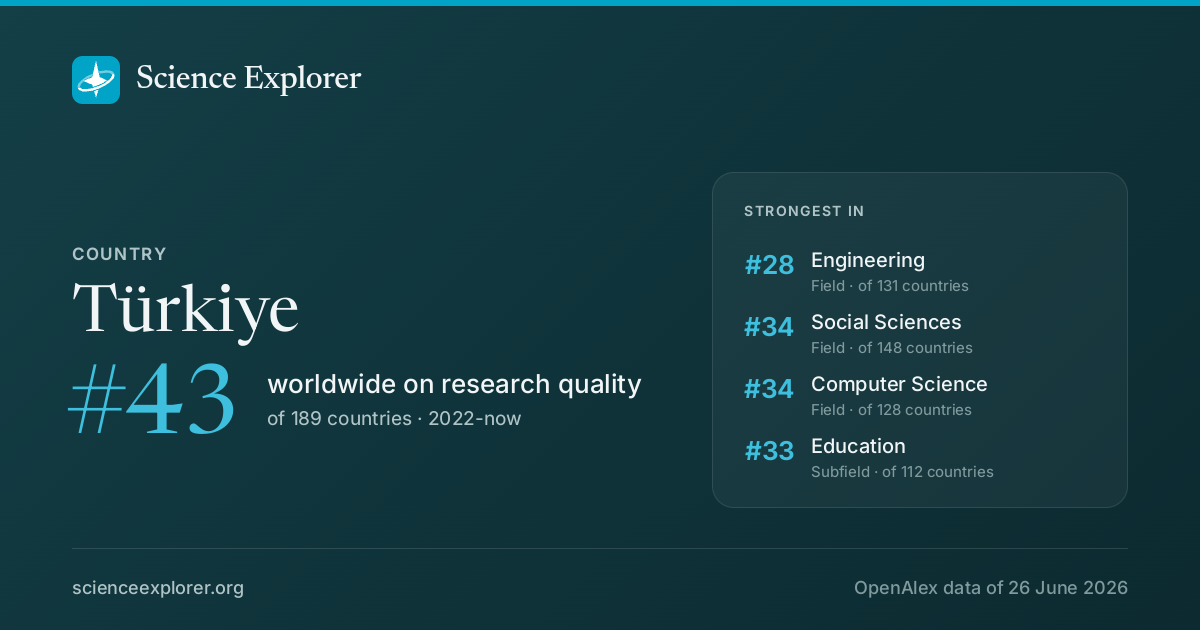
Türkiye ranks #43 of 189 countries on research quality in 2022-now (#45 all time), with 460k research works and 7.0% of them in the world's top 10%.
- World rank, 2022-now
- #43 of 189 · #45 all time
- Works, 2022-now
- 460k ▲ 32% vs 2018-21
- Citations
- 15.4M 10.9 per fractional work, all time
- Top-10% rate
- 7.0% all institutions 10.0%
- vs its own fields
- 0.62× 1.00× is exactly expected
- In the world top 100
- 0 0 in the top 1,000
- Open access
- 60% world 40%
- International
- 11% world 18%
TürkiyeWhat is Türkiye strongest at in science?
On research quality in 2022-now, Türkiye ranks highest in Engineering (#28 of 131), Social Sciences (#34 of 148) and Computer Science (#34 of 128). Relative to its size it is most specialised in Museology, Religious studies and Life-span and Life-course Studies.
| Field | World rank | Where that sits | Top-10% rate | Works | All time | Institutions |
|---|---|---|---|---|---|---|
| EngineeringField | #28 of 131 | 8.1% | 49,174 | #29 | Institutions | |
| Social SciencesField | #34 of 148 | 8.6% | 69,805 | #38 | Institutions | |
| Computer ScienceField | #34 of 128 | 9.6% | 19,874 | #33 | Institutions | |
| EducationSubfield | #33 of 112 | 9.3% | 18,988 | #28 | Institutions | |
| Economics, Econometrics and FinanceField | #33 of 107 | 5.9% | 11,825 | #33 | Institutions | |
| Arts and HumanitiesField | #32 of 103 | 10.1% | 38,941 | #32 | Institutions | |
| Sociology and Political ScienceSubfield | #37 of 119 | 7.4% | 18,550 | #41 | Institutions | |
| PsychologyField | #33 of 106 | 6.5% | 24,944 | #32 | Institutions | |
| EnergyField | #23 of 71 | 7.9% | 3,722 | #29 | Institutions | |
| Environmental ScienceField | #40 of 122 | 6.7% | 15,800 | #42 | Institutions | |
| Agricultural and Biological SciencesField | #44 of 124 | 6.4% | 23,519 | #46 | Institutions | |
| Economics and EconometricsSubfield | #35 of 98 | 6.3% | 8,697 | #37 | Institutions |
Where its research is concentrated
Location quotient: how much more (or less) of each node it does than its size predicts. Drawn around 1×, where "twice the world share" and "half of it" are the same distance apart in opposite directions. A volume reading, which on a country axis is largely population and industrial structure.
- MuseologySubfield · 6,596.0 works · #1 of 190 active here10×
- Religious studiesSubfield · 4,428.6 works · #3 of 195 active here5.1×
- Life-span and Life-course StudiesSubfield · 396.9 works · #3 of 144 active here4.6×
- ArcheologySubfield · 342.3 works · #3 of 158 active here4.3×
- PhilosophySubfield · 7,956.0 works · #3 of 208 active here3.5×
- ForestrySubfield · 1,909.3 works · #3 of 204 active here3.5×
- OrthodonticsSubfield · 2,020.8 works · #5 of 173 active here3.4×
- Leadership and ManagementSubfield · 257.3 works · #6 of 135 active here3.2×
The whole field profile
All 26 fields at once. A specialist and a generalist produce the same ranked list and a completely different shape.
Rings at 0.5×, 1× and 2×. Widest outward: Arts and Humanities, 2.8×. Every wedge is a field page.
All 26 fields, with their numbers
- Arts and Humanities2.81×42k works
- Dentistry2.52×6,377 works
- Psychology1.78×28k works
- Nursing1.50×3,827 works
- Veterinary1.19×845 works
- Social Sciences1.19×79k works
- Economics, Econometrics and Finance1.18×13k works
- Medicine1.14×114k works
- Mathematics1.13×6,936 works
- Health Professions1.09×15k works
- Decision Sciences1.09×5,496 works
- Agricultural and Biological Sciences1.07×26k works
- Business, Management and Accounting0.97×16k works
- Energy0.87×4,187 works
- Chemistry0.82×6,728 works
- Pharmacology, Toxicology and Pharmaceutics0.80×1,465 works
- Neuroscience0.79×6,654 works
- Materials Science0.77×14k works
- Biochemistry, Genetics and Molecular Biology0.74×20k works
- Immunology and Microbiology0.73×3,826 works
- Engineering0.71×55k works
- Environmental Science0.70×18k works
- Chemical Engineering0.64×1,171 works
- Computer Science0.55×22k works
- Earth and Planetary Sciences0.52×4,272 works
- Physics and Astronomy0.48×5,627 works
Which fields of science does Türkiye work in?
In 2022-now, 35% of research in Türkiye is in Social Sciences, 27% in Health Sciences. Its largest fields are Medicine (22%), Social Sciences (15%), Engineering (11%). It does 1.4× the world's share of Social Sciences.
Each ring splits the one inside it: the four domains of science, their fields, their subfields. Size is fractional works in 2022-now. Every slice is a page; the interactive view zooms down to single topics and colours each by how much more of it this country does than the world.
Its 4 domains and 26 fields, with their numbers
- Social Sciences184k35.3%
- Social Sciences79k15.1%
- Arts and Humanities42k8.1%
- Psychology28k5.4%
- Business, Management and Accounting16k3.1%
- Economics, Econometrics and Finance13k2.5%
- Decision Sciences5,4961.1%
- Health Sciences140k26.8%
- Medicine114k21.8%
- Health Professions15k2.9%
- Dentistry6,3771.2%
- Nursing3,8270.7%
- Veterinary8450.2%
- Physical Sciences139k26.6%
- Engineering55k10.6%
- Computer Science22k4.3%
- Environmental Science18k3.5%
- Materials Science14k2.7%
- Mathematics6,9361.3%
- Chemistry6,7281.3%
- Physics and Astronomy5,6271.1%
- Earth and Planetary Sciences4,2720.8%
- Energy4,1870.8%
- Chemical Engineering1,1710.2%
- Life Sciences59k11.3%
- Agricultural and Biological Sciences26k5.1%
- Biochemistry, Genetics and Molecular Biology20k3.9%
- Neuroscience6,6541.3%
- Immunology and Microbiology3,8260.7%
- Pharmacology, Toxicology and Pharmaceutics1,4650.3%
Which keywords describe research in Türkiye?
By fractional works in 2022-now, weighted toward what it does more of than the world: Cultural Heritage, Mental Health, Sufism, Epidemiology, Ottoman Empire, Ethnography, Student Perceptions and Professional Development.
- Bibliometric Analysis
- Quarantine
- Turkish Literature
- Genetic Processes
- Social Systems
- Psychological Functioning
- Turkish Culture
- Folklore
- Storytelling
- Metaphors
- Covid-19 Pandemic
- Learning
- Student Perceptions
- Professional Development
- Public Policy
- Sufism
- Qualitative Research
- Inflammation
- Sustainability
- Cultural Heritage
- Epidemiology
- Mental Health
- Education
- Quality of Life
- Teacher Training
- Meta-Analysis
- Ottoman Empire
- Ethnography
- Distance Education
- Teaching
- Teacher Perspectives
- Rituals
- Mythology
- Traditional Beliefs
- Therapy
- Content Analysis
- Family Constellations
- Divan Poetry
- Educational Research
- Theology
Size is fractional works in 2022-now in the topics tagged with each word; colour is the word's share of this country's work against its share of the world's. The 40 words are chosen for being large and distinctive. Each links to the topic it comes from most.
All 40 words, with their numbers
- Epidemiology23k◆ 1.09×140 topics
- Cultural Heritage21k▲ 7.7×39 topics
- Mental Health17k▲ 2.3×48 topics
- Sustainability14k◆ 1.10×137 topics
- Education14k▲ 1.54×156 topics
- Inflammation13k▲ 1.16×83 topics
- Quality of Life11k▲ 1.40×61 topics
- Qualitative Research9,452▲ 2.1×42 topics
- Teacher Training9,274▲ 2.9×30 topics
- Sufism8,921▲ 37×2 topics
- Meta-Analysis8,302▲ 2.7×21 topics
- Public Policy7,730▲ 3.1×33 topics
- Ottoman Empire7,615▲ 20×3 topics
- Professional Development7,558▲ 7.0×15 topics
- Ethnography7,432▲ 8.3×16 topics
- Student Perceptions7,427▲ 7.9×7 topics
- Distance Education7,212▲ 7.1×5 topics
- Learning6,969▲ 4.5×16 topics
- Teaching6,767▲ 10.0×11 topics
- Covid-19 Pandemic6,348▲ 8.9×4 topics
- Teacher Perspectives6,300▲ 31×2 topics
- Metaphors6,294▲ 37×1 topic
- Rituals6,252▲ 15×5 topics
- Storytelling6,241▲ 25×5 topics
- Mythology6,234▲ 24×3 topics
- Folklore6,228▲ 23×3 topics
- Traditional Beliefs6,131▲ 37×1 topic
- Turkish Culture6,131▲ 37×1 topic
- Therapy5,826▲ 5.7×8 topics
- Psychological Functioning5,756▲ 13×2 topics
- Content Analysis5,494▲ 8.3×8 topics
- Social Systems5,215▲ 17×5 topics
- Family Constellations5,128▲ 34×1 topic
- Genetic Processes5,128▲ 34×1 topic
- Divan Poetry4,923▲ 37×1 topic
- Turkish Literature4,923▲ 37×1 topic
- Educational Research4,874▲ 6.9×7 topics
- Quarantine4,866▲ 6.3×2 topics
- Theology4,165▲ 8.7×6 topics
- Bibliometric Analysis4,141▲ 14×4 topics
Which research topics does Türkiye publish the most in?
Its largest topics in 2022-now are Education Practices and Challenges, Cultural and Sociopolitical Studies, Families in Therapy and Culture.
Area is fractional works in 2022-now; colour is the subfield each topic belongs to. Every tile is a topic page.
- 1 Education Practices and Challenges Philosophy 6.3k works
- 2 Cultural and Sociopolitical Studies Museology 6.1k works
- 3 Families in Therapy and Culture Social Psychology 5.1k works
- 4 Turkish Literature and Culture Literature and Literary Theory 4.9k works
- 5 Islamic Thought and Society Studies Religious studies 4k works
- 6 Educational Methods and Analysis Education 4k works
- 7 Ottoman and Turkish Studies History 3.2k works
- 8 Linguistics and Cultural Studies Language and Linguistics 2.9k works
- 9 Historical Turkish Studies Political Science and International Relations 2.8k works
- 10 Turkey's Politics and Society Political Science and International Relations 2.3k works
- 11 Turkish Urban and Social Issues Urban Studies 2.1k works
- 12 Public Administration and Governance Political Science and International Relations 2k works
Which universities in Türkiye lead research?
Koç University, Istanbul Aydın University and Mi̇lli̇ Eği̇ti̇m Bakanliği rank highest in Türkiye on research quality in 2022-now.
One dot per institution in the list below. The upper left is the interesting corner.
- 1Koç UniversityUniversity · Istanbul · #1,075 worldwide10.9% top 10% · 3.1k works
- 2Istanbul Aydın UniversityUniversity · Istanbul · #1,305 worldwide5.6% top 10% · 2.3k works
- 3Mi̇lli̇ Eği̇ti̇m BakanliğiGovernment institution · Ankara · #1,350 worldwide7.2% top 10% · 4.2k works
- 4Istanbul Technical UniversityUniversity · Istanbul · #1,378 worldwide8.2% top 10% · 7.4k works
- 5Iğdır ÜniversitesiUniversity · Iğdır · #1,449 worldwide10.4% top 10% · 1.4k works
- 6Bartin UniversityUniversity · Bartın · #1,518 worldwide9.5% top 10% · 2.1k works
- 7Gazi UniversityUniversity · Ankara · #1,545 worldwide7.0% top 10% · 9.7k works
- 8Istanbul Commerce UniversityUniversity · Istanbul · #1,547 worldwide8.3% top 10% · 1.3k works
- 9Bingöl UniversityUniversity · Bingöl · #1,758 worldwide8.7% top 10% · 2k works
- 10Yıldız Technical UniversityUniversity · Istanbul · #1,810 worldwide9.2% top 10% · 5.4k works
- 11Osmaniye Korkut Ata UniversityUniversity · Osmaniye · #1,869 worldwide10.4% top 10% · 1.4k works
- 12Ankara Sosyal Bilimler ÜniversitesiUniversity · Ankara · #1,884 worldwide6.7% top 10% · 3.4k works
- 13Bandırma Onyedi Eylül UniversityUniversity · Bandırma · #1,918 worldwide9.7% top 10% · 1.8k works
- 14Fırat UniversityUniversity · Elâzığ · #2,016 worldwide8.1% top 10% · 4.6k works
- 15Batman UniversityUniversity · Batman · #2,030 worldwide10.1% top 10% · 1.6k works


The track on each row is its top-10% rate; the tick is the average of all institutions, 10.0% (how it is set): teal above it, red below.
All ranked institutions in TürkiyeWho are the top researchers in Türkiye?
Muhammet Deveci, Ilhan Tekin Ozturk and Bright Akwasi Gyamfi rank highest among researchers based in Türkiye.
- 1 Muhammet Deveci #140 worldwide 18k citations · 537 works
- 2 Ilhan Tekin Ozturk #628 worldwide 50k citations · 458 works
- 3 Bright Akwasi Gyamfi #2,231 worldwide 5.8k citations · 157 works
- 4 Buhari Doğan #3,357 worldwide 7.4k citations · 120 works
- 5 Uğur Korkut Pata #3,381 worldwide 16k citations · 275 works
- 6 Cem Işık #3,632 worldwide 10k citations · 203 works
- 7 Erfan Babaee Tırkolaee #3,957 worldwide 9.3k citations · 248 works
- 8 Eyup Dogan #4,216 worldwide 15k citations · 107 works
- 9 Arash Heidari #4,682 worldwide 5.1k citations · 79 works
- 10 Festus Víctor Bekun #8,134 worldwide 16k citations · 249 works
Which cities in Türkiye are research hubs?
- 1
IstanbulTürkiye
310k works
- 2
AnkaraTürkiye
268k works
- 3
IzmirTürkiye
83k works
- 4
KonyaTürkiye
39k works
- 5
EskişehirTürkiye
31k works
- 6
ErzurumTürkiye
28k works
- 7
BursaTürkiye
23k works
- 8
AdanaTürkiye
23k works
- 9
AntalyaTürkiye
22k works
- 10
SamsunTürkiye
22k works
- 11
KayseriTürkiye
22k works
- 12
AdapazarıTürkiye
18k works
How much of it is in the largest
The same cities as shares of everything these twelve account for.
Shares of the rows listed above, not of the whole node.
How open and international is Türkiye's research?
60% of its research is openly available (world: 40%), and 11% is written with international co-authors (world: 18%).
World: 40% of research is openly available.
World: 18% is written across borders.
In 2022-now, 74% of its research is openly available (world 63%) and 12% is written with co-authors abroad (world 22%). Against what its own mix of topics predicts, that is 1.11× the expected open access and 0.61× the expected international share, which puts it #118 of 173 countries on openness.
How has Türkiye's research grown?
Output in 2022-2025 was 32% higher than in 2018-2021.
The same series as a ribbon: one cell per year, darker for more. The line above answers how much; this answers when.
Its share of all research
Growing output can still be a shrinking share: all of science grows. This is Türkiye as a percentage of every work published that year, 2.0% in 2024.
Fractional works of Türkiye over all fractional works that year. How the balance of science has shifted.
How much of it reaches the world top 10%
Over the whole record, 7.1% of its 1.4M works since 1950 reached the world top 10% for their field and year.
Of each year's output, the share that reached the world's 10% most cited for its field and year. Peak 9.9% in 2008.
Which countries have research most like Türkiye's?
Croatia is Türkiye's closest research twin: of all countries, its research is spread across the fields most like Türkiye's, with both strong in Arts and Humanities.
- 1
 CroatiaBoth strong in Arts and Humanities, Dentistry, Psychology
0.71 Compare
- 2
 AfghanistanBoth strong in Dentistry, Nursing, Arts and Humanities
0.70 Compare
- 3
 LithuaniaBoth strong in Arts and Humanities, Psychology, Dentistry
0.66 Compare
- 4
 Bosnia and HerzegovinaBoth strong in Arts and Humanities, Dentistry, Veterinary
0.66 Compare
- 5
 RomaniaBoth strong in Dentistry, Arts and Humanities, Economics, Econometrics and Finance
0.66 Compare
Similarity is the correlation of each side's location quotients across every field it publishes in, on a log scale: 1 is the same shape of research, 0 is unrelated. It ignores size. How it is measured.
Compare Türkiye with
 Mexico
 Estonia
 Iran
 Bangladesh
 Qatar
Share Türkiye's ranking



Research fields in Türkiye
- Social Sciences
- Engineering
- Physical Sciences
- Social Sciences
- Computer Science
- Education
- Economics, Econometrics and Finance
- Arts and Humanities
- Sociology and Political Science
- Psychology
- Energy
- Environmental Science
- Agricultural and Biological Sciences
- Economics and Econometrics
- Political Science and International Relations
- Life Sciences
- Health Professions
- Business, Management and Accounting
- Mathematics
- Medicine
- Artificial Intelligence
- Health Sciences
- Global and Planetary Change
- Mechanical Engineering
- Electrical and Electronic Engineering
- Materials Science
- Social Psychology
- Decision Sciences
- Civil and Structural Engineering
- Surgery
- Clinical Psychology
- Physics and Astronomy
- Building and Construction
- Biomedical Engineering
- Chemistry
- Strategy and Management
- Renewable Energy, Sustainability and the Environment
- Biochemistry, Genetics and Molecular Biology
- Language and Linguistics
- Plant Science
- Literature and Literary Theory
- Earth and Planetary Sciences
- Computer Vision and Pattern Recognition
- Information Systems
- Materials Chemistry
- General Health Professions
- Organic Chemistry
- Management Science and Operations Research
- Mechanics of Materials
- Automotive Engineering
- Food Science
- Control and Systems Engineering
- Neuroscience
- Museology
- Environmental Engineering
- Aerospace Engineering
- Industrial and Manufacturing Engineering
- Computer Networks and Communications
- Philosophy
- Atomic and Molecular Physics, and Optics
Questions people ask
What is Türkiye strongest at in science?
On research quality in 2022-now, Türkiye ranks highest in Engineering (#28 of 131), Social Sciences (#34 of 148) and Computer Science (#34 of 128). Relative to its size it is most specialised in Museology, Religious studies and Life-span and Life-course Studies.
See the full answerHow fast is research in Türkiye growing?
Output in 2022-2025 was 32% higher than in 2018-2021.
How has Türkiye's research grown?Who are the top scientists in Türkiye?
Muhammet Deveci, Ilhan Tekin Ozturk and Bright Akwasi Gyamfi rank highest among researchers based in Türkiye.
Who are the top researchers in Türkiye?Discussion
Ask a question or share a note about Türkiye. Keep it to the research: no personal attacks, advertising or links. Any reader can report a post, which collapses it for everyone until it is opened.