 Science in Romania
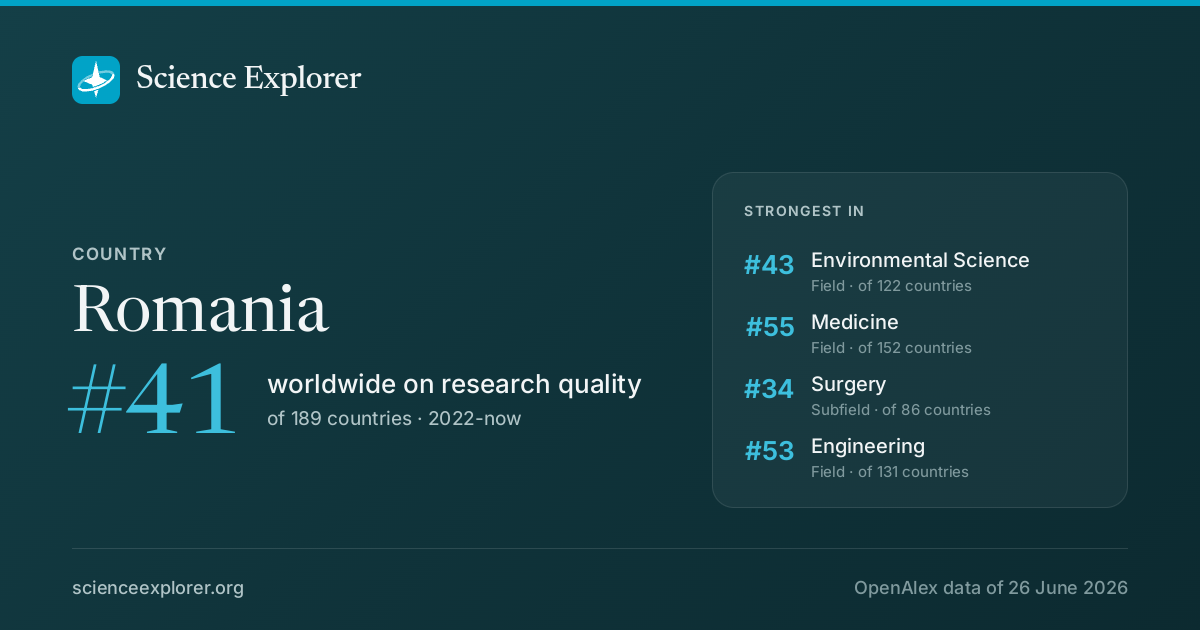
Romania ranks #41 of 189 countries on research quality in 2022-now (#61 all time), with 85k research works and 9.1% of them in the world's top 10%.
- World rank, 2022-now
- #41 of 189 · #61 all time
- Works, 2022-now
- 85k ▲ 9% vs 2018-21
- Citations
- 2.7M 7.8 per fractional work, all time
- Top-10% rate
- 9.1% all institutions 10.0%
- vs its own fields
- 1.10× 1.00× is exactly expected
- In the world top 100
- 0 0 in the top 1,000
- Open access
- 58% world 40%
- International
- 17% world 18%
RomaniaWhat is Romania strongest at in science?
On research quality in 2022-now, Romania ranks highest in Environmental Science (#43 of 122), Medicine (#55 of 152) and Surgery (#34 of 86). Relative to its size it is most specialised in General Energy, Orthodontics and Music.
| Field | World rank | Where that sits | Top-10% rate | Works | All time | Institutions |
|---|---|---|---|---|---|---|
| Environmental ScienceField | #43 of 122 | 8.9% | 4,110 | #52 | Institutions | |
| MedicineField | #55 of 152 | 13.6% | 15,921 | #74 | Institutions | |
| SurgerySubfield | #34 of 86 | 15.4% | 2,005 | #50 | Institutions | |
| EngineeringField | #53 of 131 | 5.8% | 13,148 | #58 | Institutions | |
| Social SciencesField | #61 of 148 | 6.9% | 10,031 | #64 | Institutions | |
| Agricultural and Biological SciencesField | #53 of 124 | 11.6% | 3,756 | #81 | Institutions | |
| Computer ScienceField | #55 of 128 | 7.2% | 6,121 | #61 | Institutions | |
| Biochemistry, Genetics and Molecular BiologyField | #48 of 105 | 12.2% | 2,969 | #63 | Institutions | |
| Arts and HumanitiesField | #49 of 103 | 6.7% | 4,039 | #57 | Institutions | |
| PsychologyField | #51 of 106 | 9.0% | 2,672 | #56 | Institutions | |
| Cardiology and Cardiovascular MedicineSubfield | #34 of 70 | 12.3% | 1,169 | #45 | Institutions | |
| Business, Management and AccountingField | #55 of 110 | 7.6% | 3,739 | #62 | Institutions |
Where its research is concentrated
Location quotient: how much more (or less) of each node it does than its size predicts. Drawn around 1×, where "twice the world share" and "half of it" are the same distance apart in opposite directions. A volume reading, which on a country axis is largely population and industrial structure.
- General EnergySubfield · 133.8 works · #13 of 167 active here5.2×
- OrthodonticsSubfield · 362.0 works · #18 of 173 active here3.4×
- MusicSubfield · 235.3 works · #19 of 174 active here3.0×
- BiochemistrySubfield · 323.8 works · #27 of 198 active here2.8×
- Tourism, Leisure and Hospitality ManagementSubfield · 57.0 works · #25 of 165 active here2.6×
- Geometry and TopologySubfield · 399.9 works · #20 of 186 active here2.6×
- DentistryField · 1,189.6 works · #19 of 205 active here2.6×
- PeriodonticsSubfield · 323.0 works2.5×
The whole field profile
All 26 fields at once. A specialist and a generalist produce the same ranked list and a completely different shape.
Rings at 0.5×, 1× and 2×. Widest outward: Dentistry, 2.6×. Every wedge is a field page.
All 26 fields, with their numbers
- Dentistry2.58×1,190 works
- Mathematics1.70×1,894 works
- Arts and Humanities1.64×4,483 works
- Economics, Econometrics and Finance1.60×3,242 works
- Business, Management and Accounting1.36×4,148 works
- Decision Sciences1.23×1,124 works
- Energy1.09×952 works
- Psychology1.05×3,023 works
- Engineering1.01×14k works
- Medicine1.00×18k works
- Environmental Science0.99×4,644 works
- Nursing0.97×452 works
- Pharmacology, Toxicology and Pharmaceutics0.95×316 works
- Earth and Planetary Sciences0.94×1,396 works
- Veterinary0.93×120 works
- Social Sciences0.93×11k works
- Agricultural and Biological Sciences0.92×4,158 works
- Computer Science0.92×6,755 works
- Materials Science0.89×2,961 works
- Chemical Engineering0.88×292 works
- Physics and Astronomy0.78×1,639 works
- Chemistry0.77×1,143 works
- Health Professions0.75×1,865 works
- Immunology and Microbiology0.74×706 works
- Neuroscience0.73×1,119 works
- Biochemistry, Genetics and Molecular Biology0.66×3,360 works
Which fields of science does Romania work in?
In 2022-now, 38% of research in Romania is in Physical Sciences, 29% in Social Sciences. Its largest fields are Medicine (19%), Engineering (15%), Social Sciences (12%).
Each ring splits the one inside it: the four domains of science, their fields, their subfields. Size is fractional works in 2022-now. Every slice is a page; the interactive view zooms down to single topics and colours each by how much more of it this country does than the world.
Its 4 domains and 26 fields, with their numbers
- Physical Sciences36k38.0%
- Engineering14k15.2%
- Computer Science6,7557.1%
- Environmental Science4,6444.9%
- Materials Science2,9613.1%
- Mathematics1,8942.0%
- Physics and Astronomy1,6391.7%
- Earth and Planetary Sciences1,3961.5%
- Chemistry1,1431.2%
- Energy9521.0%
- Chemical Engineering2920.3%
- Social Sciences27k28.6%
- Social Sciences11k11.8%
- Arts and Humanities4,4834.7%
- Business, Management and Accounting4,1484.4%
- Economics, Econometrics and Finance3,2423.4%
- Psychology3,0233.2%
- Decision Sciences1,1241.2%
- Health Sciences22k23.1%
- Medicine18k19.3%
- Health Professions1,8652.0%
- Dentistry1,1901.3%
- Nursing4520.5%
- Veterinary1210.1%
- Life Sciences9,66010.2%
- Agricultural and Biological Sciences4,1584.4%
- Biochemistry, Genetics and Molecular Biology3,3603.5%
- Neuroscience1,1191.2%
- Immunology and Microbiology7060.7%
- Pharmacology, Toxicology and Pharmaceutics3170.3%
Which keywords describe research in Romania?
By fractional works in 2022-now, weighted toward what it does more of than the world: Sustainability, Epidemiology, Globalization, Renewable Energy, Climate Change, Machine Learning, Sustainable Development and Environmental Impact.
- Social Perception
- International Relations
- Tissue Engineering
- Security
- Environmental Management
- Mechanical Properties
- Big Data
- Supply Chain Management
- Cardiovascular Disease
- Social Media
- Human Rights
- Biomedical Applications
- Quality of Life
- Economic Growth
- Education
- Environmental Impact
- Inflammation
- Globalization
- Climate Change
- Sustainability
- Epidemiology
- Machine Learning
- Deep Learning
- Renewable Energy
- Sustainable Development
- Artificial Intelligence
- Oxidative Stress
- Innovation
- Neural Networks
- Energy Efficiency
- COVID-19
- Identity
- Treatment
- Mental Health
- Internet of Things
- Risk Factors
- Literature
- Ethics
- European Union
- Regional Disparities
Size is fractional works in 2022-now in the topics tagged with each word; colour is the word's share of this country's work against its share of the world's. The 40 words are chosen for being large and distinctive. Each links to the topic it comes from most.
All 40 words, with their numbers
- Epidemiology3,763◆ 1.00×140 topics
- Sustainability3,280▲ 1.41×137 topics
- Machine Learning2,912◆ 0.92×97 topics
- Climate Change2,713◆ 1.05×129 topics
- Deep Learning2,665▼ 0.81×85 topics
- Globalization2,600▲ 1.39×176 topics
- Renewable Energy2,190▲ 1.60×60 topics
- Inflammation2,092◆ 1.04×83 topics
- Sustainable Development2,054▲ 1.38×10⁹ topics
- Environmental Impact1,995▲ 1.23×73 topics
- Artificial Intelligence1,769▲ 1.31×67 topics
- Education1,636◆ 1.00×155 topics
- Oxidative Stress1,524◆ 0.98×63 topics
- Economic Growth1,476▲ 1.91×36 topics
- Innovation1,410▲ 1.44×88 topics
- Quality of Life1,338◆ 0.98×61 topics
- Neural Networks1,301◆ 0.89×42 topics
- Biomedical Applications1,283◆ 1.14×36 topics
- Energy Efficiency1,242▲ 1.42×45 topics
- Human Rights1,237▲ 1.27×90 topics
- COVID-191,236◆ 1.00×34 topics
- Social Media1,232◆ 0.94×41 topics
- Identity1,231▲ 1.79×78 topics
- Cardiovascular Disease1,225◆ 1.13×39 topics
- Treatment1,201◆ 1.04×52 topics
- Supply Chain Management1,200▲ 1.41×27 topics
- Mental Health1,199◆ 0.88×48 topics
- Big Data1,164▲ 1.28×37 topics
- Internet of Things1,149▲ 1.41×33 topics
- Mechanical Properties1,136▲ 1.22×39 topics
- Risk Factors1,082◆ 1.04×37 topics
- Environmental Management962▲ 2.5×23 topics
- Literature910▲ 1.75×62 topics
- Security909▲ 1.43×31 topics
- Ethics892▲ 1.86×60 topics
- Tissue Engineering846▲ 1.47×13 topics
- European Union631▲ 3.0×29 topics
- International Relations591▲ 2.6×29 topics
- Regional Disparities397▲ 8.9×2 topics
- Social Perception355▲ 8.9×4 topics
Which research topics does Romania publish the most in?
Its largest topics in 2022-now are European Cultural and National Identity, Phytochemicals and Antioxidant Activities, Additive Manufacturing and 3D Printing Technologies.
Area is fractional works in 2022-now; colour is the subfield each topic belongs to. Every tile is a topic page.
- 1 European Cultural and National Identity Sociology and Political Science 334 works
- 2 Phytochemicals and Antioxidant Activities Biochemistry 257 works
- 3 Additive Manufacturing and 3D Printing Technologies Automotive Engineering 253 works
- 4 Digital Transformation in Industry Industrial and Manufacturing Engineering 253 works
- 5 Regional Development and Policy Political Science and International Relations 246 works
- 6 Blockchain Technology Applications and Security Information Systems 241 works
- 7 COVID-19 Pandemic Impacts Economics and Econometrics 239 works
- 8 Energy, Environment, Economic Growth Economics and Econometrics 236 works
- 9 Marine and environmental studies Oceanography 227 works
- 10 Business and Economic Development Management, Monitoring, Policy and Law 221 works
- 11 Environmental Sustainability in Business Marketing 219 works
- 12 Diverse Aspects of Tourism Research Sociology and Political Science 213 works
Which universities in Romania lead research?
Ministry of Education, Bucharest University of Economic Studies and University of Oradea rank highest in Romania on research quality in 2022-now.
One dot per institution in the list below. The upper left is the interesting corner.
- 1Ministry of EducationFunder · Bucharest · #1,050 worldwide19.4% top 10% · 712 works
- 2Bucharest University of Economic StudiesUniversity · Bucharest · #1,126 worldwide8.5% top 10% · 3.5k works
- 3University of OradeaUniversity · Oradea · #1,136 worldwide13.0% top 10% · 1.8k works
- 4West University of TimişoaraUniversity · Timișoara · #1,259 worldwide9.2% top 10% · 1.9k works
- 5Ştefan cel Mare University of SuceavaUniversity · Suceava · #1,294 worldwide8.1% top 10% · 1.7k works
- 6Lucian Blaga University of SibiuUniversity · Sibiu · #1,675 worldwide11.1% top 10% · 1.8k works
- 7Transylvania University of BrașovUniversity · Brasov · #1,765 worldwide9.1% top 10% · 2.7k works
- 8"Dunarea de Jos" University of GalatiUniversity · Galati · #1,794 worldwide8.3% top 10% · 2.6k works
- 9Babeș-Bolyai UniversityUniversity · Cluj-Napoca · #1,922 worldwide7.9% top 10% · 4.9k works
- 10University of CraiovaUniversity · Craiova · #2,459 worldwide7.9% top 10% · 2.4k works
- 11University of BucharestUniversity · Bucharest · #2,548 worldwide8.0% top 10% · 4k works
- 12Ovidius UniversityUniversity · Constanța · #2,630 worldwide6.6% top 10% · 1.5k works
- 13Valahia University of TargovisteUniversity · Târgovişte · #3,083 worldwide4.5% top 10% · 724 works
- 14Technical University of Cluj-NapocaUniversity · Cluj-Napoca · #3,094 worldwide6.9% top 10% · 2.8k works
- 15Iuliu Hațieganu University of Medicine and PharmacyUniversity · Cluj-Napoca · #3,197 worldwide16.5% top 10% · 2k works



The track on each row is its top-10% rate; the tick is the average of all institutions, 10.0% (how it is set): teal above it, red below.
All ranked institutions in RomaniaWho are the top researchers in Romania?
D. Felea, Ovidiu Chioncel and Robert Ancuceanu rank highest among researchers based in Romania.
- 1 D. Felea #4,035 worldwide 23k citations · 200 works
- 2 Ovidiu Chioncel #4,732 worldwide 55k citations · 351 works
- 3 Robert Ancuceanu #6,028 worldwide 74k citations · 151 works
- 4 Ionuţ Negoi #7,120 worldwide 154k citations · 380 works
- 5 Bogdan Oancea #7,278 worldwide 85k citations · 215 works
- 6 Ioana Octavia Agache #9,518 worldwide 32k citations · 378 works
- 7 Mihaela Hostiuc #10,604 worldwide 117k citations · 120 works
- 8 Claudiu Herţeliu #11,904 worldwide 135k citations · 158 works
- 9 Cătălina Liliana Andrei #12,169 worldwide 133k citations · 170 works
- 10 Vasile Catanescu #18,405 worldwide 15k citations · 90 works
Which cities in Romania are research hubs?
- 1
BucharestRomania
127k works
- 2
Cluj-NapocaRomania
55k works
- 3
IașiRomania
36k works
- 4
TimișoaraRomania
26k works
How much of it is in the largest
The same cities as shares of everything these twelve account for.
Shares of the rows listed above, not of the whole node.
How open and international is Romania's research?
58% of its research is openly available (world: 40%), and 17% is written with international co-authors (world: 18%).
World: 40% of research is openly available.
World: 18% is written across borders.
In 2022-now, 77% of its research is openly available (world 63%) and 18% is written with co-authors abroad (world 22%). Against what its own mix of topics predicts, that is 1.25× the expected open access and 0.82× the expected international share, which puts it #47 of 173 countries on openness.
How has Romania's research grown?
Output in 2022-2025 was 9% higher than in 2018-2021.
The same series as a ribbon: one cell per year, darker for more. The line above answers how much; this answers when.
Its share of all research
Growing output can still be a shrinking share: all of science grows. This is Romania as a percentage of every work published that year, 0.36% in 2024.
Fractional works of Romania over all fractional works that year. How the balance of science has shifted.
How much of it reaches the world top 10%
Over the whole record, 6.1% of its 341k works since 1950 reached the world top 10% for their field and year.
Of each year's output, the share that reached the world's 10% most cited for its field and year. Peak 11.2% in 2025.
Which countries have research most like Romania's?
North Macedonia is Romania's closest research twin: of all countries, its research is spread across the fields most like Romania's, with both strong in Dentistry.
- 1
 North MacedoniaBoth strong in Dentistry, Arts and Humanities, Economics, Econometrics and Finance
0.73 Compare
- 2
 KosovoBoth strong in Dentistry, Mathematics, Arts and Humanities
0.73 Compare
- 3
 AlbaniaBoth strong in Dentistry, Arts and Humanities, Economics, Econometrics and Finance
0.67 Compare
- 4
 YemenBoth strong in Dentistry, Mathematics, Business, Management and Accounting
0.66 Compare
- 5
 TürkiyeBoth strong in Dentistry, Arts and Humanities, Economics, Econometrics and Finance
0.66 Compare
Similarity is the correlation of each side's location quotients across every field it publishes in, on a log scale: 1 is the same shape of research, 0 is unrelated. It ignores size. How it is measured.
Compare Romania with
 Bangladesh
 Mexico
 Thailand
 Argentina
 Estonia
Share Romania's ranking
Badges for a website1Each links back here and updates with every snapshot

Research fields in Romania
- Physical Sciences
- Environmental Science
- Social Sciences
- Life Sciences
- Health Sciences
- Medicine
- Surgery
- Engineering
- Social Sciences
- Agricultural and Biological Sciences
- Computer Science
- Biochemistry, Genetics and Molecular Biology
- Arts and Humanities
- Psychology
- Cardiology and Cardiovascular Medicine
- Business, Management and Accounting
- Pulmonary and Respiratory Medicine
- Earth and Planetary Sciences
- Health Professions
- Mathematics
- Economics, Econometrics and Finance
- Dentistry
- Materials Science
- Physics and Astronomy
- Sociology and Political Science
- Economics and Econometrics
- Biomedical Engineering
- Epidemiology
- Physiology
- Endocrinology, Diabetes and Metabolism
- Electrical and Electronic Engineering
- Molecular Biology
- Plant Science
- Radiology, Nuclear Medicine and Imaging
- Neurology
- Artificial Intelligence
- Immunology and Microbiology
- Rheumatology
- Food Science
- Decision Sciences
- Clinical Psychology
- Public Health, Environmental and Occupational Health
- Pathology and Forensic Medicine
- Information Systems
- Neuroscience
- Political Science and International Relations
- Oncology
- Social Psychology
- Mechanical Engineering
- Building and Construction
- General Health Professions
- Management Science and Operations Research
- Industrial and Manufacturing Engineering
- Mechanics of Materials
- Computational Theory and Mathematics
- Materials Chemistry
- Education
- Infectious Diseases
- Automotive Engineering
- Energy
Questions people ask
What is Romania strongest at in science?
On research quality in 2022-now, Romania ranks highest in Environmental Science (#43 of 122), Medicine (#55 of 152) and Surgery (#34 of 86). Relative to its size it is most specialised in General Energy, Orthodontics and Music.
See the full answerDiscussion
Ask a question or share a note about Romania. Keep it to the research: no personal attacks, advertising or links. Any reader can report a post, which collapses it for everyone until it is opened.