 Science in Yemen
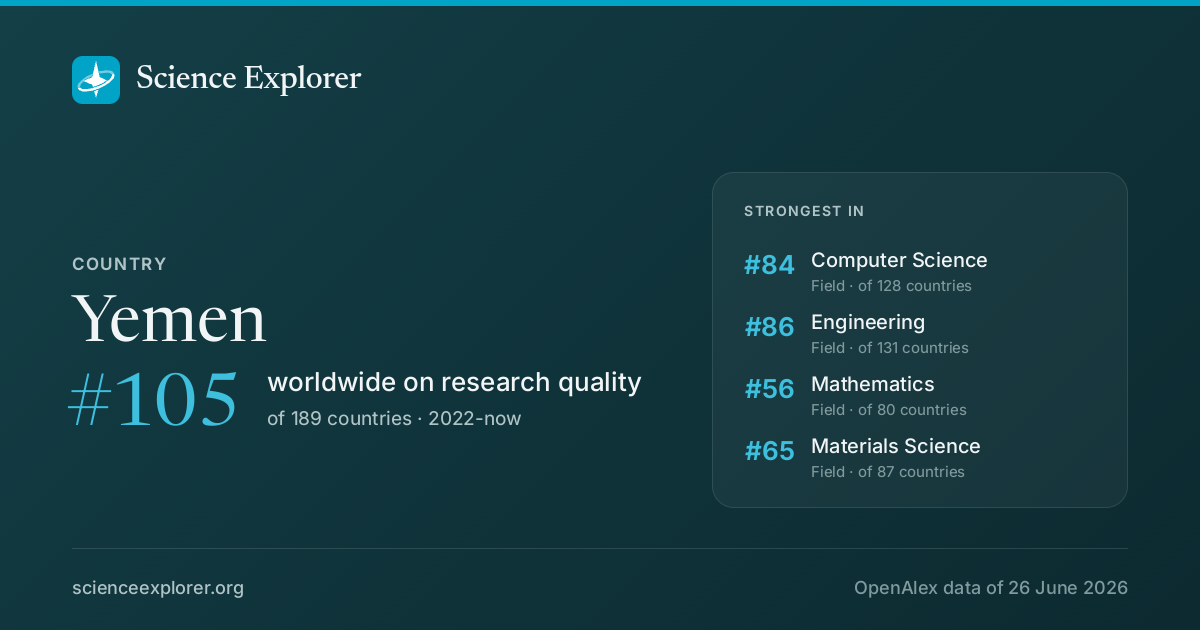
Yemen ranks #105 of 189 countries on research quality in 2022-now (#122 all time), with 7.2k research works and 8.7% of them in the world's top 10%.
- World rank, 2022-now
- #105 of 189 · #122 all time
- Works, 2022-now
- 7.2k ▲ 91% vs 2018-21
- Citations
- 150k 8.7 per fractional work, all time
- Top-10% rate
- 8.7% all institutions 10.0%
- vs its own fields
- 0.77× 1.00× is exactly expected
- In the world top 100
- 0 0 in the top 1,000
- Open access
- 69% world 40%
- International
- 54% world 18%
YemenWhat is Yemen strongest at in science?
On research quality in 2022-now, Yemen ranks highest in Computer Science (#84 of 128), Engineering (#86 of 131) and Mathematics (#56 of 80). Relative to its size it is most specialised in Drug Discovery, General Dentistry and Numerical Analysis.
| Field | World rank | Where that sits | Top-10% rate | Works | All time | Institutions |
|---|---|---|---|---|---|---|
| Computer ScienceField | #84 of 128 | 11.7% | 755 | #88 | Institutions | |
| EngineeringField | #86 of 131 | 9.2% | 889 | #99 | Institutions | |
| MathematicsField | #56 of 80 | 10.1% | 231 | #70 | ||
| Materials ScienceField | #65 of 87 | 15.4% | 278 | #72 | Institutions | |
| Business, Management and AccountingField | #83 of 110 | 12.4% | 320 | #91 | Institutions | |
| Biochemistry, Genetics and Molecular BiologyField | #81 of 105 | 7.9% | 215 | #95 | ||
| Artificial IntelligenceSubfield | #70 of 87 | 12.0% | 265 | #75 | Institutions | |
| Health ProfessionsField | #88 of 106 | 8.4% | 244 | #103 | Institutions | |
| MedicineField | #130 of 152 | 5.7% | 1,404 | #143 | Institutions | |
| Social SciencesField | #131 of 148 | 8.0% | 859 | #156 | Institutions | |
| Arts and HumanitiesField | #94 of 103 | 10.4% | 203 | #107 | Institutions | |
| Agricultural and Biological SciencesField | #114 of 124 | 7.4% | 291 | #128 | Institutions |
Where its research is concentrated
Location quotient: how much more (or less) of each node it does than its size predicts. Drawn around 1×, where "twice the world share" and "half of it" are the same distance apart in opposite directions. A volume reading, which on a country axis is largely population and industrial structure.
- Drug DiscoverySubfield · 5.3 works · #33 of 152 active here7.4×
- General DentistrySubfield · 22.2 works · #64 of 177 active here6.1×
- Numerical AnalysisSubfield · 42.4 works · #59 of 173 active here6.0×
- Geriatrics and GerontologySubfield · 50.4 works · #58 of 202 active here5.6×
- Modeling and SimulationSubfield · 62.9 works · #67 of 206 active here5.4×
- Complementary and Manual TherapySubfield · 17.1 works · #66 of 182 active here4.9×
- Applied Microbiology and BiotechnologySubfield · 19.7 works · #77 of 202 active here4.8×
- DentistryField · 187.6 works · #68 of 206 active here4.6×
The whole field profile
All 26 fields at once. A specialist and a generalist produce the same ranked list and a completely different shape.
Rings at 0.5×, 1× and 2×. Widest outward: Dentistry, 4.6×. Every wedge is a field page.
All 26 fields, with their numbers
- Dentistry4.64×188 works
- Mathematics2.69×264 works
- Pharmacology, Toxicology and Pharmaceutics2.10×62 works
- Decision Sciences1.83×147 works
- Nursing1.80×74 works
- Business, Management and Accounting1.39×375 works
- Computer Science1.38×897 works
- Health Professions1.22×268 works
- Economics, Econometrics and Finance1.15×205 works
- Chemistry1.09×143 works
- Materials Science1.09×318 works
- Veterinary1.09×12 works
- Medicine1.01×1,620 works
- Immunology and Microbiology0.98×82 works
- Arts and Humanities0.98×235 works
- Social Sciences0.94×989 works
- Energy0.85×65 works
- Agricultural and Biological Sciences0.84×332 works
- Engineering0.81×1,016 works
- Physics and Astronomy0.80×149 works
- Chemical Engineering0.78×23 works
- Environmental Science0.77×320 works
- Psychology0.75×191 works
- Biochemistry, Genetics and Molecular Biology0.56×250 works
- Earth and Planetary Sciences0.51×67 works
- Neuroscience0.34×47 works
Which fields of science does Yemen work in?
In 2022-now, 39% of research in Yemen is in Physical Sciences, 26% in Health Sciences. Its largest fields are Medicine (19%), Engineering (12%), Social Sciences (12%).
Each ring splits the one inside it: the four domains of science, their fields, their subfields. Size is fractional works in 2022-now. Every slice is a page; the interactive view zooms down to single topics and colours each by how much more of it this country does than the world.
Its 4 domains and 26 fields, with their numbers
- Physical Sciences3,26239.1%
- Engineering1,01612.2%
- Computer Science89710.8%
- Environmental Science3203.8%
- Materials Science3183.8%
- Mathematics2643.2%
- Physics and Astronomy1491.8%
- Chemistry1431.7%
- Earth and Planetary Sciences670.8%
- Energy650.8%
- Chemical Engineering230.3%
- Health Sciences2,16125.9%
- Medicine1,62019.4%
- Health Professions2683.2%
- Dentistry1882.3%
- Nursing730.9%
- Veterinary120.1%
- Social Sciences2,14225.7%
- Social Sciences98911.9%
- Business, Management and Accounting3754.5%
- Arts and Humanities2352.8%
- Economics, Econometrics and Finance2052.5%
- Psychology1912.3%
- Decision Sciences1471.8%
- Life Sciences7729.3%
Which keywords describe research in Yemen?
By fractional works in 2022-now, weighted toward what it does more of than the world: Machine Learning, Epidemiology, Deep Learning, Supply Chain Management, Healthcare, Malay Language, Sharia Law and Ethnicity.
- Cross-Cultural Communication
- Social Media Marketing
- Warfare
- Modernization
- Public Oversight
- Strategic Planning
- Organizational Performance
- Corpus Linguistics
- Malay Language
- IoT
- Islam
- Economic Security
- Philosophy
- Knowledge Management
- Culture
- Digital Transformation
- Education
- Globalization
- Healthcare
- Epidemiology
- Machine Learning
- Deep Learning
- Artificial Intelligence
- Supply Chain Management
- Ethnicity
- Literature
- History
- Legal Regulation
- Social Influence
- Science
- Customer Satisfaction
- Smart Cities
- Sharia Law
- Foresight
- Unmanned Aerial Vehicles
- Design
- Transport Policy
- Air Force
- Nonlinear Equations
- Fractional Calculus
Size is fractional works in 2022-now in the topics tagged with each word; colour is the word's share of this country's work against its share of the world's. The 40 words are chosen for being large and distinctive. Each links to the topic it comes from most.
All 40 words, with their numbers
- Machine Learning448▲ 1.61×94 topics
- Epidemiology430▲ 1.30×134 topics
- Deep Learning344▲ 1.19×84 topics
- Healthcare203▲ 2.1×31 topics
- Artificial Intelligence196▲ 1.65×57 topics
- Globalization192▲ 1.17×100 topics
- Supply Chain Management188▲ 2.5×23 topics
- Education169▲ 1.18×10² topics
- Ethnicity125▲ 4.0×15 topics
- Digital Transformation124▲ 2.8×26 topics
- Literature121▲ 2.6×27 topics
- Culture120▲ 2.8×21 topics
- History114▲ 1.97×25 topics
- Knowledge Management108▲ 2.3×30 topics
- Legal Regulation106▲ 5.7×8 topics
- Philosophy104▲ 2.8×22 topics
- Social Influence103▲ 5.8×3 topics
- Economic Security99▲ 5.6×7 topics
- Science99▲ 4.8×7 topics
- Islam98▲ 5.7×4 topics
- Customer Satisfaction98▲ 3.7×9 topics
- IoT97▲ 3.1×17 topics
- Smart Cities97▲ 4.4×8 topics
- Malay Language96▲ 8.2×1 topic
- Sharia Law96▲ 8.1×1 topic
- Corpus Linguistics85▲ 4.8×5 topics
- Foresight84▲ 7.7×2 topics
- Organizational Performance82▲ 3.8×11 topics
- Unmanned Aerial Vehicles81▲ 5.2×5 topics
- Strategic Planning80▲ 6.5×5 topics
- Design80▲ 5.8×6 topics
- Public Oversight79▲ 7.7×1 topic
- Transport Policy79▲ 7.7×1 topic
- Modernization78▲ 5.1×3 topics
- Air Force78▲ 7.9×1 topic
- Warfare78▲ 7.9×1 topic
- Nonlinear Equations76▲ 7.1×6 topics
- Social Media Marketing62▲ 15×1 topic
- Fractional Calculus58▲ 12×2 topics
- Cross-Cultural Communication57▲ 7.6×3 topics
Which research topics does Yemen publish the most in?
Its largest topics in 2022-now are Linguistic, Cultural, and Literary Studies, Legal and Regulatory Analysis, Military Technology and Strategies.
Area is fractional works in 2022-now; colour is the subfield each topic belongs to. Every tile is a topic page.
- 1 Linguistic, Cultural, and Literary Studies Sociology and Political Science 96 works
- 2 Legal and Regulatory Analysis Transportation 79 works
- 3 Military Technology and Strategies Aerospace Engineering 78 works
- 4 Organizational and Employee Performance Artificial Intelligence 62 works
- 5 Fractional Differential Equations Solutions Modeling and Simulation 49 works
- 6 Pharmaceutical Practices and Patient Outcomes Geriatrics and Gerontology 49 works
- 7 Translation Studies and Practices Language and Linguistics 39 works
- 8 Global Maternal and Child Health Pediatrics, Perinatology and Child Health 38 works
- 9 Islamic Finance and Banking Studies Accounting 37 works
- 10 Child Nutrition and Water Access Nutrition and Dietetics 36 works
- 11 Network Security and Intrusion Detection Computer Networks and Communications 34 works
- 12 Fuzzy and Soft Set Theory Management Science and Operations Research 30 works
Which universities in Yemen lead research?
University of Science and Technology, Sana'a University and Ibb University rank highest in Yemen on research quality in 2022-now.
One dot per institution in the list below. The upper left is the interesting corner.
- 1University of Science and TechnologyUniversity · Aden · #2,023 worldwide5.0% top 10% · 2.1k works
- 2Sana'a UniversityUniversity · Sanaa · #5,435 worldwide7.9% top 10% · 1.7k works
- 3Ibb UniversityUniversity · Ibb · #5,619 worldwide15.3% top 10% · 445 works
- 4Taiz UniversityUniversity · Ta‘izz · #6,065 worldwide11.9% top 10% · 445 works
- 5Thamar UniversityUniversity · Dhamār · #6,083 worldwide12.1% top 10% · 474 works
- 6University of AdenUniversity · Aden · #7,265 worldwide6.6% top 10% · 551 works
- 7Hodeidah UniversityUniversity · Al Hudaydah · #8,513 worldwide12.5% top 10% · 242 works
- 8Hadhramout UniversityUniversity · Mukalla · #8,980 worldwide10.5% top 10% · 264 works
- 9Al-Razi UniversityUniversity · Sanaa · #9,469 worldwide22.9% top 10% · 116 works
- 10Amran UniversityUniversity · ‘Amrān · #11,170 worldwide17.5% top 10% · 152 works
- 11Yemenia UniversityUniversity · Sanaa · #11,887 worldwide6.2% top 10% · 137 works
- 12Saba UniversityUniversity · Sanaa · #12,335 worldwide9.9% top 10% · 117 works
- 13Albaydha UniversityUniversity · Al Bayda · #12,430 worldwide5.9% top 10% · 134 works
- 14University of Modern SciencesUniversity · Sanaa · #12,647 worldwide11.8% top 10% · 103 works
- 15Al-Nasser UniversityUniversity · Sanaa · #18,358 worldwide4.7% top 10% · 67 works
The track on each row is its top-10% rate; the tick is the average of all institutions, 10.0% (how it is set): teal above it, red below.
All ranked institutions in YemenWho are the top researchers in Yemen?
Hamood Mohammed Al‐Hattami, Abdulwahab Rajeh and Mohammed A. Al‐Hakimi rank highest among researchers based in Yemen.
- 1 Hamood Mohammed Al‐Hattami #33,148 worldwide 1.4k citations · 60 works
- 2 Abdulwahab Rajeh #54,107 worldwide 5.9k citations · 92 works
- 3 Mohammed A. Al‐Hakimi #61,642 worldwide 1.2k citations · 42 works
- 4 Saeed Rabea Baatwah #166,289 worldwide 933 citations · 51 works
- 5 Saeed Hamood Alsamhi #167,907 worldwide 7.2k citations · 201 works
- 6 Ghaleb M. Asnag #214,813 worldwide 2k citations · 56 works
- 7 Ibraheem Saleh Al Koliby #241,485 worldwide 420 citations · 27 works
- 8 Fahmi Y. Al-Ashwal #247,148 worldwide 4.1k citations · 51 works
- 9 Belal Ali Abdulraheem Ghaleb #254,924 worldwide 674 citations · 23 works
- 10 Mohammed A. Al‐Bukhrani #266,796 worldwide 280 citations · 20 works
How open and international is Yemen's research?
69% of its research is openly available (world: 40%), and 54% is written with international co-authors (world: 18%).
World: 40% of research is openly available.
World: 18% is written across borders.
In 2022-now, 76% of its research is openly available (world 63%) and 55% is written with co-authors abroad (world 22%). Against what its own mix of topics predicts, that is 1.17× the expected open access and 2.46× the expected international share, which puts it #14 of 173 countries on openness.
How has Yemen's research grown?
Output in 2022-2025 was 91% higher than in 2018-2021.
The same series as a ribbon: one cell per year, darker for more. The line above answers how much; this answers when.
Its share of all research
Growing output can still be a shrinking share: all of science grows. This is Yemen as a percentage of every work published that year, 0.035% in 2024.
Fractional works of Yemen over all fractional works that year. How the balance of science has shifted.
How much of it reaches the world top 10%
Over the whole record, 8.1% of its 17k works since 1950 reached the world top 10% for their field and year.
Of each year's output, the share that reached the world's 10% most cited for its field and year. Peak 10.5% in 2022.
Which countries have research most like Yemen's?
Libya is Yemen's closest research twin: of all countries, its research is spread across the fields most like Yemen's, with both strong in Dentistry.
- 1
 LibyaBoth strong in Dentistry, Pharmacology, Toxicology and Pharmaceutics, Nursing
0.75 Compare
- 2
 PakistanBoth strong in Dentistry, Pharmacology, Toxicology and Pharmaceutics, Nursing
0.73 Compare
- 3
 IraqBoth strong in Dentistry, Pharmacology, Toxicology and Pharmaceutics, Mathematics
0.70 Compare
- 4
 JordanBoth strong in Mathematics, Decision Sciences, Pharmacology, Toxicology and Pharmaceutics
0.69 Compare
- 5
 SyriaBoth strong in Dentistry, Pharmacology, Toxicology and Pharmaceutics, Nursing
0.67 Compare
Similarity is the correlation of each side's location quotients across every field it publishes in, on a log scale: 1 is the same shape of research, 0 is unrelated. It ignores size. How it is measured.
Compare Yemen with
 Kuwait
 Afghanistan
 Cuba
 Mongolia
 Fiji
 Saint Kitts and Nevis
Share Yemen's ranking
Badges for a website1Each links back here and updates with every snapshot

Research fields in Yemen
- Computer Science
- Engineering
- Physical Sciences
- Life Sciences
- Materials Science
- Social Sciences
- Business, Management and Accounting
- Artificial Intelligence
- Health Professions
- Health Sciences
- Medicine
- Social Sciences
- Arts and Humanities
- Agricultural and Biological Sciences
- Sociology and Political Science
- Environmental Science
Discussion
Ask a question or share a note about Yemen. Posts are plain text and can be reported.