 Science in Libya
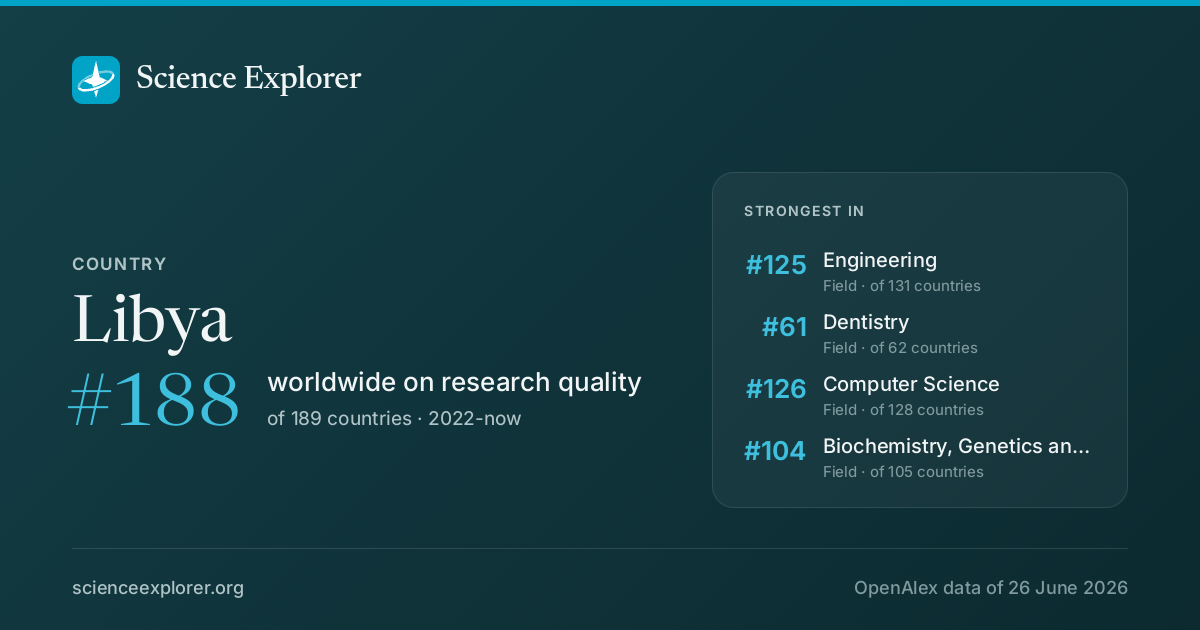
Libya ranks #188 of 189 countries on research quality in 2022-now (#201 all time), with 6.9k research works and 3.6% of them in the world's top 10%.
- World rank, 2022-now
- #188 of 189 · #201 all time
- Works, 2022-now
- 6.9k ▲ 79% vs 2018-21
- Citations
- 97k 5.5 per fractional work, all time
- Top-10% rate
- 3.6% all institutions 10.0%
- vs its own fields
- 0.35× 1.00× is exactly expected
- In the world top 100
- 0 0 in the top 1,000
- Open access
- 70% world 40%
- International
- 27% world 18%
LibyaWhat is Libya strongest at in science?
On research quality in 2022-now, Libya ranks highest in Engineering (#125 of 131), Dentistry (#61 of 62) and Computer Science (#126 of 128). Relative to its size it is most specialised in General Dentistry, Applied Microbiology and Biotechnology and Drug Discovery.
| Field | World rank | Where that sits | Top-10% rate | Works | All time | Institutions |
|---|---|---|---|---|---|---|
| EngineeringField | #125 of 131 | 3.9% | 1,066 | #128 | Institutions | |
| DentistryField | #61 of 62 | 1.1% | 208 | - | ||
| Computer ScienceField | #126 of 128 | 3.4% | 549 | #135 | Institutions | |
| Biochemistry, Genetics and Molecular BiologyField | #104 of 105 | 2.3% | 277 | #122 | Institutions | |
| Environmental ScienceField | #121 of 122 | 3.8% | 329 | #138 | Institutions | |
| Agricultural and Biological SciencesField | #123 of 124 | 2.9% | 477 | #144 | Institutions | |
| Social SciencesField | #147 of 148 | 6.5% | 640 | #164 | Institutions | |
| MedicineField | #152 of 152 | 2.3% | 1,587 | #164 | Institutions | |
| Electrical and Electronic EngineeringSubfield | #86 of 86 | 4.4% | 229 | #100 |
Where its research is concentrated
Location quotient: how much more (or less) of each node it does than its size predicts. Drawn around 1×, where "twice the world share" and "half of it" are the same distance apart in opposite directions. A volume reading, which on a country axis is largely population and industrial structure.
- General DentistrySubfield · 43.0 works · #42 of 177 active here12×
- Applied Microbiology and BiotechnologySubfield · 28.4 works · #62 of 202 active here6.8×
- Drug DiscoverySubfield · 4.9 works · #38 of 152 active here6.7×
- DentistryField · 237.4 works · #57 of 206 active here5.8×
- PeriodonticsSubfield · 64.5 works5.6×
- Oral SurgerySubfield · 82.4 works5.0×
- OrthodonticsSubfield · 47.5 works5.0×
- Geriatrics and GerontologySubfield · 41.4 works · #61 of 202 active here4.6×
The whole field profile
All 26 fields at once. A specialist and a generalist produce the same ranked list and a completely different shape.
Rings at 0.5×, 1× and 2×. Widest outward: Dentistry, 5.8×. Every wedge is a field page.
All 26 fields, with their numbers
- Dentistry5.79×237 works
- Pharmacology, Toxicology and Pharmaceutics2.37×70 works
- Veterinary1.79×21 works
- Nursing1.61×67 works
- Agricultural and Biological Sciences1.40×561 works
- Mathematics1.36×136 works
- Immunology and Microbiology1.28×109 works
- Energy1.28×99 works
- Chemistry1.25×166 works
- Medicine1.19×1,934 works
- Decision Sciences1.19×97 works
- Computer Science1.10×721 works
- Health Professions1.00×223 works
- Engineering0.99×1,262 works
- Environmental Science0.97×406 works
- Earth and Planetary Sciences0.88×117 works
- Arts and Humanities0.88×216 works
- Business, Management and Accounting0.80×218 works
- Biochemistry, Genetics and Molecular Biology0.77×345 works
- Social Sciences0.76×814 works
- Chemical Engineering0.72×21 works
- Psychology0.72×185 works
- Economics, Econometrics and Finance0.65×117 works
- Materials Science0.58×172 works
- Physics and Astronomy0.46×86 works
- Neuroscience0.40×55 works
Which fields of science does Libya work in?
In 2022-now, 38% of research in Libya is in Physical Sciences, 29% in Health Sciences. Its largest fields are Medicine (23%), Engineering (15%), Social Sciences (10%). It does 1.3× the world's share of Health Sciences.
Each ring splits the one inside it: the four domains of science, their fields, their subfields. Size is fractional works in 2022-now. Every slice is a page; the interactive view zooms down to single topics and colours each by how much more of it this country does than the world.
Its 4 domains and 26 fields, with their numbers
- Physical Sciences3,18537.7%
- Engineering1,26214.9%
- Computer Science7218.5%
- Environmental Science4064.8%
- Materials Science1722.0%
- Chemistry1662.0%
- Mathematics1361.6%
- Earth and Planetary Sciences1171.4%
- Energy991.2%
- Physics and Astronomy861.0%
- Chemical Engineering210.3%
- Health Sciences2,48229.4%
- Medicine1,93422.9%
- Dentistry2372.8%
- Health Professions2232.6%
- Nursing670.8%
- Veterinary210.2%
- Social Sciences1,64719.5%
- Social Sciences8159.6%
- Business, Management and Accounting2182.6%
- Arts and Humanities2162.5%
- Psychology1852.2%
- Economics, Econometrics and Finance1171.4%
- Decision Sciences971.1%
- Life Sciences1,13913.5%
Which keywords describe research in Libya?
By fractional works in 2022-now, weighted toward what it does more of than the world: Epidemiology, Machine Learning, Sharia Law, Malay Language, Renewable Energy, Deep Learning, Islam and Antioxidant Activity.
- L2 Motivation
- Infection Control
- Air Force
- Transport Policy
- Modernization
- Strategic Planning
- Legal Regulation
- Language Teaching
- Malay Language
- Social Influence
- Medicinal Plants
- Ethnicity
- Islam
- Culture
- Antioxidant Activity
- Quality of Life
- Cardiovascular Disease
- Environmental Impact
- Inflammation
- Machine Learning
- Epidemiology
- Deep Learning
- Renewable Energy
- Oxidative Stress
- COVID-19
- Antioxidant
- Metabolic Syndrome
- Literature
- Diabetes
- Philosophy
- Science
- Sharia Law
- Prevention
- Unmanned Aerial Vehicles
- Design
- Economic Security
- Public Oversight
- Foresight
- Warfare
- Corrective Feedback
Size is fractional works in 2022-now in the topics tagged with each word; colour is the word's share of this country's work against its share of the world's. The 40 words are chosen for being large and distinctive. Each links to the topic it comes from most.
All 40 words, with their numbers
- Epidemiology484▲ 1.44×134 topics
- Machine Learning381▲ 1.35×92 topics
- Deep Learning291◆ 1.00×77 topics
- Inflammation220▲ 1.23×83 topics
- Renewable Energy207▲ 1.69×49 topics
- Environmental Impact185▲ 1.28×57 topics
- Oxidative Stress171▲ 1.23×60 topics
- Cardiovascular Disease162▲ 1.68×38 topics
- COVID-19158▲ 1.43×30 topics
- Quality of Life157▲ 1.29×49 topics
- Antioxidant145▲ 2.5×50 topics
- Antioxidant Activity143▲ 2.7×32 topics
- Metabolic Syndrome126▲ 1.84×23 topics
- Culture109▲ 2.5×11 topics
- Literature108▲ 2.3×16 topics
- Islam103▲ 5.9×5 topics
- Diabetes103▲ 2.4×21 topics
- Ethnicity103▲ 3.3×8 topics
- Philosophy101▲ 2.7×8 topics
- Medicinal Plants101▲ 3.1×19 topics
- Science100▲ 4.8×5 topics
- Social Influence99▲ 5.6×3 topics
- Sharia Law98▲ 8.1×2 topics
- Malay Language98▲ 8.2×1 topic
- Prevention94▲ 2.6×16 topics
- Language Teaching93▲ 4.1×8 topics
- Unmanned Aerial Vehicles88▲ 5.5×4 topics
- Legal Regulation87▲ 4.6×8 topics
- Design86▲ 6.2×5 topics
- Strategic Planning86▲ 6.9×3 topics
- Economic Security85▲ 4.8×5 topics
- Modernization83▲ 5.4×2 topics
- Public Oversight83▲ 8.0×1 topic
- Transport Policy83▲ 8.0×1 topic
- Foresight82▲ 7.5×2 topics
- Air Force82▲ 8.2×1 topic
- Warfare82▲ 8.2×1 topic
- Infection Control55▲ 7.8×2 topics
- Corrective Feedback55▲ 8.7×1 topic
- L2 Motivation55▲ 8.7×1 topic
Which research topics does Libya publish the most in?
Its largest topics in 2022-now are Linguistic, Cultural, and Literary Studies, Legal and Regulatory Analysis, Military Technology and Strategies.
Area is fractional works in 2022-now; colour is the subfield each topic belongs to. Every tile is a topic page.
- 1 Linguistic, Cultural, and Literary Studies Sociology and Political Science 98 works
- 2 Legal and Regulatory Analysis Transportation 83 works
- 3 Military Technology and Strategies Aerospace Engineering 82 works
- 4 EFL/ESL Teaching and Learning Language and Linguistics 55 works
- 5 Dental Research and COVID-19 General Dentistry 43 works
- 6 Pharmaceutical Practices and Patient Outcomes Geriatrics and Gerontology 38 works
- 7 Technology-Enhanced Education Studies Education 32 works
- 8 Islamic Finance and Banking Studies Accounting 30 works
- 9 Water Quality and Pollution Assessment Water Science and Technology 29 works
- 10 Artificial Intelligence in Healthcare Health Information Management 28 works
- 11 Essential Oils and Antimicrobial Activity Food Science 28 works
- 12 Dental Health and Care Utilization Periodontics 28 works
Which universities in Libya lead research?
Al Zawiya University, Misurata University and University Elmergib rank highest in Libya on research quality in 2022-now.
One dot per institution in the list below. The upper left is the interesting corner.
- 1Al Zawiya UniversityUniversity · Az Zāwīyah · #6,198 worldwide5.6% top 10% · 616 works
- 2Misurata UniversityUniversity · Misratah · #6,450 worldwide3.6% top 10% · 557 works
- 3University ElmergibUniversity · Al Khums · #6,645 worldwide4.1% top 10% · 366 works
- 4Libyan AcademyUniversity · Tripoli · #6,993 worldwide5.6% top 10% · 359 works
- 5Omar Al-Mukhtar UniversityUniversity · Al Bayḑā’ · #7,418 worldwide2.9% top 10% · 625 works
- 6Sebha UniversityUniversity · Sabha · #8,189 worldwide3.9% top 10% · 458 works
- 7Alasmarya Islamic UniversityUniversity · Zliten · #8,526 worldwide4.3% top 10% · 245 works
- 8Center for Solar Energy Research and StudiesResearch facility · Tripoli · #10,376 worldwide7.2% top 10% · 181 works
- 9University of BenghaziUniversity · Benghazi · #10,897 worldwide2.4% top 10% · 1.5k works
- 10Sirte UniversityUniversity · Sirte · #11,154 worldwide2.6% top 10% · 195 works
- 11University of TripoliUniversity · Tripoli · #11,330 worldwide2.7% top 10% · 1.4k works
- 12Libyan International Medical UniversityUniversity · Benghazi · #14,421 worldwide3.3% top 10% · 147 works
- 13University of GharyanUniversity · Gharyan · #15,171 worldwide4.6% top 10% · 89 works
- 14Tripoli Central HospitalHospital / health system · Tripoli · #21,417 worldwide5.3% top 10% · 85 works
The track on each row is its top-10% rate; the tick is the average of all institutions, 10.0% (how it is set): teal above it, red below.
All ranked institutions in LibyaWho are the top researchers in Libya?
Muhammed Elhadi, Ali Meftah Gerged and Ibrahim Ahmed Badi rank highest among researchers based in Libya.
- 1 Muhammed Elhadi #5,131 worldwide 74k citations · 402 works
- 2 Ali Meftah Gerged #84,887 worldwide 3.5k citations · 89 works
- 3 Ibrahim Ahmed Badi #145,525 worldwide 2.3k citations · 100 works
- 4 Yasser Fathi Nassar #226,826 worldwide 4.4k citations · 136 works
- 5 Rabia Emhamed Al Mamlook #245,678 worldwide 2.3k citations · 88 works
- 6 Akram Mohammed Alkaseek #277,507 worldwide 688 citations · 24 works
- 7 Ahmed A.A. Msherghi #278,784 worldwide 15k citations · 112 works
- 8 Eman Ali Abdulwahed #288,519 worldwide 1.9k citations · 45 works
- 9 Entisar Ahmed Ali Alshareea #351,477 worldwide 1.6k citations · 28 works
- 10 Marwa Isa Biala #411,963 worldwide 1.9k citations · 29 works
How open and international is Libya's research?
70% of its research is openly available (world: 40%), and 27% is written with international co-authors (world: 18%).
World: 40% of research is openly available.
World: 18% is written across borders.
In 2022-now, 82% of its research is openly available (world 63%) and 25% is written with co-authors abroad (world 22%). Against what its own mix of topics predicts, that is 1.27× the expected open access and 1.15× the expected international share, which puts it #31 of 173 countries on openness.
How has Libya's research grown?
Output in 2022-2025 was 79% higher than in 2018-2021.
The same series as a ribbon: one cell per year, darker for more. The line above answers how much; this answers when.
Its share of all research
Growing output can still be a shrinking share: all of science grows. This is Libya as a percentage of every work published that year, 0.030% in 2024.
Fractional works of Libya over all fractional works that year. How the balance of science has shifted.
How much of it reaches the world top 10%
Over the whole record, 3.9% of its 17k works since 1959 reached the world top 10% for their field and year.
Of each year's output, the share that reached the world's 10% most cited for its field and year. Peak 7.6% in 2007.
Which countries have research most like Libya's?
Iraq is Libya's closest research twin: of all countries, its research is spread across the fields most like Libya's, with both strong in Dentistry.
- 1
 IraqBoth strong in Dentistry, Pharmacology, Toxicology and Pharmaceutics, Nursing
0.85 Compare
- 2
 SyriaBoth strong in Dentistry, Pharmacology, Toxicology and Pharmaceutics, Nursing
0.83 Compare
- 3
 MyanmarBoth strong in Dentistry, Pharmacology, Toxicology and Pharmaceutics, Veterinary
0.77 Compare
- 4
 YemenBoth strong in Dentistry, Pharmacology, Toxicology and Pharmaceutics, Nursing
0.75 Compare
- 5
 EgyptBoth strong in Dentistry, Pharmacology, Toxicology and Pharmaceutics, Veterinary
0.74 Compare
Similarity is the correlation of each side's location quotients across every field it publishes in, on a log scale: 1 is the same shape of research, 0 is unrelated. It ignores size. How it is measured.
Compare Libya with
 Tajikistan
 Antigua and Barbuda
 Guinea
 United States
 China
Share Libya's ranking
Badges for a website1Each links back here and updates with every snapshot

Research fields in Libya
Discussion
Ask a question or share a note about Libya. Posts are plain text and can be reported.