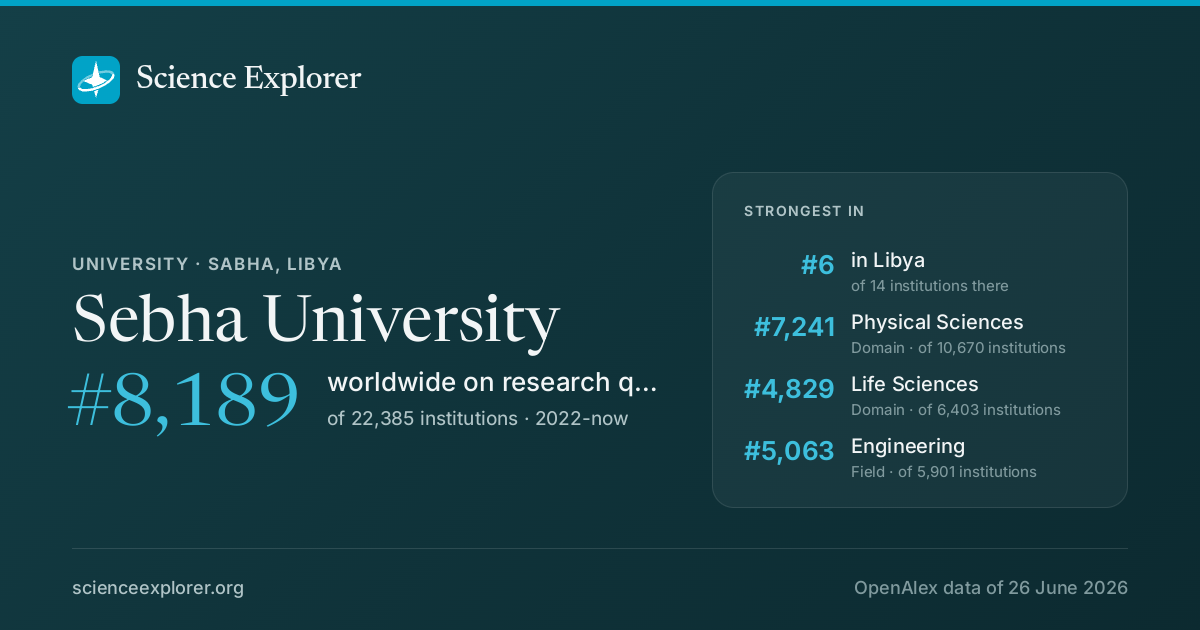
In research, Sebha University stands highest in Physical Sciences (#7,241 of 10,670 worldwide), Life Sciences (#4,829 of 6,403 worldwide) and Engineering (#5,063 of 5,901 worldwide), 2022-now.
Each strip is that field's whole ranked pool, with the notch where Sebha University sits in it, in the colour
of the band that rank falls in. The track under the rate is the rate itself: it carries no average mark, because the average
differs by field (from about 6% in Dentistry to 21% in Economics).
Which of those standings moved
The same fields on both windows: where it stood over the whole record, and where it stands in 2022-now. The distance is the story, and it is the one thing the two rank columns above cannot show.
Life Sciences16%Physical Sciences45%Health Sciences21%Social Sciences18%
Each ring splits the one inside it: the four domains of science, their fields, their subfields. Size is fractional works in 2022-now. Every slice is a page; the interactive view zooms down to single topics and colours each by how much more of it this institution does than the world.
Location quotient across every field it publishes in: outside the ring is more than an institution of this size would be expected to publish, inside it is less.
more than its size predictsabout as predictedless
Rings at 0.5×, 1× and 2×. Widest outward: Dentistry, 4.5×. Every wedge is a field page.
All 26 fields, with their numbers
Dentistry4.55×12 works
Pharmacology, Toxicology and Pharmaceutics3.07×6 works
Energy2.44×12 works
Chemical Engineering1.94×4 works
Agricultural and Biological Sciences1.93×49 works
Chemistry1.87×16 works
Computer Science1.35×56 works
Environmental Science1.14×30 works
Immunology and Microbiology1.13×6 works
Nursing1.13×3 works
Engineering1.11×90 works
Mathematics1.11×7 works
Materials Science1.05×20 works
Decision Sciences1.00×5 works
Social Sciences0.90×61 works
Health Professions0.88×12 works
Medicine0.82×85 works
Arts and Humanities0.73×11 works
Biochemistry, Genetics and Molecular Biology0.71×20 works
What are the most cited papers from Sebha University?
The most cited paper from Sebha University is "Burden of 375 diseases and injuries, risk-attributable burden of 88 risk factors, and healthy life expectancy in 204 countries and territories, including 660 subnational locations, 1990–2023: a systematic analysis for the Global Burden of Disease Study 2023" (Simon I Hay et al., 2025), with 762 citations. Next come "Global burden of 292 causes of death in 204 countries and territories and 660 subnational locations, 1990–2023: a systematic analysis for the Global Burden of Disease Study 2023" (500) and "Variable geographic distribution of Blastocystis subtypes and its potential implications" (403).
Which keywords describe research at Sebha University?
By fractional works in 2022-now, weighted toward what it does more of than the world: Social Influence, Machine Learning, Ethnicity, Islam, Sharia Law, Culture, Literature and Design.
▲ more of its work than of the world's◆ about the world's share▼ less than the world's
Size is fractional works in 2022-now in the topics tagged with each word; colour is the word's share of this institution's work against its share of the world's. The 40 words are chosen for being large and distinctive. Each links to the topic it comes from most.
All 40 words, with their numbers
Machine Learning36▲ 2.0×50 topics
Epidemiology26▲ 1.20×55 topics
Renewable Energy23▲ 2.9×26 topics
Deep Learning22▲ 1.17×45 topics
Sustainability21▲ 1.59×34 topics
Environmental Impact20▲ 2.1×24 topics
Culture18▲ 6.4×3 topics
Social Influence18▲ 16×2 topics
Literature18▲ 6.1×3 topics
Ethnicity18▲ 8.8×3 topics
History18▲ 4.8×2 topics
Islam17▲ 16×1 topic
Sharia Law17▲ 23×1 topic
Climate Change15◆ 1.06×35 topics
Design15▲ 17×2 topics
Strategic Planning14▲ 18×2 topics
Economic Security14▲ 13×2 topics
Air Force14▲ 22×1 topic
Legal Regulation14▲ 12×1 topic
Modernization14▲ 14×1 topic
Transport Policy14▲ 21×1 topic
Inflammation12◆ 1.07×33 topics
Antioxidant12▲ 3.2×28 topics
Nanoparticles11▲ 1.65×20 topics
Nanomaterials10▲ 1.78×16 topics
Treatment10▲ 1.53×15 topics
Antioxidant Activity8▲ 2.4×16 topics
Elderly8▲ 6.1×5 topics
Medicinal Plants8▲ 3.6×11 topics
Toxicity8▲ 3.2×12 topics
Immune Response7▲ 2.4×8 topics
Feature Selection7▲ 6.0×5 topics
Anti-inflammatory7▲ 4.4×14 topics
Solar Energy6▲ 3.5×5 topics
Inappropriate Medication Use5▲ 22×1 topic
Polypharmacy5▲ 22×1 topic
Anticancer5▲ 5.3×9 topics
Anticancer Agents5▲ 5.9×7 topics
Plant Growth4▲ 7.6×5 topics
MOOCs4▲ 8.9×2 topics
Which research topics does Sebha University publish most on?
Against the world's own shares: the tick on each track. Both are shares of its output, so they
sit on one scale and can be read against each other as well as against the world.
75%25%
openly available75.0%not open25.0%
World: 40% of research is openly available.
32%68%
with international co-authors31.6%domestic only68.4%
World: 18% is written across borders.
How has Sebha University's research output changed?
Output in 2022-2025 was 68% higher than in 2018-2021.
grewheldshrank
The same series as a ribbon: one cell per year, darker for more. The line above answers how much; this answers when.
Its share of all research
Growing output can still be a shrinking share: all of science grows. This is Sebha University as a percentage of every work published that year, 0.0018% in 2024.
Research measures only: rankings here say nothing about teaching, admissions or student experience. Comparable institutions and collaboration partners have tabs of their own, above.
Discussion
Ask a question or share a note about Sebha University. Posts are plain text and can be reported.
 Libya · #1,176,997 worldwide
700 citations · 19 works