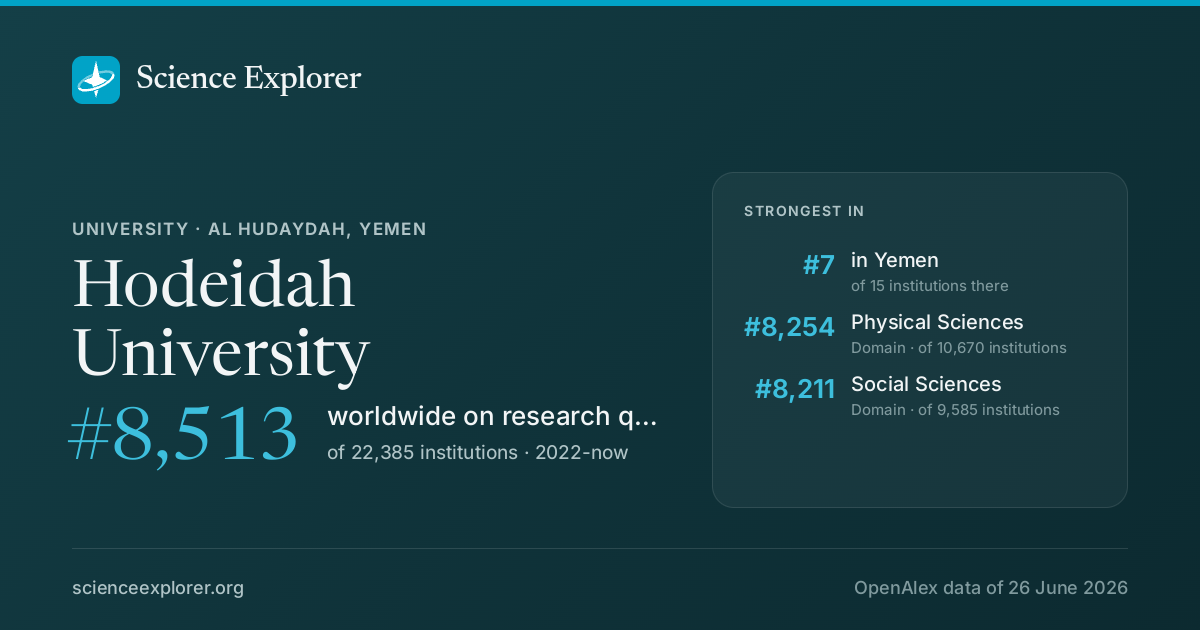
In research, Hodeidah University stands highest in Physical Sciences (#8,254 of 10,670 worldwide) and Social Sciences (#8,211 of 9,585 worldwide), 2022-now. Relative to its size it is most specialised in Mathematics (Mathematics is 10.1× its share of world research).
Each strip is that field's whole ranked pool, with the notch where Hodeidah University sits in it, in the colour
of the band that rank falls in. The track under the rate is the rate itself: it carries no average mark, because the average
differs by field (from about 6% in Dentistry to 21% in Economics).
Which fields of science does Hodeidah University work in?
Life Sciences8%Physical Sciences43%Health Sciences22%Social Sciences27%
Each ring splits the one inside it: the four domains of science, their fields, their subfields. Size is fractional works in 2022-now. Every slice is a page; the interactive view zooms down to single topics and colours each by how much more of it this institution does than the world.
Location quotient, a volume reading rather than an impact one. It surfaces small, lopsided specialities.
Field profile
Location quotient across every field it publishes in: outside the ring is more than an institution of this size would be expected to publish, inside it is less.
more than its size predictsabout as predictedless
Rings at 0.5×, 1× and 2×. Widest outward: Mathematics, 10.1×. Every wedge is a field page.
All 26 fields, with their numbers
Mathematics10.10×31 works
Decision Sciences4.23×11 works
Pharmacology, Toxicology and Pharmaceutics2.34×2 works
Nursing2.14×3 works
Veterinary2.09×1 works
Business, Management and Accounting1.88×16 works
Immunology and Microbiology1.49×4 works
Chemistry1.41×6 works
Environmental Science1.36×18 works
Health Professions1.32×9 works
Earth and Planetary Sciences1.31×5 works
Psychology1.31×10 works
Computer Science1.28×26 works
Arts and Humanities1.10×8 works
Dentistry1.04×1 works
Physics and Astronomy1.02×6 works
Medicine0.87×44 works
Economics, Econometrics and Finance0.82×5 works
Agricultural and Biological Sciences0.63×8 works
Social Sciences0.63×21 works
Biochemistry, Genetics and Molecular Biology0.49×7 works
What are the most cited papers from Hodeidah University?
The most cited paper from Hodeidah University is "Burden of 375 diseases and injuries, risk-attributable burden of 88 risk factors, and healthy life expectancy in 204 countries and territories, including 660 subnational locations, 1990–2023: a systematic analysis for the Global Burden of Disease Study 2023" (Simon I Hay et al., 2025), with 762 citations. Next come "Global burden of 292 causes of death in 204 countries and territories and 660 subnational locations, 1990–2023: a systematic analysis for the Global Burden of Disease Study 2023" (500) and "Green IoT for Eco-Friendly and Sustainable Smart Cities: Future Directions and Opportunities" (373).
Which keywords describe research at Hodeidah University?
By fractional works in 2022-now, weighted toward what it does more of than the world: Nonlinear Equations, Fractional Calculus, Anomalous Diffusion, Homotopy Analysis Method, Epidemiology, Fuzzy Sets, Rough Sets and Decision Making.
▲ more of its work than of the world's◆ about the world's share▼ less than the world's
Size is fractional works in 2022-now in the topics tagged with each word; colour is the word's share of this institution's work against its share of the world's. The 40 words are chosen for being large and distinctive. Each links to the topic it comes from most.
All 40 words, with their numbers
Epidemiology18▲ 1.75×61 topics
Nonlinear Equations14▲ 42×3 topics
Fractional Calculus11▲ 76×2 topics
Anomalous Diffusion11▲ 73×1 topic
Homotopy Analysis Method11▲ 90×1 topic
Machine Learning10▲ 1.17×33 topics
Climate Change9▲ 1.29×24 topics
Corporate Governance8▲ 4.0×13 topics
Fuzzy Sets8▲ 55×2 topics
Rough Sets8▲ 96×2 topics
Decision Making7▲ 9.5×2 topics
Boundary Value Problems7▲ 53×3 topics
Soft Set Theory7▲ 211×1 topic
Topological Spaces7▲ 211×1 topic
Controllability6▲ 55×2 topics
Public Health6▲ 1.58×23 topics
Corpus Linguistics6▲ 11×5 topics
Fractional Differential Equations6▲ 98×1 topic
Nonlinear Systems6▲ 10×2 topics
Semilinear Differential Equations6▲ 98×1 topic
Treatment5▲ 1.65×17 topics
Machine Translation4▲ 8.4×2 topics
Elderly4▲ 5.6×3 topics
Infectious Diseases3▲ 3.8×7 topics
Language Teaching3▲ 4.5×4 topics
Cross-Cultural Communication3▲ 13×2 topics
Translation3▲ 6.9×2 topics
Banach Spaces3▲ 39×2 topics
Cultural Translation3▲ 26×1 topic
Financial Constraints3▲ 11×2 topics
Technology Acceptance Model3▲ 7.1×2 topics
Translator Competence3▲ 26×1 topic
Middle East3▲ 16×2 topics
Financial Reporting3▲ 8.0×3 topics
Numerical Methods3▲ 12×2 topics
Inappropriate Medication Use2▲ 23×1 topic
Polypharmacy2▲ 23×1 topic
Qatar2▲ 52×1 topic
Aquatic Environment2▲ 11×2 topics
Earnings Management2▲ 9.2×2 topics
Which research topics does Hodeidah University publish most on?
Against the world's own shares: the tick on each track. Both are shares of its output, so they
sit on one scale and can be read against each other as well as against the world.
72%28%
openly available71.7%not open28.3%
World: 40% of research is openly available.
66%34%
with international co-authors66.3%domestic only33.7%
World: 18% is written across borders.
How has Hodeidah University's research output changed?
Output in 2022-2025 was 68% higher than in 2018-2021.
grewheldshrank
The same series as a ribbon: one cell per year, darker for more. The line above answers how much; this answers when.
Its share of all research
Growing output can still be a shrinking share: all of science grows. This is Hodeidah University as a percentage of every work published that year, 0.00089% in 2024.
Research measures only: rankings here say nothing about teaching, admissions or student experience. Comparable institutions and collaboration partners have tabs of their own, above.
Discussion
Ask a question or share a note about Hodeidah University. Posts are plain text and can be reported.
 Yemen · #33,148 worldwide
1.4k citations · 60 works