 Science in Albania
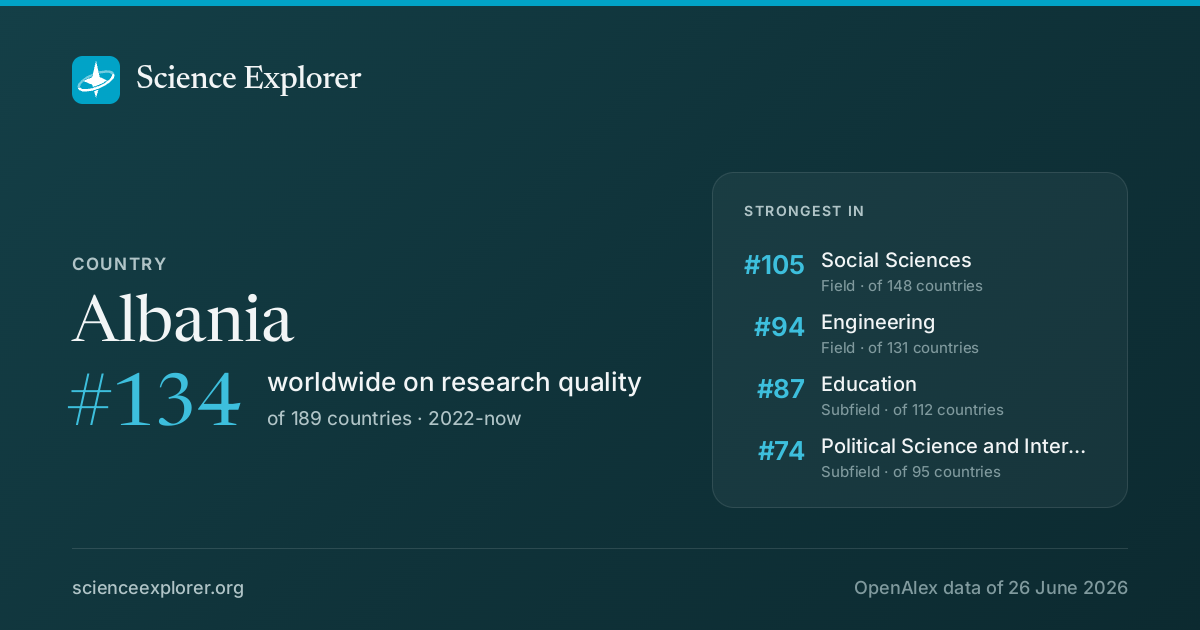
Albania ranks #134 of 189 countries on research quality in 2022-now (#167 all time), with 6.1k research works and 5.7% of them in the world's top 10%.
- World rank, 2022-now
- #134 of 189 · #167 all time
- Works, 2022-now
- 6.1k ▲ 64% vs 2018-21
- Citations
- 91k 4.9 per fractional work, all time
- Top-10% rate
- 5.7% all institutions 10.0%
- vs its own fields
- 0.48× 1.00× is exactly expected
- In the world top 100
- 0 0 in the top 1,000
- Open access
- 75% world 40%
- International
- 25% world 18%
AlbaniaWhat is Albania strongest at in science?
On research quality in 2022-now, Albania ranks highest in Social Sciences (#105 of 148), Engineering (#94 of 131) and Education (#87 of 112). Relative to its size it is most specialised in General Energy, Space and Planetary Science and Cultural Studies.
| Field | World rank | Where that sits | Top-10% rate | Works | All time | Institutions |
|---|---|---|---|---|---|---|
| Social SciencesField | #105 of 148 | 7.1% | 1,411 | #148 | Institutions | |
| EngineeringField | #94 of 131 | 4.0% | 413 | #129 | Institutions | |
| EducationSubfield | #87 of 112 | 11.9% | 208 | #112 | ||
| Political Science and International RelationsSubfield | #74 of 95 | 6.5% | 336 | #100 | Institutions | |
| Economics, Econometrics and FinanceField | #86 of 107 | 6.4% | 402 | #109 | Institutions | |
| Arts and HumanitiesField | #84 of 103 | 6.0% | 339 | #118 | Institutions | |
| Environmental ScienceField | #100 of 122 | 4.6% | 342 | #133 | Institutions | |
| Economics and EconometricsSubfield | #82 of 98 | 6.2% | 301 | #101 | ||
| Health ProfessionsField | #89 of 106 | 7.0% | 206 | #114 | ||
| Sociology and Political ScienceSubfield | #102 of 119 | 5.6% | 355 | #127 | Institutions | |
| Agricultural and Biological SciencesField | #108 of 124 | 7.9% | 230 | #139 | Institutions | |
| Computer ScienceField | #114 of 128 | 5.5% | 428 | #130 | Institutions |
Where its research is concentrated
Location quotient: how much more (or less) of each node it does than its size predicts. Drawn around 1×, where "twice the world share" and "half of it" are the same distance apart in opposite directions. A volume reading, which on a country axis is largely population and industrial structure.
- General EnergySubfield · 13.8 works · #72 of 167 active here7.1×
- Space and Planetary ScienceSubfield · 7.8 works · #64 of 158 active here5.4×
- Cultural StudiesSubfield · 152.3 works · #63 of 211 active here5.2×
- Tourism, Leisure and Hospitality ManagementSubfield · 7.3 works · #73 of 165 active here4.5×
- Language and LinguisticsSubfield · 132.8 works · #79 of 213 active here4.2×
- ArchitectureSubfield · 11.2 works · #72 of 166 active here4.0×
- Political Science and International RelationsSubfield · 371.2 works · #84 of 219 active here3.5×
- MusicSubfield · 20.4 works · #73 of 174 active here3.5×
The whole field profile
All 26 fields at once. A specialist and a generalist produce the same ranked list and a completely different shape.
Rings at 0.5×, 1× and 2×. Widest outward: Economics, Econometrics and Finance, 2.9×. Every wedge is a field page.
All 26 fields, with their numbers
- Economics, Econometrics and Finance2.85×438 works
- Arts and Humanities1.93×401 works
- Business, Management and Accounting1.87×434 works
- Social Sciences1.81×1,651 works
- Dentistry1.69×59 works
- Decision Sciences1.64×114 works
- Mathematics1.27×108 works
- Psychology1.27×280 works
- Health Professions1.26×240 works
- Environmental Science1.15×410 works
- Nursing0.91×32 works
- Computer Science0.90×505 works
- Medicine0.89×1,226 works
- Earth and Planetary Sciences0.86×97 works
- Agricultural and Biological Sciences0.77×265 works
- Energy0.69×46 works
- Immunology and Microbiology0.52×38 works
- Veterinary0.50×5 works
- Pharmacology, Toxicology and Pharmaceutics0.47×12 works
- Engineering0.47×504 works
- Neuroscience0.44×51 works
- Biochemistry, Genetics and Molecular Biology0.39×151 works
- Chemical Engineering0.33×8 works
- Chemistry0.31×34 works
- Physics and Astronomy0.28×45 works
- Materials Science0.18×46 works
Which fields of science does Albania work in?
In 2022-now, 46% of research in Albania is in Social Sciences, 25% in Physical Sciences. Its largest fields are Social Sciences (23%), Medicine (17%), Computer Science (7%). It does 1.9× the world's share of Social Sciences.
Each ring splits the one inside it: the four domains of science, their fields, their subfields. Size is fractional works in 2022-now. Every slice is a page; the interactive view zooms down to single topics and colours each by how much more of it this country does than the world.
Its 4 domains and 26 fields, with their numbers
- Social Sciences3,31846.1%
- Social Sciences1,65122.9%
- Economics, Econometrics and Finance4386.1%
- Business, Management and Accounting4346.0%
- Arts and Humanities4015.6%
- Psychology2803.9%
- Decision Sciences1141.6%
- Physical Sciences1,80425.1%
- Computer Science5057.0%
- Engineering5047.0%
- Environmental Science4105.7%
- Mathematics1071.5%
- Earth and Planetary Sciences971.4%
- Materials Science460.6%
- Energy460.6%
- Physics and Astronomy450.6%
- Chemistry340.5%
- Chemical Engineering80.1%
- Health Sciences1,56121.7%
- Medicine1,22617.0%
- Health Professions2403.3%
- Dentistry590.8%
- Nursing320.4%
- Veterinary50.1%
- Life Sciences5167.2%
Which keywords describe research in Albania?
By fractional works in 2022-now, weighted toward what it does more of than the world: Globalization, Human Rights, Nationalism, Sustainable Development, Economic Growth, Balkans, Conflict and Identity.
- Knowledge Economy
- European Legal Systems
- Constitutionalism
- Judicial Review
- Regional Development
- Social Capital
- Global Governance
- Governance
- European Union
- Post-war
- Innovation
- Memory
- Conflict
- Ethnicity
- Artificial Intelligence
- Nationalism
- Climate Change
- Machine Learning
- Sustainability
- Epidemiology
- Globalization
- Sustainable Development
- Human Rights
- Economic Growth
- Identity
- Religion
- Balkans
- Education
- Mental Health
- Renewable Energy
- Eastern Europe
- Yugoslavia
- Economic Development
- Democracy
- International Law
- Environmental Management
- Labor Market
- Fiscal Policy
- ECHR
- Geopolitics
Size is fractional works in 2022-now in the topics tagged with each word; colour is the word's share of this country's work against its share of the world's. The 40 words are chosen for being large and distinctive. Each links to the topic it comes from most.
All 40 words, with their numbers
- Globalization357▲ 2.5×125 topics
- Epidemiology302◆ 1.05×130 topics
- Sustainable Development292▲ 2.6×90 topics
- Sustainability290▲ 1.65×10³ topics
- Human Rights262▲ 3.5×72 topics
- Machine Learning245◆ 1.02×87 topics
- Economic Growth231▲ 3.9×33 topics
- Climate Change228▲ 1.17×10⁸ topics
- Identity211▲ 4.0×52 topics
- Nationalism194▲ 6.0×26 topics
- Religion172▲ 5.2×30 topics
- Artificial Intelligence168▲ 1.64×51 topics
- Balkans165▲ 99×2 topics
- Ethnicity165▲ 6.1×19 topics
- Education158▲ 1.28×97 topics
- Conflict158▲ 14×11 topics
- Mental Health152▲ 1.48×42 topics
- Memory152▲ 8.6×15 topics
- Renewable Energy151▲ 1.45×47 topics
- Innovation139▲ 1.86×65 topics
- Eastern Europe138▲ 37×2 topics
- Post-war136▲ 162×1 topic
- Yugoslavia136▲ 162×1 topic
- European Union126▲ 7.8×23 topics
- Economic Development120▲ 2.1×42 topics
- Governance117▲ 5.0×12 topics
- Democracy106▲ 4.2×19 topics
- Global Governance98▲ 5.7×22 topics
- International Law96▲ 4.2×24 topics
- Social Capital96▲ 2.6×18 topics
- Environmental Management90▲ 3.1×16 topics
- Regional Development89▲ 3.6×16 topics
- Labor Market80▲ 3.9×16 topics
- Judicial Review78▲ 13×3 topics
- Fiscal Policy76▲ 5.2×9 topics
- Constitutionalism67▲ 11×2 topics
- ECHR67▲ 27×1 topic
- European Legal Systems67▲ 27×1 topic
- Geopolitics64▲ 5.8×10 topics
- Knowledge Economy62▲ 8.0×9 topics
Which research topics does Albania publish the most in?
Its largest topics in 2022-now are Balkans: History, Politics, Society, European and International Law Studies, Diverse Aspects of Tourism Research.
Area is fractional works in 2022-now; colour is the subfield each topic belongs to. Every tile is a topic page.
- 1 Balkans: History, Politics, Society Cultural Studies 136 works
- 2 European and International Law Studies Political Science and International Relations 67 works
- 3 Diverse Aspects of Tourism Research Sociology and Political Science 33 works
- 4 Technology-Enhanced Education Studies Education 32 works
- 5 Linguistics, Language Diversity, and Identity Language and Linguistics 30 works
- 6 Translation Studies and Practices Language and Linguistics 30 works
- 7 European Politics and Security Political Science and International Relations 29 works
- 8 Business and Economic Development Management, Monitoring, Policy and Law 28 works
- 9 Economic Growth and Development Information Systems 27 works
- 10 COVID-19 Pandemic Impacts Economics and Econometrics 26 works
- 11 Regional Development and Management Studies Economics and Econometrics 26 works
- 12 Entrepreneurship Studies and Influences Management of Technology and Innovation 26 works
Which universities in Albania lead research?
University of Tirana, Aleksandër Moisiu University and University of Arts rank highest in Albania on research quality in 2022-now.
One dot per institution in the list below. The upper left is the interesting corner.
- 1University of TiranaUniversity · Tirana · #5,989 worldwide5.0% top 10% · 907 works
- 2Aleksandër Moisiu UniversityUniversity · Durrës · #6,152 worldwide8.3% top 10% · 693 works
- 3University of ArtsUniversity · Tirana · #7,294 worldwide7.6% top 10% · 253 works
- 4Polytechnic University of TiranaUniversity · Tirana · #7,693 worldwide4.7% top 10% · 471 works
- 5Albanian UniversityUniversity · Tirana · #8,467 worldwide6.0% top 10% · 280 works
- 6University of ElbasanUniversity · Elbasan · #9,172 worldwide7.1% top 10% · 182 works
- 7European University of TiranaUniversity · Tirana · #9,269 worldwide3.3% top 10% · 300 works
- 8University of Vlora "Ismail Qemali"University · Vlorë · #9,278 worldwide6.9% top 10% · 208 works
- 9Epoka UniversityUniversity · Tirana · #9,759 worldwide8.5% top 10% · 199 works
- 10Agricultural University of TiranaUniversity · Tirana · #10,060 worldwide9.9% top 10% · 262 works
- 11Polis UniversityUniversity · Tirana · #10,284 worldwide2.0% top 10% · 215 works
- 12Academy of Sciences of AlbaniaResearch facility · Tirana · #10,531 worldwide5.7% top 10% · 167 works
- 13University of Medicine TiranaUniversity · Tirana · #10,879 worldwide3.7% top 10% · 472 works
- 14University of Shkodra "Luigj Gurakuqi"University · Shkodër · #13,218 worldwide3.9% top 10% · 171 works
- 15Catholic University Our Lady of Good CounselUniversity · Tirana · #14,063 worldwide13.4% top 10% · 129 works

The track on each row is its top-10% rate; the tick is the average of all institutions, 10.0% (how it is set): teal above it, red below.
All ranked institutions in AlbaniaWho are the top researchers in Albania?
Enkeleint Aggelos Mechili, Iris Hoxha and Eglantina Hysa rank highest among researchers based in Albania.
- 1 Enkeleint Aggelos Mechili #183,280 worldwide 15k citations · 108 works
- 2 Iris Hoxha #190,137 worldwide 2.9k citations · 34 works
- 3 Eglantina Hysa #227,622 worldwide 2k citations · 99 works
- 4 Naltin Shuka #367,228 worldwide 17k citations · 27 works
- 5 Skënder Topi #454,509 worldwide 2.3k citations · 68 works
- 6 Blerina Duka #569,672 worldwide 226 citations · 38 works
- 7 Ana Uka #589,026 worldwide 371 citations · 28 works
- 8 Jolanda Hyska #590,847 worldwide 13k citations · 49 works
- 9 Artan Hysa #697,015 worldwide 705 citations · 46 works
- 10 Juel Jarani #736,293 worldwide 12k citations · 45 works
How open and international is Albania's research?
75% of its research is openly available (world: 40%), and 25% is written with international co-authors (world: 18%).
World: 40% of research is openly available.
World: 18% is written across borders.
In 2022-now, 82% of its research is openly available (world 63%) and 24% is written with co-authors abroad (world 22%). Against what its own mix of topics predicts, that is 1.22× the expected open access and 1.16× the expected international share, which puts it #48 of 173 countries on openness.
How has Albania's research grown?
Output in 2022-2025 was 64% higher than in 2018-2021.
The same series as a ribbon: one cell per year, darker for more. The line above answers how much; this answers when.
Its share of all research
Growing output can still be a shrinking share: all of science grows. This is Albania as a percentage of every work published that year, 0.028% in 2024.
Fractional works of Albania over all fractional works that year. How the balance of science has shifted.
How much of it reaches the world top 10%
Over the whole record, 4.7% of its 19k works since 1950 reached the world top 10% for their field and year.
Of each year's output, the share that reached the world's 10% most cited for its field and year. Peak 7.2% in 1991.
Which countries have research most like Albania's?
Kosovo is Albania's closest research twin: of all countries, its research is spread across the fields most like Albania's, with both strong in Economics, Econometrics and Finance.
- 1
 KosovoBoth strong in Economics, Econometrics and Finance, Business, Management and Accounting, Social Sciences
0.88 Compare
- 2
 PeruBoth strong in Economics, Econometrics and Finance, Business, Management and Accounting, Social Sciences
0.86 Compare
- 3
 AfghanistanBoth strong in Social Sciences, Economics, Econometrics and Finance, Dentistry
0.86 Compare
- 4
 Dominican RepublicBoth strong in Social Sciences, Dentistry, Arts and Humanities
0.85 Compare
- 5
 KyrgyzstanBoth strong in Economics, Econometrics and Finance, Arts and Humanities, Social Sciences
0.84 Compare
Similarity is the correlation of each side's location quotients across every field it publishes in, on a log scale: 1 is the same shape of research, 0 is unrelated. It ignores size. How it is measured.
Compare Albania with
 Cameroon
 Belarus
 Liberia
 Jamaica
 Republic of the Congo
 New Caledonia
Share Albania's ranking
Badges for a website1Each links back here and updates with every snapshot

Research fields in Albania
- Social Sciences
- Social Sciences
- Engineering
- Political Science and International Relations
- Physical Sciences
- Economics, Econometrics and Finance
- Arts and Humanities
- Environmental Science
- Sociology and Political Science
- Agricultural and Biological Sciences
- Computer Science
- Business, Management and Accounting
- Life Sciences
- Health Sciences
- Medicine
Discussion
Ask a question or share a note about Albania. Posts are plain text and can be reported.