 Science in Kyrgyzstan
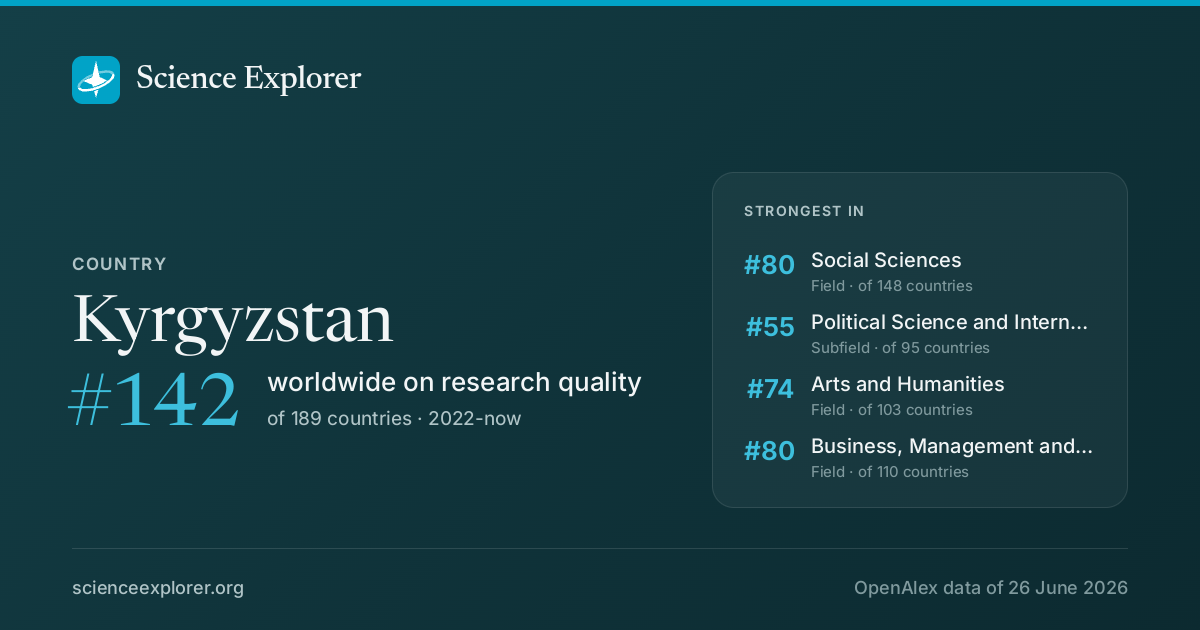
Kyrgyzstan ranks #142 of 189 countries on research quality in 2022-now (#162 all time), with 6.4k research works and 5.1% of them in the world's top 10%.
- World rank, 2022-now
- #142 of 189 · #162 all time
- Works, 2022-now
- 6.4k ▲ 87% vs 2018-21
- Citations
- 34k 2.6 per fractional work, all time
- Top-10% rate
- 5.1% all institutions 10.0%
- vs its own fields
- 0.41× 1.00× is exactly expected
- In the world top 100
- 0 0 in the top 1,000
- Open access
- 73% world 40%
- International
- 25% world 18%
KyrgyzstanWhat is Kyrgyzstan strongest at in science?
On research quality in 2022-now, Kyrgyzstan ranks highest in Social Sciences (#80 of 148), Political Science and International Relations (#55 of 95) and Arts and Humanities (#74 of 103). Relative to its size it is most specialised in Anatomy, Fuel Technology and Archeology.
| Field | World rank | Where that sits | Top-10% rate | Works | All time | Institutions |
|---|---|---|---|---|---|---|
| Social SciencesField | #80 of 148 | 7.0% | 1,935 | #96 | Institutions | |
| Political Science and International RelationsSubfield | #55 of 95 | 9.3% | 436 | #74 | Institutions | |
| Arts and HumanitiesField | #74 of 103 | 9.5% | 373 | #103 | Institutions | |
| Business, Management and AccountingField | #80 of 110 | 7.5% | 222 | #99 | ||
| EducationSubfield | #82 of 112 | 5.6% | 642 | #94 | Institutions | |
| Sociology and Political ScienceSubfield | #89 of 119 | 6.5% | 321 | #98 | ||
| Economics, Econometrics and FinanceField | #84 of 107 | 6.4% | 309 | #107 | Institutions | |
| PsychologyField | #86 of 106 | 3.3% | 220 | - | Institutions | |
| Environmental ScienceField | #101 of 122 | 4.1% | 229 | #120 | ||
| Information SystemsSubfield | #76 of 90 | 3.5% | 316 | #94 | Institutions | |
| Economics and EconometricsSubfield | #83 of 98 | 6.0% | 231 | #99 | Institutions | |
| Computer ScienceField | #116 of 128 | 4.0% | 503 | #129 | Institutions |
Where its research is concentrated
Location quotient: how much more (or less) of each node it does than its size predicts. Drawn around 1×, where "twice the world share" and "half of it" are the same distance apart in opposite directions. A volume reading, which on a country axis is largely population and industrial structure.
- AnatomySubfield · 30.4 works · #28 of 159 active here16×
- Fuel TechnologySubfield · 6.5 works · #27 of 113 active here10×
- ArcheologySubfield · 11.5 works · #49 of 158 active here9.6×
- General EnergySubfield · 14.8 works · #68 of 167 active here7.0×
- Numerical AnalysisSubfield · 44.8 works · #58 of 173 active here6.7×
- MuseologySubfield · 61.3 works · #55 of 190 active here6.4×
- Nuclear Energy and EngineeringSubfield · 3.2 works · #45 of 121 active here6.0×
- Emergency MedicineSubfield · 110.8 works · #63 of 212 active here5.8×
The whole field profile
All 26 fields at once. A specialist and a generalist produce the same ranked list and a completely different shape.
Rings at 0.5×, 1× and 2×. Widest outward: Social Sciences, 2.3×. Every wedge is a field page.
All 26 fields, with their numbers
- Social Sciences2.33×2,300 works
- Economics, Econometrics and Finance2.19×365 works
- Arts and Humanities1.91×429 works
- Mathematics1.90×174 works
- Psychology1.19×282 works
- Veterinary1.15×12 works
- Business, Management and Accounting1.06×265 works
- Computer Science1.02×617 works
- Medicine0.92×1,372 works
- Agricultural and Biological Sciences0.87×322 works
- Health Professions0.83×171 works
- Dentistry0.75×28 works
- Environmental Science0.73×283 works
- Immunology and Microbiology0.72×56 works
- Earth and Planetary Sciences0.70×86 works
- Energy0.69×49 works
- Decision Sciences0.65×49 works
- Nursing0.64×24 works
- Pharmacology, Toxicology and Pharmaceutics0.55×15 works
- Neuroscience0.45×57 works
- Engineering0.45×527 works
- Biochemistry, Genetics and Molecular Biology0.41×170 works
- Physics and Astronomy0.31×53 works
- Chemistry0.21×25 works
- Materials Science0.20×55 works
- Chemical Engineering0.16×4 works
Which fields of science does Kyrgyzstan work in?
In 2022-now, 47% of research in Kyrgyzstan is in Social Sciences, 24% in Physical Sciences. Its largest fields are Social Sciences (30%), Medicine (18%), Computer Science (8%). It does 1.9× the world's share of Social Sciences.
Each ring splits the one inside it: the four domains of science, their fields, their subfields. Size is fractional works in 2022-now. Every slice is a page; the interactive view zooms down to single topics and colours each by how much more of it this country does than the world.
Its 4 domains and 26 fields, with their numbers
- Social Sciences3,69047.4%
- Social Sciences2,30029.5%
- Arts and Humanities4295.5%
- Economics, Econometrics and Finance3654.7%
- Psychology2813.6%
- Business, Management and Accounting2653.4%
- Decision Sciences490.6%
- Physical Sciences1,87424.0%
- Computer Science6177.9%
- Engineering5276.8%
- Environmental Science2833.6%
- Mathematics1742.2%
- Earth and Planetary Sciences861.1%
- Materials Science550.7%
- Physics and Astronomy530.7%
- Energy490.6%
- Chemistry250.3%
- Chemical Engineering40.1%
- Health Sciences1,60820.6%
- Medicine1,37217.6%
- Health Professions1712.2%
- Dentistry280.4%
- Nursing240.3%
- Veterinary120.2%
- Life Sciences6218.0%
Which keywords describe research in Kyrgyzstan?
By fractional works in 2022-now, weighted toward what it does more of than the world: Education, Innovation, Pedagogy, Sustainable Development, Globalization, Educational Technology, Digital Education and E-Learning.
- Russia-China cooperation
- Soft Power
- Language
- Distance Learning
- Geopolitics
- Digital Transformation
- Student Competencies
- Formative Assessment
- International Relations
- Teaching Methods
- Central Asia
- Social Media
- Public Health
- Economic Development
- Digital Economy
- Online Learning
- E-Learning
- Pedagogy
- Innovation
- Globalization
- Education
- Sustainable Development
- Educational Technology
- Sustainability
- Climate Change
- Digital Education
- Artificial Intelligence
- Educational Technologies
- Language Teaching
- Teacher Training
- Tourism Development
- Critical Thinking
- Entrepreneurship
- Artistic Education
- Cultural Diplomacy
- Migration
- Security
- Digitalization
- Belt and Road Initiative
- Eurasian integration
Size is fractional works in 2022-now in the topics tagged with each word; colour is the word's share of this country's work against its share of the world's. The 40 words are chosen for being large and distinctive. Each links to the topic it comes from most.
All 40 words, with their numbers
- Education583▲ 4.3×88 topics
- Globalization536▲ 3.5×10³ topics
- Sustainable Development521▲ 4.3×91 topics
- Innovation487▲ 6.1×59 topics
- Educational Technology440▲ 4.8×42 topics
- Pedagogy407▲ 10×17 topics
- Sustainability373▲ 1.96×98 topics
- E-Learning359▲ 4.8×23 topics
- Climate Change352▲ 1.66×10⁷ topics
- Online Learning304▲ 4.7×23 topics
- Digital Education302▲ 26×6 topics
- Digital Economy282▲ 18×17 topics
- Artificial Intelligence280▲ 2.5×61 topics
- Economic Development279▲ 4.5×38 topics
- Educational Technologies274▲ 39×2 topics
- Public Health272▲ 2.4×57 topics
- Language Teaching267▲ 13×8 topics
- Social Media256▲ 2.4×32 topics
- Teacher Training255▲ 5.3×21 topics
- Central Asia253▲ 46×4 topics
- Tourism Development246▲ 23×2 topics
- Teaching Methods241▲ 19×10 topics
- Critical Thinking237▲ 26×4 topics
- International Relations237▲ 13×25 topics
- Entrepreneurship235▲ 7.6×14 topics
- Formative Assessment233▲ 36×2 topics
- Artistic Education232▲ 46×1 topic
- Student Competencies232▲ 46×1 topic
- Cultural Diplomacy224▲ 35×5 topics
- Digital Transformation222▲ 5.3×26 topics
- Migration219▲ 8.2×22 topics
- Geopolitics214▲ 18×10 topics
- Security205▲ 3.9×26 topics
- Distance Learning205▲ 7.6×10 topics
- Digitalization203▲ 13×13 topics
- Language192▲ 9.9×11 topics
- Belt and Road Initiative182▲ 61×3 topics
- Soft Power146▲ 46×3 topics
- Eurasian integration142▲ 153×1 topic
- Russia-China cooperation142▲ 153×1 topic
Which research topics does Kyrgyzstan publish the most in?
Its largest topics in 2022-now are Education, Innovation and Language Studies, Central Asia Education and Culture, Economic and Industrial Development.
Area is fractional works in 2022-now; colour is the subfield each topic belongs to. Every tile is a topic page.
- 1 Education, Innovation and Language Studies Education 232 works
- 2 Central Asia Education and Culture Political Science and International Relations 142 works
- 3 Economic and Industrial Development Economics and Econometrics 131 works
- 4 Foreign Language Teaching Methods Education 99 works
- 5 Emergency Medicine Education and Research Emergency Medicine 89 works
- 6 Soviet and Russian History Political Science and International Relations 77 works
- 7 Linguistics and Cultural Studies Language and Linguistics 77 works
- 8 Educational Innovations and Challenges Information Systems 76 works
- 9 Healthcare Systems and Public Health Epidemiology 71 works
- 10 Regional Socio-Economic Development Trends Demography 66 works
- 11 Psychology of Development and Education Developmental and Educational Psychology 56 works
- 12 Language, Communication, and Linguistic Studies Communication 56 works
Which universities in Kyrgyzstan lead research?
Kyrgyz State National University, Kyrgyz-Türkish Manas Üniversity and Osh State University rank highest in Kyrgyzstan on research quality in 2022-now.
One dot per institution in the list below. The upper left is the interesting corner.
- 1Kyrgyz State National UniversityUniversity · Bishkek · #1,780 worldwide2.5% top 10% · 1.2k works
- 2Kyrgyz-Türkish Manas ÜniversityUniversity · Bishkek · #4,489 worldwide8.5% top 10% · 716 works
- 3Osh State UniversityUniversity · Osh · #7,035 worldwide4.4% top 10% · 914 works
- 4Aga Khan FoundationNonprofit · Bishkek · #7,658 worldwide6.4% top 10% · 285 works
- 5University of Central AsiaUniversity · Bishkek · #8,157 worldwide12.5% top 10% · 219 works
- 6International University of KyrgyzstanUniversity · Bishkek · #8,495 worldwide6.7% top 10% · 311 works
- 7Kyrgyz State Technical UniversityUniversity · Bishkek · #8,626 worldwide5.5% top 10% · 275 works
- 8Kyrgyz National UniversityUniversity · Bishkek · #8,661 worldwide6.3% top 10% · 351 works
- 9National Academy of Sciences of the Republic of KyrgyzstanResearch facility · Bishkek · #10,233 worldwide4.1% top 10% · 151 works
- 10Osh Technological UniversityUniversity · Osh · #10,606 worldwide2.7% top 10% · 219 works
- 11Kyrgyz-Russian Slavic University named after B.N. YeltsinUniversity · Bishkek · #10,656 worldwide3.8% top 10% · 218 works
- 12Jalalabad State UniversityUniversity · Jalal-Abad · #12,810 worldwide6.8% top 10% · 126 works
- 13Kyrgyz State Medical AcademyHospital / health system · Bishkek · #14,318 worldwide1.4% top 10% · 450 works
- 14Ala-Too International UniversityUniversity · Bishkek · #14,551 worldwide11.6% top 10% · 114 works
- 15Kyrgyz State University of Construction, Transport and Architecture named after N. IsanovUniversity · Bishkek · #15,443 worldwide2.9% top 10% · 116 works
The track on each row is its top-10% rate; the tick is the average of all institutions, 10.0% (how it is set): teal above it, red below.
All ranked institutions in KyrgyzstanWho are the top researchers in Kyrgyzstan?
Erkin Mirsaidovich Mirrakhimov, Alina S Kerimkulova and Kashif Hasan Khan rank highest among researchers based in Kyrgyzstan.
- 1 Erkin Mirsaidovich Mirrakhimov #910 worldwide 238k citations · 309 works
- 2 Alina S Kerimkulova #184,365 worldwide 54k citations · 73 works
- 3 Kashif Hasan Khan #402,554 worldwide 217 citations · 36 works
- 4 Kubatbek Sh. Tabaldiev #510,674 worldwide 2.5k citations · 44 works
- 5 Ayman Aljarbouh #536,372 worldwide 1.2k citations · 66 works
- 6 Bakhytzhan Kurmanov #679,009 worldwide 158 citations · 26 works
- 7 Vitalii Zaginaev #698,035 worldwide 367 citations · 25 works
- 8 Shujaat Naeem Azmi #766,036 worldwide 220 citations · 26 works
- 9 Alexander V. Zubovich #841,648 worldwide 1.6k citations · 35 works
- 10 Olga Sergeevna Lunegova #944,682 worldwide 19k citations · 59 works
How open and international is Kyrgyzstan's research?
73% of its research is openly available (world: 40%), and 25% is written with international co-authors (world: 18%).
World: 40% of research is openly available.
World: 18% is written across borders.
In 2022-now, 77% of its research is openly available (world 63%) and 22% is written with co-authors abroad (world 22%). Against what its own mix of topics predicts, that is 1.05× the expected open access and 1.30× the expected international share, which puts it #132 of 173 countries on openness.
How has Kyrgyzstan's research grown?
Output in 2022-2025 was 87% higher than in 2018-2021.
The same series as a ribbon: one cell per year, darker for more. The line above answers how much; this answers when.
Its share of all research
Growing output can still be a shrinking share: all of science grows. This is Kyrgyzstan as a percentage of every work published that year, 0.030% in 2024.
Fractional works of Kyrgyzstan over all fractional works that year. How the balance of science has shifted.
How much of it reaches the world top 10%
Over the whole record, 5.2% of its 13k works since 1950 reached the world top 10% for their field and year.
Of each year's output, the share that reached the world's 10% most cited for its field and year. Peak 11.2% in 2012.
Which countries have research most like Kyrgyzstan's?
Afghanistan is Kyrgyzstan's closest research twin: of all countries, its research is spread across the fields most like Kyrgyzstan's, with both strong in Social Sciences.
- 1
 AfghanistanBoth strong in Social Sciences, Economics, Econometrics and Finance, Arts and Humanities
0.84 Compare
- 2
 AlbaniaBoth strong in Economics, Econometrics and Finance, Arts and Humanities, Social Sciences
0.84 Compare
- 3
 HondurasBoth strong in Economics, Econometrics and Finance, Social Sciences, Mathematics
0.84 Compare
- 4
 Cape VerdeBoth strong in Social Sciences, Economics, Econometrics and Finance, Mathematics
0.83 Compare
- 5
 Bosnia and HerzegovinaBoth strong in Economics, Econometrics and Finance, Arts and Humanities, Social Sciences
0.82 Compare
Similarity is the correlation of each side's location quotients across every field it publishes in, on a log scale: 1 is the same shape of research, 0 is unrelated. It ignores size. How it is measured.
Compare Kyrgyzstan with
 Trinidad and Tobago
 Monaco
 Bhutan
 São Tomé and Príncipe
 Tunisia
 French Guiana
Share Kyrgyzstan's ranking
Badges for a website1Each links back here and updates with every snapshot

Research fields in Kyrgyzstan
- Social Sciences
- Social Sciences
- Political Science and International Relations
- Arts and Humanities
- Education
- Physical Sciences
- Economics, Econometrics and Finance
- Psychology
- Information Systems
- Economics and Econometrics
- Computer Science
- Engineering
- Life Sciences
- Agricultural and Biological Sciences
- Health Sciences
- Medicine
Discussion
Ask a question or share a note about Kyrgyzstan. Posts are plain text and can be reported.