 Science in Cape Verde
Cape Verde ranks #177 of 189 countries on research quality in 2022-now (#165 all time), with 240 research works and 6.8% of them in the world's top 10%.
- World rank, 2022-now
- #177 of 189 · #165 all time
- Works, 2022-now
- 240 ▲ 39% vs 2018-21
- Citations
- 4.1k 4.6 per fractional work, all time
- Top-10% rate
- 6.8% all institutions 10.0%
- vs its own fields
- 0.93× 1.00× is exactly expected
- In the world top 100
- 0 0 in the top 1,000
- Open access
- 79% world 40%
- International
- 47% world 18%
Cape VerdeWhich fields of science does Cape Verde work in?
In 2022-now, 46% of research in Cape Verde is in Social Sciences, 28% in Physical Sciences. Its largest fields are Social Sciences (29%), Environmental Science (15%), Medicine (11%). It does 1.8× the world's share of Social Sciences.
Each ring splits the one inside it: the four domains of science, their fields, their subfields. Size is fractional works in 2022-now. Every slice is a page; the interactive view zooms down to single topics and colours each by how much more of it this country does than the world.
Its 4 domains and 25 fields, with their numbers
- Social Sciences12546.3%
- Social Sciences7929.4%
- Business, Management and Accounting114.2%
- Economics, Econometrics and Finance114.1%
- Arts and Humanities103.8%
- Psychology103.6%
- Decision Sciences31.0%
- Physical Sciences7628.3%
- Environmental Science4014.8%
- Engineering124.4%
- Computer Science114.1%
- Mathematics62.4%
- Earth and Planetary Sciences41.4%
- Physics and Astronomy20.6%
- Energy10.5%
- Materials Science00.1%
- Chemical Engineering00.0%
- Chemistry00.0%
- Health Sciences4115.3%
- Medicine2910.9%
- Health Professions103.8%
- Nursing10.5%
- Dentistry00.1%
- Life Sciences2710.1%
Which keywords describe research in Cape Verde?
By fractional works in 2022-now, weighted toward what it does more of than the world: Climate Change, Globalization, Sustainability, Public Policy, Sustainable Development, Colonialism, Rural Development and Public Health.
- Post-Colonial Africa
- Gender Dynamics
- Marine Spatial Planning
- Stakeholder Engagement
- Community Development
- Social Inequality
- Economic Impact
- Biodiversity Conservation
- Conservation
- Healthcare Access
- Economic Growth
- Population Dynamics
- Community Participation
- COVID-19
- Mental Health
- Rural Development
- Education
- Public Health
- Epidemiology
- Sustainability
- Climate Change
- Globalization
- Sustainable Development
- Public Policy
- Colonialism
- Governance
- Qualitative Research
- Urban Development
- Social Impact
- Biodiversity
- Sustainable Development Goals
- Teacher Training
- Cultural Studies
- Food Security
- Vulnerability
- Imperialism
- Ecosystem Health
- Ecosystem-Based Management
- Environmental Education
- African History
Size is fractional works in 2022-now in the topics tagged with each word; colour is the word's share of this country's work against its share of the world's. The 40 words are chosen for being large and distinctive. Each links to the topic it comes from most.
All 40 words, with their numbers
- Climate Change23▲ 3.1×45 topics
- Sustainability19▲ 2.9×37 topics
- Globalization19▲ 3.6×41 topics
- Epidemiology15▲ 1.42×43 topics
- Sustainable Development15▲ 3.5×32 topics
- Public Health13▲ 3.3×26 topics
- Public Policy11▲ 8.9×16 topics
- Education10▲ 2.2×27 topics
- Colonialism9▲ 7.2×11 topics
- Rural Development9▲ 9.4×12 topics
- Governance8▲ 9.5×9 topics
- Mental Health8▲ 2.1×17 topics
- Qualitative Research8▲ 3.5×11 topics
- COVID-198▲ 2.2×16 topics
- Urban Development8▲ 7.9×8 topics
- Community Participation7▲ 7.8×8 topics
- Social Impact7▲ 7.0×9 topics
- Population Dynamics7▲ 10×9 topics
- Biodiversity7▲ 3.5×17 topics
- Economic Growth7▲ 3.0×12 topics
- Sustainable Development Goals7▲ 14×5 topics
- Healthcare Access6▲ 8.9×8 topics
- Teacher Training6▲ 3.9×10 topics
- Conservation6▲ 5.5×11 topics
- Cultural Studies6▲ 6.3×7 topics
- Biodiversity Conservation6▲ 5.6×11 topics
- Food Security6▲ 3.9×11 topics
- Economic Impact6▲ 3.8×5 topics
- Vulnerability5▲ 8.6×6 topics
- Social Inequality5▲ 6.9×7 topics
- Imperialism5▲ 24×3 topics
- Community Development5▲ 9.6×4 topics
- Ecosystem Health5▲ 36×2 topics
- Stakeholder Engagement5▲ 19×2 topics
- Ecosystem-Based Management4▲ 51×1 topic
- Marine Spatial Planning4▲ 51×1 topic
- Environmental Education4▲ 10×5 topics
- Gender Dynamics4▲ 14×2 topics
- African History4▲ 65×1 topic
- Post-Colonial Africa4▲ 65×1 topic
Which research topics does Cape Verde publish the most in?
Its largest topics in 2022-now are Coastal and Marine Management, African history and culture studies, Social and Economic Solidarity.
Area is fractional works in 2022-now; colour is the subfield each topic belongs to. Every tile is a topic page.
- 1 Coastal and Marine Management Management, Monitoring, Policy and Law 4 works
- 2 African history and culture studies Anthropology 4 works
- 3 Social and Economic Solidarity Sociology and Political Science 3 works
- 4 Health, Nursing, Elderly Care General Health Professions 3 works
- 5 Business, Innovation, and Economy Economics and Econometrics 3 works
- 6 International Development and Aid Development 3 works
- 7 Turtle Biology and Conservation Nature and Landscape Conservation 2 works
- 8 Island Studies and Pacific Affairs Demography 2 works
- 9 Urban and Rural Development Challenges Urban Studies 2 works
- 10 Coral and Marine Ecosystems Studies Ecology 2 works
- 11 Environmental Sustainability and Education Management, Monitoring, Policy and Law 2 works
- 12 Education during COVID-19 pandemic Education 2 works
Which universities in Cape Verde lead research?
University of Cape Verde rank highest in Cape Verde on research quality in 2022-now.
- 1University of Cape VerdeUniversity · Praia · #12,927 worldwide8.1% top 10% · 129 works
The track on each row is its top-10% rate; the tick is the average of all institutions, 10.0% (how it is set): teal above it, red below.
All ranked institutions in Cape VerdeWho are the top researchers in Cape Verde?
Herculano Andrade Dinis, Adilson José DePina and Rui Freitas rank highest among researchers based in Cape Verde.
- 1 Herculano Andrade Dinis #1,168,953 worldwide 683 citations · 37 works
- 2 Adilson José DePina #1,241,128 worldwide 397 citations · 36 works
- 3 Rui Freitas #1,733,975 worldwide 817 citations · 44 works
- 4 Silvânia da Veiga Leal #1,796,476 worldwide 356 citations · 33 works
- 5 Lara Ferrero Gómez #2,279,391 worldwide 406 citations · 30 works
- 6 António Lima Moreira #2,364,070 worldwide 169 citations · 17 works
- 7 Vanda Azevedo #2,555,707 worldwide 767 citations · 19 works
- 8 Pedro López‐Suárez #2,573,398 worldwide 344 citations · 16 works
- 9 Isaurinda Baptista #2,718,042 worldwide 775 citations · 19 works
- 10 Corrine Almeida #3,635,922 worldwide 242 citations · 18 works
How open and international is Cape Verde's research?
79% of its research is openly available (world: 40%), and 47% is written with international co-authors (world: 18%).
World: 40% of research is openly available.
World: 18% is written across borders.
How has Cape Verde's research grown?
Output in 2022-2025 was 39% higher than in 2018-2021.
The same series as a ribbon: one cell per year, darker for more. The line above answers how much; this answers when.
Its share of all research
Growing output can still be a shrinking share: all of science grows. This is Cape Verde as a percentage of every work published that year, 0.00093% in 2024.
Fractional works of Cape Verde over all fractional works that year. How the balance of science has shifted.
How much of it reaches the world top 10%
Over the whole record, 6.1% of its 896 works since 1967 reached the world top 10% for their field and year.
Of each year's output, the share that reached the world's 10% most cited for its field and year. Peak 10.0% in 2017.
Which countries have research most like Cape Verde's?
Bhutan is Cape Verde's closest research twin: of all countries, its research is spread across the fields most like Cape Verde's, with both strong in Environmental Science.
- 1
 BhutanBoth strong in Environmental Science, Social Sciences, Agricultural and Biological Sciences
0.88 Compare
- 2
 HondurasBoth strong in Economics, Econometrics and Finance, Social Sciences, Agricultural and Biological Sciences
0.84 Compare
- 3
 KyrgyzstanBoth strong in Social Sciences, Economics, Econometrics and Finance, Mathematics
0.83 Compare
- 4
 SurinameBoth strong in Social Sciences, Environmental Science, Agricultural and Biological Sciences
0.81 Compare
- 5
 LesothoBoth strong in Social Sciences, Economics, Econometrics and Finance, Agricultural and Biological Sciences
0.80 Compare
Similarity is the correlation of each side's location quotients across every field it publishes in, on a log scale: 1 is the same shape of research, 0 is unrelated. It ignores size. How it is measured.
Compare Cape Verde with
 Syria
 South Sudan
 Burundi
 Barbados
 Eritrea
 Grenada
Share Cape Verde's ranking
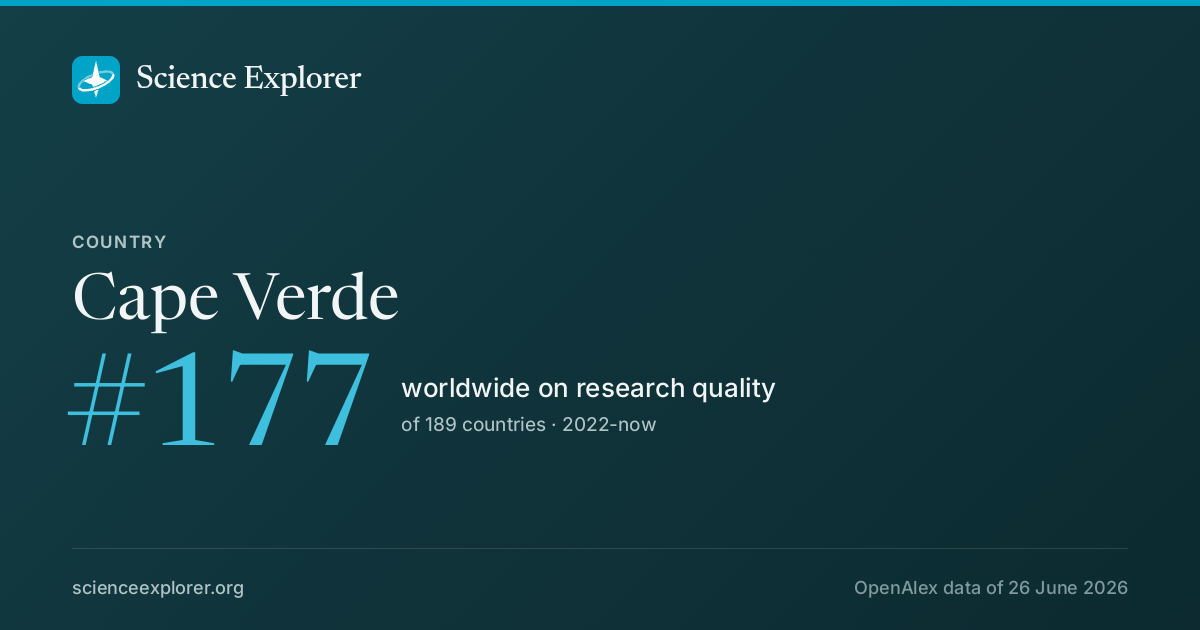
Badges for a website1Each links back here and updates with every snapshot

Discussion
Ask a question or share a note about Cape Verde. Posts are plain text and can be reported.