 Science in Bhutan
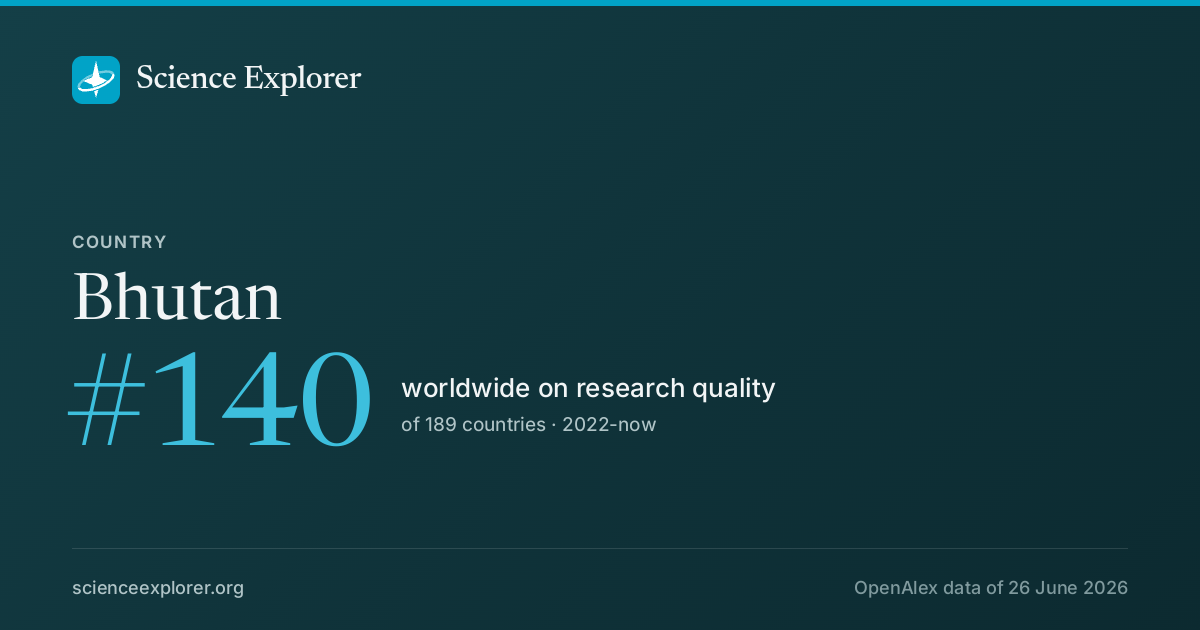
Bhutan ranks #140 of 189 countries on research quality in 2022-now (#160 all time), with 917 research works and 4.9% of them in the world's top 10%.
- World rank, 2022-now
- #140 of 189 · #160 all time
- Works, 2022-now
- 917 ▲ 32% vs 2018-21
- Citations
- 18k 8.2 per fractional work, all time
- Top-10% rate
- 4.9% all institutions 10.0%
- vs its own fields
- 0.75× 1.00× is exactly expected
- In the world top 100
- 0 0 in the top 1,000
- Open access
- 74% world 40%
- International
- 35% world 18%
BhutanWhich fields of science does Bhutan work in?
In 2022-now, 35% of research in Bhutan is in Social Sciences, 32% in Physical Sciences. Its largest fields are Social Sciences (20%), Medicine (13%), Environmental Science (13%). It does 1.4× the world's share of Social Sciences.
Each ring splits the one inside it: the four domains of science, their fields, their subfields. Size is fractional works in 2022-now. Every slice is a page; the interactive view zooms down to single topics and colours each by how much more of it this country does than the world.
Its 4 domains and 26 fields, with their numbers
- Social Sciences35435.3%
- Social Sciences20520.4%
- Psychology535.3%
- Business, Management and Accounting424.2%
- Economics, Econometrics and Finance222.2%
- Arts and Humanities202.0%
- Decision Sciences121.2%
- Physical Sciences31731.6%
- Environmental Science12712.7%
- Engineering929.2%
- Computer Science595.9%
- Earth and Planetary Sciences121.1%
- Mathematics80.8%
- Energy70.7%
- Materials Science60.6%
- Physics and Astronomy30.3%
- Chemistry20.2%
- Chemical Engineering10.1%
- Health Sciences17117.0%
- Medicine13513.4%
- Health Professions262.6%
- Nursing70.7%
- Dentistry20.2%
- Veterinary10.1%
- Life Sciences16216.2%
Which keywords describe research in Bhutan?
By fractional works in 2022-now, weighted toward what it does more of than the world: Climate Change, Biodiversity, Technology Integration, Educational Technology, Sustainability, Teaching Strategies, Mobile Learning and Education.
- Model Evaluation
- Occupancy Rates
- Vulnerability
- Higher-Order Thinking
- Nursing Education
- Population Dynamics
- Adaptation
- Biogeography
- Teacher Perception
- Conservation
- Higher Education
- Social Justice
- Meta-Analysis
- Teaching Strategies
- Remote Sensing
- Online Learning
- E-Learning
- Education
- Educational Technology
- Sustainability
- Climate Change
- Epidemiology
- Biodiversity
- Globalization
- Technology Integration
- Environmental Impact
- Renewable Energy
- Mobile Learning
- Invasive Species
- Student Satisfaction
- Student Engagement
- Google Classroom
- 21st Century Skills
- Habitat Fragmentation
- Global Change
- Critical Thinking Skills
- Habitat Selection
- Instructional Interventions
- Animal Movement
- Teacher Professional Development
Size is fractional works in 2022-now in the topics tagged with each word; colour is the word's share of this country's work against its share of the world's. The 40 words are chosen for being large and distinctive. Each links to the topic it comes from most.
All 40 words, with their numbers
- Climate Change90▲ 3.3×71 topics
- Sustainability48▲ 1.96×55 topics
- Epidemiology46▲ 1.16×75 topics
- Educational Technology40▲ 3.4×22 topics
- Biodiversity37▲ 4.9×22 topics
- Education37▲ 2.2×28 topics
- Globalization33▲ 1.65×37 topics
- E-Learning29▲ 3.0×11 topics
- Technology Integration28▲ 8.7×8 topics
- Online Learning27▲ 3.3×9 topics
- Environmental Impact27▲ 1.59×31 topics
- Remote Sensing27▲ 2.2×21 topics
- Renewable Energy25▲ 1.73×28 topics
- Teaching Strategies24▲ 8.4×5 topics
- Mobile Learning22▲ 6.3×4 topics
- Meta-Analysis21▲ 3.5×11 topics
- Invasive Species20▲ 4.8×16 topics
- Social Justice19▲ 3.2×13 topics
- Student Satisfaction19▲ 10×2 topics
- Higher Education18▲ 3.3×14 topics
- Student Engagement18▲ 4.4×10 topics
- Conservation17▲ 3.9×16 topics
- Google Classroom16▲ 16×1 topic
- Teacher Perception16▲ 15×1 topic
- 21st Century Skills16▲ 5.6×6 topics
- Biogeography16▲ 5.6×13 topics
- Habitat Fragmentation15▲ 7.0×5 topics
- Adaptation15▲ 4.9×6 topics
- Global Change15▲ 5.5×5 topics
- Population Dynamics14▲ 5.6×8 topics
- Critical Thinking Skills14▲ 7.8×2 topics
- Nursing Education14▲ 10×2 topics
- Habitat Selection12▲ 17×2 topics
- Higher-Order Thinking12▲ 16×1 topic
- Instructional Interventions12▲ 16×1 topic
- Vulnerability12▲ 5.4×7 topics
- Animal Movement12▲ 23×1 topic
- Occupancy Rates12▲ 23×1 topic
- Teacher Professional Development12▲ 7.2×5 topics
- Model Evaluation11▲ 8.7×2 topics
Which research topics does Bhutan publish the most in?
Its largest topics in 2022-now are Technology-Enhanced Education Studies, Education and Critical Thinking Development, Wildlife Ecology and Conservation.
Area is fractional works in 2022-now; colour is the subfield each topic belongs to. Every tile is a topic page.
- 1 Technology-Enhanced Education Studies Education 16 works
- 2 Education and Critical Thinking Development Education 12 works
- 3 Wildlife Ecology and Conservation Ecology 12 works
- 4 Rangeland Management and Livestock Ecology Management, Monitoring, Policy and Law 8 works
- 5 South Asian Studies and Conflicts Political Science and International Relations 8 works
- 6 Species Distribution and Climate Change Ecological Modeling 8 works
- 7 Ethnobotanical and Medicinal Plants Studies Plant Science 7 works
- 8 Conservation, Biodiversity, and Resource Management Global and Planetary Change 7 works
- 9 Plant and animal studies Ecology, Evolution, Behavior and Systematics 6 works
- 10 Ecology and Vegetation Dynamics Studies Nature and Landscape Conservation 6 works
- 11 Entrepreneurship Studies and Influences Management of Technology and Innovation 6 works
- 12 Educational Methods and Media Use Information Systems 5 works
Which universities in Bhutan lead research?
Royal University of Bhutan, Ministry of Agriculture and Forests and Centre for Bhutan Studies and GNH Research rank highest in Bhutan on research quality in 2022-now.
- 1Royal University of BhutanUniversity · Thimphu · #4,919 worldwide4.9% top 10% · 586 works
- 2Ministry of Agriculture and ForestsGovernment institution · Thimphu · #11,842 worldwide5.1% top 10% · 159 works
- 3Centre for Bhutan Studies and GNH ResearchUniversity · Thimphu · #14,252 worldwide4.6% top 10% · 103 works

The track on each row is its top-10% rate; the tick is the average of all institutions, 10.0% (how it is set): teal above it, red below.
All ranked institutions in BhutanWho are the top researchers in Bhutan?
Sonam Wangchuk, Karma Tempa and Rajnish Ratna rank highest among researchers based in Bhutan.
- 1 Sonam Wangchuk #879,489 worldwide 2.1k citations · 81 works
- 2 Karma Tempa #1,298,054 worldwide 366 citations · 27 works
- 3 Rajnish Ratna #1,299,859 worldwide 567 citations · 23 works
- 4 Pem Chuki #1,519,786 worldwide 503 citations · 21 works
- 5 Binay Thapa #1,532,348 worldwide 745 citations · 15 works
- 6 Tandin Dorji #1,544,428 worldwide 604 citations · 24 works
- 7 Jelle J.P. Wouters #1,568,997 worldwide 399 citations · 46 works
- 8 Tashi Samdup #1,622,838 worldwide 463 citations · 19 works
- 9 Norbu Wangdi #1,714,243 worldwide 233 citations · 26 works
- 10 Ngawang Chhogyel #1,743,822 worldwide 586 citations · 33 works
How open and international is Bhutan's research?
74% of its research is openly available (world: 40%), and 35% is written with international co-authors (world: 18%).
World: 40% of research is openly available.
World: 18% is written across borders.
In 2022-now, 82% of its research is openly available (world 63%) and 32% is written with co-authors abroad (world 22%). Against what its own mix of topics predicts, that is 1.17× the expected open access and 1.29× the expected international share, which puts it #63 of 173 countries on openness.
How has Bhutan's research grown?
Output in 2022-2025 was 32% higher than in 2018-2021.
The same series as a ribbon: one cell per year, darker for more. The line above answers how much; this answers when.
Its share of all research
Growing output can still be a shrinking share: all of science grows. This is Bhutan as a percentage of every work published that year, 0.0034% in 2024.
Fractional works of Bhutan over all fractional works that year. How the balance of science has shifted.
How much of it reaches the world top 10%
Over the whole record, 5.4% of its 2.1k works since 1970 reached the world top 10% for their field and year.
Of each year's output, the share that reached the world's 10% most cited for its field and year. Peak 8.4% in 2014.
Which countries have research most like Bhutan's?
Cape Verde is Bhutan's closest research twin: of all countries, its research is spread across the fields most like Bhutan's, with both strong in Environmental Science.
- 1
 Cape VerdeBoth strong in Environmental Science, Social Sciences, Agricultural and Biological Sciences
0.88 Compare
- 2
 TanzaniaBoth strong in Agricultural and Biological Sciences, Environmental Science, Social Sciences
0.87 Compare
- 3
 MalawiBoth strong in Agricultural and Biological Sciences, Environmental Science, Social Sciences
0.87 Compare
- 4
 GhanaBoth strong in Agricultural and Biological Sciences, Social Sciences, Environmental Science
0.87 Compare
- 5
 Sierra LeoneBoth strong in Agricultural and Biological Sciences, Social Sciences, Nursing
0.85 Compare
Similarity is the correlation of each side's location quotients across every field it publishes in, on a log scale: 1 is the same shape of research, 0 is unrelated. It ignores size. How it is measured.
Compare Bhutan with
 Tunisia
 Trinidad and Tobago
 Bosnia and Herzegovina
 Kyrgyzstan
 New Caledonia
 Monaco
Share Bhutan's ranking
Badges for a website1Each links back here and updates with every snapshot

Research fields in Bhutan
Discussion
Ask a question or share a note about Bhutan. Posts are plain text and can be reported.