 Science in Tanzania
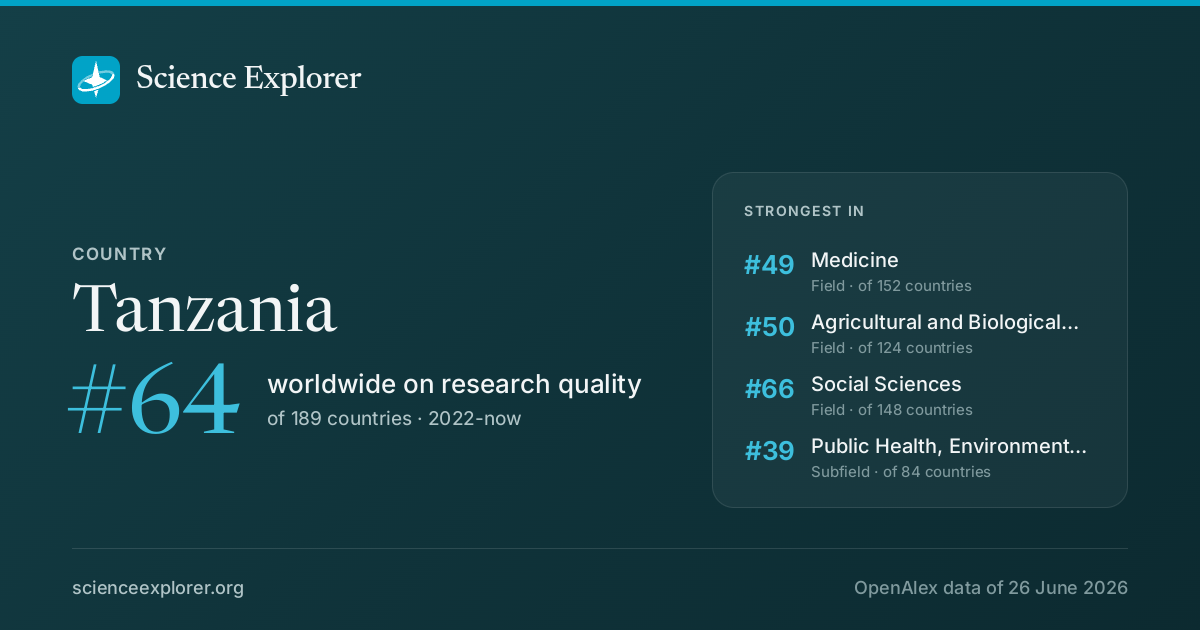
Tanzania ranks #64 of 189 countries on research quality in 2022-now (#74 all time), with 17k research works and 7.7% of them in the world's top 10%.
- World rank, 2022-now
- #64 of 189 · #74 all time
- Works, 2022-now
- 17k ▲ 101% vs 2018-21
- Citations
- 762k 14.6 per fractional work, all time
- Top-10% rate
- 7.7% all institutions 10.0%
- vs its own fields
- 0.90× 1.00× is exactly expected
- In the world top 100
- 0 0 in the top 1,000
- Open access
- 69% world 40%
- International
- 30% world 18%
TanzaniaWhat is Tanzania strongest at in science?
On research quality in 2022-now, Tanzania ranks highest in Medicine (#49 of 152), Agricultural and Biological Sciences (#50 of 124) and Social Sciences (#66 of 148). Relative to its size it is most specialised in Library and Information Sciences, Applied Microbiology and Biotechnology and Parasitology.
| Field | World rank | Where that sits | Top-10% rate | Works | All time | Institutions |
|---|---|---|---|---|---|---|
| MedicineField | #49 of 152 | 8.1% | 3,095 | #56 | Institutions | |
| Agricultural and Biological SciencesField | #50 of 124 | 9.3% | 1,766 | #76 | Institutions | |
| Social SciencesField | #66 of 148 | 7.4% | 3,374 | #89 | Institutions | |
| Public Health, Environmental and Occupational HealthSubfield | #39 of 84 | 12.2% | 512 | #52 | Institutions | |
| Health ProfessionsField | #50 of 106 | 10.9% | 630 | #67 | Institutions | |
| EducationSubfield | #58 of 112 | 7.0% | 1,113 | #79 | Institutions | |
| Pediatrics, Perinatology and Child HealthSubfield | #34 of 65 | 10.2% | 346 | #43 | ||
| General Health ProfessionsSubfield | #44 of 84 | 10.0% | 412 | #67 | Institutions | |
| EpidemiologySubfield | #41 of 77 | 7.4% | 276 | #44 | ||
| Business, Management and AccountingField | #59 of 110 | 7.3% | 1,397 | #81 | Institutions | |
| Environmental ScienceField | #66 of 122 | 6.8% | 1,421 | #76 | Institutions | |
| Plant ScienceSubfield | #49 of 90 | 10.1% | 539 | #67 | Institutions |
Where its research is concentrated
Location quotient: how much more (or less) of each node it does than its size predicts. Drawn around 1×, where "twice the world share" and "half of it" are the same distance apart in opposite directions. A volume reading, which on a country axis is largely population and industrial structure.
- Library and Information SciencesSubfield · 35.9 works · #22 of 146 active here9.3×
- Applied Microbiology and BiotechnologySubfield · 56.1 works · #45 of 202 active here5.6×
- ParasitologySubfield · 114.3 works · #43 of 211 active here5.4×
- Safety ResearchSubfield · 285.7 works · #50 of 215 active here5.1×
- Business and International ManagementSubfield · 102.4 works · #34 of 192 active here4.8×
- VirologySubfield · 54.2 works · #40 of 204 active here4.6×
- ArcheologySubfield · 13.6 works · #46 of 158 active here4.4×
- General Agricultural and Biological SciencesSubfield · 357.8 works · #35 of 206 active here4.0×
The whole field profile
All 26 fields at once. A specialist and a generalist produce the same ranked list and a completely different shape.
Rings at 0.5×, 1× and 2×. Widest outward: Nursing, 2.6×. Every wedge is a field page.
All 26 fields, with their numbers
- Nursing2.63×259 works
- Business, Management and Accounting2.45×1,587 works
- Agricultural and Biological Sciences2.19×2,091 works
- Decision Sciences2.14×416 works
- Economics, Econometrics and Finance2.03×875 works
- Environmental Science1.68×1,677 works
- Veterinary1.63×45 works
- Social Sciences1.58×4,019 works
- Immunology and Microbiology1.52×308 works
- Health Professions1.35×716 works
- Medicine0.97×3,736 works
- Psychology0.86×524 works
- Arts and Humanities0.68×396 works
- Pharmacology, Toxicology and Pharmaceutics0.65×46 works
- Energy0.63×116 works
- Mathematics0.62×146 works
- Computer Science0.58×903 works
- Earth and Planetary Sciences0.54×171 works
- Biochemistry, Genetics and Molecular Biology0.50×531 works
- Dentistry0.43×42 works
- Engineering0.36×1,097 works
- Materials Science0.26×183 works
- Chemical Engineering0.25×17 works
- Chemistry0.24×74 works
- Neuroscience0.20×65 works
- Physics and Astronomy0.15×67 works
Which fields of science does Tanzania work in?
In 2022-now, 39% of research in Tanzania is in Social Sciences, 24% in Health Sciences. Its largest fields are Social Sciences (20%), Medicine (19%), Agricultural and Biological Sciences (10%). It does 1.6× the world's share of Social Sciences.
Each ring splits the one inside it: the four domains of science, their fields, their subfields. Size is fractional works in 2022-now. Every slice is a page; the interactive view zooms down to single topics and colours each by how much more of it this country does than the world.
Its 4 domains and 26 fields, with their numbers
- Social Sciences7,81738.9%
- Social Sciences4,01920.0%
- Business, Management and Accounting1,5877.9%
- Economics, Econometrics and Finance8754.4%
- Psychology5242.6%
- Decision Sciences4162.1%
- Arts and Humanities3962.0%
- Health Sciences4,79823.9%
- Medicine3,73618.6%
- Health Professions7163.6%
- Nursing2591.3%
- Veterinary450.2%
- Dentistry420.2%
- Physical Sciences4,45322.1%
- Environmental Science1,6778.3%
- Engineering1,0975.5%
- Computer Science9034.5%
- Materials Science1830.9%
- Earth and Planetary Sciences1710.9%
- Mathematics1460.7%
- Energy1160.6%
- Chemistry740.4%
- Physics and Astronomy670.3%
- Chemical Engineering170.1%
- Life Sciences3,04115.1%
Which keywords describe research in Tanzania?
By fractional works in 2022-now, weighted toward what it does more of than the world: Climate Change, Sustainability, Epidemiology, Poverty Reduction, Social Capital, Smallholder Farmers, Sustainable Agriculture and Maternal Mortality.
- Microfinance
- Poverty Alleviation
- Conditional Cash Transfers
- Empowerment
- Livelihood Diversification
- Antiretroviral Therapy
- Child Mortality
- Technology Adoption
- Health Inequalities
- Technology Integration
- Social Networks
- Community Health Workers
- Gender Equality
- Rural Development
- Sustainable Agriculture
- Supply Chain Management
- Social Capital
- Sustainable Development
- Globalization
- Climate Change
- Epidemiology
- Sustainability
- Environmental Impact
- Education
- Poverty Reduction
- Economic Development
- Smallholder Farmers
- Risk Management
- Maternal Mortality
- Food Security
- Gender Inequality
- Development
- Socio-economic Factors
- Adaptation
- Health Systems
- Agricultural Innovation
- Market Participation
- Primary Education
- School Subsidies
- Financial Inclusion
Size is fractional works in 2022-now in the topics tagged with each word; colour is the word's share of this country's work against its share of the world's. The 40 words are chosen for being large and distinctive. Each links to the topic it comes from most.
All 40 words, with their numbers
- Epidemiology1,175▲ 1.47×137 topics
- Climate Change1,053▲ 1.93×111 topics
- Sustainability1,002▲ 2.0×10² topics
- Globalization626▲ 1.58×121 topics
- Environmental Impact569▲ 1.66×66 topics
- Sustainable Development542▲ 1.72×94 topics
- Education539▲ 1.56×10² topics
- Social Capital536▲ 5.1×20 topics
- Poverty Reduction482▲ 18×6 topics
- Supply Chain Management418▲ 2.3×25 topics
- Economic Development413▲ 2.6×37 topics
- Sustainable Agriculture403▲ 6.5×16 topics
- Smallholder Farmers396▲ 9.3×6 topics
- Rural Development392▲ 5.7×18 topics
- Risk Management370▲ 3.9×16 topics
- Gender Equality364▲ 6.4×16 topics
- Maternal Mortality351▲ 7.8×5 topics
- Community Health Workers335▲ 19×2 topics
- Food Security334▲ 3.1×23 topics
- Social Networks325▲ 6.0×10 topics
- Gender Inequality310▲ 11×7 topics
- Technology Integration307▲ 4.8×11 topics
- Development289▲ 4.0×21 topics
- Health Inequalities284▲ 12×5 topics
- Socio-economic Factors278▲ 12×3 topics
- Technology Adoption276▲ 7.4×6 topics
- Adaptation273▲ 4.5×14 topics
- Child Mortality272▲ 19×1 topic
- Health Systems272▲ 19×1 topic
- Antiretroviral Therapy235▲ 7.2×6 topics
- Agricultural Innovation233▲ 25×2 topics
- Livelihood Diversification229▲ 36×1 topic
- Market Participation229▲ 36×1 topic
- Empowerment222▲ 11×6 topics
- Primary Education218▲ 27×2 topics
- Conditional Cash Transfers218▲ 31×1 topic
- School Subsidies218▲ 31×1 topic
- Poverty Alleviation215▲ 11×3 topics
- Financial Inclusion209▲ 20×1 topic
- Microfinance209▲ 20×1 topic
Which research topics does Tanzania publish the most in?
Its largest topics in 2022-now are Global Maternal and Child Health, Agricultural Innovations and Practices, Poverty, Education, and Child Welfare.
Area is fractional works in 2022-now; colour is the subfield each topic belongs to. Every tile is a topic page.
- 1 Global Maternal and Child Health Pediatrics, Perinatology and Child Health 272 works
- 2 Agricultural Innovations and Practices General Agricultural and Biological Sciences 229 works
- 3 Poverty, Education, and Child Welfare Safety Research 218 works
- 4 Microfinance and Financial Inclusion Economics and Econometrics 209 works
- 5 Child Nutrition and Water Access Nutrition and Dietetics 195 works
- 6 Islamic Finance and Banking Studies Accounting 157 works
- 7 Technology Adoption and User Behaviour Information Systems and Management 132 works
- 8 Urban and Rural Development Challenges Urban Studies 115 works
- 9 HIV/AIDS Research and Interventions Infectious Diseases 112 works
- 10 Energy and Environment Impacts Pollution 108 works
- 11 Malaria Research and Control Public Health, Environmental and Occupational Health 103 works
- 12 Economic Growth and Development Information Systems 102 works
Which universities in Tanzania lead research?
University of Dar es Salaam, The University of Dodoma and Muhimbili University of Health and Allied Sciences rank highest in Tanzania on research quality in 2022-now.
One dot per institution in the list below. The upper left is the interesting corner.
- 1University of Dar es SalaamUniversity · Dar es Salaam · #1,893 worldwide7.5% top 10% · 2.6k works
- 2The University of DodomaUniversity · Dodoma · #2,642 worldwide12.5% top 10% · 1.8k works
- 3Muhimbili University of Health and Allied SciencesUniversity · Dar es Salaam · #3,411 worldwide8.3% top 10% · 928 works
- 4Mzumbe UniversityUniversity · Morogoro · #3,422 worldwide8.5% top 10% · 684 works
- 5Nelson Mandela African Institution of Science and TechnologyUniversity · Arusha · #3,772 worldwide11.1% top 10% · 566 works
- 6Mbeya University of Science and TechnologyUniversity · Mbeya · #3,821 worldwide7.2% top 10% · 439 works
- 7Sokoine University of AgricultureUniversity · Morogoro · #4,659 worldwide6.4% top 10% · 1.3k works
- 8St. Augustine University of TanzaniaUniversity · Mwanza · #5,902 worldwide4.8% top 10% · 516 works
- 9Tanzania National ParksArchive · Arusha · #5,986 worldwide3.4% top 10% · 415 works
- 10College of Business EducationUniversity · Dar es Salaam · #6,263 worldwide4.9% top 10% · 402 works
- 11Open University of TanzaniaUniversity · Dar es Salaam · #6,914 worldwide3.0% top 10% · 671 works
- 12National Institute for Medical ResearchResearch facility · Dar es Salaam · #7,051 worldwide13.5% top 10% · 210 works
- 13Dar es Salaam Institute of TechnologyUniversity · Dar es Salaam · #7,764 worldwide5.4% top 10% · 216 works
- 14Institute of Accountancy ArushaUniversity · Arusha · #7,896 worldwide3.8% top 10% · 428 works
- 15Ifakara Health InstituteNonprofit · Ifakara · #8,317 worldwide14.2% top 10% · 168 works

The track on each row is its top-10% rate; the tick is the average of all institutions, 10.0% (how it is set): teal above it, red below.
All ranked institutions in TanzaniaWho are the top researchers in Tanzania?
Andrew R. Williamson, Audax Z. P. Mabulla and Susan F. Rumisha rank highest among researchers based in Tanzania.
- 1 Andrew R. Williamson #1,536 worldwide 85k citations · 325 works
- 2 Audax Z. P. Mabulla #25,355 worldwide 9.3k citations · 201 works
- 3 Susan F. Rumisha #33,455 worldwide 37k citations · 167 works
- 4 Gerry F. Killeen #34,603 worldwide 16k citations · 207 works
- 5 Fredros O. Okumu #46,417 worldwide 6.3k citations · 186 works
- 6 Nicodem James Govella #48,904 worldwide 4.8k citations · 121 works
- 7 Arega D. Alene #51,324 worldwide 6.3k citations · 153 works
- 8 Fredros O. Okumu #57,306 worldwide 3.7k citations · 150 works
- 9 Emanuel H. Martin #61,987 worldwide 6.2k citations · 60 works
- 10 Deus S. Ishengoma #68,754 worldwide 4.8k citations · 173 works
Which cities in Tanzania are research hubs?
- 1
Dar es SalaamTanzania
30k works
How open and international is Tanzania's research?
69% of its research is openly available (world: 40%), and 30% is written with international co-authors (world: 18%).
World: 40% of research is openly available.
World: 18% is written across borders.
In 2022-now, 83% of its research is openly available (world 63%) and 25% is written with co-authors abroad (world 22%). Against what its own mix of topics predicts, that is 1.18× the expected open access and 1.10× the expected international share, which puts it #70 of 173 countries on openness.
How has Tanzania's research grown?
Output in 2022-2025 was 101% higher than in 2018-2021.
The same series as a ribbon: one cell per year, darker for more. The line above answers how much; this answers when.
Its share of all research
Growing output can still be a shrinking share: all of science grows. This is Tanzania as a percentage of every work published that year, 0.081% in 2024.
Fractional works of Tanzania over all fractional works that year. How the balance of science has shifted.
How much of it reaches the world top 10%
Over the whole record, 8.6% of its 52k works since 1950 reached the world top 10% for their field and year.
Of each year's output, the share that reached the world's 10% most cited for its field and year. Peak 11.5% in 1997.
Which countries have research most like Tanzania's?
Kenya is Tanzania's closest research twin: of all countries, its research is spread across the fields most like Tanzania's, with both strong in Nursing.
- 1
 KenyaBoth strong in Nursing, Business, Management and Accounting, Agricultural and Biological Sciences
0.96 Compare
- 2
 Sierra LeoneBoth strong in Nursing, Business, Management and Accounting, Agricultural and Biological Sciences
0.95 Compare
- 3
 GhanaBoth strong in Nursing, Business, Management and Accounting, Economics, Econometrics and Finance
0.95 Compare
- 4
 ZambiaBoth strong in Business, Management and Accounting, Nursing, Agricultural and Biological Sciences
0.93 Compare
- 5
 MalawiBoth strong in Nursing, Agricultural and Biological Sciences, Environmental Science
0.92 Compare
Similarity is the correlation of each side's location quotients across every field it publishes in, on a log scale: 1 is the same shape of research, 0 is unrelated. It ignores size. How it is measured.
Compare Tanzania with
 Montenegro
 Indonesia
 Puerto Rico
 Vietnam
 Panama
Share Tanzania's ranking
Badges for a website1Each links back here and updates with every snapshot

Research fields in Tanzania
- Health Sciences
- Medicine
- Life Sciences
- Agricultural and Biological Sciences
- Social Sciences
- Social Sciences
- Public Health, Environmental and Occupational Health
- Health Professions
- Education
- General Health Professions
- Business, Management and Accounting
- Environmental Science
- Plant Science
- Physical Sciences
- Infectious Diseases
- Economics, Econometrics and Finance
- Biochemistry, Genetics and Molecular Biology
- Computer Science
- Economics and Econometrics
- Arts and Humanities
- Psychology
- Engineering
- Sociology and Political Science
- Surgery
- General Agricultural and Biological Sciences
- Global and Planetary Change
Questions people ask
What is Tanzania strongest at in science?
On research quality in 2022-now, Tanzania ranks highest in Medicine (#49 of 152), Agricultural and Biological Sciences (#50 of 124) and Social Sciences (#66 of 148). Relative to its size it is most specialised in Library and Information Sciences, Applied Microbiology and Biotechnology and Parasitology.
See the full answerDiscussion
Ask a question or share a note about Tanzania. Posts are plain text and can be reported.