 Science in Ghana
Ghana ranks #58 of 189 countries on research quality in 2022-now (#68 all time), with 27k research works and 10.8% of them in the world's top 10%.
- World rank, 2022-now
- #58 of 189 · #68 all time
- Works, 2022-now
- 27k ▲ 42% vs 2018-21
- Citations
- 963k 12.1 per fractional work, all time
- Top-10% rate
- 10.8% all institutions 10.0%
- vs its own fields
- 1.00× 1.00× is exactly expected
- In the world top 100
- 0 0 in the top 1,000
- Open access
- 65% world 40%
- International
- 33% world 18%
GhanaWhat is Ghana strongest at in science?
On research quality in 2022-now, Ghana ranks highest in Agricultural and Biological Sciences (#43 of 124), Medicine (#58 of 152) and Economics, Econometrics and Finance (#41 of 107). Relative to its size it is most specialised in Library and Information Sciences, Horticulture and Research and Theory.
| Field | World rank | Where that sits | Top-10% rate | Works | All time | Institutions |
|---|---|---|---|---|---|---|
| Agricultural and Biological SciencesField | #43 of 124 | 11.0% | 2,323 | #57 | Institutions | |
| MedicineField | #58 of 152 | 10.1% | 4,290 | #63 | Institutions | |
| Economics, Econometrics and FinanceField | #41 of 107 | 13.1% | 1,553 | #52 | Institutions | |
| Health ProfessionsField | #42 of 106 | 13.2% | 1,100 | #52 | Institutions | |
| Social SciencesField | #59 of 148 | 11.6% | 5,025 | #59 | Institutions | |
| Economics and EconometricsSubfield | #40 of 98 | 13.1% | 1,134 | #54 | Institutions | |
| Business, Management and AccountingField | #46 of 110 | 12.9% | 2,284 | #57 | Institutions | |
| Environmental ScienceField | #52 of 122 | 9.1% | 1,922 | #51 | Institutions | |
| Sociology and Political ScienceSubfield | #54 of 119 | 11.5% | 1,373 | #60 | Institutions | |
| EducationSubfield | #54 of 112 | 12.9% | 1,302 | #61 | Institutions | |
| Computer ScienceField | #62 of 128 | 10.8% | 1,419 | #68 | Institutions | |
| Public Health, Environmental and Occupational HealthSubfield | #41 of 84 | 12.8% | 777 | #49 | Institutions |
Where its research is concentrated
Location quotient: how much more (or less) of each node it does than its size predicts. Drawn around 1×, where "twice the world share" and "half of it" are the same distance apart in opposite directions. A volume reading, which on a country axis is largely population and industrial structure.
- Library and Information SciencesSubfield · 163.2 works · #5 of 146 active here27×
- HorticultureSubfield · 104.3 works · #11 of 178 active here25×
- Research and TheorySubfield · 45.4 works · #34 of 183 active here5.6×
- Business and International ManagementSubfield · 173.7 works · #25 of 192 active here5.3×
- Chemical Health and SafetySubfield · 9.8 works · #34 of 139 active here4.8×
- Safety ResearchSubfield · 360.7 works · #41 of 215 active here4.2×
- Radiological and Ultrasound TechnologySubfield · 141.0 works · #39 of 200 active here3.8×
- Applied Microbiology and BiotechnologySubfield · 58.0 works · #44 of 202 active here3.7×
The whole field profile
All 26 fields at once. A specialist and a generalist produce the same ranked list and a completely different shape.
Rings at 0.5×, 1× and 2×. Widest outward: Nursing, 3.2×. Every wedge is a field page.
All 26 fields, with their numbers
- Nursing3.16×484 works
- Business, Management and Accounting2.59×2,613 works
- Economics, Econometrics and Finance2.52×1,686 works
- Agricultural and Biological Sciences1.81×2,689 works
- Decision Sciences1.74×526 works
- Health Professions1.60×1,313 works
- Social Sciences1.48×5,857 works
- Environmental Science1.45×2,250 works
- Psychology1.28×1,217 works
- Immunology and Microbiology1.17×367 works
- Arts and Humanities0.97×872 works
- Energy0.91×262 works
- Mathematics0.90×330 works
- Medicine0.87×5,200 works
- Pharmacology, Toxicology and Pharmaceutics0.83×91 works
- Veterinary0.80×34 works
- Computer Science0.69×1,679 works
- Earth and Planetary Sciences0.50×247 works
- Biochemistry, Genetics and Molecular Biology0.45×756 works
- Engineering0.43×2,003 works
- Chemistry0.39×192 works
- Dentistry0.33×50 works
- Neuroscience0.26×134 works
- Materials Science0.23×250 works
- Chemical Engineering0.20×22 works
- Physics and Astronomy0.17×117 works
Which fields of science does Ghana work in?
In 2022-now, 41% of research in Ghana is in Social Sciences, 24% in Physical Sciences. Its largest fields are Social Sciences (19%), Medicine (17%), Agricultural and Biological Sciences (9%). It does 1.7× the world's share of Social Sciences.
Each ring splits the one inside it: the four domains of science, their fields, their subfields. Size is fractional works in 2022-now. Every slice is a page; the interactive view zooms down to single topics and colours each by how much more of it this country does than the world.
Its 4 domains and 26 fields, with their numbers
- Social Sciences13k40.9%
- Social Sciences5,85718.7%
- Business, Management and Accounting2,6138.4%
- Economics, Econometrics and Finance1,6865.4%
- Psychology1,2173.9%
- Arts and Humanities8722.8%
- Decision Sciences5261.7%
- Physical Sciences7,35123.5%
- Environmental Science2,2507.2%
- Engineering2,0036.4%
- Computer Science1,6795.4%
- Mathematics3291.1%
- Energy2620.8%
- Materials Science2500.8%
- Earth and Planetary Sciences2470.8%
- Chemistry1920.6%
- Physics and Astronomy1170.4%
- Chemical Engineering220.1%
- Health Sciences7,08022.7%
- Medicine5,19916.6%
- Health Professions1,3134.2%
- Nursing4841.5%
- Dentistry500.2%
- Veterinary340.1%
- Life Sciences4,03812.9%
Which keywords describe research in Ghana?
By fractional works in 2022-now, weighted toward what it does more of than the world: Sustainability, Epidemiology, Maternal Mortality, Social Capital, Poverty Reduction, Economic Growth, Risk Management and Globalization.
- Institutional Quality
- Maternal and Child Undernutrition
- Vulnerability
- Global Burden of Disease
- Sustainable Agriculture
- Governance
- Smallholder Farmers
- Child Mortality
- Leadership
- Urbanization
- Biodiversity Conservation
- Consumer Behavior
- Corporate Governance
- Supply Chain Management
- Mental Health
- Social Capital
- Education
- Renewable Energy
- Globalization
- Sustainability
- Epidemiology
- Climate Change
- Environmental Impact
- Sustainable Development
- Economic Growth
- Public Health
- Risk Management
- Maternal Mortality
- Poverty Reduction
- Community Health Workers
- Health Inequalities
- Child Development
- Socio-economic Factors
- Health Systems
- Social Networks
- Development
- Gender Inequality
- Poverty Alleviation
- ICT
- Water Sanitation Hygiene
Size is fractional works in 2022-now in the topics tagged with each word; colour is the word's share of this country's work against its share of the world's. The 40 words are chosen for being large and distinctive. Each links to the topic it comes from most.
All 40 words, with their numbers
- Epidemiology1,614▲ 1.30×136 topics
- Sustainability1,476▲ 1.93×10⁹ topics
- Climate Change1,179▲ 1.39×111 topics
- Globalization1,054▲ 1.72×132 topics
- Environmental Impact932▲ 1.75×67 topics
- Renewable Energy815▲ 1.80×53 topics
- Sustainable Development808▲ 1.65×89 topics
- Education786▲ 1.46×101 topics
- Economic Growth786▲ 3.1×34 topics
- Social Capital700▲ 4.3×21 topics
- Public Health690▲ 1.52×65 topics
- Mental Health661▲ 1.48×43 topics
- Risk Management650▲ 4.4×18 topics
- Supply Chain Management597▲ 2.1×26 topics
- Maternal Mortality544▲ 7.8×5 topics
- Corporate Governance529▲ 2.3×27 topics
- Poverty Reduction517▲ 13×7 topics
- Consumer Behavior514▲ 2.6×18 topics
- Community Health Workers479▲ 17×2 topics
- Biodiversity Conservation456▲ 3.9×17 topics
- Health Inequalities456▲ 12×5 topics
- Urbanization456▲ 3.6×13 topics
- Child Development449▲ 3.5×8 topics
- Leadership447▲ 2.9×35 topics
- Socio-economic Factors435▲ 12×3 topics
- Child Mortality432▲ 19×1 topic
- Health Systems432▲ 19×1 topic
- Smallholder Farmers429▲ 6.5×6 topics
- Social Networks417▲ 4.9×13 topics
- Governance412▲ 4.0×15 topics
- Development397▲ 3.6×19 topics
- Sustainable Agriculture395▲ 4.1×15 topics
- Gender Inequality381▲ 8.8×6 topics
- Global Burden of Disease372▲ 4.8×4 topics
- Poverty Alleviation372▲ 12×3 topics
- Vulnerability370▲ 5.1×8 topics
- ICT305▲ 7.3×5 topics
- Maternal and Child Undernutrition305▲ 12×1 topic
- Water Sanitation Hygiene305▲ 12×1 topic
- Institutional Quality302▲ 9.2×3 topics
Which research topics does Ghana publish the most in?
Its largest topics in 2022-now are Global Maternal and Child Health, Child Nutrition and Water Access, Economic Growth and Development.
Area is fractional works in 2022-now; colour is the subfield each topic belongs to. Every tile is a topic page.
- 1 Global Maternal and Child Health Pediatrics, Perinatology and Child Health 432 works
- 2 Child Nutrition and Water Access Nutrition and Dietetics 305 works
- 3 Economic Growth and Development Information Systems 224 works
- 4 Energy and Environment Impacts Pollution 222 works
- 5 Poverty, Education, and Child Welfare Safety Research 215 works
- 6 Urban and Rural Development Challenges Urban Studies 201 works
- 7 Microfinance and Financial Inclusion Economics and Econometrics 198 works
- 8 Agricultural Innovations and Practices General Agricultural and Biological Sciences 190 works
- 9 Islamic Finance and Banking Studies Accounting 181 works
- 10 Innovation and Socioeconomic Development Business and International Management 169 works
- 11 Malaria Research and Control Public Health, Environmental and Occupational Health 154 works
- 12 COVID-19 Pandemic Impacts Economics and Econometrics 153 works
Which universities in Ghana lead research?
University of Ghana, University of Cape Coast and Kwame Nkrumah University of Science and Technology rank highest in Ghana on research quality in 2022-now.
One dot per institution in the list below. The upper left is the interesting corner.
- 1University of GhanaUniversity · Accra · #1,257 worldwide11.0% top 10% · 5.3k works
- 2University of Cape CoastUniversity · Cape Coast · #1,886 worldwide12.8% top 10% · 2.8k works
- 3Kwame Nkrumah University of Science and TechnologyUniversity · Kumasi · #1,933 worldwide10.8% top 10% · 4.5k works
- 4University for Development StudiesUniversity · Tamale · #2,179 worldwide11.1% top 10% · 1.9k works
- 5University of Education, WinnebaUniversity · Winneba · #2,389 worldwide8.0% top 10% · 1.4k works
- 6Takoradi Technical UniversityUniversity · Takoradze · #3,511 worldwide13.8% top 10% · 404 works
- 7University of Energy and Natural ResourcesUniversity · Sunyani · #3,902 worldwide11.6% top 10% · 675 works
- 8University of Professional StudiesUniversity · Accra · #4,211 worldwide14.0% top 10% · 472 works
- 9Ho Technical UniversityUniversity · Ho · #4,298 worldwide13.8% top 10% · 356 works
- 10University of Health and Allied SciencesUniversity · Ho · #4,365 worldwide12.4% top 10% · 729 works
- 11Kumasi Technical UniversityUniversity · Kumasi · #4,476 worldwide10.2% top 10% · 451 works
- 12Ghana Health ServiceGovernment institution · Accra · #5,658 worldwide11.3% top 10% · 415 works
- 13Cape Coast Technical UniversityUniversity · Cape Coast · #5,785 worldwide12.1% top 10% · 244 works
- 14University of Mines and TechnologyUniversity · Tarkwa · #5,801 worldwide8.6% top 10% · 396 works
- 15Ghana Communication Technology UniversityUniversity · Accra · #6,066 worldwide10.7% top 10% · 313 works


The track on each row is its top-10% rate; the tick is the average of all institutions, 10.0% (how it is set): teal above it, red below.
All ranked institutions in GhanaWho are the top researchers in Ghana?
Richard Gyan Aboagye, Emmanuel Joel Aikins Abakah and Martin Amogre Ayanore rank highest among researchers based in Ghana.
- 1 Richard Gyan Aboagye #22,347 worldwide 39k citations · 250 works
- 2 Emmanuel Joel Aikins Abakah #27,882 worldwide 4.7k citations · 132 works
- 3 Martin Amogre Ayanore #33,207 worldwide 54k citations · 181 works
- 4 Robert Kokou Dowou #33,244 worldwide 25k citations · 109 works
- 5 Hubert Amu #37,771 worldwide 49k citations · 190 works
- 6 Mustapha Immurana #46,457 worldwide 28k citations · 144 works
- 7 Aniefiok John Udoakang #51,343 worldwide 21k citations · 60 works
- 8 Samuel Adams #54,144 worldwide 6.4k citations · 91 works
- 9 Abubakari Ahmed #60,755 worldwide 2.9k citations · 96 works
- 10 David Teye Doku #64,346 worldwide 64k citations · 118 works
Which cities in Ghana are research hubs?
How open and international is Ghana's research?
65% of its research is openly available (world: 40%), and 33% is written with international co-authors (world: 18%).
World: 40% of research is openly available.
World: 18% is written across borders.
In 2022-now, 74% of its research is openly available (world 63%) and 33% is written with co-authors abroad (world 22%). Against what its own mix of topics predicts, that is 1.09× the expected open access and 1.43× the expected international share, which puts it #98 of 173 countries on openness.
How has Ghana's research grown?
Output in 2022-2025 was 42% higher than in 2018-2021.
The same series as a ribbon: one cell per year, darker for more. The line above answers how much; this answers when.
Its share of all research
Growing output can still be a shrinking share: all of science grows. This is Ghana as a percentage of every work published that year, 0.12% in 2024.
Fractional works of Ghana over all fractional works that year. How the balance of science has shifted.
How much of it reaches the world top 10%
Over the whole record, 9.7% of its 80k works since 1950 reached the world top 10% for their field and year.
Of each year's output, the share that reached the world's 10% most cited for its field and year. Peak 11.4% in 1991.
Which countries have research most like Ghana's?
Kenya is Ghana's closest research twin: of all countries, its research is spread across the fields most like Ghana's, with both strong in Nursing.
- 1
 KenyaBoth strong in Nursing, Business, Management and Accounting, Economics, Econometrics and Finance
0.97 Compare
- 2
 Sierra LeoneBoth strong in Nursing, Economics, Econometrics and Finance, Business, Management and Accounting
0.95 Compare
- 3
 TanzaniaBoth strong in Nursing, Business, Management and Accounting, Economics, Econometrics and Finance
0.95 Compare
- 4
 MalawiBoth strong in Nursing, Agricultural and Biological Sciences, Health Professions
0.93 Compare
- 5
 ZimbabweBoth strong in Business, Management and Accounting, Economics, Econometrics and Finance, Agricultural and Biological Sciences
0.92 Compare
Similarity is the correlation of each side's location quotients across every field it publishes in, on a log scale: 1 is the same shape of research, 0 is unrelated. It ignores size. How it is measured.
Compare Ghana with
 Colombia
 Slovakia
 Ukraine
 Ecuador
Share Ghana's ranking
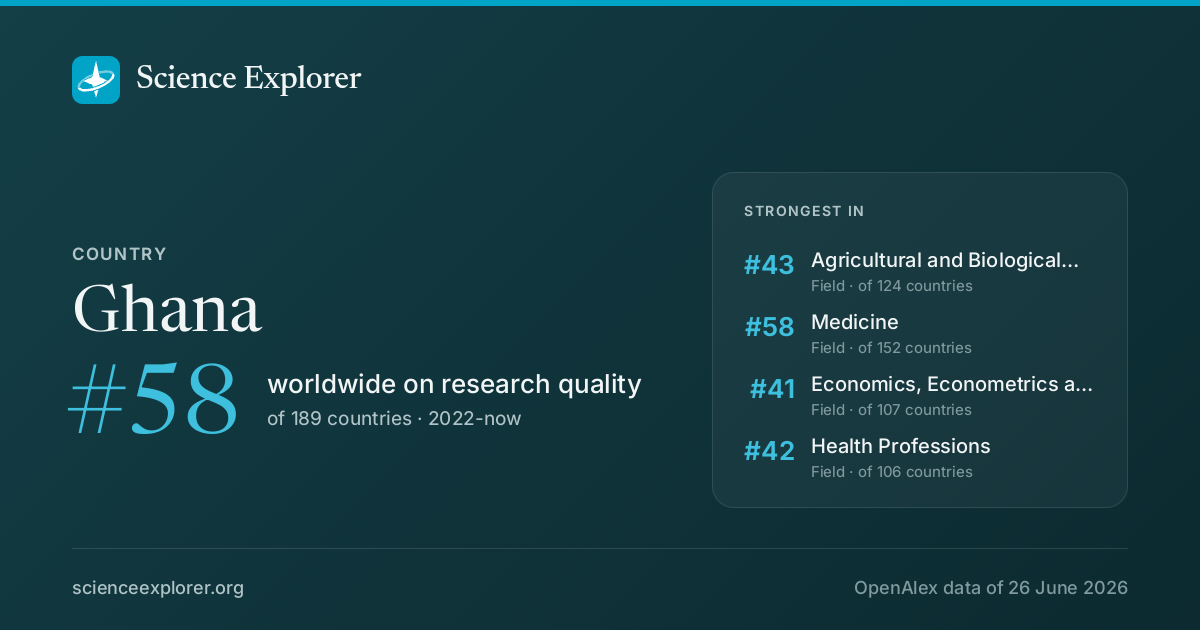
Badges for a website1Each links back here and updates with every snapshot

Research fields in Ghana
- Health Sciences
- Social Sciences
- Agricultural and Biological Sciences
- Medicine
- Economics, Econometrics and Finance
- Life Sciences
- Health Professions
- Social Sciences
- Economics and Econometrics
- Business, Management and Accounting
- Environmental Science
- Physical Sciences
- Sociology and Political Science
- Education
- Computer Science
- Public Health, Environmental and Occupational Health
- General Health Professions
- Accounting
- Arts and Humanities
- Psychology
- Engineering
- Plant Science
- Infectious Diseases
- Immunology and Microbiology
- Strategy and Management
- Biochemistry, Genetics and Molecular Biology
- Decision Sciences
- Pediatrics, Perinatology and Child Health
- Information Systems
- Nursing
- Epidemiology
- Building and Construction
- Nutrition and Dietetics
- Artificial Intelligence
- Global and Planetary Change
- Food Science
- Clinical Psychology
- Pollution
- Molecular Biology
- Urban Studies
- Political Science and International Relations
- Surgery
- Safety Research
- Electrical and Electronic Engineering
- Materials Science
Questions people ask
What is Ghana strongest at in science?
On research quality in 2022-now, Ghana ranks highest in Agricultural and Biological Sciences (#43 of 124), Medicine (#58 of 152) and Economics, Econometrics and Finance (#41 of 107). Relative to its size it is most specialised in Library and Information Sciences, Horticulture and Research and Theory.
See the full answerWho are the top scientists in Ghana?
Richard Gyan Aboagye, Emmanuel Joel Aikins Abakah and Martin Amogre Ayanore rank highest among researchers based in Ghana.
Who are the top researchers in Ghana?Discussion
Ask a question or share a note about Ghana. Posts are plain text and can be reported.