Science Explorer Back to mapMap
Discussion
University · Takoradze · Ghana

Takoradi Technical University

In research, Takoradi Technical University stands highest in Social Sciences (#2,588 of 9,585 worldwide), Social Sciences (#2,291 of 5,988 worldwide) and Business, Management and Accounting (#1,145 of 2,581 worldwide), 2022-now. Relative to its size it is most specialised in Museology (Museology is 34.9× its share of world research).

World rank, 2022-now
#3,511
of 22,385 · #6,451 all time
Rank in Ghana
#6
of 45
Research works
713
▲ 165% vs 2018-21
Citations
3.2k
4.5 per fractional work
Top-10% rate
14.2%
all institutions 10.0%
vs its own fields
1.20×
1.00× is exactly expected
Open access
84%
world 40%
International
21%
world 18%

What is Takoradi Technical University known for in research?

The fields where it stands highest, 2022-now, ranked among every institution above the floor in each field.

FieldWorld rankWhere that sitsTop-10% rateWorksAll time
Social SciencesDomain #2,588 of 9,585 16.8%233 #5008
Social SciencesField #2,291 of 5,988 22.3%79 #5167
Business, Management and AccountingField #1,145 of 2,581 18.5%71 #1925
Physical SciencesDomain #4,981 of 10,670 4.7%107 #7602

Each strip is that field's whole ranked pool, with the notch where Takoradi Technical University sits in it, in the colour of the band that rank falls in. The track under the rate is the rate itself: it carries no average mark, because the average differs by field (from about 6% in Dentistry to 21% in Economics).

Which of those standings moved

The same fields on both windows: where it stood over the whole record, and where it stands in 2022-now. The distance is the story, and it is the one thing the two rank columns above cannot show.

  1. Social Sciences#5,008 #2,588
  2. Social Sciences#5,167 #2,291
  3. Business, Management and Accounting#1,925 #1,145
  4. Physical Sciences#7,602 #4,981
all time2022-now, better2022-now, worse

A dot further right is a better standing. Fields it was not ranked in over the whole record are left out.

Which fields of science does Takoradi Technical University work in?

In 2022-now, 57% of research at Takoradi Technical University is in Social Sciences, 27% in Physical Sciences. Its largest fields are Social Sciences (19%), Business, Management and Accounting (18%), Engineering (12%). It does 2.3× the world's share of Social Sciences.

Social Sciences: 267 fractional works · 56.6% of its workSocial Sciences: 90 fractional works · 19.0% of its workSociology and Political Science: 23 fractional works · 4.8% of its workEducation: 20 fractional works · 4.2% of its workUrban Studies: 11 fractional works · 2.3% of its workPolitical Science and International Relations: 5 fractional works · 1.1% of its workGender Studies: 5 fractional works · 1.0% of its workAnthropology: 4 fractional works · 0.8% of its workCommunication: 3 fractional works · 0.7% of its workDemography: 3 fractional works · 0.7% of its workHealth: 3 fractional works · 0.5% of its workHuman Factors and Ergonomics: 2 fractional works · 0.5% of its workSafety Research: 2 fractional works · 0.5% of its workTransportation: 2 fractional works · 0.4% of its workLinguistics and Language: 2 fractional works · 0.4% of its workLaw: 2 fractional works · 0.4% of its workPublic Administration: 1 fractional works · 0.2% of its workCultural Studies: 1 fractional works · 0.2% of its workSmaller subfields together: 2 fractional works · 0.3% of its workBusiness, Management and Accounting: 84 fractional works · 17.8% of its workStrategy and Management: 24 fractional works · 5.1% of its workAccounting: 13 fractional works · 2.8% of its workManagement of Technology and Innovation: 12 fractional works · 2.6% of its workMarketing: 10 fractional works · 2.1% of its workOrganizational Behavior and Human Resource Management: 9 fractional works · 1.9% of its workManagement Information Systems: 8 fractional works · 1.7% of its workBusiness and International Management: 6 fractional works · 1.3% of its workTourism, Leisure and Hospitality Management: 1 fractional works · 0.2% of its workArts and Humanities: 43 fractional works · 9.0% of its workMuseology: 20 fractional works · 4.3% of its workVisual Arts and Performing Arts: 6 fractional works · 1.3% of its workLiterature and Literary Theory: 4 fractional works · 0.9% of its workLanguage and Linguistics: 4 fractional works · 0.9% of its workArcheology: 4 fractional works · 0.8% of its workReligious studies: 2 fractional works · 0.4% of its workConservation: 2 fractional works · 0.3% of its workSmaller subfields together: 1 fractional works · 0.2% of its workPsychology: 19 fractional works · 4.0% of its workSocial Psychology: 6 fractional works · 1.3% of its workExperimental and Cognitive Psychology: 4 fractional works · 0.9% of its workClinical Psychology: 4 fractional works · 0.8% of its workDevelopmental and Educational Psychology: 3 fractional works · 0.6% of its workApplied Psychology: 2 fractional works · 0.4% of its workEconomics, Econometrics and Finance: 18 fractional works · 3.8% of its workEconomics and Econometrics: 14 fractional works · 3.0% of its workFinance: 3 fractional works · 0.6% of its workGeneral Economics, Econometrics and Finance: 1 fractional works · 0.2% of its workDecision Sciences: 14 fractional works · 2.9% of its workManagement Science and Operations Research: 8 fractional works · 1.6% of its workInformation Systems and Management: 3 fractional works · 0.7% of its workStatistics, Probability and Uncertainty: 2 fractional works · 0.5% of its workSmaller subfields together: 0 fractional works · 0.0% of its workPhysical Sciences: 126 fractional works · 26.7% of its workEngineering: 56 fractional works · 11.9% of its workBuilding and Construction: 11 fractional works · 2.3% of its workCivil and Structural Engineering: 10 fractional works · 2.1% of its workElectrical and Electronic Engineering: 8 fractional works · 1.6% of its workMechanical Engineering: 8 fractional works · 1.6% of its workBiomedical Engineering: 3 fractional works · 0.7% of its workMedia Technology: 3 fractional works · 0.6% of its workAutomotive Engineering: 3 fractional works · 0.6% of its workControl and Systems Engineering: 3 fractional works · 0.5% of its workArchitecture: 2 fractional works · 0.5% of its workOcean Engineering: 2 fractional works · 0.5% of its workMechanics of Materials: 1 fractional works · 0.3% of its workIndustrial and Manufacturing Engineering: 1 fractional works · 0.2% of its workSmaller subfields together: 2 fractional works · 0.3% of its workComputer Science: 25 fractional works · 5.4% of its workInformation Systems: 11 fractional works · 2.4% of its workArtificial Intelligence: 7 fractional works · 1.4% of its workComputer Graphics and Computer-Aided Design: 2 fractional works · 0.5% of its workComputer Networks and Communications: 2 fractional works · 0.4% of its workSignal Processing: 1 fractional works · 0.2% of its workComputer Science Applications: 1 fractional works · 0.2% of its workSmaller subfields together: 1 fractional works · 0.2% of its workEnvironmental Science: 25 fractional works · 5.4% of its workPollution: 7 fractional works · 1.4% of its workIndustrial and Manufacturing Engineering: 5 fractional works · 1.0% of its workEnvironmental Engineering: 3 fractional works · 0.7% of its workGlobal and Planetary Change: 2 fractional works · 0.5% of its workManagement, Monitoring, Policy and Law: 2 fractional works · 0.5% of its workHealth, Toxicology and Mutagenesis: 1 fractional works · 0.3% of its workEcology: 1 fractional works · 0.3% of its workNature and Landscape Conservation: 1 fractional works · 0.2% of its workWater Science and Technology: 1 fractional works · 0.2% of its workSmaller subfields together: 1 fractional works · 0.2% of its workMathematics: 6 fractional works · 1.2% of its workStatistics and Probability: 4 fractional works · 0.8% of its workModeling and Simulation: 2 fractional works · 0.3% of its workSmaller subfields together: 0 fractional works · 0.1% of its workMaterials Science: 5 fractional works · 1.1% of its workMaterials Chemistry: 2 fractional works · 0.4% of its workPolymers and Plastics: 2 fractional works · 0.3% of its workSmaller subfields together: 2 fractional works · 0.4% of its workChemistry: 3 fractional works · 0.7% of its workAnalytical Chemistry: 1 fractional works · 0.3% of its workOrganic Chemistry: 1 fractional works · 0.2% of its workSmaller subfields together: 1 fractional works · 0.2% of its workEnergy: 2 fractional works · 0.5% of its workRenewable Energy, Sustainability and the Environment: 2 fractional works · 0.3% of its workEnergy Engineering and Power Technology: 1 fractional works · 0.2% of its workEarth and Planetary Sciences: 1 fractional works · 0.3% of its workPhysics and Astronomy: 1 fractional works · 0.1% of its workChemical Engineering: 0 fractional works · 0.1% of its workHealth Sciences: 58 fractional works · 12.4% of its workMedicine: 38 fractional works · 8.1% of its workPublic Health, Environmental and Occupational Health: 10 fractional works · 2.0% of its workPediatrics, Perinatology and Child Health: 8 fractional works · 1.8% of its workPulmonary and Respiratory Medicine: 3 fractional works · 0.6% of its workEpidemiology: 3 fractional works · 0.5% of its workOncology: 2 fractional works · 0.5% of its workInfectious Diseases: 2 fractional works · 0.4% of its workObstetrics and Gynecology: 2 fractional works · 0.4% of its workPathology and Forensic Medicine: 2 fractional works · 0.4% of its workCardiology and Cardiovascular Medicine: 1 fractional works · 0.3% of its workEndocrinology, Diabetes and Metabolism: 1 fractional works · 0.2% of its workSmaller subfields together: 4 fractional works · 0.9% of its workHealth Professions: 15 fractional works · 3.2% of its workGeneral Health Professions: 9 fractional works · 2.0% of its workRadiological and Ultrasound Technology: 3 fractional works · 0.6% of its workSpeech and Hearing: 1 fractional works · 0.3% of its workSmaller subfields together: 1 fractional works · 0.3% of its workNursing: 5 fractional works · 1.1% of its workNutrition and Dietetics: 5 fractional works · 1.1% of its workVeterinary: 0 fractional works · 0.0% of its workLife Sciences: 20 fractional works · 4.3% of its workAgricultural and Biological Sciences: 15 fractional works · 3.1% of its workPlant Science: 6 fractional works · 1.2% of its workFood Science: 4 fractional works · 0.7% of its workSoil Science: 3 fractional works · 0.6% of its workSmaller subfields together: 3 fractional works · 0.5% of its workBiochemistry, Genetics and Molecular Biology: 3 fractional works · 0.7% of its workMolecular Biology: 1 fractional works · 0.2% of its workSmaller subfields together: 2 fractional works · 0.4% of its workImmunology and Microbiology: 2 fractional works · 0.3% of its workNeuroscience: 1 fractional works · 0.2% of its workALL ITS WORKTakoradiTechnical…471fractional works, 2022-now
Life Sciences4%Physical Sciences27%Health Sciences12%Social Sciences57%

Each ring splits the one inside it: the four domains of science, their fields, their subfields. Size is fractional works in 2022-now. Every slice is a page; the interactive view zooms down to single topics and colours each by how much more of it this institution does than the world.

Its 4 domains and 24 fields, with their numbers
    1. Social Sciences9019.0%
    2. Business, Management and Accounting8417.8%
    3. Arts and Humanities439.0%
    4. Psychology194.0%
    5. Economics, Econometrics and Finance183.8%
    6. Decision Sciences142.9%
    1. Engineering5611.9%
    2. Computer Science255.4%
    3. Environmental Science255.4%
    4. Mathematics61.2%
    5. Materials Science51.1%
    6. Chemistry30.7%
    7. Energy20.5%
    8. Earth and Planetary Sciences10.3%
    9. Physics and Astronomy10.1%
    10. Chemical Engineering00.1%
    1. Medicine388.1%
    2. Health Professions153.2%
    3. Nursing51.1%
    4. Veterinary00.0%
    1. Agricultural and Biological Sciences153.1%
    2. Biochemistry, Genetics and Molecular Biology30.7%
    3. Immunology and Microbiology20.3%
    4. Neuroscience10.2%
All of science, and how each field's share has moved since 1950: the Science domain explorer

What does Takoradi Technical University specialise in?

Where its research is concentrated relative to its size: Museology takes 34.9× the share of its output that it takes of world research.

  1. MuseologySubfield · 20.2 works35×
← less than its size predicts1×more →

Location quotient, a volume reading rather than an impact one. It surfaces small, lopsided specialities.

Field profile

Location quotient across every field it publishes in: outside the ring is more than an institution of this size would be expected to publish, inside it is less.

Agricultural and Biological Sciences: 0.66× its world share, 15 worksAgricultural and Bio…Biochemistry, Genetics and Molecular Biology: 0.13× its world share, 3 worksBiochemistry, Geneti…Immunology and Microbiology: 0.33× its world share, 2 worksImmunology and Micro…Neuroscience: 0.10× its world share, 1 worksNeuroscienceChemical Engineering: 0.23× its world share, 0 worksChemical EngineeringChemistry: 0.42× its world share, 3 worksChemistryComputer Science: 0.69× its world share, 25 worksComputer ScienceEarth and Planetary Sciences: 0.20× its world share, 2 worksEarth and Planetary …Energy: 0.58× its world share, 2 worksEnergyEngineering: 0.80× its world share, 56 worksEngineeringEnvironmental Science: 1.08× its world share, 25 worksEnvironmental ScienceMaterials Science: 0.32× its world share, 5 worksMaterials ScienceMathematics: 1.04× its world share, 6 worksMathematicsPhysics and Astronomy: 0.06× its world share, 1 worksPhysics and AstronomyHealth Professions: 1.20× its world share, 15 worksHealth ProfessionsMedicine: 0.42× its world share, 38 worksMedicineNursing: 2.20× its world share, 5 worksNursingVeterinary: 0.26× its world share, 0 worksVeterinaryArts and Humanities: 3.12× its world share, 42 worksArts and HumanitiesBusiness, Management and Accounting: 5.54× its world share, 84 worksBusiness, Management…Decision Sciences: 3.00× its world share, 14 worksDecision SciencesEconomics, Econometrics and Finance: 1.79× its world share, 18 worksEconomics, Econometr…Psychology: 1.30× its world share, 19 worksPsychologySocial Sciences: 1.50× its world share, 90 worksSocial Sciences1×world share
more than its size predictsabout as predictedless

Rings at 0.5×, 1× and 2×. Widest outward: Business, Management and Accounting, 5.5×. Every wedge is a field page.

All 24 fields, with their numbers
  1. Business, Management and Accounting5.54×84 works
  2. Arts and Humanities3.12×42 works
  3. Decision Sciences3.00×14 works
  4. Nursing2.20×5 works
  5. Economics, Econometrics and Finance1.79×18 works
  6. Social Sciences1.50×90 works
  7. Psychology1.30×19 works
  8. Health Professions1.20×15 works
  9. Environmental Science1.08×25 works
  10. Mathematics1.04×6 works
  11. Engineering0.80×56 works
  12. Computer Science0.69×25 works
  13. Agricultural and Biological Sciences0.66×15 works
  14. Energy0.58×2 works
  15. Chemistry0.42×3 works
  16. Medicine0.42×38 works
  17. Immunology and Microbiology0.33×2 works
  18. Materials Science0.32×5 works
  19. Veterinary0.26×0 works
  20. Chemical Engineering0.23×0 works
  21. Earth and Planetary Sciences0.20×2 works
  22. Biochemistry, Genetics and Molecular Biology0.13×3 works
  23. Neuroscience0.10×1 works
  24. Physics and Astronomy0.06×1 works

Who are the top researchers at Takoradi Technical University?

Ranked on the quality score, John Oti Amoah, Ronald Osei Mensah and Bright Opoku Ahinkorah lead among researchers whose main affiliation is Takoradi Technical University.

  1. 1 John Oti Amoah Ghana · #116,420 worldwide 3.4k citations · 56 works
  2. 2 Ronald Osei Mensah Ghana · #225,607 worldwide 649 citations · 138 works
  3. 3 Bright Opoku Ahinkorah Ghana · #409,060 worldwide 479 citations · 25 works
  4. 4 Marshall Wellington Blay Ghana · #436,881 worldwide 89 citations · 30 works
  5. 5 Alhassan Musah Ghana · #666,718 worldwide 430 citations · 38 works
  6. 6 Abigail Padi Ghana · #893,136 worldwide 181 citations · 33 works
  7. 7 Daniel Odei Okyere Ghana · #951,412 worldwide 77 citations · 16 works
  8. 8 Evans Kwadwo Donkor Ghana · #1,332,474 worldwide 72 citations · 39 works
  9. 9 Richard Acquaye Ghana · #1,346,982 worldwide 206 citations · 41 works
  10. 10 Victor Fannam Nunfam Ghana · #1,378,318 worldwide 699 citations · 49 works
All ranked researchers at Takoradi Technical University

What are the most cited papers from Takoradi Technical University?

The most cited paper from Takoradi Technical University is "Board gender diversity, environmental innovation and corporate carbon emissions" (Renata Konadu, Gabriel Sam Ahinful, Danquah Jeff Boakye et al., 2021), with 348 citations. Next come "Climate change and occupational heat stress risks and adaptation strategies of mining workers: Perspectives of supervisors and other stakeholders in Ghana" (168) and "Factors Influencing Domestic and Marital Violence against Women in Ghana" (164).

Most cited papers
#PaperReleasedCitations
1 Board gender diversity, environmental innovation and corporate carbon emissions Renata Konadu, Gabriel Sam Ahinful, Danquah Jeff Boakye et al. · Technological Forecasting and Social Change 21 Oct 2021 348
2 Climate change and occupational heat stress risks and adaptation strategies of mining workers: Perspectives of supervisors and other stakeholders in Ghana Victor Fannam Nunfam, Eddie J. B. van Etten, Jacques Oosthuizen et al. · Environmental Research Open access 5 Nov 2018 168
3 Factors Influencing Domestic and Marital Violence against Women in Ghana Eric Yeboah Tenkorang, Adobea Yaa Owusu, Eric Henry Yeboah et al. · Journal of Family Violence 20 Sep 2013 164
4 α+-thalassemia protects African children from severe malaria Frank P. Mockenhaupt, Stephan Ehrhardt, Sabine Gellert et al. · Blood Open access 17 Jun 2004 149
5 Sustainable environmental practices and financial performance: Evidence from listed small and medium‐sized enterprise in the United Kingdom Danquah Jeff Boakye, Ishmael Tingbani, Gabriel Sam Ahinful et al. · Business Strategy and the Environment 19 May 2020 114
All 63 most cited papers, with filters and sorting

Which keywords describe research at Takoradi Technical University?

By fractional works in 2022-now, weighted toward what it does more of than the world: Sustainability, Social Capital, Supply Chain Management, Cultural Studies, Risk Management, Globalization, Entrepreneurship and Embodiment.

▲ more of its work than of the world's◆ about the world's share▼ less than the world's

Size is fractional works in 2022-now in the topics tagged with each word; colour is the word's share of this institution's work against its share of the world's. The 40 words are chosen for being large and distinctive. Each links to the topic it comes from most.

All 40 words, with their numbers
  1. Sustainability45▲ 3.9×38 topics
  2. Globalization26▲ 2.8×31 topics
  3. Social Capital24▲ 10.0×13 topics
  4. Supply Chain Management21▲ 5.0×15 topics
  5. Innovation19▲ 3.9×20 topics
  6. Risk Management17▲ 7.7×13 topics
  7. Cultural Studies17▲ 9.9×6 topics
  8. Entrepreneurship15▲ 8.3×7 topics
  9. Identity15▲ 4.4×7 topics
  10. Embodiment14▲ 16×2 topics
  11. Environmental Impact14▲ 1.70×28 topics
  12. Sociology14▲ 21×3 topics
  13. Digital Media14▲ 16×2 topics
  14. Fashion14▲ 75×2 topics
  15. Clothing13▲ 147×1 topic
  16. Material Culture13▲ 69×1 topic
  17. Consumer Behavior13▲ 4.4×11 topics
  18. Corporate Governance13▲ 3.7×11 topics
  19. Environmental Management13▲ 6.7×7 topics
  20. Cultural Heritage12▲ 4.9×7 topics
  21. Leadership12▲ 5.4×13 topics
  22. Urban Development12▲ 7.2×8 topics
  23. Entrepreneurial Orientation11▲ 28×1 topic
  24. Opportunity Recognition11▲ 28×1 topic
  25. Social Impact9▲ 5.1×5 topics
  26. Health Inequalities8▲ 15×2 topics
  27. Poverty Alleviation8▲ 18×2 topics
  28. Maternal Mortality8▲ 7.8×2 topics
  29. Socio-economic Factors8▲ 15×2 topics
  30. Child Mortality8▲ 23×1 topic
  31. Circular Economy8▲ 6.0×4 topics
  32. Health Systems8▲ 23×1 topic
  33. Policy Instruments8▲ 27×2 topics
  34. Design7▲ 9.7×2 topics
  35. Feminism7▲ 5.4×5 topics
  36. Public Procurement7▲ 117×1 topic
  37. Sustainable Procurement7▲ 117×1 topic
  38. Emerging Markets7▲ 23×2 topics
  39. Bottom of the Pyramid6▲ 25×1 topic
  40. Frugal Innovation6▲ 25×1 topic

Which research topics does Takoradi Technical University publish most on?

By volume in 2022-now: Fashion and Cultural Textiles, Entrepreneurship Studies and Influences, Global Maternal and Child Health and Public Procurement and Policy.

  1. 1 Fashion and Cultural Textiles Museology 13 works
  2. 2 Entrepreneurship Studies and Influences Management of Technology and Innovation 11 works
  3. 3 Global Maternal and Child Health Pediatrics, Perinatology and Child Health 8 works
  4. 4 Public Procurement and Policy Strategy and Management 7 works
  5. 5 Innovation and Socioeconomic Development Business and International Management 6 works
  6. 6 Crafts, Textile, and Design Museology 6 works
  7. 7 Sustainable Supply Chain Management Strategy and Management 6 works
  8. 8 Cultural Industries and Urban Development Urban Studies 6 works
  9. 9 Environmental Sustainability in Business Marketing 4 works
  10. 10 Islamic Finance and Banking Studies Accounting 4 works

How open and international is its research?

Against the world's own shares: the tick on each track. Both are shares of its output, so they sit on one scale and can be read against each other as well as against the world.

openly available84.3%not open15.7%

World: 40% of research is openly available.

with international co-authors20.6%domestic only79.4%

World: 18% is written across borders.

How has Takoradi Technical University's research output changed?

Output in 2022-2025 was 165% higher than in 2018-2021.

still counting20052010201520202025
grewheldshrank

The same series as a ribbon: one cell per year, darker for more. The line above answers how much; this answers when.

Its share of all research

Growing output can still be a shrinking share: all of science grows. This is Takoradi Technical University as a percentage of every work published that year, 0.0017% in 2024.

still counting0.0010%0.0020%0.0030%Takoradi Technical University0.0023% in 202519801990200020102020

Fractional works of Takoradi Technical University over all fractional works that year. How the balance of science has shifted.

How much of it reaches the world top 10%

Year by year, against all institutions in the same year.

still counting10%20%Takoradi Technical University19.4% in 2025all institutions10.0% in 20252020

Of each year's output, the share that reached the world's 10% most cited for its field and year. Peak 19.4% in 2025.

Share Takoradi Technical University's ranking
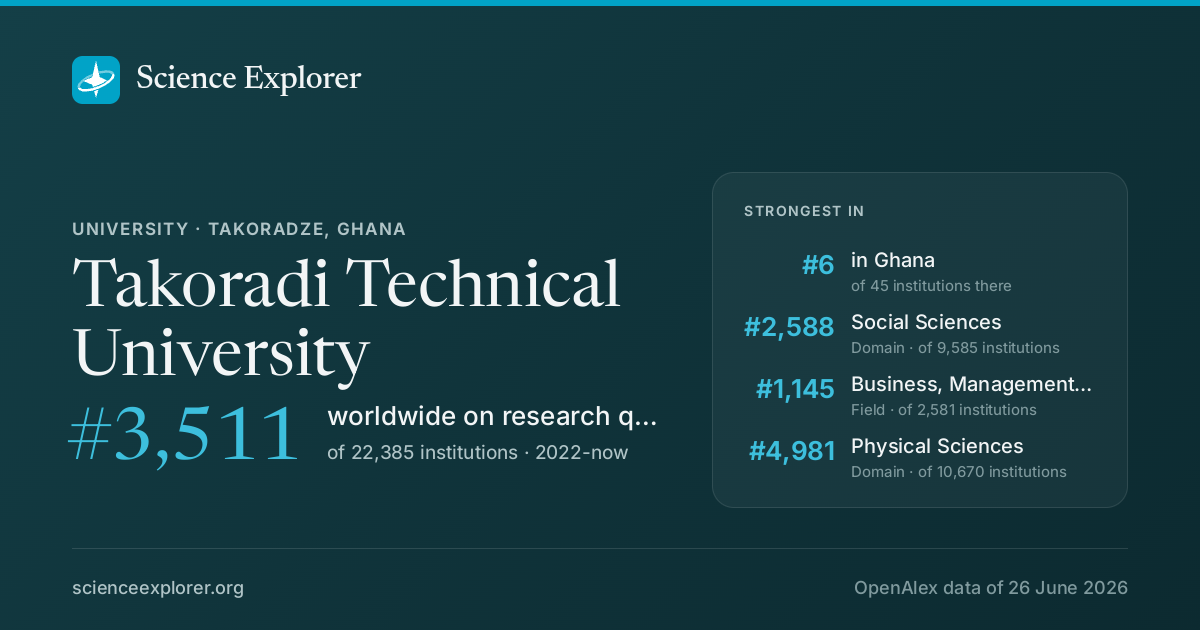
Takoradi Technical University on Science Explorer

A card with Takoradi Technical University's standing and the fields it leads in, for a post or a slide. A link to this page previews as the same card.

Download the card

1200 × 630 PNG, sized for social posts, drawn from the latest snapshot.

Badges for a website1Each links back here and updates with every snapshot

Research measures only: rankings here say nothing about teaching, admissions or student experience. Comparable institutions and collaboration partners have tabs of their own, above.

Discussion

Ask a question or share a note about Takoradi Technical University. Posts are plain text and can be reported.