 Science in Malawi
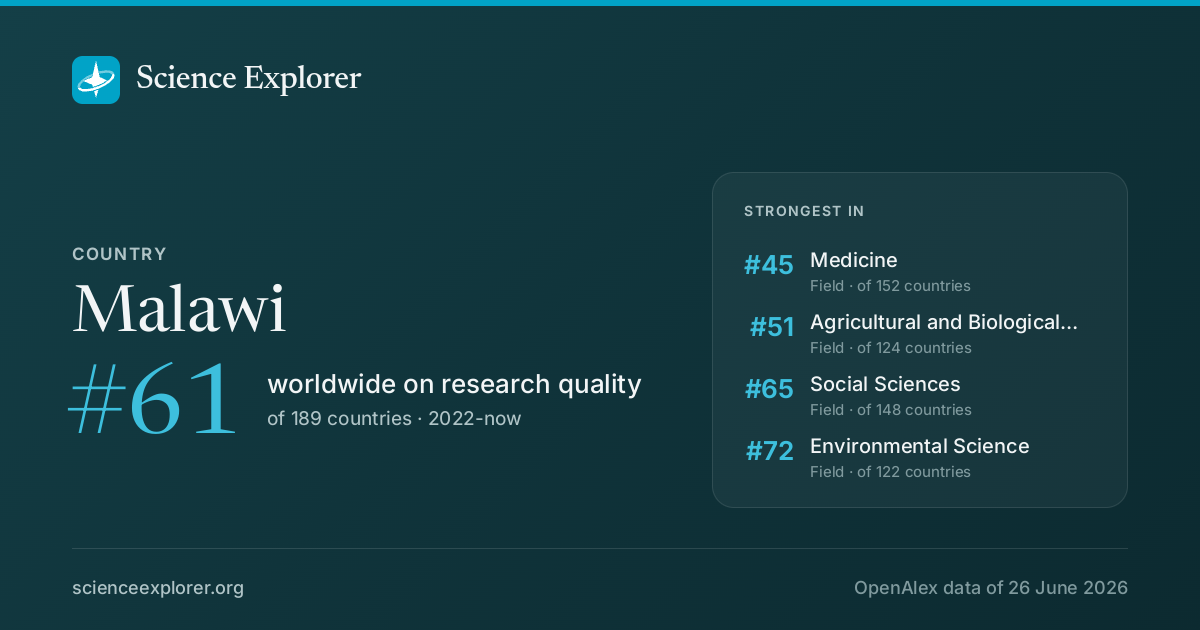
Malawi ranks #61 of 189 countries on research quality in 2022-now (#55 all time), with 3k research works and 9.5% of them in the world's top 10%.
- World rank, 2022-now
- #61 of 189 · #55 all time
- Works, 2022-now
- 3k ▲ 46% vs 2018-21
- Citations
- 189k 16.6 per fractional work, all time
- Top-10% rate
- 9.5% all institutions 10.0%
- vs its own fields
- 1.12× 1.00× is exactly expected
- In the world top 100
- 0 0 in the top 1,000
- Open access
- 63% world 40%
- International
- 49% world 18%
MalawiWhat is Malawi strongest at in science?
On research quality in 2022-now, Malawi ranks highest in Medicine (#45 of 152), Agricultural and Biological Sciences (#51 of 124) and Social Sciences (#65 of 148). Relative to its size it is most specialised in Forestry, Applied Microbiology and Biotechnology and Parasitology.
| Field | World rank | Where that sits | Top-10% rate | Works | All time | Institutions |
|---|---|---|---|---|---|---|
| MedicineField | #45 of 152 | 11.8% | 641 | #37 | Institutions | |
| Agricultural and Biological SciencesField | #51 of 124 | 11.7% | 336 | #50 | Institutions | |
| Social SciencesField | #65 of 148 | 8.2% | 534 | #60 | Institutions | |
| Environmental ScienceField | #72 of 122 | 7.4% | 275 | #70 | Institutions |
Where its research is concentrated
Location quotient: how much more (or less) of each node it does than its size predicts. Drawn around 1×, where "twice the world share" and "half of it" are the same distance apart in opposite directions. A volume reading, which on a country axis is largely population and industrial structure.
- ForestrySubfield · 26.7 works · #84 of 204 active here7.2×
- Applied Microbiology and BiotechnologySubfield · 12.1 works · #87 of 202 active here6.9×
- ParasitologySubfield · 22.1 works · #90 of 211 active here5.9×
- VirologySubfield · 10.7 works · #85 of 204 active here5.2×
- Research and TheorySubfield · 4.7 works · #78 of 183 active here5.1×
- EndocrinologySubfield · 13.7 works · #87 of 203 active here4.9×
- Infectious DiseasesSubfield · 115.8 works · #87 of 221 active here4.8×
- Soil ScienceSubfield · 48.5 works · #85 of 205 active here4.5×
The whole field profile
All 26 fields at once. A specialist and a generalist produce the same ranked list and a completely different shape.
Rings at 0.5×, 1× and 2×. Widest outward: Nursing, 4.2×. Every wedge is a field page.
All 26 fields, with their numbers
- Nursing4.20×73 works
- Agricultural and Biological Sciences2.54×429 works
- Environmental Science1.94×342 works
- Immunology and Microbiology1.93×69 works
- Health Professions1.84×172 works
- Economics, Econometrics and Finance1.52×116 works
- Social Sciences1.36×612 works
- Decision Sciences1.18×40 works
- Medicine1.08×739 works
- Psychology1.01×110 works
- Business, Management and Accounting1.00×114 works
- Arts and Humanities0.96×98 works
- Mathematics0.95×40 works
- Veterinary0.82×4 works
- Energy0.78×26 works
- Pharmacology, Toxicology and Pharmaceutics0.72×9 works
- Earth and Planetary Sciences0.63×35 works
- Computer Science0.53×146 works
- Biochemistry, Genetics and Molecular Biology0.49×92 works
- Engineering0.40×213 works
- Chemical Engineering0.30×4 works
- Neuroscience0.25×14 works
- Chemistry0.25×14 works
- Dentistry0.25×4 works
- Materials Science0.23×28 works
- Physics and Astronomy0.11×9 works
Which fields of science does Malawi work in?
In 2022-now, 31% of research in Malawi is in Social Sciences, 28% in Health Sciences. Its largest fields are Medicine (21%), Social Sciences (17%), Agricultural and Biological Sciences (12%). It does 1.3× the world's share of Life Sciences.
Each ring splits the one inside it: the four domains of science, their fields, their subfields. Size is fractional works in 2022-now. Every slice is a page; the interactive view zooms down to single topics and colours each by how much more of it this country does than the world.
Its 4 domains and 26 fields, with their numbers
- Social Sciences1,09130.7%
- Social Sciences61217.2%
- Economics, Econometrics and Finance1163.3%
- Business, Management and Accounting1143.2%
- Psychology1103.1%
- Arts and Humanities982.8%
- Decision Sciences401.1%
- Health Sciences99327.9%
- Medicine73920.8%
- Health Professions1724.8%
- Nursing732.1%
- Dentistry40.1%
- Veterinary40.1%
- Physical Sciences85624.1%
- Environmental Science3429.6%
- Engineering2136.0%
- Computer Science1464.1%
- Mathematics401.1%
- Earth and Planetary Sciences351.0%
- Materials Science280.8%
- Energy260.7%
- Chemistry140.4%
- Physics and Astronomy90.2%
- Chemical Engineering40.1%
- Life Sciences61417.3%
Which keywords describe research in Malawi?
By fractional works in 2022-now, weighted toward what it does more of than the world: Epidemiology, Climate Change, Maternal Mortality, Sustainable Agriculture, Community Health Workers, Antiretroviral Therapy, Health Inequalities and Socio-economic Factors.
- Global Health
- Livelihood Diversification
- Preexposure Prophylaxis
- Vulnerability
- Gender Inequality
- Water Sanitation Hygiene
- Technology Adoption
- Global Burden of Disease
- Colonialism
- Poverty Reduction
- Rural Development
- Food Security
- Child Development
- Health Systems
- Biodiversity
- Health Inequalities
- Community Health Workers
- Maternal Mortality
- Globalization
- Climate Change
- Epidemiology
- Sustainability
- Environmental Impact
- Sustainable Agriculture
- Antiretroviral Therapy
- Socio-economic Factors
- Child Mortality
- Smallholder Farmers
- Social Networks
- Biodiversity Conservation
- Global Burden
- Vaccine
- Genetic Diversity
- Mortality Rates
- Maternal and Child Undernutrition
- HIV Transmission
- Viral Load
- Agricultural Innovation
- Stigma and Discrimination
- Market Participation
Size is fractional works in 2022-now in the topics tagged with each word; colour is the word's share of this country's work against its share of the world's. The 40 words are chosen for being large and distinctive. Each links to the topic it comes from most.
All 40 words, with their numbers
- Epidemiology245▲ 1.73×119 topics
- Climate Change202▲ 2.1×10³ topics
- Sustainability141▲ 1.62×81 topics
- Globalization99▲ 1.41×86 topics
- Environmental Impact98▲ 1.61×51 topics
- Maternal Mortality91▲ 11×5 topics
- Sustainable Agriculture88▲ 8.0×13 topics
- Community Health Workers87▲ 28×2 topics
- Antiretroviral Therapy80▲ 14×6 topics
- Health Inequalities76▲ 18×4 topics
- Socio-economic Factors75▲ 19×2 topics
- Biodiversity74▲ 2.8×32 topics
- Child Mortality74▲ 29×1 topic
- Health Systems74▲ 29×1 topic
- Smallholder Farmers73▲ 9.8×6 topics
- Child Development72▲ 5.0×8 topics
- Social Networks70▲ 7.2×9 topics
- Food Security65▲ 3.4×20 topics
- Biodiversity Conservation65▲ 4.8×16 topics
- Rural Development64▲ 5.3×15 topics
- Global Burden62▲ 3.2×12 topics
- Poverty Reduction62▲ 13×5 topics
- Vaccine60▲ 4.2×11 topics
- Colonialism58▲ 3.5×17 topics
- Genetic Diversity58▲ 3.8×20 topics
- Global Burden of Disease57▲ 6.5×4 topics
- Mortality Rates53▲ 16×2 topics
- Technology Adoption53▲ 8.0×6 topics
- Maternal and Child Undernutrition52▲ 18×1 topic
- Water Sanitation Hygiene52▲ 18×1 topic
- HIV Transmission51▲ 19×2 topics
- Gender Inequality48▲ 9.7×6 topics
- Viral Load47▲ 17×2 topics
- Vulnerability47▲ 5.7×8 topics
- Agricultural Innovation44▲ 27×3 topics
- Preexposure Prophylaxis44▲ 26×1 topic
- Stigma and Discrimination44▲ 26×1 topic
- Livelihood Diversification44▲ 39×1 topic
- Market Participation44▲ 39×1 topic
- Global Health42▲ 7.6×6 topics
Which research topics does Malawi publish the most in?
Its largest topics in 2022-now are Global Maternal and Child Health, Child Nutrition and Water Access, HIV/AIDS Research and Interventions.
Area is fractional works in 2022-now; colour is the subfield each topic belongs to. Every tile is a topic page.
- 1 Global Maternal and Child Health Pediatrics, Perinatology and Child Health 74 works
- 2 Child Nutrition and Water Access Nutrition and Dietetics 51 works
- 3 HIV/AIDS Research and Interventions Infectious Diseases 44 works
- 4 Agricultural Innovations and Practices General Agricultural and Biological Sciences 44 works
- 5 Poverty, Education, and Child Welfare Safety Research 31 works
- 6 Adolescent Sexual and Reproductive Health General Health Professions 29 works
- 7 Malaria Research and Control Public Health, Environmental and Occupational Health 23 works
- 8 Global Health and Surgery Public Health, Environmental and Occupational Health 23 works
- 9 Energy and Environment Impacts Pollution 22 works
- 10 Linguistic, Cultural, and Literary Studies Sociology and Political Science 21 works
- 11 Microfinance and Financial Inclusion Economics and Econometrics 19 works
- 12 Military Technology and Strategies Aerospace Engineering 19 works
Which universities in Malawi lead research?
University of Malawi, Kamuzu Central Hospital and Ministry of Education Science and Technology rank highest in Malawi on research quality in 2022-now.
One dot per institution in the list below. The upper left is the interesting corner.
- 1University of MalawiUniversity · Zomba · #2,880 worldwide9.1% top 10% · 650 works
- 2Kamuzu Central HospitalHospital / health system · Lilongwe · #5,238 worldwide12.3% top 10% · 279 works
- 3Ministry of Education Science and TechnologyGovernment institution · Lilongwe · #5,348 worldwide7.7% top 10% · 312 works
- 4Mzuzu UniversityUniversity · Mzuzu · #7,704 worldwide6.9% top 10% · 241 works
- 5Malawi University of Science and TechnologyUniversity · Blantyre · #8,187 worldwide6.9% top 10% · 172 works
- 6Lilongwe University of Agriculture and Natural ResourcesUniversity · Lilongwe · #9,511 worldwide11.0% top 10% · 243 works
- 7Department of ForestryGovernment institution · Lilongwe · #10,861 worldwide8.7% top 10% · 261 works
- 8Ministry of HealthGovernment institution · Lilongwe · #13,699 worldwide16.2% top 10% · 102 works
- 9Blantyre Institute for Community OphthalmologyNonprofit · Blantyre · #14,144 worldwide11.0% top 10% · 80 works
- 10DMI-St. John the Baptist UniversityUniversity · Mangochi · #14,274 worldwide2.0% top 10% · 147 works
The track on each row is its top-10% rate; the tick is the average of all institutions, 10.0% (how it is set): teal above it, red below.
All ranked institutions in MalawiWho are the top researchers in Malawi?
Amelia Catharine Crampin, Kelias Phiri Msyamboza and Eduard E. Zijlstra rank highest among researchers based in Malawi.
- 1 Amelia Catharine Crampin #138,780 worldwide 23k citations · 372 works
- 2 Kelias Phiri Msyamboza #162,077 worldwide 12k citations · 53 works
- 3 Eduard E. Zijlstra #238,180 worldwide 4.8k citations · 91 works
- 4 Elsbeth Robson #239,786 worldwide 3k citations · 121 works
- 5 Felix Khuluza #244,579 worldwide 1.6k citations · 40 works
- 6 Charles W Mwansambo #245,150 worldwide 4.2k citations · 48 works
- 7 Ibrahim Chikowe #247,210 worldwide 1.7k citations · 74 works
- 8 Kondwani Kawaza #252,587 worldwide 2.3k citations · 113 works
- 9 Ulla K. Hemmilä #254,139 worldwide 3.2k citations · 26 works
- 10 Andreas K. Jahn #273,079 worldwide 7k citations · 232 works
How open and international is Malawi's research?
63% of its research is openly available (world: 40%), and 49% is written with international co-authors (world: 18%).
World: 40% of research is openly available.
World: 18% is written across borders.
In 2022-now, 75% of its research is openly available (world 63%) and 56% is written with co-authors abroad (world 22%). Against what its own mix of topics predicts, that is 1.07× the expected open access and 2.19× the expected international share, which puts it #81 of 173 countries on openness.
How has Malawi's research grown?
Output in 2022-2025 was 46% higher than in 2018-2021.
The same series as a ribbon: one cell per year, darker for more. The line above answers how much; this answers when.
Its share of all research
Growing output can still be a shrinking share: all of science grows. This is Malawi as a percentage of every work published that year, 0.014% in 2024.
Fractional works of Malawi over all fractional works that year. How the balance of science has shifted.
How much of it reaches the world top 10%
Over the whole record, 9.8% of its 11k works since 1950 reached the world top 10% for their field and year.
Of each year's output, the share that reached the world's 10% most cited for its field and year. Peak 13.9% in 2016.
Which countries have research most like Malawi's?
Sierra Leone is Malawi's closest research twin: of all countries, its research is spread across the fields most like Malawi's, with both strong in Nursing.
- 1
 Sierra LeoneBoth strong in Nursing, Agricultural and Biological Sciences, Immunology and Microbiology
0.93 Compare
- 2
 GhanaBoth strong in Nursing, Agricultural and Biological Sciences, Health Professions
0.93 Compare
- 3
 TanzaniaBoth strong in Nursing, Agricultural and Biological Sciences, Environmental Science
0.92 Compare
- 4
 Democratic Republic of the CongoBoth strong in Nursing, Agricultural and Biological Sciences, Health Professions
0.91 Compare
- 5
 UgandaBoth strong in Nursing, Immunology and Microbiology, Health Professions
0.90 Compare
Similarity is the correlation of each side's location quotients across every field it publishes in, on a log scale: 1 is the same shape of research, 0 is unrelated. It ignores size. How it is measured.
Compare Malawi with
 Ukraine
 Puerto Rico
 Colombia
 Montenegro
Share Malawi's ranking
Badges for a website1Each links back here and updates with every snapshot

Research fields in Malawi
Discussion
Ask a question or share a note about Malawi. Posts are plain text and can be reported.