 Science in Uganda
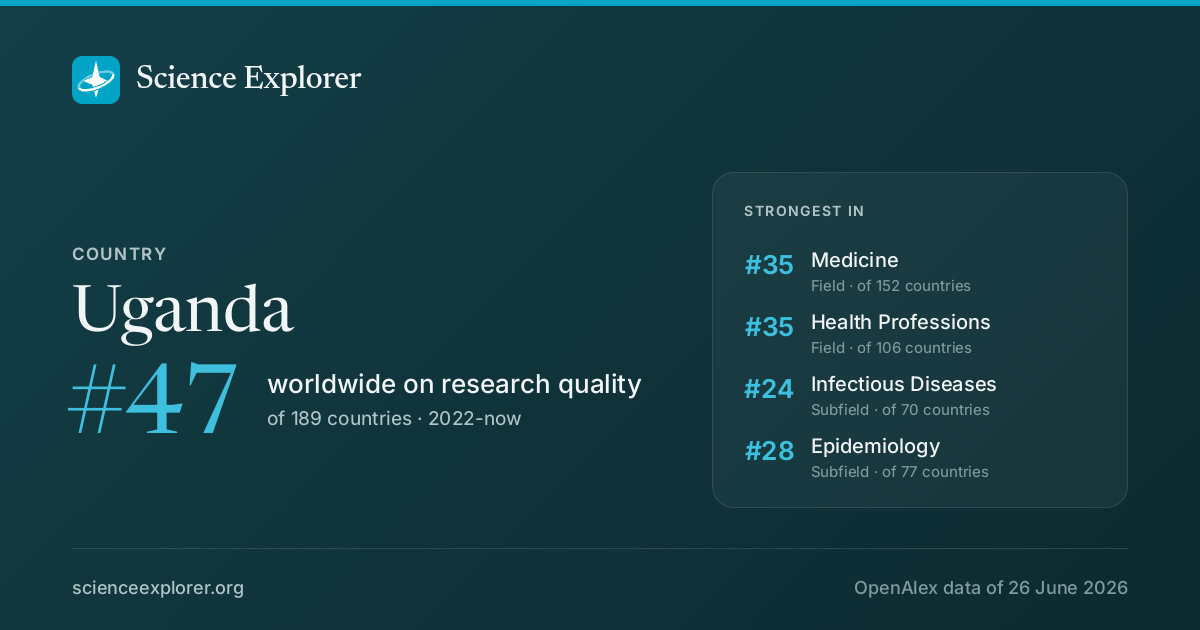
Uganda ranks #47 of 189 countries on research quality in 2022-now (#49 all time), with 13k research works and 9.5% of them in the world's top 10%.
- World rank, 2022-now
- #47 of 189 · #49 all time
- Works, 2022-now
- 13k ▲ 75% vs 2018-21
- Citations
- 601k 14.5 per fractional work, all time
- Top-10% rate
- 9.5% all institutions 10.0%
- vs its own fields
- 1.06× 1.00× is exactly expected
- In the world top 100
- 0 1 in the top 1,000
- Open access
- 71% world 40%
- International
- 41% world 18%
UgandaWhat is Uganda strongest at in science?
On research quality in 2022-now, Uganda ranks highest in Medicine (#35 of 152), Health Professions (#35 of 106) and Infectious Diseases (#24 of 70). Relative to its size it is most specialised in Virology, Applied Microbiology and Biotechnology and Infectious Diseases.
| Field | World rank | Where that sits | Top-10% rate | Works | All time | Institutions |
|---|---|---|---|---|---|---|
| MedicineField | #35 of 152 | 10.5% | 3,685 | #34 | Institutions | |
| Health ProfessionsField | #35 of 106 | 11.5% | 683 | #36 | Institutions | |
| Infectious DiseasesSubfield | #24 of 70 | 10.7% | 654 | #23 | Institutions | |
| EpidemiologySubfield | #28 of 77 | 9.4% | 465 | #26 | Institutions | |
| Social SciencesField | #54 of 148 | 8.0% | 2,147 | #57 | Institutions | |
| Public Health, Environmental and Occupational HealthSubfield | #31 of 84 | 11.7% | 585 | #32 | Institutions | |
| Agricultural and Biological SciencesField | #46 of 124 | 10.4% | 1,048 | #47 | Institutions | |
| General Health ProfessionsSubfield | #32 of 84 | 11.3% | 487 | #35 | Institutions | |
| Pediatrics, Perinatology and Child HealthSubfield | #27 of 65 | 9.9% | 395 | #30 | Institutions | |
| EducationSubfield | #48 of 112 | 7.6% | 654 | #55 | Institutions | |
| Immunology and MicrobiologyField | #31 of 71 | 12.1% | 293 | #30 | Institutions | |
| Plant ScienceSubfield | #40 of 90 | 11.9% | 374 | #44 | Institutions |
Where its research is concentrated
Location quotient: how much more (or less) of each node it does than its size predicts. Drawn around 1×, where "twice the world share" and "half of it" are the same distance apart in opposite directions. A volume reading, which on a country axis is largely population and industrial structure.
- VirologySubfield · 88.3 works · #32 of 204 active here9.8×
- Applied Microbiology and BiotechnologySubfield · 65.0 works · #40 of 202 active here8.4×
- Infectious DiseasesSubfield · 770.6 works · #38 of 221 active here7.3×
- HorticultureSubfield · 10.1 works · #52 of 178 active here4.8×
- ParasitologySubfield · 73.9 works · #62 of 211 active here4.5×
- Library and Information SciencesSubfield · 13.1 works · #49 of 146 active here4.4×
- Safety ResearchSubfield · 187.5 works · #59 of 215 active here4.4×
- Business and International ManagementSubfield · 68.0 works · #46 of 192 active here4.2×
The whole field profile
All 26 fields at once. A specialist and a generalist produce the same ranked list and a completely different shape.
Rings at 0.5×, 1× and 2×. Widest outward: Nursing, 3.6×. Every wedge is a field page.
All 26 fields, with their numbers
- Nursing3.56×271 works
- Immunology and Microbiology2.38×372 works
- Health Professions1.97×807 works
- Business, Management and Accounting1.82×909 works
- Economics, Econometrics and Finance1.72×571 works
- Agricultural and Biological Sciences1.67×1,234 works
- Medicine1.51×4,516 works
- Social Sciences1.31×2,580 works
- Environmental Science1.21×931 works
- Pharmacology, Toxicology and Pharmaceutics1.19×65 works
- Decision Sciences1.19×179 works
- Psychology1.19×561 works
- Veterinary0.97×20 works
- Biochemistry, Genetics and Molecular Biology0.63×520 works
- Energy0.63×90 works
- Mathematics0.58×106 works
- Arts and Humanities0.54×244 works
- Computer Science0.47×564 works
- Dentistry0.40×30 works
- Engineering0.28×646 works
- Neuroscience0.26×65 works
- Chemistry0.20×48 works
- Earth and Planetary Sciences0.19×45 works
- Materials Science0.19×102 works
- Chemical Engineering0.15×8 works
- Physics and Astronomy0.13×45 works
Which fields of science does Uganda work in?
In 2022-now, 36% of research in Uganda is in Health Sciences, 32% in Social Sciences. Its largest fields are Medicine (29%), Social Sciences (17%), Agricultural and Biological Sciences (8%). It does 1.6× the world's share of Health Sciences.
Each ring splits the one inside it: the four domains of science, their fields, their subfields. Size is fractional works in 2022-now. Every slice is a page; the interactive view zooms down to single topics and colours each by how much more of it this country does than the world.
Its 4 domains and 26 fields, with their numbers
- Health Sciences5,64536.3%
- Medicine4,51629.1%
- Health Professions8075.2%
- Nursing2711.7%
- Dentistry300.2%
- Veterinary200.1%
- Social Sciences5,04432.5%
- Social Sciences2,58016.6%
- Business, Management and Accounting9095.9%
- Economics, Econometrics and Finance5713.7%
- Psychology5613.6%
- Arts and Humanities2441.6%
- Decision Sciences1791.2%
- Physical Sciences2,58616.6%
- Environmental Science9316.0%
- Engineering6464.2%
- Computer Science5653.6%
- Mathematics1060.7%
- Materials Science1020.7%
- Energy900.6%
- Chemistry480.3%
- Earth and Planetary Sciences450.3%
- Physics and Astronomy450.3%
- Chemical Engineering80.1%
- Life Sciences2,25614.5%
Which keywords describe research in Uganda?
By fractional works in 2022-now, weighted toward what it does more of than the world: Epidemiology, Antiretroviral Therapy, Maternal Mortality, Vaccine, Community Health Workers, Health Inequalities, Socio-economic Factors and Child Mortality.
- Adolescent Health
- Global Health
- Water Sanitation Hygiene
- Gender Inequality
- Smallholder Farmers
- Vaccine Development
- Preexposure Prophylaxis
- Child Development
- Genetic Diversity
- Social Capital
- Drug Resistance
- Diagnosis
- Child Mortality
- Global Burden
- Community Health Workers
- Risk Factors
- Vaccine
- Globalization
- Antiretroviral Therapy
- Sustainability
- Epidemiology
- Climate Change
- Public Health
- Maternal Mortality
- Immune Response
- Mental Health
- Health Inequalities
- Socio-economic Factors
- Health Systems
- Mortality Rates
- HIV Transmission
- Viral Load
- Poverty Reduction
- Pathogenesis
- Stigma and Discrimination
- Global Burden of Disease
- HIV Infection
- Maternal and Child Undernutrition
- HIV Prevention
- HIV
Size is fractional works in 2022-now in the topics tagged with each word; colour is the word's share of this country's work against its share of the world's. The 40 words are chosen for being large and distinctive. Each links to the topic it comes from most.
All 40 words, with their numbers
- Epidemiology1,464▲ 2.4×135 topics
- Sustainability576▲ 1.52×10⁵ topics
- Climate Change570▲ 1.35×10⁴ topics
- Antiretroviral Therapy528▲ 21×6 topics
- Public Health472▲ 2.1×63 topics
- Globalization448▲ 1.47×113 topics
- Maternal Mortality443▲ 13×5 topics
- Vaccine430▲ 6.9×11 topics
- Immune Response417▲ 4.7×23 topics
- Risk Factors396▲ 2.3×37 topics
- Mental Health380▲ 1.71×45 topics
- Community Health Workers376▲ 27×2 topics
- Health Inequalities348▲ 18×5 topics
- Global Burden341▲ 4.0×12 topics
- Socio-economic Factors339▲ 20×3 topics
- Child Mortality336▲ 30×1 topic
- Health Systems336▲ 30×1 topic
- Diagnosis323▲ 2.2×40 topics
- Mortality Rates307▲ 21×2 topics
- Drug Resistance293▲ 6.5×9 topics
- HIV Transmission287▲ 24×2 topics
- Social Capital277▲ 3.4×19 topics
- Viral Load273▲ 23×2 topics
- Genetic Diversity272▲ 4.0×21 topics
- Poverty Reduction271▲ 13×6 topics
- Child Development268▲ 4.2×8 topics
- Pathogenesis263▲ 3.3×24 topics
- Preexposure Prophylaxis259▲ 34×1 topic
- Stigma and Discrimination259▲ 34×1 topic
- Vaccine Development259▲ 6.5×11 topics
- Global Burden of Disease229▲ 6.0×4 topics
- Smallholder Farmers196▲ 6.0×6 topics
- HIV Infection194▲ 12×4 topics
- Gender Inequality191▲ 8.9×6 topics
- Maternal and Child Undernutrition189▲ 15×1 topic
- Water Sanitation Hygiene189▲ 15×1 topic
- HIV Prevention179▲ 20×2 topics
- Global Health174▲ 7.2×8 topics
- HIV173▲ 13×4 topics
- Adolescent Health170▲ 13×3 topics
Which research topics does Uganda publish the most in?
Its largest topics in 2022-now are Global Maternal and Child Health, HIV/AIDS Research and Interventions, Child Nutrition and Water Access.
Area is fractional works in 2022-now; colour is the subfield each topic belongs to. Every tile is a topic page.
- 1 Global Maternal and Child Health Pediatrics, Perinatology and Child Health 336 works
- 2 HIV/AIDS Research and Interventions Infectious Diseases 259 works
- 3 Child Nutrition and Water Access Nutrition and Dietetics 189 works
- 4 Adolescent Sexual and Reproductive Health General Health Professions 165 works
- 5 Tuberculosis Research and Epidemiology Infectious Diseases 131 works
- 6 Poverty, Education, and Child Welfare Safety Research 130 works
- 7 Malaria Research and Control Public Health, Environmental and Occupational Health 125 works
- 8 Microfinance and Financial Inclusion Economics and Econometrics 98 works
- 9 Agricultural Innovations and Practices General Agricultural and Biological Sciences 98 works
- 10 Viral Infections and Outbreaks Research Infectious Diseases 94 works
- 11 Energy and Environment Impacts Pollution 91 works
- 12 Global Health and Surgery Public Health, Environmental and Occupational Health 85 works
How many world-class institutions does Uganda hold?
Average quality and elite capacity disagree by construction, and both are worth knowing: the first is decided by a country's whole institution population, the second counts the institutions it holds at the top. One square per institution.
| Standing among countries | 2022-now | Where that sits | All time |
|---|---|---|---|
| Average qualityits whole institution population | #47 of 189 | #49 of 203 | |
| Elite capacitythe institutions it holds at the top | #44 of 204 | #47 of 216 |
Elite capacity counts a country's institutions by their worldwide rank, weighted so a place at #1 counts for more than one at #480. Countries under 100 fractional works are left out.
Bands are exclusive, so the squares add up to 1 (the institutions it holds in the world top 1,000), not to four times it.
Which universities in Uganda lead research?
Makerere University, Kampala International University and Mbarara University of Science and Technology rank highest in Uganda on research quality in 2022-now.
One dot per institution in the list below. The upper left is the interesting corner.
- 1Makerere UniversityUniversity · Kampala · #807 worldwide9.6% top 10% · 3.7k works
- 2Kampala International UniversityUniversity · Kampala · #2,692 worldwide12.9% top 10% · 1.4k works
- 3Mbarara University of Science and TechnologyUniversity · Mbarara · #3,048 worldwide9.8% top 10% · 741 works
- 4Kyambogo UniversityUniversity · Kampala · #4,760 worldwide6.5% top 10% · 574 works
- 5Gulu UniversityUniversity · Gulu · #5,236 worldwide9.0% top 10% · 426 works
- 6Kabale UniversityUniversity · Kabale · #5,561 worldwide8.8% top 10% · 337 works
- 7Infectious Diseases InstituteNonprofit · Kampala · #5,836 worldwide15.0% top 10% · 211 works
- 8Busitema UniversityUniversity · Tororo · #5,922 worldwide9.2% top 10% · 360 works
- 9Centers for Disease Control and PreventionGovernment institution · Kampala · #6,684 worldwide10.8% top 10% · 211 works
- 10Uganda Virus Research InstituteResearch facility · Entebbe · #7,668 worldwide12.3% top 10% · 210 works
- 11Ministry of HealthGovernment institution · Kampala · #8,135 worldwide17.4% top 10% · 218 works
- 12Lira HospitalHospital / health system · Lira · #9,067 worldwide8.5% top 10% · 194 works
- 13Islamic University in UgandaUniversity · Mbale · #9,551 worldwide8.4% top 10% · 211 works
- 14Muni UniversityUniversity · Arua · #10,076 worldwide11.7% top 10% · 143 works
- 15Uganda Management InstituteUniversity · Kampala · #10,196 worldwide4.9% top 10% · 171 works

The track on each row is its top-10% rate; the tick is the average of all institutions, 10.0% (how it is set): teal above it, red below.
All ranked institutions in UgandaWho are the top researchers in Uganda?
Mahadih Kyambade, Afulah Namatovu and Adoke Yeka rank highest among researchers based in Uganda.
- 1 Mahadih Kyambade #22,796 worldwide 818 citations · 67 works
- 2 Afulah Namatovu #24,940 worldwide 658 citations · 49 works
- 3 Adoke Yeka #39,181 worldwide 5.6k citations · 116 works
- 4 Jimmy Opigo #56,186 worldwide 2.3k citations · 144 works
- 5 Moses Robert Kamya #68,808 worldwide 28k citations · 864 works
- 6 Joaniter Immaculate Nankabirwa #72,175 worldwide 5.3k citations · 218 works
- 7 Peter Waiswa #76,995 worldwide 7.3k citations · 203 works
- 8 Samuel Gonahasa #78,747 worldwide 1.5k citations · 62 works
- 9 Robert Bitariho #80,448 worldwide 5.2k citations · 80 works
- 10 Samuel L. Nsobya #81,841 worldwide 4.4k citations · 138 works
Which cities in Uganda are research hubs?
How open and international is Uganda's research?
71% of its research is openly available (world: 40%), and 41% is written with international co-authors (world: 18%).
World: 40% of research is openly available.
World: 18% is written across borders.
In 2022-now, 85% of its research is openly available (world 63%) and 41% is written with co-authors abroad (world 22%). Against what its own mix of topics predicts, that is 1.20× the expected open access and 1.69× the expected international share, which puts it #20 of 173 countries on openness.
How has Uganda's research grown?
Output in 2022-2025 was 75% higher than in 2018-2021.
The same series as a ribbon: one cell per year, darker for more. The line above answers how much; this answers when.
Its share of all research
Growing output can still be a shrinking share: all of science grows. This is Uganda as a percentage of every work published that year, 0.061% in 2024.
Fractional works of Uganda over all fractional works that year. How the balance of science has shifted.
How much of it reaches the world top 10%
Over the whole record, 9.5% of its 41k works since 1950 reached the world top 10% for their field and year.
Of each year's output, the share that reached the world's 10% most cited for its field and year. Peak 14.8% in 1993.
Which countries have research most like Uganda's?
Tanzania is Uganda's closest research twin: of all countries, its research is spread across the fields most like Uganda's, with both strong in Nursing.
- 1
 TanzaniaBoth strong in Nursing, Business, Management and Accounting, Economics, Econometrics and Finance
0.92 Compare
- 2
 SomaliaBoth strong in Nursing, Health Professions, Economics, Econometrics and Finance
0.92 Compare
- 3
 GhanaBoth strong in Nursing, Business, Management and Accounting, Economics, Econometrics and Finance
0.91 Compare
- 4
 MalawiBoth strong in Nursing, Immunology and Microbiology, Health Professions
0.90 Compare
- 5
 ZambiaBoth strong in Nursing, Business, Management and Accounting, Immunology and Microbiology
0.90 Compare
Similarity is the correlation of each side's location quotients across every field it publishes in, on a log scale: 1 is the same shape of research, 0 is unrelated. It ignores size. How it is measured.
Compare Uganda with
 Qatar
 Cyprus
 Iran
 Russia
 Estonia
 Iceland
Share Uganda's ranking
Badges for a website1Each links back here and updates with every snapshot

Research fields in Uganda
- Health Sciences
- Medicine
- Life Sciences
- Health Professions
- Infectious Diseases
- Social Sciences
- Epidemiology
- Social Sciences
- Public Health, Environmental and Occupational Health
- Agricultural and Biological Sciences
- General Health Professions
- Pediatrics, Perinatology and Child Health
- Education
- Immunology and Microbiology
- Plant Science
- Psychology
- Sociology and Political Science
- Business, Management and Accounting
- Engineering
- Computer Science
- Nursing
- Nutrition and Dietetics
- Environmental Science
- Physical Sciences
- Clinical Psychology
- Economics, Econometrics and Finance
- Biochemistry, Genetics and Molecular Biology
- Economics and Econometrics
- Strategy and Management
Questions people ask
What is Uganda strongest at in science?
On research quality in 2022-now, Uganda ranks highest in Medicine (#35 of 152), Health Professions (#35 of 106) and Infectious Diseases (#24 of 70). Relative to its size it is most specialised in Virology, Applied Microbiology and Biotechnology and Infectious Diseases.
See the full answerDiscussion
Ask a question or share a note about Uganda. Posts are plain text and can be reported.