 Science in Zambia
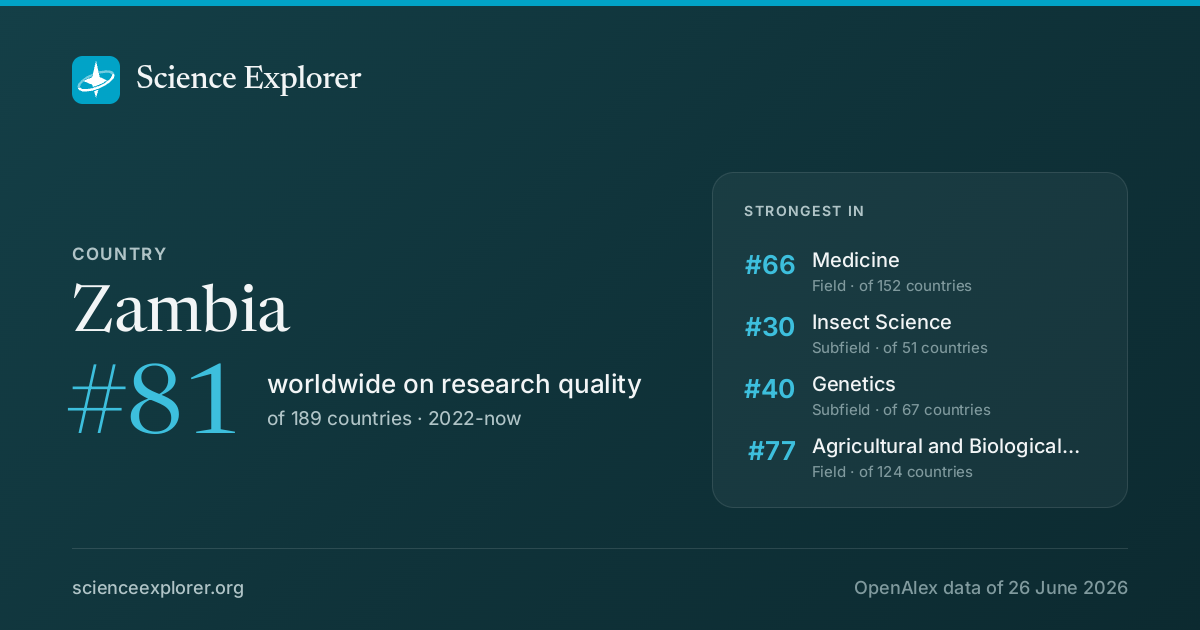
Zambia ranks #81 of 189 countries on research quality in 2022-now (#70 all time), with 6.6k research works and 5.9% of them in the world's top 10%.
- World rank, 2022-now
- #81 of 189 · #70 all time
- Works, 2022-now
- 6.6k ▲ 97% vs 2018-21
- Citations
- 180k 9.8 per fractional work, all time
- Top-10% rate
- 5.9% all institutions 10.0%
- vs its own fields
- 0.80× 1.00× is exactly expected
- In the world top 100
- 0 0 in the top 1,000
- Open access
- 71% world 40%
- International
- 44% world 18%
ZambiaWhat is Zambia strongest at in science?
On research quality in 2022-now, Zambia ranks highest in Medicine (#66 of 152), Insect Science (#30 of 51) and Genetics (#40 of 67). Relative to its size it is most specialised in Insect Science, Aquatic Science and Business and International Management.
| Field | World rank | Where that sits | Top-10% rate | Works | All time | Institutions |
|---|---|---|---|---|---|---|
| MedicineField | #66 of 152 | 7.2% | 1,229 | #51 | Institutions | |
| Insect ScienceSubfield | #30 of 51 | 0.5% | 445 | #39 | Institutions | |
| GeneticsSubfield | #40 of 67 | 0.9% | 273 | - | Institutions | |
| Agricultural and Biological SciencesField | #77 of 124 | 4.0% | 1,085 | #72 | Institutions | |
| Biochemistry, Genetics and Molecular BiologyField | #67 of 105 | 3.8% | 410 | #77 | Institutions | |
| Social SciencesField | #98 of 148 | 7.4% | 887 | #83 | Institutions | |
| Environmental ScienceField | #83 of 122 | 5.8% | 480 | #85 | Institutions | |
| Health ProfessionsField | #74 of 106 | 6.5% | 262 | #63 | Institutions | |
| Economics, Econometrics and FinanceField | #76 of 107 | 4.8% | 329 | #70 | Institutions | |
| Economics and EconometricsSubfield | #74 of 98 | 4.7% | 247 | #67 | Institutions | |
| Business, Management and AccountingField | #86 of 110 | 5.1% | 530 | #76 | Institutions | |
| EngineeringField | #103 of 131 | 6.2% | 331 | #102 | Institutions |
Where its research is concentrated
Location quotient: how much more (or less) of each node it does than its size predicts. Drawn around 1×, where "twice the world share" and "half of it" are the same distance apart in opposite directions. A volume reading, which on a country axis is largely population and industrial structure.
- Insect ScienceSubfield · 448.8 works · #36 of 214 active here20×
- Aquatic ScienceSubfield · 122.3 works · #48 of 214 active here8.4×
- Business and International ManagementSubfield · 52.4 works · #55 of 192 active here6.2×
- Applied Microbiology and BiotechnologySubfield · 24.4 works · #67 of 202 active here6.1×
- VirologySubfield · 24.7 works · #65 of 204 active here5.3×
- Ecology, Evolution, Behavior and SystematicsSubfield · 164.7 works · #80 of 223 active here4.4×
- GeneticsSubfield · 279.0 works · #65 of 221 active here4.2×
- Infectious DiseasesSubfield · 222.2 works · #71 of 221 active here4.1×
The whole field profile
All 26 fields at once. A specialist and a generalist produce the same ranked list and a completely different shape.
Rings at 0.5×, 1× and 2×. Widest outward: Agricultural and Biological Sciences, 3.1×. Every wedge is a field page.
All 26 fields, with their numbers
- Agricultural and Biological Sciences3.14×1,198 works
- Business, Management and Accounting2.65×687 works
- Economics, Econometrics and Finance2.34×402 works
- Nursing2.31×91 works
- Decision Sciences1.99×155 works
- Immunology and Microbiology1.78×144 works
- Environmental Science1.52×608 works
- Health Professions1.47×311 works
- Social Sciences1.17×1,191 works
- Dentistry1.10×43 works
- Biochemistry, Genetics and Molecular Biology1.04×447 works
- Medicine0.94×1,452 works
- Psychology0.82×202 works
- Veterinary0.77×8 works
- Mathematics0.71×67 works
- Arts and Humanities0.58×135 works
- Pharmacology, Toxicology and Pharmaceutics0.47×13 works
- Computer Science0.47×292 works
- Energy0.45×33 works
- Earth and Planetary Sciences0.37×46 works
- Engineering0.32×391 works
- Neuroscience0.22×28 works
- Chemistry0.19×24 works
- Chemical Engineering0.15×4 works
- Materials Science0.15×41 works
- Physics and Astronomy0.13×22 works
Which fields of science does Zambia work in?
In 2022-now, 34% of research in Zambia is in Social Sciences, 24% in Health Sciences. Its largest fields are Medicine (18%), Agricultural and Biological Sciences (15%), Social Sciences (15%). It does 1.7× the world's share of Life Sciences.
Each ring splits the one inside it: the four domains of science, their fields, their subfields. Size is fractional works in 2022-now. Every slice is a page; the interactive view zooms down to single topics and colours each by how much more of it this country does than the world.
Its 4 domains and 26 fields, with their numbers
- Social Sciences2,77134.5%
- Social Sciences1,19114.8%
- Business, Management and Accounting6878.6%
- Economics, Econometrics and Finance4025.0%
- Psychology2022.5%
- Decision Sciences1551.9%
- Arts and Humanities1351.7%
- Health Sciences1,90523.7%
- Medicine1,45218.1%
- Health Professions3113.9%
- Nursing911.1%
- Dentistry430.5%
- Veterinary80.1%
- Life Sciences1,83022.8%
- Physical Sciences1,53019.0%
- Environmental Science6087.6%
- Engineering3914.9%
- Computer Science2923.6%
- Mathematics670.8%
- Earth and Planetary Sciences460.6%
- Materials Science410.5%
- Energy330.4%
- Chemistry240.3%
- Physics and Astronomy220.3%
- Chemical Engineering40.1%
Which keywords describe research in Zambia?
By fractional works in 2022-now, weighted toward what it does more of than the world: Biodiversity, Phylogeny, Invasive Species, DNA Barcoding, Conservation, Taxonomy, Evolution and Biological Control.
- Morphology
- Child Mortality
- Health Inequalities
- Vaccine
- Antiretroviral Therapy
- Chemical Ecology
- Pheromones
- Food Security
- Economic Growth
- Environmental Challenge
- Social Capital
- Pest Management
- Host Specificity
- Lepidoptera
- Biological Control
- Evolution
- Conservation
- Invasive Species
- Climate Change
- Biodiversity
- Epidemiology
- Sustainability
- Phylogeny
- DNA Barcoding
- Taxonomy
- Environmental Impact
- Cryptic Species
- Molecular Phylogenetics
- Ecological Impact
- Sustainable Energy
- Economic Assessment
- Water Hyacinth
- Economic Development
- Poverty Reduction
- Genetic Diversity
- Odor Source Localization
- Maternal Mortality
- Community Health Workers
- Socio-economic Factors
- Health Systems
Size is fractional works in 2022-now in the topics tagged with each word; colour is the word's share of this country's work against its share of the world's. The 40 words are chosen for being large and distinctive. Each links to the topic it comes from most.
All 40 words, with their numbers
- Epidemiology502▲ 1.57×133 topics
- Biodiversity393▲ 6.4×34 topics
- Sustainability366▲ 1.86×95 topics
- Climate Change347▲ 1.59×10⁷ topics
- Phylogeny319▲ 24×16 topics
- Invasive Species310▲ 9.1×21 topics
- DNA Barcoding306▲ 22×9 topics
- Conservation299▲ 8.7×21 topics
- Taxonomy294▲ 25×13 topics
- Evolution291▲ 14×15 topics
- Environmental Impact277▲ 2.0×59 topics
- Biological Control267▲ 22×9 topics
- Cryptic Species240▲ 117×2 topics
- Lepidoptera238▲ 156×1 topic
- Molecular Phylogenetics238▲ 156×1 topic
- Host Specificity220▲ 24×5 topics
- Ecological Impact202▲ 48×3 topics
- Pest Management200▲ 30×5 topics
- Sustainable Energy198▲ 13×4 topics
- Social Capital197▲ 4.7×20 topics
- Economic Assessment191▲ 87×2 topics
- Environmental Challenge191▲ 193×1 topic
- Water Hyacinth191▲ 193×1 topic
- Economic Growth179▲ 2.7×31 topics
- Economic Development171▲ 2.7×40 topics
- Food Security166▲ 3.8×21 topics
- Poverty Reduction159▲ 15×6 topics
- Pheromones142▲ 33×3 topics
- Genetic Diversity140▲ 4.0×21 topics
- Chemical Ecology139▲ 182×1 topic
- Odor Source Localization139▲ 182×1 topic
- Antiretroviral Therapy136▲ 10×6 topics
- Maternal Mortality132▲ 7.3×5 topics
- Vaccine132▲ 4.1×11 topics
- Community Health Workers121▲ 17×2 topics
- Health Inequalities114▲ 12×5 topics
- Socio-economic Factors111▲ 12×3 topics
- Child Mortality109▲ 19×1 topic
- Health Systems109▲ 19×1 topic
- Morphology106▲ 7.4×9 topics
Which research topics does Zambia publish the most in?
Its largest topics in 2022-now are Lepidoptera: Biology and Taxonomy, Biological Control of Invasive Species, Insect Pheromone Research and Control.
Area is fractional works in 2022-now; colour is the subfield each topic belongs to. Every tile is a topic page.
- 1 Lepidoptera: Biology and Taxonomy Genetics 238 works
- 2 Biological Control of Invasive Species Insect Science 191 works
- 3 Insect Pheromone Research and Control Insect Science 139 works
- 4 Global Maternal and Child Health Pediatrics, Perinatology and Child Health 109 works
- 5 Microfinance and Financial Inclusion Economics and Econometrics 75 works
- 6 HIV/AIDS Research and Interventions Infectious Diseases 69 works
- 7 Child Nutrition and Water Access Nutrition and Dietetics 63 works
- 8 Poverty, Education, and Child Welfare Safety Research 63 works
- 9 Adolescent Sexual and Reproductive Health General Health Professions 60 works
- 10 Insect Utilization and Effects Insect Science 58 works
- 11 Innovation and Socioeconomic Development Business and International Management 52 works
- 12 Fish Biology and Ecology Studies Aquatic Science 46 works
Which universities in Zambia lead research?
University of Zambia, Copperbelt University and University of Lusaka rank highest in Zambia on research quality in 2022-now.
One dot per institution in the list below. The upper left is the interesting corner.
- 1University of ZambiaUniversity · Lusaka · #1,529 worldwide4.1% top 10% · 3k works
- 2Copperbelt UniversityUniversity · Kitwe · #5,005 worldwide9.9% top 10% · 442 works
- 3University of LusakaUniversity · Lusaka · #7,238 worldwide7.1% top 10% · 297 works
- 4Kwame Nkrumah UniversityUniversity · Kabwe · #8,330 worldwide5.9% top 10% · 419 works
- 5University Teaching HospitalHospital / health system · Lusaka · #9,115 worldwide4.8% top 10% · 423 works
- 6Mulungushi UniversityUniversity · Kabwe · #9,895 worldwide7.8% top 10% · 196 works
- 7University of AfricaUniversity · Lusaka · #10,776 worldwide2.9% top 10% · 226 works
- 8Department of FisheriesGovernment institution · Lusaka · #12,641 worldwide5.9% top 10% · 319 works
- 9Ministry of HealthGovernment institution · Lusaka · #12,978 worldwide8.4% top 10% · 132 works
- 10Centre for Infectious Disease Research in ZambiaNonprofit · Lusaka · #14,333 worldwide14.3% top 10% · 102 works
- 11Golden Valley Agricultural Research TrustGovernment institution · Lusaka · #14,379 worldwide12.2% top 10% · 95 works
- 12Zambia Centre for Accountancy StudiesUniversity · Lusaka · #14,522 worldwide2.7% top 10% · 147 works
- 13DMI St. Eugene UniversityUniversity · Lusaka · #17,043 worldwide6.9% top 10% · 85 works
- 14Lusaka Apex Medical UniversityUniversity · Lusaka · #17,385 worldwide5.9% top 10% · 123 works
- 15National HIV/AIDS/STI/TB CouncilGovernment institution · Lusaka · #18,937 worldwide9.1% top 10% · 67 works
The track on each row is its top-10% rate; the tick is the average of all institutions, 10.0% (how it is set): teal above it, red below.
All ranked institutions in ZambiaWho are the top researchers in Zambia?
Ramasamy Subbaiya, Matthew Bates and Duncan M Chanda rank highest among researchers based in Zambia.
- 1 Ramasamy Subbaiya #37,734 worldwide 6.1k citations · 110 works
- 2 Matthew Bates #121,851 worldwide 9.2k citations · 157 works
- 3 Duncan M Chanda #189,837 worldwide 4.7k citations · 83 works
- 4 Enock Siankwilimba #204,647 worldwide 585 citations · 58 works
- 5 Monde Muyoyeta #219,462 worldwide 3.4k citations · 135 works
- 6 Nathan Kapata #222,735 worldwide 8.1k citations · 161 works
- 7 Mirfin M. Mpundu #225,551 worldwide 1.2k citations · 40 works
- 8 Vesper Hichilombwe Chisumpa #234,593 worldwide 52k citations · 49 works
- 9 Chabila Christopher Mapoma #243,191 worldwide 35k citations · 33 works
- 10 Felix Masiye #281,474 worldwide 32k citations · 144 works
How open and international is Zambia's research?
71% of its research is openly available (world: 40%), and 44% is written with international co-authors (world: 18%).
World: 40% of research is openly available.
World: 18% is written across borders.
In 2022-now, 87% of its research is openly available (world 63%) and 51% is written with co-authors abroad (world 22%). Against what its own mix of topics predicts, that is 1.22× the expected open access and 1.97× the expected international share, which puts it #6 of 173 countries on openness.
How has Zambia's research grown?
Output in 2022-2025 was 97% higher than in 2018-2021.
The same series as a ribbon: one cell per year, darker for more. The line above answers how much; this answers when.
Its share of all research
Growing output can still be a shrinking share: all of science grows. This is Zambia as a percentage of every work published that year, 0.025% in 2024.
Fractional works of Zambia over all fractional works that year. How the balance of science has shifted.
How much of it reaches the world top 10%
Over the whole record, 6.8% of its 18k works since 1950 reached the world top 10% for their field and year.
Of each year's output, the share that reached the world's 10% most cited for its field and year. Peak 10.8% in 1993.
Which countries have research most like Zambia's?
Tanzania is Zambia's closest research twin: of all countries, its research is spread across the fields most like Zambia's, with both strong in Business, Management and Accounting.
- 1
 TanzaniaBoth strong in Business, Management and Accounting, Nursing, Agricultural and Biological Sciences
0.93 Compare
- 2
 KenyaBoth strong in Business, Management and Accounting, Economics, Econometrics and Finance, Nursing
0.90 Compare
- 3
 UgandaBoth strong in Nursing, Business, Management and Accounting, Immunology and Microbiology
0.90 Compare
- 4
 GhanaBoth strong in Business, Management and Accounting, Economics, Econometrics and Finance, Nursing
0.88 Compare
- 5
 SomaliaBoth strong in Nursing, Economics, Econometrics and Finance, Immunology and Microbiology
0.86 Compare
Similarity is the correlation of each side's location quotients across every field it publishes in, on a log scale: 1 is the same shape of research, 0 is unrelated. It ignores size. How it is measured.
Compare Zambia with
 Uruguay
 Nicaragua
 Laos
 Brunei
 Mozambique
 Costa Rica
Share Zambia's ranking
Badges for a website1Each links back here and updates with every snapshot

Research fields in Zambia
- Health Sciences
- Medicine
- Life Sciences
- Insect Science
- Genetics
- Agricultural and Biological Sciences
- Biochemistry, Genetics and Molecular Biology
- Social Sciences
- Social Sciences
- Environmental Science
- Health Professions
- Economics, Econometrics and Finance
- Physical Sciences
- Economics and Econometrics
- Business, Management and Accounting
- Engineering
- Sociology and Political Science
- Education
- Computer Science
Discussion
Ask a question or share a note about Zambia. Posts are plain text and can be reported.