 Science in Zimbabwe
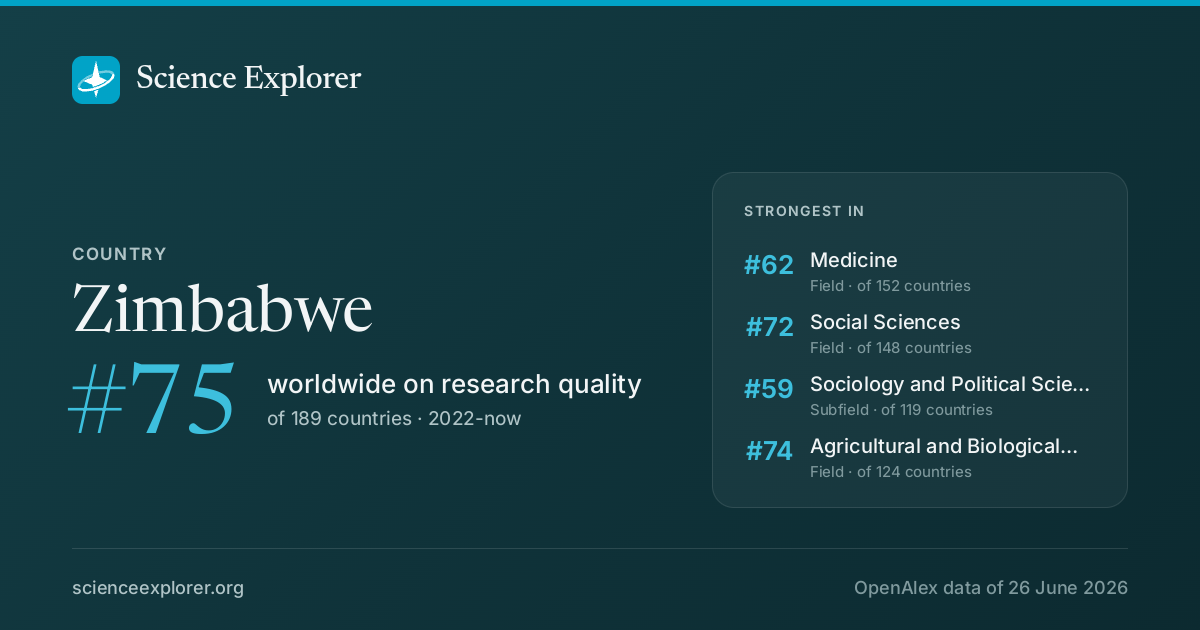
Zimbabwe ranks #75 of 189 countries on research quality in 2022-now (#82 all time), with 7.2k research works and 6.9% of them in the world's top 10%.
- World rank, 2022-now
- #75 of 189 · #82 all time
- Works, 2022-now
- 7.2k ▲ 51% vs 2018-21
- Citations
- 262k 10.3 per fractional work, all time
- Top-10% rate
- 6.9% all institutions 10.0%
- vs its own fields
- 0.83× 1.00× is exactly expected
- In the world top 100
- 0 0 in the top 1,000
- Open access
- 52% world 40%
- International
- 31% world 18%
ZimbabweWhat is Zimbabwe strongest at in science?
On research quality in 2022-now, Zimbabwe ranks highest in Medicine (#62 of 152), Social Sciences (#72 of 148) and Sociology and Political Science (#59 of 119). Relative to its size it is most specialised in Fuel Technology, Archeology and Public Administration.
| Field | World rank | Where that sits | Top-10% rate | Works | All time | Institutions |
|---|---|---|---|---|---|---|
| MedicineField | #62 of 152 | 9.9% | 785 | #66 | Institutions | |
| Social SciencesField | #72 of 148 | 7.3% | 1,985 | #73 | Institutions | |
| Sociology and Political ScienceSubfield | #59 of 119 | 7.5% | 725 | #61 | Institutions | |
| Agricultural and Biological SciencesField | #74 of 124 | 7.3% | 623 | #78 | Institutions | |
| EducationSubfield | #70 of 112 | 6.2% | 431 | #71 | Institutions | |
| Economics, Econometrics and FinanceField | #70 of 107 | 4.6% | 367 | #73 | Institutions | |
| Health ProfessionsField | #72 of 106 | 9.9% | 276 | #77 | Institutions | |
| Computer ScienceField | #87 of 128 | 6.8% | 336 | #92 | Institutions | |
| Economics and EconometricsSubfield | #67 of 98 | 4.7% | 287 | #71 | Institutions | |
| Business, Management and AccountingField | #76 of 110 | 6.0% | 548 | #78 | Institutions | |
| Environmental ScienceField | #85 of 122 | 4.8% | 509 | #92 | Institutions | |
| EngineeringField | #97 of 131 | 4.3% | 677 | #104 | Institutions |
Where its research is concentrated
Location quotient: how much more (or less) of each node it does than its size predicts. Drawn around 1×, where "twice the world share" and "half of it" are the same distance apart in opposite directions. A volume reading, which on a country axis is largely population and industrial structure.
- Fuel TechnologySubfield · 9.4 works · #22 of 113 active here14×
- ArcheologySubfield · 11.8 works · #48 of 158 active here9.2×
- Public AdministrationSubfield · 25.7 works · #58 of 186 active here5.7×
- Safety ResearchSubfield · 127.5 works · #67 of 215 active here5.5×
- Library and Information SciencesSubfield · 7.7 works · #58 of 146 active here4.8×
- ForestrySubfield · 40.3 works · #63 of 204 active here4.6×
- Urban StudiesSubfield · 107.0 works · #68 of 204 active here4.6×
- Business and International ManagementSubfield · 39.5 works · #67 of 192 active here4.5×
The whole field profile
All 26 fields at once. A specialist and a generalist produce the same ranked list and a completely different shape.
Rings at 0.5×, 1× and 2×. Widest outward: Business, Management and Accounting, 2.3×. Every wedge is a field page.
All 26 fields, with their numbers
- Business, Management and Accounting2.30×618 works
- Economics, Econometrics and Finance2.24×401 works
- Social Sciences2.18×2,300 works
- Agricultural and Biological Sciences1.83×727 works
- Decision Sciences1.81×146 works
- Nursing1.67×68 works
- Environmental Science1.43×592 works
- Health Professions1.40×308 works
- Immunology and Microbiology1.03×87 works
- Psychology1.00×255 works
- Arts and Humanities0.87×209 works
- Veterinary0.82×9 works
- Pharmacology, Toxicology and Pharmaceutics0.68×20 works
- Energy0.63×49 works
- Computer Science0.60×393 works
- Engineering0.59×745 works
- Mathematics0.59×58 works
- Medicine0.57×918 works
- Materials Science0.47×137 works
- Biochemistry, Genetics and Molecular Biology0.33×147 works
- Chemical Engineering0.32×10 works
- Chemistry0.32×42 works
- Earth and Planetary Sciences0.32×42 works
- Neuroscience0.21×28 works
- Physics and Astronomy0.21×40 works
- Dentistry0.16×6 works
Which fields of science does Zimbabwe work in?
In 2022-now, 47% of research in Zimbabwe is in Social Sciences, 25% in Physical Sciences. Its largest fields are Social Sciences (28%), Medicine (11%), Engineering (9%). It does 1.9× the world's share of Social Sciences.
Each ring splits the one inside it: the four domains of science, their fields, their subfields. Size is fractional works in 2022-now. Every slice is a page; the interactive view zooms down to single topics and colours each by how much more of it this country does than the world.
Its 4 domains and 26 fields, with their numbers
- Social Sciences3,92947.0%
- Social Sciences2,30027.5%
- Business, Management and Accounting6187.4%
- Economics, Econometrics and Finance4014.8%
- Psychology2553.0%
- Arts and Humanities2092.5%
- Decision Sciences1461.7%
- Physical Sciences2,10625.2%
- Engineering7458.9%
- Environmental Science5937.1%
- Computer Science3934.7%
- Materials Science1371.6%
- Mathematics580.7%
- Energy490.6%
- Earth and Planetary Sciences420.5%
- Chemistry420.5%
- Physics and Astronomy400.5%
- Chemical Engineering90.1%
- Health Sciences1,31015.7%
- Medicine91811.0%
- Health Professions3083.7%
- Nursing680.8%
- Veterinary90.1%
- Dentistry60.1%
- Life Sciences1,00912.1%
Which keywords describe research in Zimbabwe?
By fractional works in 2022-now, weighted toward what it does more of than the world: Colonialism, Social Justice, Nationalism, Political Economy, Land Reform, Agrarian Relations, Zimbabwe and History.
- Community Health Workers
- Slum Upgrading
- Urban Poverty
- Smallholder Farmers
- Health Equity
- Antiretroviral Therapy
- Vulnerability
- Gender Inequality
- Development
- Digital Transformation
- Poverty Reduction
- Higher Education
- COVID-19
- Environmental Impact
- Globalization
- Zimbabwe
- History
- Climate Change
- Sustainability
- Social Justice
- Colonialism
- Nationalism
- Political Economy
- Land Reform
- Agrarian Relations
- Sustainable Development
- Social Capital
- Mental Health
- Economic Growth
- Human Rights
- Innovation
- Economic Development
- Sustainable Agriculture
- Social Impact
- Poverty Alleviation
- Rural Development
- Land Tenure
- Postcolonialism
- Housing Policy
- Decolonization
Size is fractional works in 2022-now in the topics tagged with each word; colour is the word's share of this country's work against its share of the world's. The 40 words are chosen for being large and distinctive. Each links to the topic it comes from most.
All 40 words, with their numbers
- Colonialism557▲ 14×23 topics
- Social Justice455▲ 9.1×35 topics
- Nationalism444▲ 12×15 topics
- Sustainability430▲ 2.1×96 topics
- Political Economy415▲ 19×14 topics
- Climate Change406▲ 1.79×10⁸ topics
- Land Reform389▲ 99×2 topics
- History388▲ 6.7×13 topics
- Agrarian Relations362▲ 470×1 topic
- Zimbabwe362▲ 470×1 topic
- Sustainable Development355▲ 2.7×84 topics
- Globalization319▲ 1.94×10⁴ topics
- Social Capital236▲ 5.4×18 topics
- Environmental Impact225▲ 1.58×65 topics
- Mental Health203▲ 1.70×41 topics
- COVID-19196▲ 1.81×29 topics
- Economic Growth190▲ 2.8×30 topics
- Higher Education180▲ 4.0×27 topics
- Human Rights179▲ 2.1×51 topics
- Poverty Reduction175▲ 16×6 topics
- Innovation173▲ 2.0×56 topics
- Digital Transformation161▲ 3.6×22 topics
- Economic Development157▲ 2.4×38 topics
- Development142▲ 4.8×17 topics
- Sustainable Agriculture134▲ 5.2×14 topics
- Gender Inequality128▲ 11×6 topics
- Social Impact128▲ 3.9×15 topics
- Vulnerability125▲ 6.4×8 topics
- Poverty Alleviation124▲ 16×2 topics
- Antiretroviral Therapy122▲ 9.0×6 topics
- Rural Development122▲ 4.2×15 topics
- Health Equity115▲ 4.7×6 topics
- Land Tenure114▲ 33×2 topics
- Smallholder Farmers107▲ 6.1×6 topics
- Postcolonialism93▲ 7.8×10 topics
- Urban Poverty87▲ 24×2 topics
- Housing Policy87▲ 37×1 topic
- Slum Upgrading87▲ 37×1 topic
- Decolonization86▲ 13×7 topics
- Community Health Workers84▲ 11×2 topics
Which research topics does Zimbabwe publish the most in?
Its largest topics in 2022-now are African studies and sociopolitical issues, Urban and Rural Development Challenges, Poverty, Education, and Child Welfare.
Area is fractional works in 2022-now; colour is the subfield each topic belongs to. Every tile is a topic page.
- 1 African studies and sociopolitical issues Sociology and Political Science 361 works
- 2 Urban and Rural Development Challenges Urban Studies 87 works
- 3 Poverty, Education, and Child Welfare Safety Research 80 works
- 4 African cultural and philosophical studies Education 78 works
- 5 COVID-19 Pandemic Impacts Economics and Econometrics 72 works
- 6 HIV/AIDS Research and Interventions Infectious Diseases 69 works
- 7 Adolescent Sexual and Reproductive Health General Health Professions 66 works
- 8 Microfinance and Financial Inclusion Economics and Econometrics 63 works
- 9 African history and culture studies Anthropology 62 works
- 10 Global Maternal and Child Health Pediatrics, Perinatology and Child Health 60 works
- 11 Agricultural Innovations and Practices General Agricultural and Biological Sciences 60 works
- 12 Entrepreneurship Studies and Influences Management of Technology and Innovation 50 works
Which universities in Zimbabwe lead research?
University of Zimbabwe, National University of Science and Technology and Great Zimbabwe University rank highest in Zimbabwe on research quality in 2022-now.
One dot per institution in the list below. The upper left is the interesting corner.
- 1University of ZimbabweUniversity · Harare · #2,072 worldwide6.5% top 10% · 1.5k works
- 2National University of Science and TechnologyUniversity · Bulawayo · #3,975 worldwide6.3% top 10% · 1.2k works
- 3Great Zimbabwe UniversityUniversity · Masvingo · #5,399 worldwide5.6% top 10% · 524 works
- 4Midlands State UniversityUniversity · Gweru · #5,401 worldwide6.6% top 10% · 1.1k works
- 5Chinhoyi University of TechnologyUniversity · Chinhoyi · #5,942 worldwide6.9% top 10% · 389 works
- 6Harare Institute of TechnologyUniversity · Harare · #7,220 worldwide3.4% top 10% · 228 works
- 7Zimbabwe Open UniversityUniversity · Harare · #8,076 worldwide6.3% top 10% · 287 works
- 8Bindura University of Science EducationUniversity · Bindura · #8,641 worldwide7.3% top 10% · 328 works
- 9Africa UniversityUniversity · Mutare · #9,184 worldwide9.8% top 10% · 327 works
- 10Centre for Research and DevelopmentNonprofit · Mutare · #10,151 worldwide8.0% top 10% · 153 works
- 11Lupane State UniversityUniversity · Bulawayo · #13,929 worldwide7.2% top 10% · 142 works
- 12Women's University in AfricaUniversity · Harare · #14,684 worldwide5.4% top 10% · 122 works
- 13Zimbabwe Ezekiel Guti UniversityUniversity · Bindura · #15,248 worldwide4.1% top 10% · 142 works
- 14Ministry of Health and Child WelfareGovernment institution · Harare · #15,403 worldwide12.6% top 10% · 77 works
- 15Biomedical Research and Training InstituteHospital / health system · Harare · #17,020 worldwide12.7% top 10% · 71 works

The track on each row is its top-10% rate; the tick is the average of all institutions, 10.0% (how it is set): teal above it, red below.
All ranked institutions in ZimbabweWho are the top researchers in Zimbabwe?
Jephat Chifamba, Brighton Nyagadza and Régis Chikowo rank highest among researchers based in Zimbabwe.
- 1 Jephat Chifamba #20,133 worldwide 23k citations · 165 works
- 2 Brighton Nyagadza #68,624 worldwide 1.6k citations · 133 works
- 3 Régis Chikowo #103,612 worldwide 6.2k citations · 178 works
- 4 Christian Thierfelder #135,188 worldwide 10k citations · 271 works
- 5 Willis Gwenzi #170,977 worldwide 8.2k citations · 219 works
- 6 Nyaradzo Mavis Mgodi #171,015 worldwide 6.4k citations · 149 works
- 7 Frances Mary Cowan #196,989 worldwide 13k citations · 446 works
- 8 Robert Ntozini #244,136 worldwide 6.1k citations · 152 works
- 9 Owen M. Mugurungi #250,252 worldwide 5.9k citations · 272 works
- 10 Constance Anesu Nyamukapa #257,719 worldwide 7.4k citations · 197 works
How open and international is Zimbabwe's research?
52% of its research is openly available (world: 40%), and 31% is written with international co-authors (world: 18%).
World: 40% of research is openly available.
World: 18% is written across borders.
In 2022-now, 65% of its research is openly available (world 63%) and 35% is written with co-authors abroad (world 22%). Against what its own mix of topics predicts, that is 0.98× the expected open access and 1.56× the expected international share, which puts it #141 of 173 countries on openness.
How has Zimbabwe's research grown?
Output in 2022-2025 was 51% higher than in 2018-2021.
The same series as a ribbon: one cell per year, darker for more. The line above answers how much; this answers when.
Its share of all research
Growing output can still be a shrinking share: all of science grows. This is Zimbabwe as a percentage of every work published that year, 0.031% in 2024.
Fractional works of Zimbabwe over all fractional works that year. How the balance of science has shifted.
How much of it reaches the world top 10%
Over the whole record, 6.8% of its 25k works since 1950 reached the world top 10% for their field and year.
Of each year's output, the share that reached the world's 10% most cited for its field and year. Peak 9.0% in 2006.
Which countries have research most like Zimbabwe's?
Kenya is Zimbabwe's closest research twin: of all countries, its research is spread across the fields most like Zimbabwe's, with both strong in Business, Management and Accounting.
- 1
 KenyaBoth strong in Business, Management and Accounting, Economics, Econometrics and Finance, Agricultural and Biological Sciences
0.94 Compare
- 2
 GhanaBoth strong in Business, Management and Accounting, Economics, Econometrics and Finance, Agricultural and Biological Sciences
0.92 Compare
- 3
 Sierra LeoneBoth strong in Economics, Econometrics and Finance, Business, Management and Accounting, Agricultural and Biological Sciences
0.91 Compare
- 4
 South AfricaBoth strong in Economics, Econometrics and Finance, Business, Management and Accounting, Social Sciences
0.90 Compare
- 5
 TanzaniaBoth strong in Business, Management and Accounting, Economics, Econometrics and Finance, Agricultural and Biological Sciences
0.90 Compare
Similarity is the correlation of each side's location quotients across every field it publishes in, on a log scale: 1 is the same shape of research, 0 is unrelated. It ignores size. How it is measured.
Compare Zimbabwe with
 Serbia
 Lebanon
 Lithuania
 Bulgaria
 Pakistan
 Mozambique
Share Zimbabwe's ranking
Badges for a website1Each links back here and updates with every snapshot

Research fields in Zimbabwe
- Health Sciences
- Medicine
- Social Sciences
- Social Sciences
- Sociology and Political Science
- Physical Sciences
- Agricultural and Biological Sciences
- Education
- Life Sciences
- Economics, Econometrics and Finance
- Health Professions
- Computer Science
- Economics and Econometrics
- Business, Management and Accounting
- Environmental Science
- Engineering
Discussion
Ask a question or share a note about Zimbabwe. Posts are plain text and can be reported.